How to List a Degree on Your Resume (Examples & Guide)

Our customers have been hired at: *Foot Note


Table of Contents
Get started with MyPerfectResume today!
- Build a resume on any device
- Pick an ATS-friendly template
- Tailor with AI copy suggestions
Whether you’ve recently graduated, are still earning your degree, or completed your education years ago, knowing how to present your academic credentials on your resume is key.
A clear and accurate degree listing in your education section helps employers understand your background and verify that you meet a position’s educational requirements.
In this guide, we’ll cover how to list a degree on your resume, including examples for different degree types and situations, and formatting tips for a polished and professional resume.
Why Your Degree Matters on a Resume
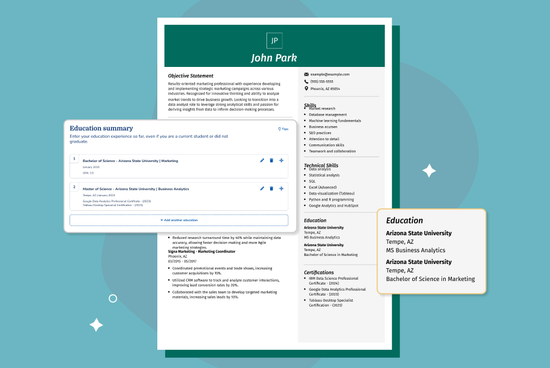
Your degree helps employers quickly understand your educational background and evaluate whether you meet the requirements for a role. In many industries, it signals that you’ve gained the foundational knowledge, training, and skills needed to perform effectively in the position.
When writing your resume, including your degree can also strengthen your overall qualifications, particularly when applying for roles that require a specific level of education or specialized expertise.
Even when a degree isn’t strictly required, it can still add value by highlighting subject-matter knowledge, academic achievement, and commitment to development.
Ultimately, your degree provides important context about your qualifications and helps employers assess your fit for a role at a glance.
How Do You List Your Degree on a Resume?
To list a degree on your resume, include the essential details that clearly communicate your academic background. These core elements help employers quickly understand your level of education and verify your qualifications:
- Degree type and full degree name
- School or university name
- Location of the institution (city and state)
- Graduation date or expected graduation date (if recent)
You can also include additional information when it strengthens your application, such as your major or concentration, minor, GPA (if it’s strong—typically 3.5 or higher—and you’re early in your career), academic honors, relevant coursework, or certifications earned through your program.
Avoid including details that don’t add value or may clutter your resume. This includes outdated or irrelevant coursework, high school information once you have a college degree, or overly detailed academic history that doesn’t relate to the role.
Once you’ve gathered the right information, the next step is deciding how to format and place your degree within your resume for maximum clarity and impact.
Where to Place a Degree on Your Resume
Place your degree in the education section of your resume—typically toward the bottom of your resume, especially if you have relevant work experience that takes priority.
The exact placement can vary depending on your background and career stage. If you’re a recent graduate or currently in school, place your education section near the top of your resume to highlight your academic background first. For experienced professionals, it usually appears after your work experience, since employers are more focused on practical experience.
If you have multiple degrees, list your highest level of education first. Format your education section in reverse-chronological order, starting with your most recent degree.
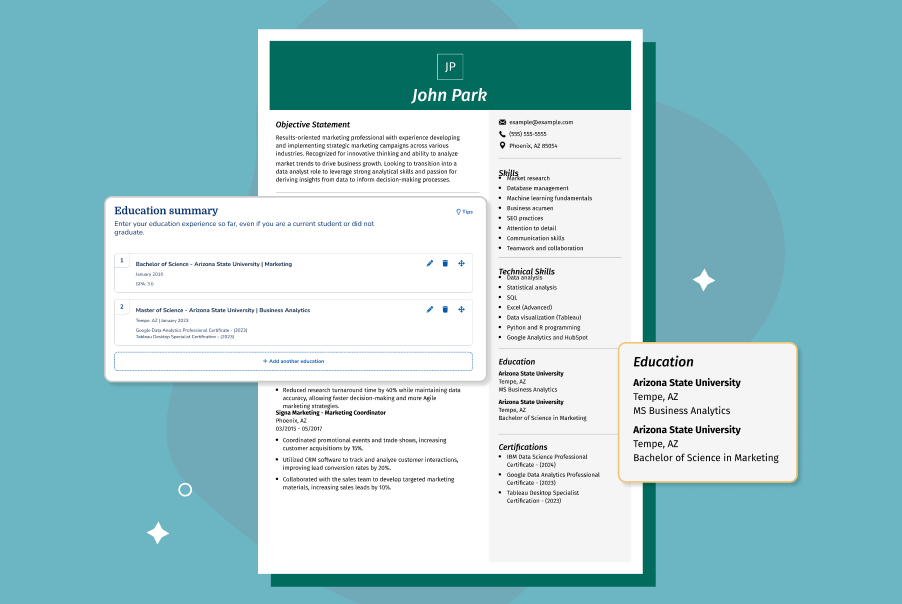
Here’s an example with multiple degrees listed at the bottom of the resume:

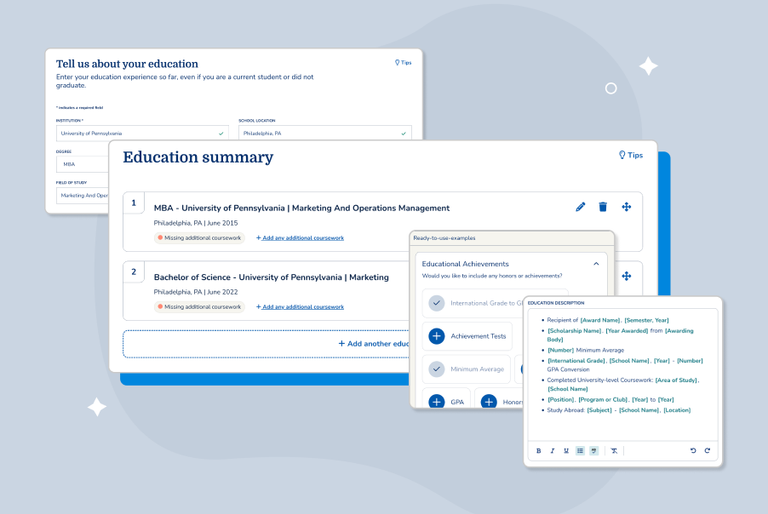
You can quickly format your degrees using MyPerfectResume’s Resume Builder, which helps you structure your education section clearly and professionally in just a few steps.
How to List Different Types of Degrees on a Resume
The way you list a degree on your resume can vary depending on the type of qualification you’ve earned. Whether you hold a bachelor’s, master’s, or associate degree, each should be presented clearly so employers can quickly understand your level of education and field of study.
Below are examples of how to list different types of degrees on a resume, along with formatting guidance to help you present each one correctly and consistently.
Listing an Associate Degree
When listing an associate degree, clearly state the completed or in-progress degree, institution, degree type, and graduation date.
For example:
Education
Community College of San Francisco | San Francisco, CA
Associate of Science in Biology
May 2026
Include your graduation date if you’re a recent graduate, currently in school, or if the timing of your education is relevant to the role. This is especially important for entry-level candidates. You can leave it out if you have significant work experience and it’s no longer necessary for context, or if you want to reduce emphasis on dates in your resume.
Listing a Bachelor’s Degree
When you’re listing a bachelor’s degree on your resume, include your degree name, school, location, and graduation date when relevant.
For example:
Education
University of Oregon | Eugene, OR
Bachelor of Science in Marketing | May 2023
If you’re writing your resume while your bachelor’s degree is still in progress, clearly indicate your expected graduation date to help employers understand when you’ll complete your program. Format it as “Expected [Month Year].”
Here’s an example of how to list an in-progress Bachelor of Science on a resume:
Education
Stanford University | Stanford, CA
Bachelor of Science in Computer Science | Expected June 2026
Listing a Master’s Degree
When listing a master’s degree, include the completed degree information, the institution, degree type, and graduation date if it’s recent and relevant.
For example:
Education
University of California, Berkeley – Berkeley, CA
Master of Science in Biology
May 2025
Listing a Doctoral Degree
When listing a doctoral degree on your resume, include the full degree title, school name, location, and any other relevant details.
For example:
Education
Harvard University – Cambridge, MA
PhD in Psychology | May 2025
Our collection of resume examples is a great resource for reviewing how and where to list different degrees on a resume, depending on your experience level and target industry.
How to List Degrees for Different Scenarios
Not all education follows a straightforward path, so the way you list your degree may need to be adjusted for different circumstances. In these cases, the goal is to stay clear and honest while still presenting your qualifications in a professional format.
Here are common situations and how to list your degree in each one:
Listing an Unfinished Degree
If you started a degree but didn’t complete it, you can still include it on your resume if it’s relevant to the role. The key is to indicate that the program wasn’t finished, so employers understand your academic history accurately.
Include the school name, location, degree program, and dates attended. You can also note the number of credits completed or relevant coursework if it strengthens your application.
For example:
Education
University of Oregon | Eugene, OR
Bachelor of Science in Biology (Completed 60 credits)
2019–2021
Listing Related Awards & Honors
If your degree includes notable awards or academic honors, you can include them directly within your education entry to highlight strong academic performance. This is especially useful if you’re early in your career or applying for roles where academic achievement is relevant.
For example:
Education
University of California, Los Angeles – Los Angeles, CA
Bachelor of Science in Economics
Honors: Dean’s List (2022–2024), cum laude
Listing Related Coursework & Projects
If you want to strengthen your education section, you can include relevant coursework or academic projects from your degree that directly support the role you’re applying for. This is especially useful for students, recent graduates, or candidates with limited work experience.
For example:
Education
University of Washington | Seattle, WA
Bachelor of Science in Computer Science – June 2025
Relevant coursework: Data Structures, Algorithms, Database Systems, Machine Learning
Projects: Built a web-based task management app using React and Node.js
Listing Online Degrees
Online degrees should be listed in the same format as traditional degrees, since employers typically evaluate them equally when they’re earned from accredited institutions.
If the online format is relevant to the role (for example, remote work or digital skills), you may include “Online” next to the degree to provide additional context. Otherwise, it can be omitted if the institution is already well known or if you prefer a cleaner presentation.
For example:
Education
Arizona State University – Tempe, AZ
Bachelor of Science in Business Administration (Online) – May 2024
Listing Multiple Degrees
If you’ve earned more than one degree, list them in reverse-chronological order, starting with your most recent or highest level of education. This helps employers quickly see your most advanced qualification first.
For example:
Education
University of Washington | Seattle, WA
Master of Science in Data Science
June 2024
University of Oregon | Eugene, OR
Bachelor of Science in Statistics
May 2022
Avoid combining multiple degrees into a single line or mixing formats, as this can make your resume harder to read and reduce clarity.
We recommend using a professional resume template to organize your education credentials professionally and effectively.
How to List Your Degree for Different Industries
Tailor your resume to the job you’re applying for by highlighting the aspects of your education most relevant to your industry. While the core information stays the same, different fields may place more emphasis on specific details, such as your major, specialization, or level of education.
Here are some examples of degrees on a resume for various industries:
Example Degree on an IT Resume
Education
Drexel University | Philadelphia, PA
Bachelor of Science in Computer Science
May 2024
Example Degree on a Marketing Resume
Education
University of California, Berkeley – Berkeley, CA
Bachelor of Science in Marketing (May 2021)
Relevant coursework: Digital Marketing, Consumer Behavior, Market Research, Brand Strategy
Honors: Dean’s List (2017–2019)
Example Degree on a Finance Resume
Education
Bachelor of Science in Finance
University of Vermont, Burlington, VT | May 2018
Relevant coursework: Financial Analysis, Investment Management
Example Degree on a Healthcare Resume
Education
De Anza College | Cupertino, CA
Bachelor of Science in Nursing | June 2024
Licensed Registered Nurse (RN), California
Clinical training: Patient Care, Anatomy & Physiology, Pharmacology
Example Degree on an Engineering Resume
Education
Massachusetts Institute of Technology – Cambridge, MA
Bachelor of Science in Mechanical Engineering
Projects: CAD modeling and simulation using SolidWorks and MATLAB, and designed and built an automated robotic arm for a senior capstone project
Example Degree on an Education Resume
Education
University of Oregon – Eugene, OR
Bachelor of Arts in Education – Graduated May 2024
Relevant coursework: Classroom Management, Curriculum Development
Example Degree on an HR Resume
Education
Loyola University Chicago – Chicago, IL
Bachelor of Arts in Human Resources Management
Relevant coursework: Organizational Behavior, Employment Law, Talent Acquisition
Example Degree on a Hospitality Resume
Education
University of Nevada, Las Vegas – Las Vegas, NV
Bachelor of Science in Hospitality Management, May 2023
Relevant coursework: Hotel Operations, Event Planning, Food and Beverage Management
Example Degree on an Environmental Science Resume
Education
Montana State University, Bozeman, MT
Bachelor of Science in Environmental Science | May 2023
Relevant coursework: Ecology, Environmental Policy, Soil Science, Climate Systems
Example Degree on a Construction Management Resume
Education
University of Minnesota – Minneapolis, MN
Bachelor of Science in Construction Management (2021)
Capstone project: Managed mock commercial build, including budgeting, scheduling, and subcontractor coordination
Common Mistakes to Avoid When Listing a Degree on Your Resume
Small errors in how you list your degree can make your resume less clear or even raise questions for employers. Keeping your education section accurate, consistent, and concise helps ensure your qualifications are easy to understand and professionally presented.
Here are a few common mistakes to avoid when listing a degree on your resume:
- Including irrelevant details, such as full coursework lists or outdated academic information that don’t support the role
- Using inconsistent formatting across different degrees or education entries, making your resume harder to scan
- Omitting key details like the degree name, school, or location, which reduces clarity and completeness
- Failing to clearly indicate an unfinished or in-progress degree, which can create confusion for employers
- Misrepresenting your education, such as listing a degree as completed when it hasn’t been finished
- Overemphasizing education at the expense of work experience, especially for mid- to senior-level candidates
Key Takeaways
- To list a degree on your resume, include the degree type and name, school, location, and graduation or expected graduation date to communicate your academic background.
- Add supporting details only when relevant, such as your major, minor, GPA (if strong and early-career), honors, coursework, or projects.
- Place your education section based on experience level—near the top for recent graduates and lower on the resume for experienced professionals.
- List multiple degrees in reverse-chronological order, starting with the most recent or highest-level degree, and keep each entry separate and consistent.
- Tailor your degree details to the job, highlighting the most relevant coursework, specialization, or credentials for the specific industry or role you’re applying to.
- Avoid clutter or irrelevant information, such as outdated coursework, high school details (once you have a degree), or inconsistent formatting that reduces clarity.
Frequently Asked Questions
How do I list two degrees from the same school on a resume?
If you have two degrees from the same school, list them separately in reverse-chronological order, starting with the most recent. Give each degree its own entry with the degree name, school name, location, and graduation date (if recent and relevant). This keeps your education section clear, structured, and easy for employers to scan.
Do I need to include my GPA on my resume?
You should include your GPA on your resume only if it’s strong (typically 3.5 or higher), you’re a recent graduate or early in your career, and it strengthens your qualifications. If you have significant work experience or your GPA isn’t competitive, it’s better to omit it and focus on skills and experience instead.
Is it “bachelor” or “bachelor’s” degree on a resume?
When listing a degree on a resume, you should use “Bachelor” in the official degree title format rather than “bachelor’s degree.” The possessive form (“bachelor’s”) is used in general writing, not in formal resume education entries.
Here’s an example you might see on a resume: Bachelor of Science in Computer Science.
Is a major the same as a degree?
No, a major is not the same as a degree. A degree is the formal qualification you earn, such as a Bachelor of Science or Bachelor of Arts, while a major is your specific area of study within that degree, such as Marketing, Biology, or Computer Science.
On a resume, your degree indicates your level of education, while your major indicates your field of specialization.
Rate this article
How to List a Degree on a Resume


Elizabeth is a Certified Professional Resume Writer (CPRW) and a member of the Professional Association of Resume Writers & Career Coaches. She is committed to helping job seekers navigate the job market and succeed in their careers.
More Articles by Elizabeth Muenzen, CPRWShare this page
 Add MyPerfectResume as a preferred source on Google
Add
Our customers have been hired at:*Foot Note