How to List Education on a Resume (Examples & Complete Guide)

Our customers have been hired at: *Foot Note


Table of Contents
Get started with MyPerfectResume today!
- Build a resume on any device
- Pick an ATS-friendly template
- Tailor with AI copy suggestions
The education section of your resume is essential for showcasing how your background and credentials align with your target role.
We’ll cover everything you need to know about how to list education on your resume so that you can present your skills and qualifications in the best possible light.
Explore actionable tips and professionally crafted resume education section examples to start building your job-winning resume today.
What to Put in the Education Section of Your Resume
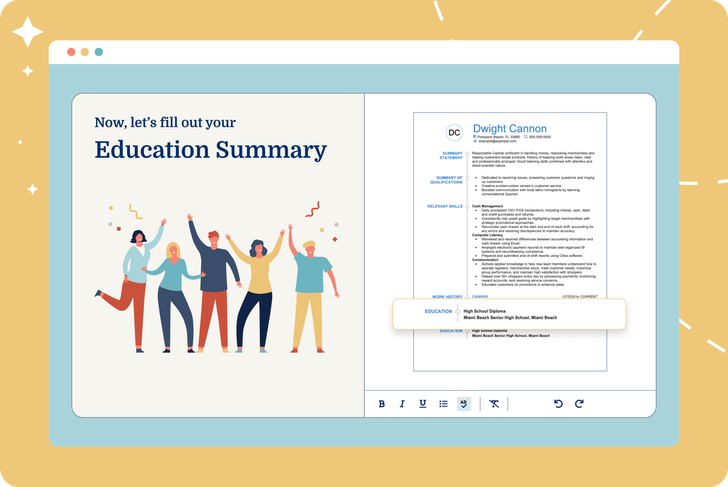
Determining what education details to put on your resume depends on your background and the role you’re applying for. As a general rule, you should typically include the following information:
- Your degree, major, and minor (if applicable)
- The name of the school you attended
- The city and state where the school is located
- Your GPA (if it is above 3.0 and relevant to the role)
- Job-relevant coursework or projects you completed (optional)
Once you apply the basics, customize your resume to the job you’re applying for and impress the hiring manager with your accomplishments.
Highlight Relevant Coursework or Projects
When you’re a recent graduate, customize your resume education section by highlighting coursework, awards, research, projects, papers, or theses relevant to the specific job or industry. Here’s an example:
EDUCATION
Bachelor of Science in Marketing
University of Central Florida | Orlando, FL
May 2025
- Relevant Coursework: Digital Marketing, Consumer Behavior, Market Research, Social Media Strategy
- Senior Research Project: Analyzed social media engagement trends for small retail brands and presented findings to a faculty panel
- Honors: Dean’s List (2023–2025)
Match your educational accomplishments to the job requirements and use resume keywords from the job description or for the industry when possible. For example:
- For a job in the tech industry, you might showcase coursework or projects in specific programming languages or software.
- For a job in the healthcare industry, you could emphasize clinical work, research, or lab work, along with your knowledge of medical terminology.
- For a job in the finance industry, you could highlight coursework in financial modeling and regulations.
- For a job in social work, you might include a research paper, a published report, or a community needs assessment project.
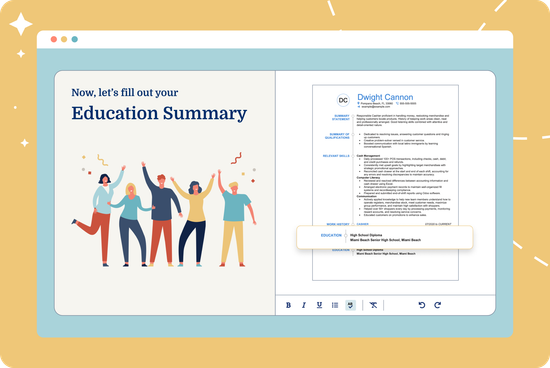
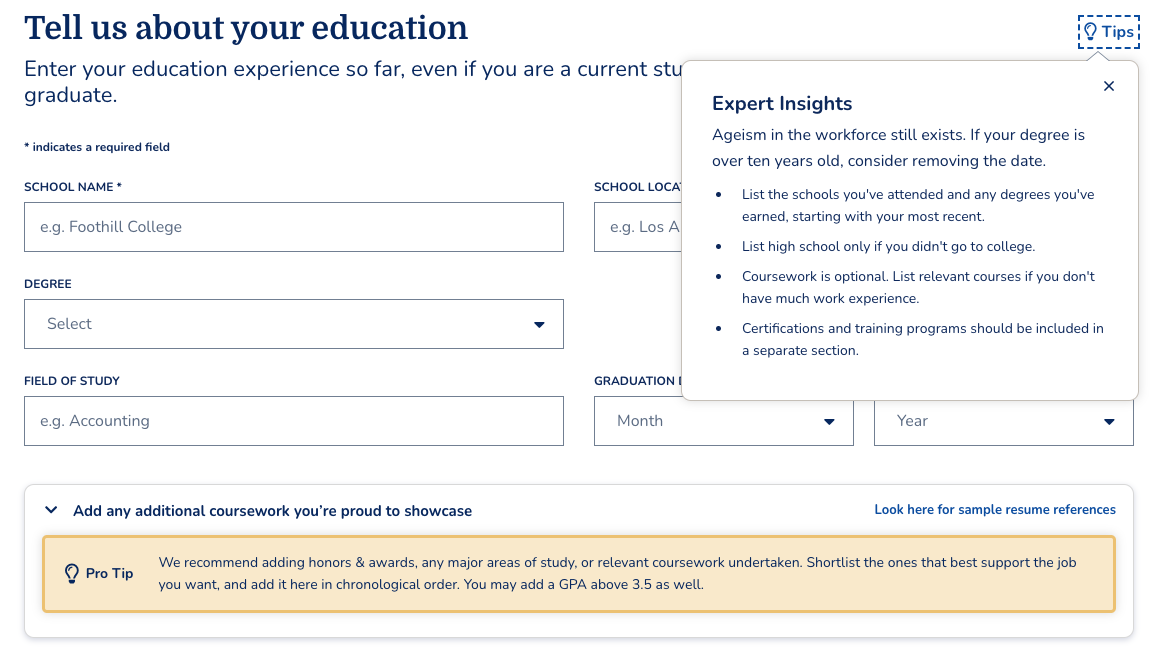
Our Resume Builder helps you customize your education credentials quickly. You’ll get expert insights and pro tips tailored to your experience level.
Include Academic Achievements
Highlighting accomplishments in the education section of your resume shows potential employers that you have the knowledge and skills required for the job.
This can be particularly helpful if you have minimal work experience but extensive educational credentials and accomplishments relevant to the role you’re applying for.
Examples of accomplishments include awards, honors, scholarships, and grants. Here’s an example for a job seeker applying to an accounting role:
EDUCATION
Bachelor of Science in Accounting, cum laude
University of San Francisco | San Francisco, CA
June 2014
Accomplishments:
- Dean’s List every semester
- President of the Accounting Society
- Member of the Beta Alpha Psi Honor Society
- Received the American Institute of Certified Public Accountants (AICPA) Scholarship
- Graduated with honors
Quantify achievements in your resume education section whenever possible. Our brains are naturally drawn to numbers, for example:
Accomplishments:
- Graduated summa cum laude with a 4.0 GPA
- Ranked in the top 2% of my graduating class
- Dean’s list 2012 and 2013
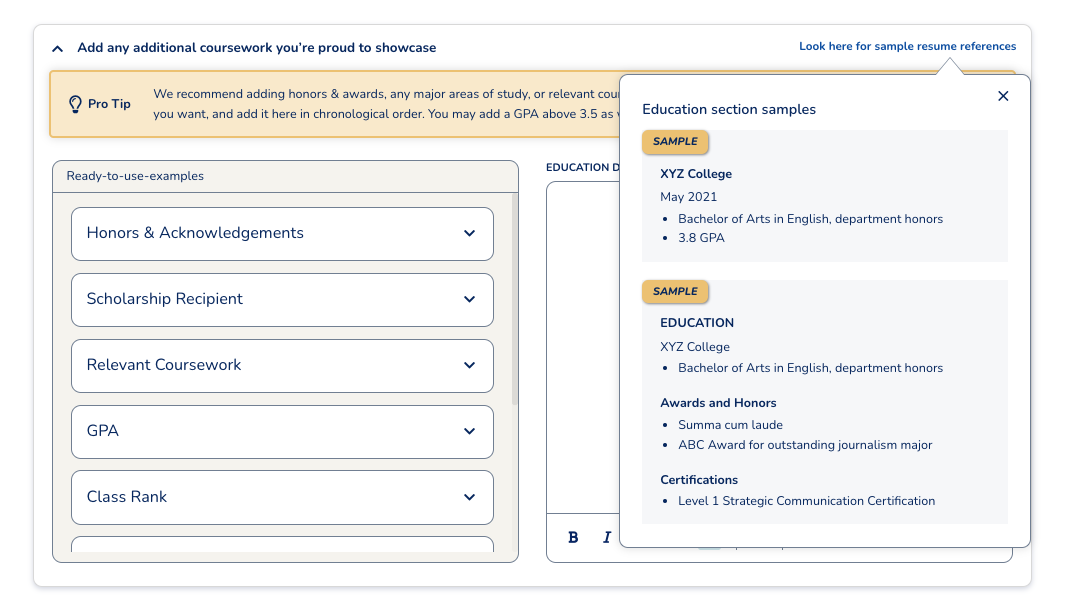
Use our Resume Builder to easily add relevant academic achievements and impressive skills to your education section. Browse built-in samples for inspiration and guidance.
What Not to Include in Your Education Section
Your education section should focus only on academic details that strengthen your qualifications for the role. Don’t include unnecessary, outdated, or irrelevant information, such as:
- Irrelevant or outdated education: Leave off education that doesn’t relate to your career path. Focus on degrees, certifications, or training that directly support the role you’re applying for, rather than listing every educational experience you’ve had.
- High school education: High school information is unnecessary once you’ve completed a college degree or gained several years of work experience. It may still be appropriate to include it only if it’s your highest level of education or if a specific program, coursework, or achievement is highly relevant to the job.
- Incomplete or unfinished programs without context: Listing an unfinished degree without explanation can confuse employers. If the program is relevant, clarify it by writing “Coursework toward [degree]” or indicating the number of credits completed.
- Low GPAs: A GPA is optional and should only be included if it strengthens your application. If your GPA is below 3.0 or the employer hasn’t requested it, leaving it out helps keep the focus on stronger qualifications.
- Long lists of coursework: Listing too many classes can clutter your resume and distract from more important details. If you choose to include coursework, limit it to a few courses that directly support the job you’re applying for.
- Unnecessary personal details: Your education section should focus on academic credentials. Avoid including unrelated extracurricular activities, personal explanations about your schooling, or other background details that don’t support your qualifications.
Explore our selection of professional resume examples to see sample resume education sections for various industries, roles, and career levels.
Where to Put Education on a Resume
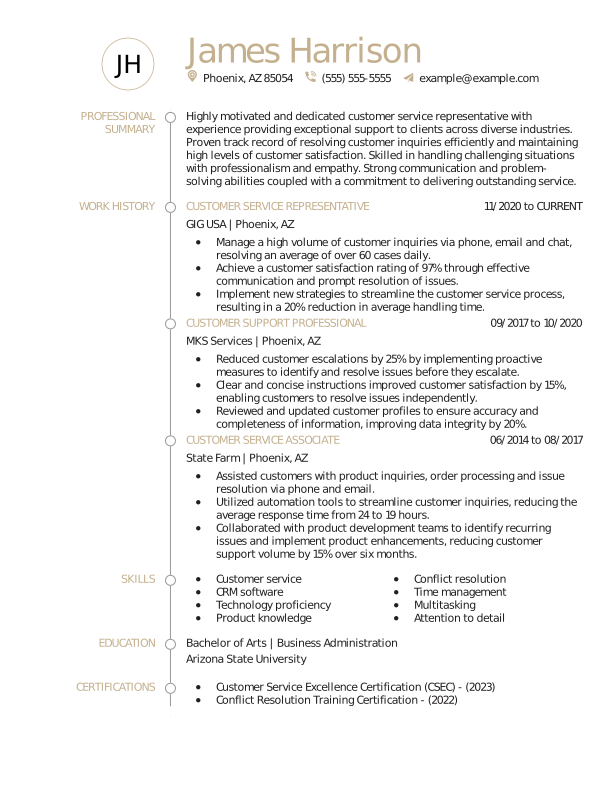
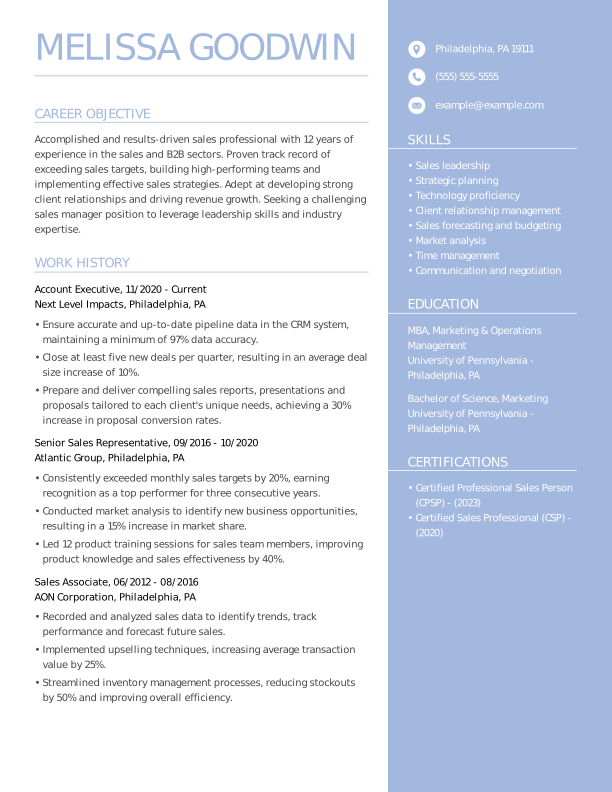
When you’re writing a resume, place the education section near the top if you’re a student or recent graduate, or after work experience if you’re a mid- to senior-level professional.
At the Top of Your Resume (Students or Recent Graduates)
After Work Experience (Mid-Career Candidates)
Below Your Skills (Senior-Level Professionals)
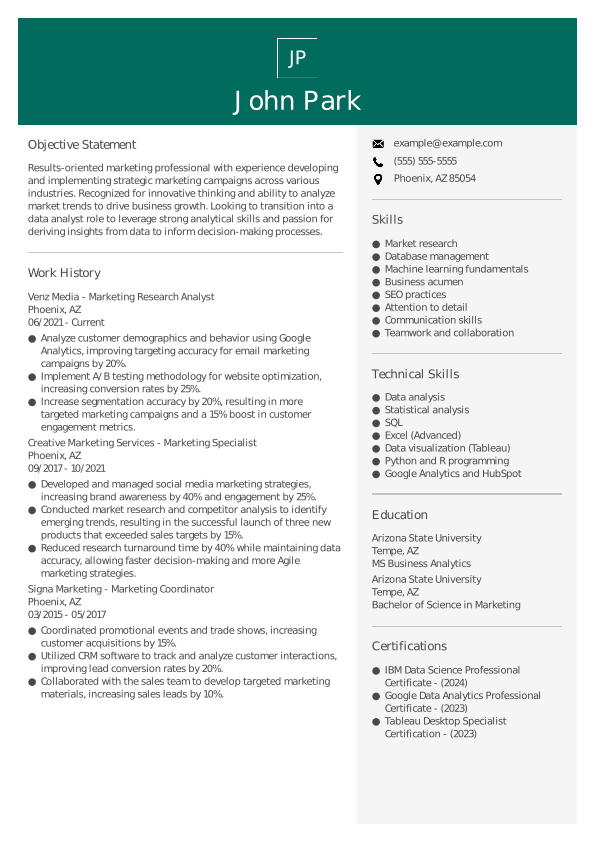
As a more experienced worker, it isn’t required to include dates in your education section. In fact, it can lead to age bias if you do.— Toni Frana, Career Professional
Near Your Skills & Certifications (Career Changers)
If you’re changing careers, add your education section near your skills and certifications section to emphasize courses or certifications that directly relate to your new career goals.
When creating the education section of your resume while changing careers, focus on highlighting the knowledge, experiences, and transferable skills gained from your education.
Here’s an example of an education section for a career changer:
Use one of our best resume templates to easily craft a resume that showcases your relevant education, skills, and work experience.
Format for Listing Education on Resumes
Your education section should be organized, consistent, and easy for hiring managers to scan. Using a clear format with reverse-chronological order, proper dates, and essential details ensures your credentials stand out professionally without overwhelming the reader.
Here’s a closer look at how to format education on a resume:
- Use reverse-chronological order. List your most recent or highest-level degree first, followed by earlier degrees. This highlights your latest and most relevant education.
- List the degree and major first. Start each entry with your degree and major so that employers immediately see your level and focus of study.
- Add the school name and location second. Include the full name of the institution along with city and state, e.g., “University of Washington, Seattle, WA.”
- Include optional details last. Add additional information last, such as your expected graduation date (month and year), honors or awards, and relevant coursework.
- Use consistent formatting. Keep font, style, spacing, and bullet points consistent across all entries. Clear formatting ensures readability and professionalism.
Here’s an example of the correct education format in a resume:
EDUCATION
Bachelor of Science in Marketing
University of Washington, Seattle, WA
May 2024 | cum laude
- Relevant Coursework: Digital Marketing, Consumer Behavior, Marketing Analytics
Associate of Arts in Business Administration
Seattle Central College, Seattle, WA
June 2020
Resume Education Format for Students
If you’re a student applying for a part-time job or writing an internship resume, you can emphasize relevant coursework, special recognitions, and your expected graduation date.
Showcase your education section at the top of your resume, directly below your contact information and above your resume objective.
High School Students
If you’re in high school, include your current high school name and where it’s located, your expected graduation date, and your GPA under education on your resume.
Display honors, awards, and other recognition, as well as extracurricular activities such as volunteer work, academic clubs, or sports.
Here’s an example of how to list education on your resume if you are still in high school:
EDUCATION
Valley High School | Boise, ID
Expected Diploma: 2026
Member of National Honor Society
Chess Club Secretary 2022 – Present
Explore our high school graduate resume templates if you recently graduated from high school and are applying for your first job.
College Students
If you’re in college with a degree in progress, include the name of your school, the city and state where it is located, the degree you expect to earn, and your anticipated graduation date.
To make your resume stand out, display classes or special projects that are pertinent to the internship or job you are applying for, and showcase honors, awards, and scholarships.
Here is an example of how to list education on a resume if you are still in college:
EDUCATION
Bachelor of Science in Civil Engineering
Temple University | Philadelphia, PA
Expected Graduation: May 2026
Relevant achievements:
- Current GPA: 3.8
- Dean’s List, all semesters
- President of the American Society of Civil Engineers (ASCE) student chapter
- Member of the Concrete Canoe Team, which won first place at the 2022 National Concrete Canoe Competition
Relevant coursework completed:
- Engineering Mechanics
- Statics and Dynamics
- Fluid Mechanics
- Structures
- Geotechnical Engineering
- Construction Engineering
- Environmental Engineering
Relevant projects accomplished:
- Designed and built a concrete canoe.
- Conducted a study on the effects of climate change on infrastructure.
How to Write Education on a Resume for Special Circumstances
Explore how to list education on a resume for different situations, such as listing transfer schools or an incomplete degree.
Featuring Multiple Degrees
Include the name of each institution you’ve attended, the city and state where each one is located, the degree you earned, and the year you graduated (if applicable).
EDUCATION
Master of Arts, Public Policy
Stanford University | Stanford, CA
June 2020
- GPA: 4.0
- Dean’s List
- Research Assistant to Professor John Smith
- Graduate Teaching Assistant for Introduction to Public Policy
Bachelor of Arts, Political Science
University of California, Berkeley | Berkeley, CA
May 2018
- GPA: 3.9
- Dean’s List
- Member of the Debate Team
Highlighting Relevant Coursework
Bulleted lists are useful when you have several schools to display or when you want to highlight specific courses. Below is an example of how to write education on a resume with a bulleted list.
EDUCATION
Doctor of Business Administration
Harvard Business School | Boston, MA
May 2025
- Coursework included: Strategic Management, Marketing, Operations Management, and Leadership
Master of Science in Finance
London School of Economics | London, U.K.
June 2020
- Coursework included: Financial Markets, Corporate Finance, Investments, and Derivatives.
Bachelor of Arts in Economics
University of Pennsylvania | Philadelphia, PA
June 2018
- Coursework included: Microeconomics, Macroeconomics, Statistical Econometrics, Game Theory, and Behavioral Economics.
Listing Transfer Schools
If you transferred from one school to the next, it might look like this on your resume:
EDUCATION
Bachelor of Arts in Psychology
University of Wisconsin | Milwaukee, WI
2010 – 2011
Psychology major, Writing minor
Georgia State University | Atlanta, GA
2007 – 2010
Listing an Incomplete Degree
In reverse-chronological order, list the degree program you started, the institution(s) you attended, the number of credits you completed, and any relevant coursework you completed.
Remember to showcase job-relevant coursework or projects you completed to shift the focus away from the incomplete degree.
Here’s an example of how to list education on a resume with an incomplete degree:
EDUCATION
University of Hawaii | Honolulu, HI
2019 – 2020
- Completed 40 credits in graphic design.
- Coursework completed: Digital Imaging, Graphic Design Principles, and Branding and Visual Identity.
- Project completed: Developed a brand identity for a company by performing market research; created a logo and color palette; collaborated on website design; and proposed a social media strategy for the brand.
Don’t divulge why you didn’t complete your education on your resume. You can talk about that in the job interview.
Listing an In-Progress Degree
When listing an in-progress degree on a resume, it’s important to clearly convey your current academic status and anticipated completion date. State the degree program you are pursuing, the name of the institution, and your expected graduation date.
Here’s an example of how to put an in-progress degree on a resume:
EDUCATION
Bachelor of Arts in Economics
University of California, Los Angeles | Los Angeles, CA
Expected Graduation: June 2027
- Relevant coursework: Microeconomics, Macroeconomics, Econometrics
How to List Continuing Education on a Resume
Listing continuing education on your resume can enhance your qualifications and demonstrate your commitment to professional development.
Below are a few examples to help you effectively include continuing education on your resume.
Certifications & Professional Courses
Listing certifications and professional courses on your resume can enhance your qualifications and demonstrate ongoing professional development.
Place certifications and professional courses under a distinct section, typically titled “Certifications” or “Professional Development,” near the education section of your resume.
Here’s an example of how to list certifications on your resume:
CERTIFICATIONS
Certified ScrumMaster (CSM)
Scrum Alliance, Online
August 2023
Project Management Professional (PMP)
Project Management Institute (PMI), Washington, D.C.
July 2022
Google Analytics Individual Qualification (GAIQ)
Google, Online
April 2022
Prioritize listing certifications and courses that are directly relevant to the job you’re applying for. This helps demonstrate your technical skills and expertise in specific areas.
Online Courses & Self-Guided Learning
Ongoing education through online courses or self-guided study is a great way to demonstrate your commitment to lifelong learning and keep up with industry trends.
Create a subsection called “Continuing Education” or “Professional Development” under the education section of your resume.
Here’s an example of how to list ongoing education on a resume:
PROFESSIONAL DEVELOPMENT
Northwestern University, Center for Public Safety, Evanston, IL
Law Enforcement Management and Leadership Education Certificate
- Anticipated completion date: April 2026
- Courses include Contemporary Policing, Decision Making, Problem Solving, and Resource Allocation
Tips for Writing Education on a Resume
- Use action verbs to describe your educational accomplishments. For example, “Achieved Dean’s List status for three consecutive semesters.”
- If you have an incomplete or in-progress college degree, it can help to indicate how many credits you have earned.
- Read the job description closely for educational requirements and match your education on your resume to those listed.
- Ensure you create an ATS-friendly resume education section by using keywords from the job description, bullet points to break up information, and clear formatting.
- Resume templates are useful when crafting a resume because they ensure everything is in the right place and formatted correctly.
- Use our ATS Resume Checker to scan your resume for common errors and receive instant optimization suggestions to improve your resume score.
Key Takeaways
- Where you put education on a resume depends largely on your career goals, work experience, and resume format.
- Emphasize and quantify your academic achievements in your resume’s education section.
- Order your schools from most recent to least recent. Use bullet points to make your education information easy to read.
- If you have an incomplete degree, showcase job-relevant coursework, projects, and recognitions in your resume’s education section.
- If you are a student, list your in-progress education on your resume and include your anticipated graduation date.
FAQ
How should you list your education on a resume?
You should list your education on a resume in reverse-chronological order, starting with your most recent or highest-level degree. Include your degree and major, school name and location, and graduation date or expected graduation if recent and relevant.
Add optional details, such as honors and coursework, if relevant, and keep the format consistent, clear, and concise so hiring managers can quickly see your academic qualifications.
Is it okay to omit education on a resume?
It is okay to omit your education on a resume if your work experience, skills, or certifications are more relevant to the job than your academic background. This is especially true for experienced candidates or those with extensive professional achievements.
That said, if your education is a key qualification or the employer specifically requests it, you should include it to strengthen your application.
How do you make education stand out on a resume?
To make your education stand out on a resume, highlight your highest degrees, relevant honors, awards, or distinctions like “cum laude.” Include key coursework that directly relates to the job, and consider adding certifications or professional training.
Use clear formatting, reverse-chronological order, and consistent dates so hiring managers can quickly see your academic achievements and their relevance to the role.
Do employers care more about education or experience?
Employers generally prioritize relevant work experience over education, especially for mid- to senior-level roles. Practical skills, accomplishments, and demonstrated results often outweigh academic credentials.
But for entry-level positions, internships, or fields requiring specific degrees or certifications, education can be just as important. Tailor your resume to emphasize whichever—education or experience—is most directly relevant to the job.
When should you stop putting education on your resume?
You can remove or de-emphasize education on your resume once your work experience better demonstrates your qualifications. High school should be omitted after earning a college degree, and graduation dates can be left out for degrees earned over 10 to 15 years ago to avoid age bias.
For seasoned professionals, list only the institution and degree, moving education to the bottom of the resume after five to seven years of experience. Keep education visible if it’s highly relevant, prestigious, or required for the job.


Elizabeth is a Certified Professional Resume Writer (CPRW) and a member of the Professional Association of Resume Writers & Career Coaches. She is committed to helping job seekers navigate the job market and succeed in their careers.
More Articles by Elizabeth Muenzen, CPRWShare this page
 Add MyPerfectResume as a preferred source on Google
Add
Our customers have been hired at:*Foot Note