The Invisible Pay Cut: How Commuting Costs Workers an Average of $8,000 a Year in Lost Time


Our customers have been hired at: *Foot Note


Table of Contents
Get started with MyPerfectResume today!
- Build a resume on any device
- Pick an ATS-friendly template
- Tailor with AI copy suggestions
As return-to-office mandates spread across the country, commuting is back at the center of American working life. And while most workers view commuting as an inconvenience, it also represents a hidden cost of time that could otherwise be used for work, rest, or personal pursuits.
A new MyPerfectResume analysis translates that time into its wage equivalent, creating a thought exercise we call the “invisible pay cut.” This isn’t a literal pay cut, but a way to visualize how the return to commuting can quietly erode the value of our time.
Key Findings

- 223 hours: The average U.S. worker spends this much time commuting each year, nearly 6 unpaid 40-hour workweeks.
- $8,158: The time value of that commute, based on the national average hourly wage ($36.53).
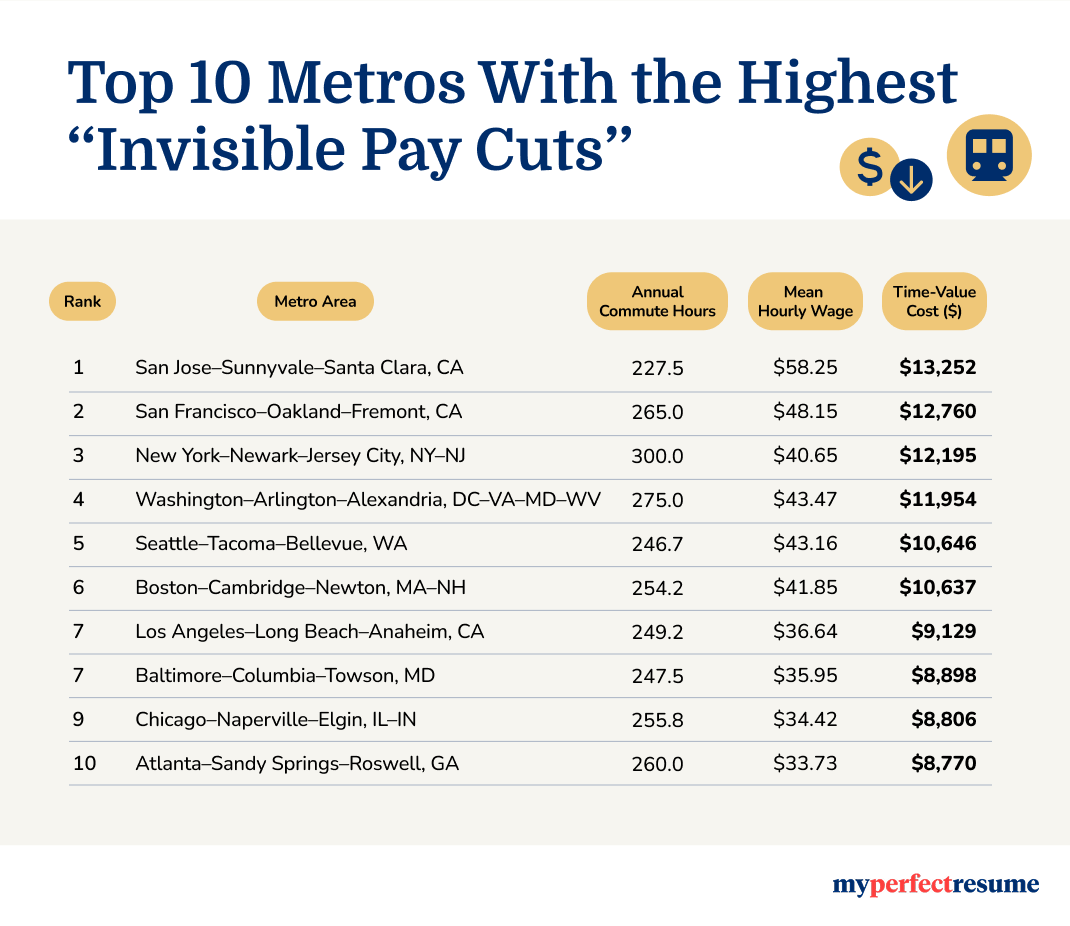
- Top invisible pay cuts: Workers in San Jose, San Francisco, and New York lose the most time value, each exceeding $12,000 annually.
- Longest commute: New York City has an average one-way commute of 36 minutes, corresponding to about 300 hours per year in transit.
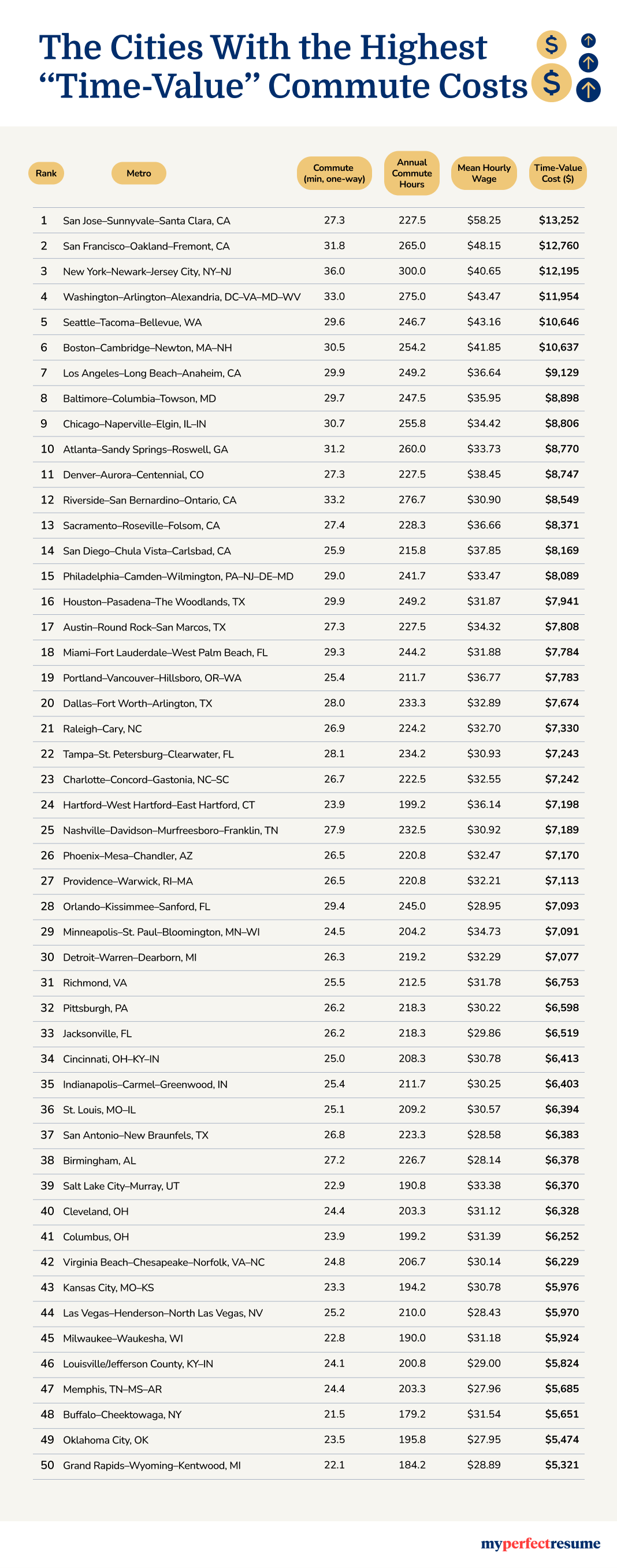
- Lowest costs: Smaller metros, such as Grand Rapids, Memphis, and Oklahoma City, average around $5,000 per year, but often lack efficient transit options.
- Return-to-office impact: The shift back to in-person work has reintroduced a significant time burden for millions who previously saved those hours through remote or hybrid arrangements.
Top 10 Metros With the Highest “Invisible Pay Cuts”
The metros listed below rank highest in MyPerfectResume’s analysis of the invisible pay cut, in which long commutes and higher local wages combine to impose the highest time-value costs on workers.
Why the Invisible Pay Cut Matters
This analysis isn’t meant to suggest that workers literally lose money when they commute. It’s a conceptual lens for illustrating the extent of our time that has economic value but goes uncompensated. Here’s why it matters:
- It reframes time as part of total compensation. The hours employees spend traveling to and from work are hours they can’t use elsewhere, effectively expanding their workday without additional pay.
- It highlights an overlooked cost of return-to-office policies. Many employees who transitioned to remote work during the pandemic experienced firsthand how much time they regained. Reinstating commutes can feel like an unacknowledged loss of autonomy and balance.
- It shows the uneven impact of location and policy. In some high-wage metropolitan areas, the dollar value of commute time is substantial. In other cases, workers face long commutes with lower wages and few transit options, distinct challenges, and the same time tax.
Ultimately, the invisible pay cut helps us visualize an old truth: time is money, and where we work affects both.
All 50 Metro Areas Ranked by Invisible Pay Cut
The table below illustrates how the average commute time by city and local wages intersect to influence the time value of commuting in each metro area.
This is not a literal loss of pay, but a means of visualizing how much time workers spend traveling and what that time could be worth if it were compensated.
The invisible pay cut isn’t about money left on the table. It’s about the time left on the road.
By translating commute hours into a measure of time value, this analysis highlights how return-to-office mandates have reintroduced one of the most overlooked costs of modern work: the hours employees give away just to show up.
In an era where flexibility and balance are increasingly valued, the findings show that how and where we work shape not only productivity and satisfaction, but also the actual value of our time.
Recognizing the commute as part of the total work experience can help both employers and employees make more informed, equitable decisions about the future of work.
For press inquiries, please contact Nathan Barber at nathan.barber@bold.com.
Methodology
This analysis reframes commuting as a time-value exercise rather than a literal pay reduction.
It estimates the value of a worker’s commuting time when compensated at their local average hourly wage, thereby providing a means to visualize the opportunity cost of return-to-office policies. We combined data from two federal sources:
- Commute times come from the U.S. Census Bureau’s American Community Survey (Table S0801), which reports the mean one-way travel time to work by metro area.
- Wage data come from the U.S. Bureau of Labor Statistics’ Occupational Employment and Wage Statistics (OEWS), May 2024 release, which provides mean hourly wages for all occupations.
Both datasets were matched at the metropolitan statistical area (MSA) level. For each metro, the ACS one-way commute time was doubled to capture a daily round trip, multiplied by 250 workdays per year (five days per week across 50 weeks), and then converted from minutes to hours. Each metro’s annual commuting hours were then multiplied by its OEWS mean hourly wage to determine the “invisible pay cut,” a time-value estimate of what those commuting hours would be worth if paid.
The results were used to rank the 50 most populous U.S. metro areas by total annual time-value cost, with a national average provided for reference. This method standardizes commuting assumptions across regions, making comparisons consistent and easily interpretable.
While this approach helps quantify the value of time, it’s not a literal financial loss. The ACS measure reflects only workers who commute (excluding remote employees), and wages include all employed workers, regardless of their work schedule or overtime status. The analysis excludes out-of-pocket costs, such as fuel, transit fares, and parking, and focuses solely on the time dimension.
Limitations:
Commuting can serve multiple purposes beyond work, such as listening to music, reading, or unwinding, meaning not all time in transit is truly “lost.” Hybrid and flexible work arrangements also vary widely across companies and regions, which may reduce or redistribute commuting time in practice.
About MyPerfectResume
MyPerfectResume Resume Builder with professional templates is designed to help job seekers elevate their careers. The easy-to-use platform was created to eliminate the hassle of resume writing, offering professionally written examples, free expert tips, step-by-step guidance to make a resume, and valuable interview advice to create an outstanding job application effortlessly. Since 2012, MyPerfectResume’s Resume Builder has helped more than 11 million job seekers create their perfect resumes online. Its comprehensive employment surveys have been featured in Forbes, Yahoo! Finance, CNBC, Newsweek, USA Today, BBC, Workable, and more. Stay connected with MyPerfectResume’s latest Facebook, LinkedIn, Instagram, X, and Pinterest updates.
Rate this article
The Invisible Pay Cut

Jasmine is a certified career coach and recognized expert in job search strategy. She is committed to helping job seekers navigate the job market and succeed in their careers.
More Articles by Jasmine EscaleraShare this page
 Add MyPerfectResume as a preferred source on Google
Add
Our customers have been hired at:*Foot Note