Fake Job Postings: 59% of Workers Have Encountered a Fraudulent or Misleading Opportunity


Our customers have been hired at: *Foot Note


Table of Contents
Get started with MyPerfectResume today!
- Build a resume on any device
- Pick an ATS-friendly template
- Tailor with AI copy suggestions
For many workers, searching for a job now involves more than evaluating the role, salary, and company. It also means deciding whether they can trust an opportunity.
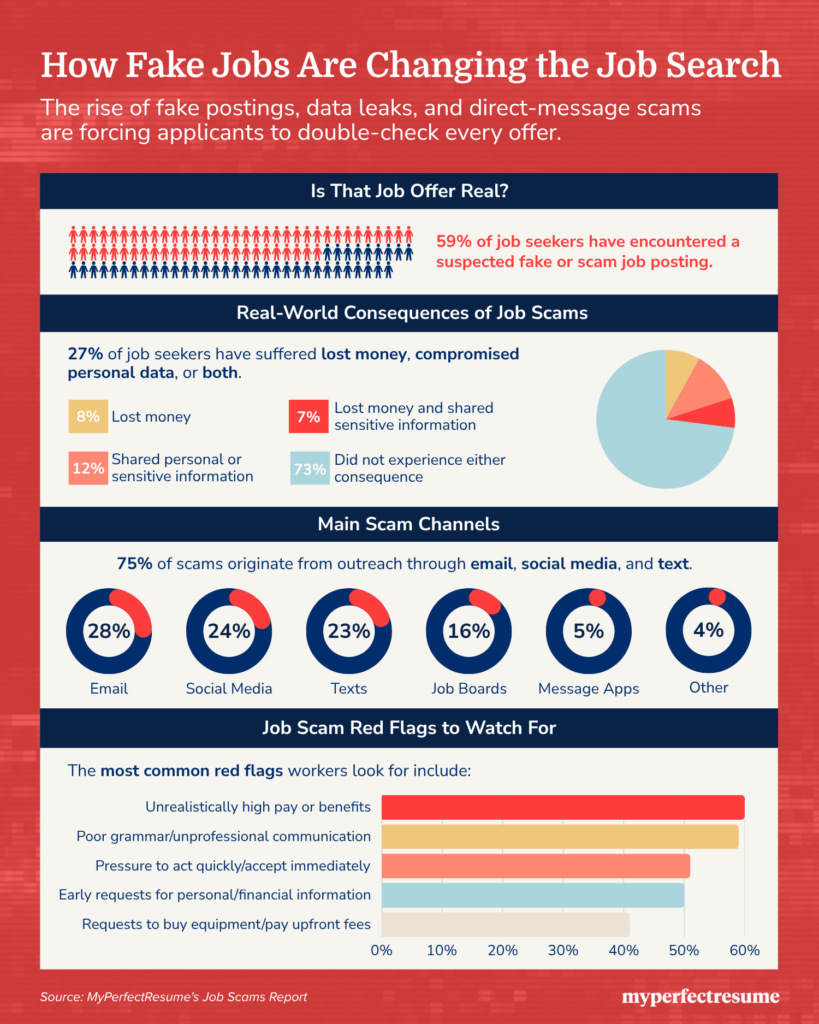
New national survey data from MyPerfectResume suggests that concerns about fraudulent or misleading job opportunities are widespread. Nearly 6 in 10 workers say they’ve encountered a job posting, recruiter, or hiring message they believed was fraudulent, a scam, or misleading.
The findings show that these concerns are changing how workers approach job searches, from researching employers more carefully to limiting the personal information they share and hesitating to pursue some opportunities.
Key Findings
- 59% of workers have encountered a job posting, recruiter, or hiring message they believed was fraudulent, a scam, or misleading.
- 80% are concerned about encountering scams or fake job postings, including 50% who are very or extremely concerned.
- 79% say scam concerns have affected how they approach job searches.
- 46% research employers more carefully, while 42% avoid sharing personal information online.
- 27% say they lost money, shared sensitive information, or experienced both because of a suspected job scam.
- Only 23% mostly or completely trust online job postings to represent real, actively hiring opportunities.
Together, the results suggest that concerns about suspicious opportunities have become an important part of how workers evaluate job postings, recruiters, and employers.
Suspicious Job Opportunities Are Widespread
Most workers have encountered or questioned the legitimacy of a job posting, recruiter, or hiring message.
According to the survey:
- 48% have encountered an opportunity they believed was fraudulent, a scam, or misleading multiple times.
- 11% have encountered one once.
- 22% haven’t encountered one but have been suspicious of some opportunities.
- 19% have never encountered or suspected one.
This means 59% have directly encountered an opportunity they believed was fraudulent, a scam, or misleading, while another 22% have been suspicious of opportunities they came across.
The findings suggest that workers may approach unfamiliar job postings and recruiter outreach with greater caution, even when the opportunity is legitimate.
80% of Workers Are Concerned About Job Scams
Concern about how many job postings are fake extends beyond workers who say they’ve personally encountered a fraudulent listing.
The survey found:
- 24% are extremely concerned.
- 26% are very concerned.
- 30% are somewhat concerned.
- 12% aren’t very concerned.
- 8% aren’t concerned at all.
Altogether, 80% express at least some concern about encountering scams or fraudulent job postings, including half of workers who say they are very or extremely concerned.
This level of concern suggests that verifying opportunities has become an increasingly important part of the job search process.
Scam Concerns Are Changing How Workers Search
Concerns about suspicious opportunities are influencing how workers research employers, interact with recruiters, and decide which jobs to pursue.
Workers report making several changes:
- 46% research employers more carefully.
- 42% avoid sharing personal information online.
- 35% hesitate to apply for remote jobs.
- 20% have stopped applying to some jobs entirely.
- 20% trust recruiters less than before.
- 21% say scam concerns haven’t affected their behavior.
- 3% cited other changes.
The most common responses involve taking additional precautions, but some workers are also pulling back from potential opportunities.
More than one-third hesitate to apply for remote jobs, while one in five say they’ve stopped applying to certain jobs entirely because of scam concerns.
More Than 1 in 4 Report Consequences From Suspected Job Scams
For some workers, suspected job scams have resulted in financial or personal-data consequences.
The survey found:
- 8% lost money.
- 12% shared personal or sensitive information.
- 7% both lost money and shared sensitive information.
- 73% didn’t experience either consequence.
Altogether, 27% report losing money, sharing sensitive information, or experiencing both because of a suspected job scam. Including workers who experienced both consequences, 19% shared sensitive information, and 15% lost money.
These findings show that suspicious job opportunities can create risks that extend beyond wasted time or uncertainty during a job search.
Email, Social Media, & Text Are Common Sources of Suspicious Opportunities
Suspicious job postings and recruiter messages can appear across a variety of online channels.
When asked where they most commonly encounter them, workers cited:
- 28% email
- 24% social media platforms
- 23% text messages
- 16% job boards
- 5% messaging apps
- 4% other sources
Together, 75% say email, social media, or text messages are where they most commonly encounter suspicious opportunities.
The findings suggest that workers may be particularly cautious when receiving direct employment outreach through digital communication channels.
Unrealistic Pay & Poor Communication Raise the Most Red Flags
Workers rely on several warning signs when deciding whether a job opportunity appears trustworthy.
The most commonly cited red flags include:
- 60% cite unrealistically high pay or benefits.
- 59% cite poor grammar or unprofessional communication.
- 51% cite pressure to act quickly or accept immediately.
- 50% cite requests for personal or financial information early in the process.
- 41% cite requests to purchase equipment or pay upfront fees.
- 40% cite vague job descriptions or responsibilities.
- 37% cite interviews conducted only through text or messaging apps.
- 36% cite limited or missing company information online.
- 36% cite being offered a job without a formal interview.
- 35% cite a lack of a formal job description.
- 31% cite inconsistent information about the role or company.
- 29% cite communication from personal email accounts instead of company domains.
- 2% cited other red flags.
The results suggest that workers look closely at both what an opportunity promises and how the hiring process is conducted when deciding whether it appears legitimate.
Trust in Online Job Opportunities Remains Limited
The survey findings point to a job search environment where workers are increasingly cautious about the opportunities they encounter online.
Only 23% mostly or completely trust online job postings to represent real, actively hiring opportunities. At the same time, 79% say concerns about scams have changed their job search behavior, showing that uncertainty is translating into action.
As workers navigate online opportunities, many are taking additional steps to research companies, verify recruiters, protect their personal information, and look for warning signs of job scams before moving forward.
For press inquiries, please contact Nathan Barber at nathan.barber@bold.com.
Methodology
The findings are based on a national survey conducted by MyPerfectResume using Pollfish in June 2026.
The survey collected responses from 1,000 U.S. workers. Respondents answered a mix of single-selection and multiple-choice questions about trust in online job postings, experiences with suspicious hiring activity, concerns about job posting scams, changes in job search behavior, warning signs, and financial and personal data consequences.
The findings reflect respondents’ perceptions and self-reported experiences. Opportunities described as fraudulent, scams, or misleading were not independently verified.
Demographic Breakdown
The survey sample included 50% female respondents, 49% male respondents, and 1% who preferred not to answer. Respondents ranged in age from 18 to 99, including 13% aged 18 to 24, 20% aged 25 to 34, 17% aged 35 to 44, 17% aged 45 to 54, 15% aged 55 to 64, and 18% aged 65 or older.
About MyPerfectResume
MyPerfectResume Resume Builder with professional templates is designed to help job seekers elevate their careers. The easy-to-use platform was created to eliminate the hassle of resume writing, offering professionally written examples, free expert tips, step-by-step guidance to make a resume, and valuable interview advice to create an outstanding job application effortlessly. Since 2012, MyPerfectResume’s Resume Builder has helped more than 11 million job seekers create their perfect resumes online. The MyPerfectResume Research Center produces employment surveys and workforce research that have been featured in Forbes, Yahoo! Finance, CNBC, USA Today, BBC, and more. Add MyPerfectResume as a preferred source on Google to receive more workforce trends, career insights, and labor market research in your personalized search experience.
Rate this article
Fake Job Postings

Jasmine is a certified career coach and recognized expert in job search strategy. She is committed to helping job seekers navigate the job market and succeed in their careers.
More Articles by Jasmine EscaleraShare this page
 Add MyPerfectResume as a preferred source on Google
Add
Our customers have been hired at:*Foot Note