

Our customers have been hired at: *Foot Note


Table of Contents
Get started with MyPerfectResume today!
- Build a resume on any device
- Pick an ATS-friendly template
- Tailor with AI copy suggestions
The U.S. labor market has long been measured by the number of job openings, but a closer look reveals a troubling truth: Not all postings are real opportunities.
An analysis of the U.S. Bureau of Labor Statistics Job Openings and Labor Turnover Survey (JOLTS) shows a structural imbalance. Millions of job postings never result in an actual hire, creating what’s come to be known as the “ghost job economy.”
According to the June 2026 JOLTS report (based on April 2026 data), employers reported roughly 7.6 million job openings but made just 5.1 million hires, leaving more than 2.5 million jobs that never materialized in a single month. That means roughly 1 in 3 job listings lead nowhere.
Despite a cooler labor market, the share of job postings that result in hires has barely changed. In other words, the labor market is posting fewer jobs, but not filling a higher share of them.
Key Takeaways
- Millions of job postings lead nowhere. Roughly 33% of job openings failed to result in a hire, according to recent data, representing more than 2.5 million roles.
- The gap isn’t new. Since 2021, the “phantom gap” between openings and hires has remained persistently elevated, often leaving more than 1 million to 4 million openings unfilled each month.
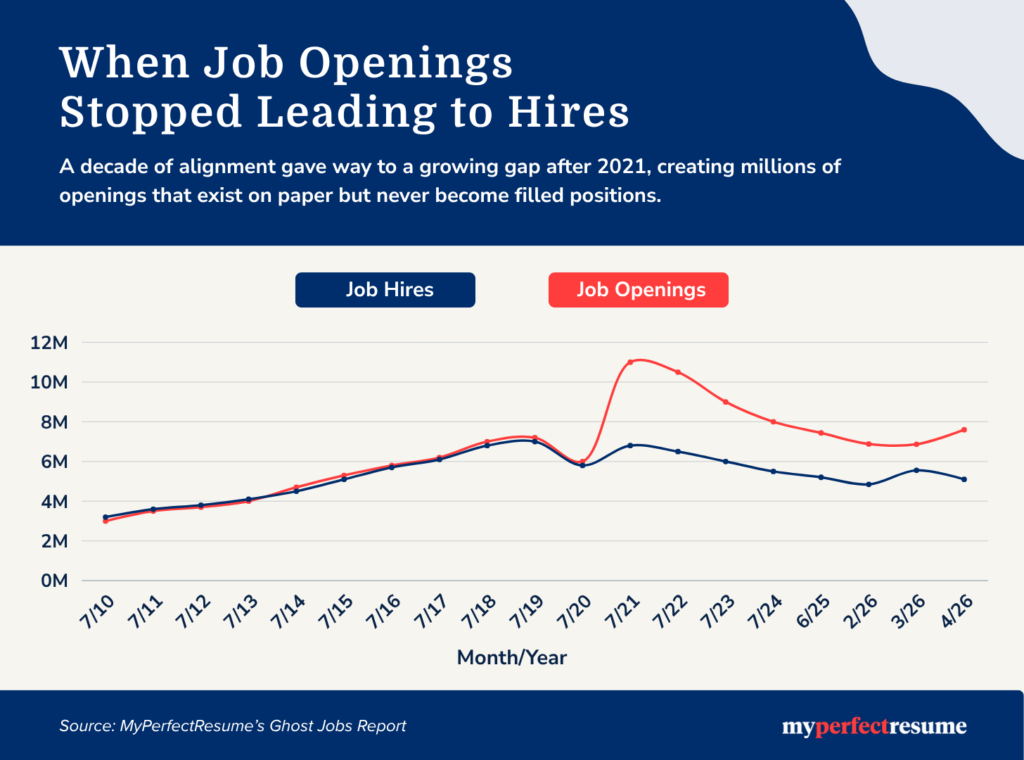
- The gap peaked in 2021. Job postings surged above 11 million, but hires flatlined at 6–7 million.
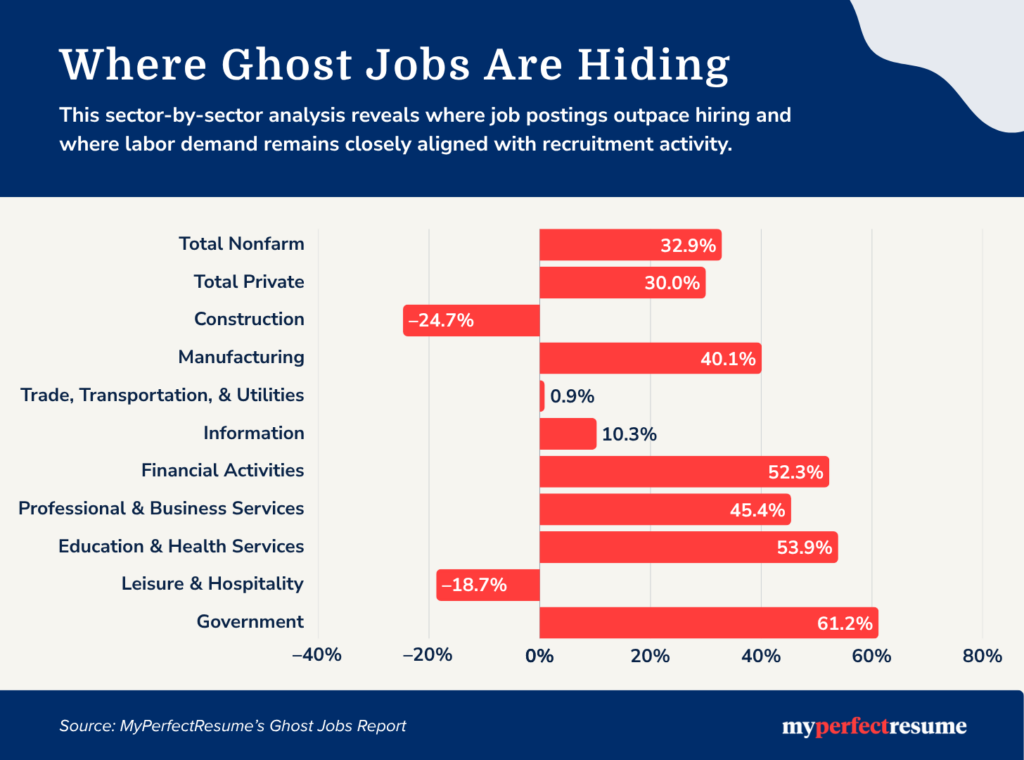
- The worst-hit sectors include government (61.2%), financial activities (52.3%), and education and health services (53.9%).
- Exceptions exist in construction and hospitality, where hires often match or even exceed the number of openings.
Why it matters: For job seekers, this means career stagnation and wasted time. For policymakers, it means distorted data. For employers, it raises serious credibility issues.
How We Got Here: A Historical Shift
Why do companies post ghost jobs? For more than a decade after the Great Recession, job postings and hires moved in tandem, with only modest gaps between them.
But in 2021, the relationship between openings and hires fractured, and it has yet to recover.
- 2010–2014: Following the Great Recession, job openings ranged from 3 million to 4.7 million, and hires closely tracked them. The gap rarely exceeded 500,000 jobs, or roughly 2%–5% of postings.
- 2015–2019: Openings rose steadily to 5–7 million, with hires nearly matching demand. The gap remained historically small, generally between 2% and 4% of openings.
- 2020: The pandemic temporarily disrupted the labor market, but openings and hires still rebounded largely in tandem. The gap remained relatively modest at roughly 3% of postings.
- 2021–2022: Openings surged to record highs above 10–11 million, while hires remained stuck near 6–7 million. The gap exploded to more than 4 million jobs, meaning approximately 38% of postings did not result in hires.
- 2023–2025: The labor market cooled, but the structural imbalance persisted. Despite fewer total openings, the “ghost job rate” remained elevated at roughly 30%–33% of postings.
- 2025–2026: Job openings continued declining from post-pandemic highs, but hiring activity remained uneven. While the gap narrowed compared to the peak years of 2021–2022, there were still more than 2.5 million openings that did not result in a hire in April 2026, meaning roughly 33% of posted jobs failed to lead to actual hiring.
This turning point is best seen visually. The chart below shows how openings and hires moved together for years, until the lines diverged after 2021, creating millions of jobs that existed only on paper.
Sector Breakdown: Where Ghost Jobs Are Concentrated
Not all industries are equally affected by the ghost job economy. Recent JOLTS data using preliminary estimates for March 2026 reveal wide disparities across industries:
| Sector/Industry | Openings | Hires | Gap | Ghost Job Rate |
|---|---|---|---|---|
| Total Nonfarm | 7.61M | 5.11M | 2.5M | 32.9% |
| Total Private | 6.84M | 4.79M | 2.05M | 30.0% |
| Construction* | 259K | 323K | –64K | –24.7% |
| Manufacturing | 474K | 284K | 190K | 40.1% |
| Trade, Transportation, & Utilities | 1.17M | 1.07M | 100K | 0.9% |
| Information | 87K | 78K | 9K | 10.3% |
| Financial Activities | 367K | 175K | 192K | 52.3% |
| Professional & Business Services | 1.71M | 933K | 777K | 45.4% |
| Education & Health Services | 1.58M | 729K | 851K | 53.9% |
| Leisure & Hospitality* | 815K | 967K | –152K | –18.7% |
| Government | 817K | 317K | 500K | 61.2% |
This breakdown indicates that ghost jobs are primarily concentrated in the government, education and healthcare, financial services, professional services, and manufacturing industries.
In contrast, consumer-facing sectors such as construction and hospitality maintain a relatively healthy alignment between postings and hires.
Why this matters: The implications of this gap extend beyond data; they directly affect how workers and employers navigate the labor market.
What This Means for Job Seekers & Employers
The U.S. labor market looks deceptively strong on paper. Millions of openings suggest opportunity, but many are illusions.
Despite a cooling labor market, the gap between job postings and actual hiring remains structurally intact. That means job seekers are navigating a market where a significant share of opportunities may never materialize.
For employers, persistent overposting risks damaging credibility. For policymakers, it distorts signals about labor demand. And for workers, it creates frustration, inefficiency, and wasted effort.
Until postings more accurately reflect actual hiring, the labor market will continue to send mixed signals, and workers will continue chasing jobs that don’t exist.
Limitations: Why Some Gaps Exist
It’s important to note that not every unfilled posting is a deliberate ghost job. Several structural factors contribute to the persistent gap between openings and hires:
- Labor shortages: Some industries, particularly healthcare and education, struggle to recruit sufficient numbers of qualified workers despite genuine job openings.
- Administrative delays: Budget freezes, internal approvals, or shifting priorities can leave roles posted but unfilled for months.
- High-turnover industries: Sectors like hospitality may post continuously to maintain a candidate pipeline.
These limitations suggest the ghost job economy is a mix of intentional overposting and structural labor challenges. While not all postings are fake, the scale of the gap shows many workers are chasing opportunities that may never materialize.
For press inquiries, please contact Nathan Barber at nathan.barber@bold.com.
Methodology
This analysis was conducted by MyPerfectResume using publicly available data from the Bureau of Labor Statistics Job Openings and Labor Turnover Survey (JOLTS).
To measure the scale of “ghost jobs,” we defined the gap as the difference between the number of job openings employers reported and the number of hires they actually made.
For example, in the most recent data, JOLTS shows roughly 7.6 million openings and 5.1 million hires, leaving more than 2.5 million roles that never materialized.
To understand how this imbalance developed, we examined historical trends in job openings and hires from 2010 through early 2026, drawing on Federal Reserve Economic Data (FRED series JTSJOL and JTSHIL). We also analyzed industry-level results from the June 2026 JOLTS release.
This approach allowed us to capture both the long-term structural divergence between openings and hires and the specific industries where ghost jobs are most concentrated.
Rate this article
Ghost Job Economy

Jasmine is a certified career coach and recognized expert in job search strategy. She is committed to helping job seekers navigate the job market and succeed in their careers.
More Articles by Jasmine EscaleraShare this page
 Add MyPerfectResume as a preferred source on Google
Add
Our customers have been hired at:*Foot Note