

Our customers have been hired at: *Foot Note


Table of Contents
Get started with MyPerfectResume today!
- Build a resume on any device
- Pick an ATS-friendly template
- Tailor with AI copy suggestions
Retirement is becoming a moving target for many U.S. workers. Rising living expenses, limited savings, healthcare and housing costs, and debt are forcing workers to reconsider when they can leave the workforce.
According to the latest Retirement Reality Gap Report from MyPerfectResume, a national survey of 1,000 U.S. workers, retirement plans are increasingly being shaped by financial realities. The survey examines how savings, living costs, income, debt, and other financial pressures are influencing when workers expect to retire and how confident they feel about reaching full retirement.
These delayed retirement statistics show how financial pressure can affect more than workers’ current budgets. It can also reshape their long-term plans, extend their working years, and make full retirement feel increasingly uncertain.
Key Findings
- Retirement is being delayed. 35% of workers say their expected retirement age has moved later over the past three years.
- Most workers expect to retire later in life. 55% expect to retire at 65 or later, including 14% who don’t expect to retire fully.
- Cost of living is the top barrier to early retirement. 64% cite the cost-of-living retirement barrier as a factor preventing them from retiring as early as they’d like.
- Retirement readiness remains weak. 51% are behind on retirement savings or haven’t started saving.
- Confidence isn’t secure. 32% aren’t confident they will be able to retire fully.
- Early retirement feels unrealistic for typical workers. 51% say retiring before age 60 isn’t realistic for someone with a typical full-time job.
- Financial Independence, Retire Early (FIRE) is seen as out of reach. 71% say retiring early through aggressive saving and investing is unrealistic for most people or only realistic for high earners or wealthy households.
Retirement Is Being Delayed
For more than one-third of workers, retirement has moved further into the future. When asked how their expected retirement age had changed over the past three years, workers said:
- 52% say their expected retirement age has stayed about the same.
- 35% say they now expect to retire later.
- 13% say they now expect to retire earlier.
Among workers whose plans changed, respondents were more than twice as likely to delay retirement as they were to advance it.
A delayed retirement timeline may require workers to rethink several areas of their lives. They may need to remain in the workforce longer, continue building savings, maintain employer-sponsored health insurance, or adjust the lifestyle they once expected to have in retirement.
For some workers, retirement may no longer mean leaving the workforce entirely. It could involve shifting into part-time employment, consulting, freelance work, or another form of paid work later in life.
More Than Half Expect to Retire at 65 or Later
The traditional idea of retiring before age 65 doesn’t reflect the expectations of most workers surveyed. When asked when they realistically expect or plan to retire:
- 27% expect to retire between the ages of 65 and 69.
- 21% expect to retire between the ages of 60 and 64.
- 17% expect to retire between the ages of 50 and 59.
- 14% expect to retire at age 70 or older.
- 14% don’t expect to retire fully.
- 7% expect to retire before age 50.
Together, 55% expect to retire at age 65 or later, including those who don’t expect to retire fully. Another 24% expect to retire before age 60, while 21% expect to retire between ages 60 and 64.
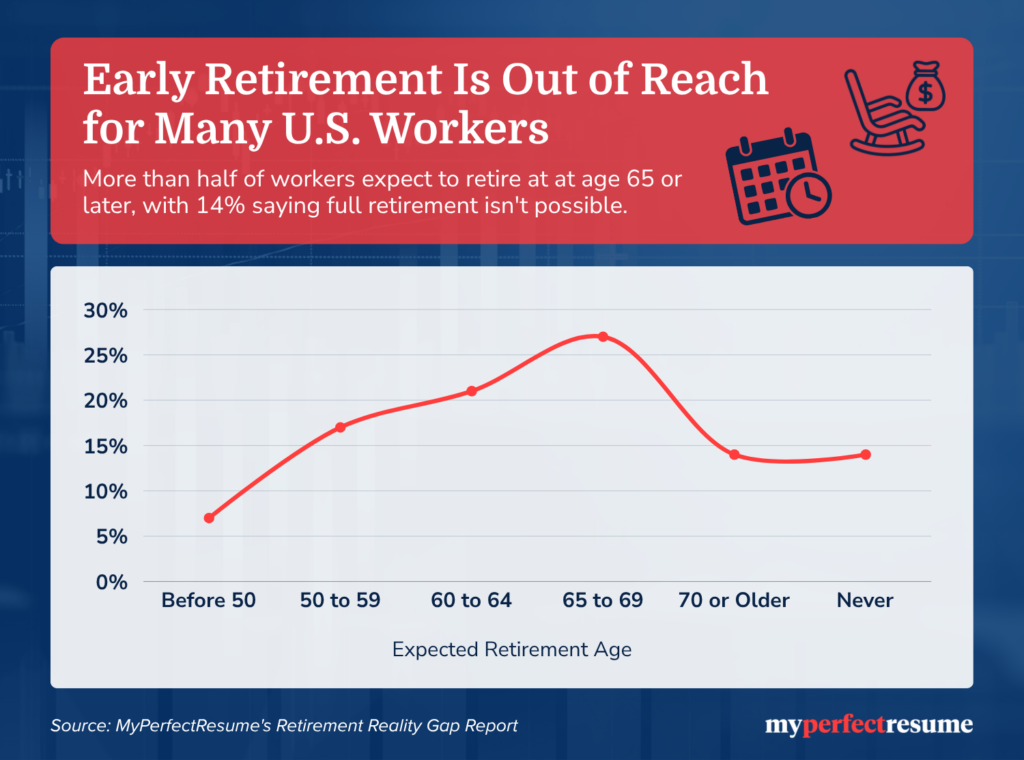
The 14% who don’t expect to retire fully represent an especially important part of the retirement picture. For these workers, retirement isn’t simply being delayed—it may no longer feel financially possible.
Rising Costs Are Pushing Retirement Further Away
Cost of living is the most commonly reported barrier preventing workers from retiring when they’d like to.
When asked to identify the biggest obstacles standing between them and an earlier retirement, respondents selected the following:
- Cost of living: 64%
- Not earning enough income: 37%
- Not having enough retirement savings: 34%
- Healthcare costs: 31%
- Housing costs: 30%
- Debt: 30%
- Job instability or economic uncertainty: 21%
- Supporting children or family members: 16%
- Other barriers: 9%
The results show that retirement challenges are connected to workers’ immediate financial obligations. Money that could potentially be directed toward retirement accounts may instead be needed for housing, healthcare, debt payments, family support, and everyday expenses.
Income is another significant constraint. More than one-third of workers say they aren’t earning enough to retire as early as they’d like. Workers can’t always solve a retirement savings shortfall by cutting expenses, especially when essential costs continue to consume a large portion of their paychecks.
Retirement Readiness Is Falling Short
Delayed retirement timelines are occurring alongside significant gaps in retirement savings. When asked how they’d describe their current retirement savings progress:
- 34% say they’re behind where they need to be.
- 33% say they’re about on track.
- 17% say they haven’t started saving.
- 16% say they’re ahead of where they need to be.
In total, 51% are either behind or have not started saving for retirement, compared with 49% who say they’re on track or ahead.
Being behind on retirement savings doesn’t necessarily mean workers are failing to prioritize their futures. Many may be balancing retirement contributions against more immediate financial demands, such as rent or mortgage payments, medical expenses, debt, childcare, and other household costs.
But the longer workers go without saving enough, the more difficult it can become to close the gap. Workers may eventually have to save a larger portion of their income, reduce their expected retirement spending, or remain employed longer than originally planned.
Retirement Confidence Is Showing Cracks
Many workers still believe they may eventually be able to retire, but nearly one-third aren’t confident that full retirement will be possible. When asked how confident they are that they’ll be able to fully retire one day:
- 20% say they aren’t very confident they’ll be able to retire fully.
- 12% say they aren’t at all confident.
- 31% say they’re somewhat confident.
- 37% say they’re very confident.
Overall, 32% aren’t confident they’ll be able to fully retire.
Retirement confidence can be affected by more than the amount currently held in a retirement account. Workers must also consider how long their savings will need to last, what healthcare may cost, whether they will still have housing or debt payments, and how inflation may affect their future purchasing power.
For workers who are already behind or haven’t started saving, these uncertainties can make retirement feel less like a defined goal and more like a milestone that may continue moving further away.
Early Retirement Feels Unrealistic for Many Workers
Retiring before age 60 remains an appealing idea, but workers are divided over whether it’s realistic for someone with a typical full-time job:
- 34% say no, not really.
- 28% say yes, somewhat.
- 21% say yes, definitely.
- 17% say no, definitely not.
Ultimately, 51% say retiring before age 60 isn’t realistic for a typical full-time worker, while 49% say it’s at least somewhat realistic. Only 21% say early retirement is definitely realistic.
This nearly even split reflects the uncertainty surrounding early retirement. Although it may be achievable under certain circumstances, many workers don’t see it as a dependable path for the typical employee.
Income, household expenses, employer benefits, debt, investment returns, and access to healthcare can all influence whether leaving the workforce before age 60 is financially possible.
Most Workers See FIRE as Out of Reach
The FIRE movement promotes aggressive saving and investing to leave the workforce before the traditional retirement age. While the idea is attractive, most workers don’t believe it’s realistic.
When asked which statement best describes their view of FIRE:
- 44% say it sounds appealing, but unrealistic for most people.
- 27% say it’s realistic only for high earners or wealthy households.
- 22% say it’s realistic for people like them.
- 7% say they’d rather work longer and enjoy life now.
In total, 71% believe FIRE isn’t broadly realistic, either because it’s unrealistic for most people or because it’s only achievable for high earners or wealthy households. Only 22% believe FIRE is realistic for people like them.
Workers are similarly divided when considering their personal ability to pursue FIRE right now:
- 27% say it feels somewhat achievable.
- 23% say it doesn’t feel very achievable.
- 22% say it doesn’t feel achievable at all.
- 17% say it feels very achievable.
- 11% say they aren’t interested in pursuing FIRE.
In total, 44% say FIRE feels achievable, while 45% say it doesn’t. Another 11% say they’re not interested in pursuing it.
These findings show a clear gap between the appeal of financial independence and workers’ ability to pursue it. Aggressive saving can be difficult when employees are already struggling with essential expenses, debt, limited income, and insufficient retirement savings.
What the Retirement Reality Gap Means for Workers
Retirement planning is no longer only about choosing a target age. Workers must evaluate whether their current income, savings, expenses, benefits, and debt levels support the future they expect.
For employees who are concerned about their retirement readiness, several career-related factors may deserve closer attention:
- Whether their current compensation allows them to make consistent retirement contributions
- Whether they’re receiving the full employer retirement match available to them
- Whether a job change could provide stronger pay, benefits, or long-term financial stability
- Whether their skills and experience will allow them to remain employable later in their careers
- Whether part-time, freelance, or consulting work may become part of their retirement plan
Career decisions made today can have a lasting effect on retirement readiness. Compensation, access to benefits, job stability, and opportunities for advancement all influence how much workers can save and how long they may need to remain employed.
For many workers, the retirement reality gap isn’t simply the distance between their current savings and their financial goal—it’s the growing distance between when they hoped to retire and when they now believe retirement will actually be possible.
For press inquiries, please contact Nathan Barber at nathan.barber@bold.com.
Methodology
The findings presented in this report are based on a national survey conducted by MyPerfectResume using Pollfish in May 2026. The survey collected responses from 1,000 U.S. workers. Respondents answered a mix of single-selection and multiple-choice questions about retirement expectations, retirement confidence, savings progress, barriers to early retirement, and views on FIRE (Financial Independence, Retire Early).
Demographic Breakdown
The survey sample included 50% female respondents, 49% male respondents, and 1% who preferred not to say or identified as another gender.
The age distribution included:
- 14% ages 18–24
- 16% ages 25–34
- 20% ages 35–44
- 18% ages 45–54
- 12% ages 55–64
- 20% ages 65 or older
About MyPerfectResume
MyPerfectResume Resume Builder with professional templates is designed to help job seekers elevate their careers. The easy-to-use platform was created to eliminate the hassle of resume writing, offering professionally written examples, free expert tips, step-by-step guidance to make a resume, and valuable interview advice to create an outstanding job application effortlessly. Since 2012, MyPerfectResume’s Resume Builder has helped more than 11 million job seekers create their perfect resumes online. Its comprehensive employment surveys have been featured in Forbes, Yahoo! Finance, CNBC, USA Today, BBC, and more. Follow MyPerfectResume as a preferred source in Google to receive more workforce trends, career insights, and labor market research in your personalized search experience.
Rate this article
Retirement Reality Gap

Jasmine is a certified career coach and recognized expert in job search strategy. She is committed to helping job seekers navigate the job market and succeed in their careers.
More Articles by Jasmine EscaleraShare this page
 Add MyPerfectResume as a preferred source on Google
Add
Our customers have been hired at:*Foot Note