

Our customers have been hired at: *Foot Note


Table of Contents
Get started with MyPerfectResume today!
- Build a resume on any device
- Pick an ATS-friendly template
- Tailor with AI copy suggestions
Artificial intelligence is no longer an experimental hiring tool. It’s becoming part of the standard recruitment process.
A new MyPerfectResume survey of 1,000 U.S. employers involved in hiring and workforce decisions finds that the majority use AI to support hiring decisions and say the technology has improved their hiring outcomes.
Employers are using AI to screen resumes, schedule interviews, assess skills, conduct background checks, source candidates, and produce hiring materials.
The results aren’t universally positive—some employers report no noticeable improvement, and organizations remain divided over whether AI increases or decreases candidate diversity.
Key Findings
- AI is widely adopted in hiring. 73% of employers say they use AI in hiring decisions, while 27% don’t.
- AI is delivering results, but not universally. 57% say AI improves hiring outcomes, while 16% see no noticeable impact and 4% say it worsens results.
- AI is most widely used in early-stage hiring decisions. 42% use AI for resume screening, making it the most common use case.
- Hiring processes are increasingly automated. 35% use AI for interview scheduling and background checks, while 33% use it for skills assessments.
- Adoption varies across more advanced use cases. 28% use AI for candidate sourcing, 25% for job description writing, 20% for video interview analysis, and 18% for offer letter generation.
AI Adoption Is Widespread in Hiring
The survey results revealed how many employers use AI in hiring, with nearly three-quarters of those surveyed saying they use it as part of their decision-making process:
- 73% use AI in hiring.
- 27% don’t use AI in hiring.
Candidates are increasingly likely to encounter some form of automation before communicating directly with a recruiter or hiring manager.
AI may be involved in reviewing an application, identifying relevant qualifications, scheduling an interview, administering an assessment, or analyzing information collected during the evaluation process.
For employers, these tools can help manage large numbers of applications and complete repetitive administrative tasks. For job seekers, however, the growing use of AI means applications may need to perform well with both automated systems and human decision-makers.
Resume Screening Is the Most Common Use of AI
Resume screening is the leading AI use case reported by employers, with 42% using the technology at this stage in the hiring process.
Employers report using AI for:
- Resume screening: 42%
- Interview scheduling: 35%
- Background checks: 35%
- Skills assessments: 33%
- Candidate sourcing: 28%
- Job description writing: 25%
- Video interview analysis: 20%
- Offer letter generation: 18%
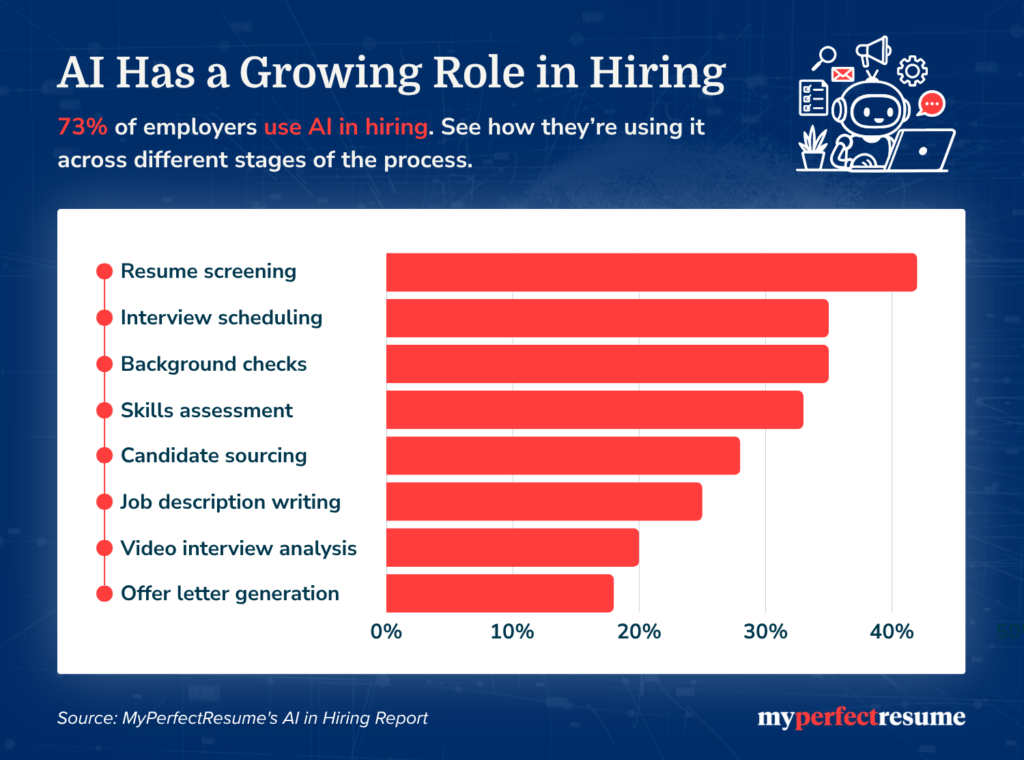
These AI resume screening statistics for 2026 reveal that AI is most established in the early and administrative stages of recruitment.
Screening resumes, identifying candidates, scheduling interviews, and administering assessments are often repeatable processes that can be handled at scale.
More advanced or sensitive applications remain less common. Only 20% of employers use AI for video interview analysis, while 18% use it to generate offer letters.
Most Employers Report Better Hiring Outcomes
Most employers using AI report positive results:
- 57% say AI improves hiring outcomes.
- 16% report no noticeable impact.
- 4% say AI worsens hiring outcomes.
AI is delivering value for many organizations, but simply adopting the technology doesn’t guarantee better hiring.
The quality of the results may depend on how an organization selects, configures, and evaluates its tools. AI can support a hiring team, but employers still need clear job requirements, reliable data, appropriate oversight, and a consistent evaluation process.
An inefficient or poorly designed hiring process doesn’t automatically become more effective simply by adding AI. In some cases, automation may allow existing problems to operate more quickly or at a larger scale.
AI’s Impact on Candidate Diversity Remains Unclear
Employers are less aligned on whether AI improves candidate diversity:
- 28% say AI increases the diversity of candidates who advance.
- 19% say AI decreases candidate diversity.
- 31% report no impact.
The gap between these responses shows that AI doesn’t produce the same diversity outcomes across organizations.
AI tools may help employers review larger applicant pools or apply criteria more consistently. At the same time, their recommendations can reflect limitations in the data, rules, and hiring practices used to build or operate them.
Employers should therefore evaluate more than efficiency. They should also examine who’s being recommended, who’s being filtered out, and whether automated decisions produce consistent, job-relevant results.
What AI Hiring Means for Job Seekers
As AI becomes more common, job seekers should assume that their applications may be reviewed by technology before they reach a person.
That doesn’t mean candidates should fill their resumes with excessive keywords or write only for an algorithm. The goal should be to make qualifications easy to identify and understand.
Job seekers can improve the clarity of their applications by:
- Using standard section headings such as “Work Experience,” “Skills,” and “Education”
- Including keywords from the job description that accurately reflect their experience
- Describing accomplishments with clear outcomes and specific details
- Avoiding complicated formatting that may make information difficult to interpret
- Tailoring each application to the requirements of the position
Candidates should also remember that AI may be used for more than just resume screening. Automated scheduling tools, skills assessments, chatbots, and video interview platforms may all appear during the hiring process.
What Employers Should Consider Before Expanding AI Use
AI can help hiring teams work more efficiently, but employers shouldn’t judge a tool solely by the time it saves.
Before expanding AI use, organizations should consider whether the technology:
- Uses criteria directly connected to the requirements of the job
- Produces consistent recommendations across candidate groups
- Gives hiring teams enough information to understand its output
- Allows human review of significant decisions
- Protects candidate information and privacy
- Creates a clear and accessible experience for applicants
- Improves the quality of hiring outcomes over time
Employers should also regularly review the performance of their tools. A system that worked well when it was introduced may become less useful as job requirements, candidate behavior, or organizational needs change.
AI Is Becoming Standard, but Human Oversight Still Matters
The survey findings point to a hiring landscape in which AI is increasingly common but not uniformly effective.
Most employers say AI improves hiring outcomes, and automation is expanding across key stages of recruitment. At the same time, some organizations report no improvement or worse results, and the effect on candidate diversity remains inconsistent.
AI can process applications, identify patterns, and complete administrative tasks faster than a hiring team could manually. It can’t, however, determine an organization’s hiring priorities or guarantee that its process is fair and effective.
The most successful employers are likely to treat AI as a decision-support tool rather than a complete replacement for human judgment. As adoption grows, the central question will no longer be whether employers use AI. It will depend on whether they use it responsibly and effectively.
For press inquiries, please contact Nathan Barber at nathan.barber@bold.com.
Methodology
The findings presented in this report are based on a nationally representative survey conducted by MyPerfectResume using Pollfish in March 2026. The survey collected responses from 1,000 U.S. employers involved in hiring and workforce decision-making.
Respondents answered yes-or-no, single-selection, and multiple-choice questions about their organizations’ use of artificial intelligence in hiring, candidate evaluation, diversity outcomes, workforce planning, layoffs, and restructuring.
The survey included employers across several age groups. Respondents ages 44–60 accounted for 44% of the sample, followed by ages 28–43 at 36%, ages 61–79 at 12%, and ages 18–27 at 8%.
The sample included organizations with varying levels of AI adoption, including employers actively using AI, those exploring its use, and those not currently using AI tools.
About MyPerfectResume
MyPerfectResume Resume Builder with professional templates is designed to help job seekers elevate their careers. The easy-to-use platform was created to eliminate the hassle of resume writing, offering professionally written examples, free expert tips, step-by-step guidance to make a resume, and valuable interview advice to create an outstanding job application effortlessly. Since 2012, MyPerfectResume’s Resume Builder has helped more than 11 million job seekers create their perfect resumes online. Its comprehensive employment surveys have been featured in Forbes, Yahoo! Finance, CNBC, USA Today, BBC, and more. Follow MyPerfectResume as a preferred source in Google to receive more workforce trends, career insights, and labor market research in your personalized search experience.
Rate this article
AI in Hiring Report

Jasmine is a certified career coach and recognized expert in job search strategy. She is committed to helping job seekers navigate the job market and succeed in their careers.
More Articles by Jasmine EscaleraShare this page
 Add MyPerfectResume as a preferred source on Google
Add
Our customers have been hired at:*Foot Note