Act Your Wage: 78% of Workers Report Doing the Bare Minimum at Work to Keep Their Jobs


Our customers have been hired at: *Foot Note


Table of Contents
Get started with MyPerfectResume today!
- Build a resume on any device
- Pick an ATS-friendly template
- Tailor with AI copy suggestions
When workers believe their pay no longer reflects what their job demands, many reconsider how much effort they’re willing to give.
MyPerfectResume’s Act Your Wage Report examines how compensation, workload, and perceptions of unfair rewards influence workplace effort. Based on a national survey of 1,000 U.S. workers, the findings show that pulling back isn’t an isolated response.
More than three-quarters of workers have intentionally done only the minimum required to keep their jobs. Many have also stopped volunteering for extra assignments, avoided unpaid overtime, declined work outside their roles, or become less emotionally invested.
These behaviors point to a broader disconnect between what employers expect and what workers believe they receive in return.
Key Findings
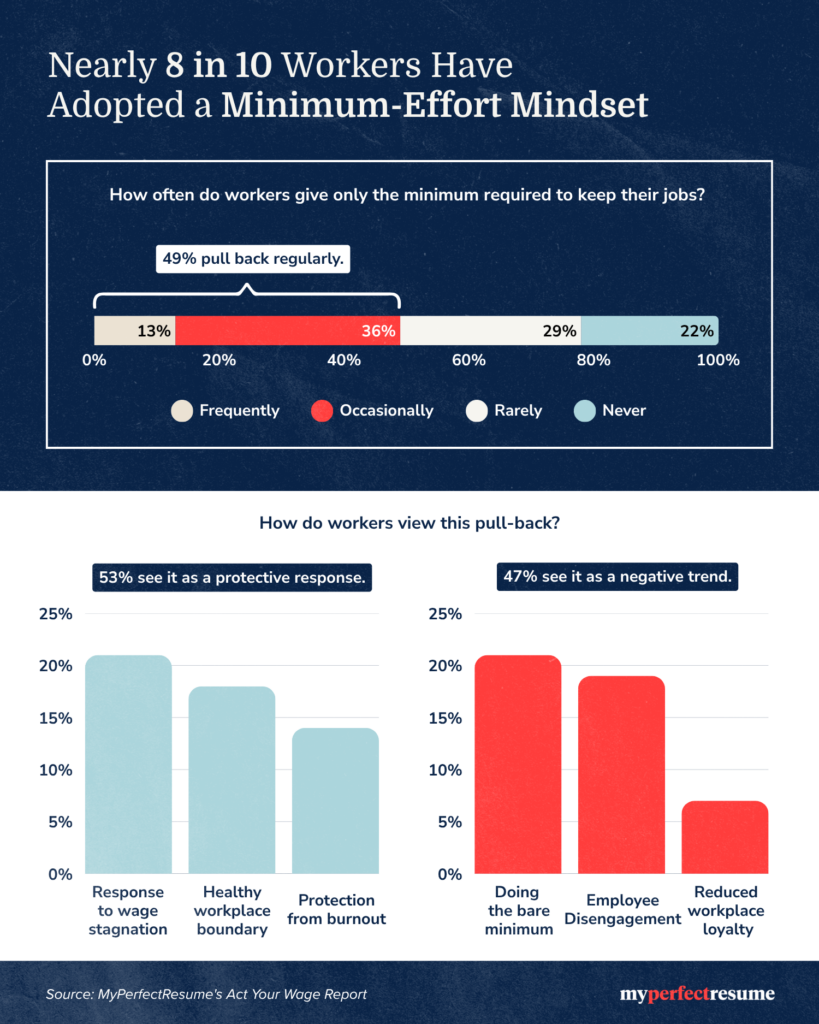
- Minimum-effort behavior is widespread. 78% have intentionally done only the minimum required to keep their job, including 49% who have done so frequently or occasionally.
- Pay mismatches are affecting effort. 69% have limited their effort because their pay didn’t match their job’s expectations or responsibilities.
- Extra effort is rarely seen as consistently rewarding. 92% say employees aren’t consistently rewarded fairly for going above and beyond, while 52% say they’re rarely or almost never rewarded.
- Working outside formal job duties is common. 86% have been asked to take on responsibilities outside their job description without additional compensation.
- Additional responsibilities consume significant time. 44% spend at least two hours per week working outside their formal roles.
- Feeling underpaid or overworked changes behavior. 83% have changed at least one workplace behavior or considered leaving their job for these reasons.
Most Workers Have Taken a Minimum-Effort Approach
More than three-quarters of workers say they’ve intentionally done only the minimum required to keep their job at least once:
- 13% frequently
- 36% occasionally
- 29% rarely
- 22% never
Nearly half of workers (49%) have taken this approach frequently or occasionally.
Doing only what a job requires can reflect different attitudes toward work. Some employees may be disengaged, while others may be setting boundaries after being repeatedly asked to provide more time, energy, or responsibility without a corresponding reward.
Workers are nearly evenly divided in how they interpret matching effort to pay. Fifty-three percent view it as a response to workplace pressures:
- 21% see it as a response to wage stagnation.
- 18% see it as a healthy workplace boundary.
- 14% see it as protection from burnout.
The remaining 47% take a more negative view:
- 21% see it as doing the bare minimum.
- 19% see it as employee disengagement.
- 7% see it as reduced workplace loyalty.
69% Have Limited Their Effort Because of a Pay Mismatch
For many workers, pulling back at work and reducing effort is directly connected to compensation.
Sixty-nine percent have intentionally limited their effort because they believed their pay didn’t match the expectations or responsibilities of their role:
- 12% frequently
- 31% occasionally
- 26% rarely
- 31% never
Altogether, 43% have pulled back frequently or occasionally because of a perceived pay mismatch.
This doesn’t necessarily mean employees are refusing to perform their jobs. Workers may still complete their assigned duties while becoming less willing to absorb additional work, remain available outside scheduled hours, or volunteer for assignments that offer no added compensation or recognition.
When job demands expand but pay remains unchanged, employees may begin treating their formal job descriptions as firmer boundaries.
Only 9% Say Extra Effort Is Consistently Rewarded
Workers overwhelmingly doubt that going above and beyond produces a fair and predictable reward:
- 9% say extra effort is consistently rewarded fairly.
- 39% say it’s sometimes rewarded fairly.
- 32% say it’s rarely rewarded fairly.
- 20% say it’s almost never rewarded fairly.
More than half (52%) believe extra effort isn’t rewarded at work and is rarely or almost never rewarded fairly.
The results suggest the issue isn’t simply whether recognition happens. Workers may also be evaluating whether recognition is consistent, meaningful, and proportionate to the additional effort being requested.
Feeling underpaid and experiencing burnout are tied as the leading reasons employees stop going beyond their job requirements:
- 22% cite feeling underpaid.
- 22% cite burnout.
- 19% cite a lack of recognition.
- 17% cite seeing hard work go unrewarded.
- 11% cite poor leadership.
- 6% cite a lack of advancement.
- 3% cite anxiety about layoffs.
Combined, 58% identify feeling underpaid, lacking recognition, or seeing hard work go unrewarded as the primary reason employees pull back.
86% Have Been Asked to Work Outside Their Role Without Extra Pay
Requests to take on work beyond an employee’s formal job description are common.
Eighty-six percent of workers have been asked to assume additional responsibilities without receiving extra compensation:
- 25% frequently
- 40% occasionally
- 21% rarely
- 14% never
Workers also see this as a widespread workplace practice. Nearly three-quarters (74%) say employees commonly perform work beyond their official roles without additional pay:
- 31% say it’s extremely common.
- 43% say it’s somewhat common.
- 18% say it’s not very common.
- 8% say it rarely happens.
Occasionally helping with an unexpected task may be a normal part of working on a team. The situation can become more difficult when temporary requests turn into permanent responsibilities without changes to an employee’s title, workload, compensation, or priorities.
Employees may then feel that performing unpaid work outside their job description simply resets what their employer considers the minimum.
44% Spend at Least 2 Hours per Week Outside Their Formal Role
Additional responsibilities aren’t always brief or infrequent. Nearly three-quarters of workers (73%) spend at least some time each week completing tasks outside their formal job duties:
- 27% spend no time working outside their role.
- 29% spend less than two hours.
- 28% spend two to five hours.
- 10% spend six to 10 hours.
- 6% spend more than 10 hours.
Overall, 44% spend at least two hours per week on work beyond their formal responsibilities, and 16% spend six hours or more.
For a worker spending six hours each week on responsibilities outside their role, that additional work can add up to more than 300 hours over a year.
Even when these tasks are completed during regular working hours, they may leave less time for the responsibilities used to evaluate the employee’s performance.
Underpaid & Overworked Employees Are Changing Their Behavior
Feeling underpaid or overworked can affect more than how hard employees work on individual assignments. It may also change how they participate in the workplace and whether they plan to remain with their employer.
Eighty-three percent of workers have taken at least one of the following actions or considered leaving their jobs because they felt underpaid or overworked:
- 31% became less emotionally invested in their job.
- 30% stopped volunteering for extra work.
- 28% considered quitting.
- 28% avoided unpaid overtime.
- 25% focused only on tasks tied to their job description.
- 24% declined responsibilities outside their role.
- 24% started looking for another job.
- 14% stopped responding to work messages outside working hours.
- 14% pulled back from workplace culture or team activities.
Only 17% took none of these actions. The most common response was becoming less emotionally invested, followed closely by no longer volunteering for extra work.
Employers may find these changes hard to spot because employees can keep completing required tasks while withdrawing from optional activities and long-term involvement.
The results also reveal potential retention concerns. More than one-quarter considered quitting, and nearly one-quarter started searching for another job.
What Employees Can Do When Their Responsibilities Outgrow Their Pay
Employees don’t have to choose immediately between accepting every additional responsibility and refusing all work outside their job descriptions. A more productive first step is to document how the role has changed and discuss expectations with a manager.
Workers can prepare for that conversation by:
- Listing responsibilities added since they accepted the position
- Tracking the time spent on duties outside the original role
- Documenting measurable results connected to the additional work
- Asking which assignments should take priority when workloads conflict
- Requesting a review of their title, job description, or compensation
- Connecting requests for higher pay to expanded responsibilities and results
- Establishing clear boundaries around unpaid overtime and after-hours availability
- Reviewing external opportunities if the employer cannot address an ongoing mismatch
The discussion should focus on how the position has changed, rather than on a general statement that the workload feels unfair. Specific examples can show whether an occasional assignment has become a substantial part of the role.
For press inquiries, please contact Nathan Barber at nathan.barber@bold.com.
Methodology
This report’s findings are based on a national survey conducted by MyPerfectResume using Pollfish in July 2026. The survey collected responses from 1,000 U.S. workers.
Respondents answered a mix of single-selection and multiple-choice questions about workplace effort, compensation, responsibilities outside formal job roles, employee engagement, workplace boundaries, and perceptions of whether extra effort is fairly rewarded.
The survey sample included 50% female respondents, 49% male respondents, and 1% who identified as another gender. Age distribution was broad, with 14% aged 18 to 24, 19% aged 25 to 34, 18% aged 35 to 44, 17% aged 45 to 54, 15% aged 55 to 64, and 17% aged 65 or older.
Rate this article

Jasmine is a certified career coach and recognized expert in job search strategy. She is committed to helping job seekers navigate the job market and succeed in their careers.
More Articles by Jasmine EscaleraShare this page
 Add MyPerfectResume as a preferred source on Google
Add
Our customers have been hired at:*Foot Note