

Our customers have been hired at: *Foot Note


Table of Contents
Get started with MyPerfectResume today!
- Build a resume on any device
- Pick an ATS-friendly template
- Tailor with AI copy suggestions
Nearly two-thirds of workers have accepted a job that turned out to be meaningfully different from how it was described, according to new data from MyPerfectResume.
The Job Description Trust Report, based on a national survey of 1,000 U.S. workers, found that 65% have experienced a mismatch between a job description and the reality of the role. Nearly 3 in 10 workers say it’s happened more than once.
This lack of job description accuracy may also contribute to early turnover, as more than three-quarters of workers say they’d consider leaving within the first year if a position failed to match what was advertised.
Key Findings
- Job descriptions often miss the mark. 65% have accepted a role that was meaningfully different from how it was described.
- A mismatch creates retention risk. 78% would consider leaving within the first year if a role failed to meet expectations.
- Complete trust is rare. Only 18% completely trust job descriptions to reflect a role accurately.
- Skepticism is common. 35% express some level of distrust toward job descriptions and job posting buzzwords that may not reflect the reality of the role.
- Vague language raises red flags. 55% believe vague job descriptions signal hidden downsides or organizational problems.
- Workers see vague wording as strategic. 64% believe companies use vague language to attract applicants or avoid discouraging candidates.
- Job description mismatch is often repeated. 29% say they’ve experienced this mismatch more than once.
Few Workers Trust What Job Descriptions Say
Workers may rely on job descriptions to decide whether a position fits their experience, goals, and expectations, but relatively few trust those descriptions completely.
When asked how much they trust job descriptions to accurately reflect the reality of a role, respondents said:
- 29% somewhat distrust job descriptions.
- 6% completely distrust job descriptions.
- 47% somewhat trust job descriptions.
- 18% completely trust job descriptions.
Combined, 35% express some level of distrust toward job descriptions.
Another 47% say they only somewhat trust them, suggesting that many candidates approach job postings with caution. Workers may assume that important information about responsibilities, workloads, schedules, management expectations, or workplace culture is missing.
Even before submitting an application, candidates may feel they need to read between the lines to determine what the role will actually involve.
Misleading Job Descriptions Are Common
The survey shows that misleading or inaccurate job descriptions are not isolated incidents.
When asked whether they’d ever accepted a role that was meaningfully different from how it was described, respondents said:
- 36% say yes, once.
- 29% say yes, more than once.
- 35% say no.
Combined, 65% report experiencing a mismatch between a job description and the reality of the position. And for nearly 30% of workers, this has happened more than once, suggesting the problem may go beyond an occasional misunderstanding between an employer and a new hire.
A job description creates the initial expectations for a position. Candidates use it to evaluate the responsibilities, workload, qualifications, compensation, and workplace environment before deciding whether to apply or accept an offer.
When the reality of the role is substantially different from the job title and description, employees may feel that they made an important career decision without receiving accurate information.
78% Would Consider Leaving When Expectations Don’t Match Reality
The consequences of a misleading job description may continue long after the hiring process ends.
When asked how likely they would be to leave a role within the first year if it turned out to be meaningfully different from its description, respondents said:
- 28% say very likely.
- 50% say somewhat likely.
- 19% say not very likely.
- 3% say not at all likely.
Combined, 78% would consider leaving if the position failed to meet the expectations established during recruitment. This makes job description accuracy a retention issue, not only a recruiting concern.
An unclear or inaccurate posting may attract candidates who aren’t prepared for the position’s actual responsibilities or working conditions. Even when employees are capable of doing the work, feeling misled can weaken their trust in the employer and reduce their willingness to remain in the role.
Workers Believe Vague Job Descriptions Hide Important Details
Job description red flags, such as vague or overly polished wording, may create concerns before a candidate even applies.
When asked what a vague job description signals about a company, respondents said:
- 42% say the company is hiding downsides.
- 32% say the company is using standard HR language.
- 13% say the company is disorganized.
- 13% say there is no negative signal.
Combined, 55% interpret vague descriptions as a sign that the employer is hiding downsides or experiencing organizational problems.
Broad phrases may be intended to make a position sound appealing or accessible to more candidates. But workers may interpret a lack of detail as a warning that the company doesn’t want to disclose the full reality of the role.
For candidates, missing information about workload, scheduling, team structure, performance expectations, or management can make it harder to determine whether a job is a good fit.
Why Workers Think Companies Use Vague Workplace Language
Workers also tend to believe vague job posting language is used strategically rather than accidentally.
When asked why companies use vague language in job postings, respondents said:
- 56% say it’s to appeal to more applicants.
- 40% say it’s common HR language.
- 36% say it’s to avoid discouraging candidates.
- 31% say it’s to simplify postings.
- 27% say it’s to hide downsides.
- 14% say hiring teams don’t realize how the language sounds.
Combined, 64% selected at least one strategic reason, saying companies use vague language either to appeal to more applicants or avoid discouraging candidates. (Because respondents could select more than one answer, responses don’t total 100%).
Using broad language may help an employer attract a larger applicant pool, but it may not yield candidates well-matched to the role. A posting can generate interest without giving applicants enough information to judge whether the position aligns with their expectations.
That may lead to more applications during recruitment, but also increase the risk of dissatisfaction and workplace detachment once someone begins the job.
Burnout Is Workers’ Biggest Fear Behind Workplace Buzzwords
When workers encounter overly polished language and job posting buzzwords, many assume it may be masking a negative workplace reality.
When asked which hidden issue concerns them most, respondents said:
- 25% say burnout or excessive workload.
- 21% say unclear role expectations.
- 18% say high turnover or instability.
- 16% say poor management or boundaries.
- 13% say being understaffed.
- 7% say no particular concern.
Only 7% report having no concerns. That means 93% associate polished workplace language with at least one potential downside.
Burnout or excessive workloads ranked as the most common concern, followed by unclear role expectations. Together, these findings suggest workers are especially wary of language that avoids describing how much work they will be expected to handle and what they will be responsible for.
Candidates may see phrases such as “fast-paced environment,” “high-ownership role,” or “wear many hats” as possible signals that workloads are excessive, teams are understaffed, or responsibilities aren’t clearly defined.
Which Job Description Phrases Do Workers Trust Most & Least?
Not every phrase in a job description creates the same reaction.
Workers reported the greatest skepticism toward language that may suggest excessive workloads, unclear expectations, or responsibilities that extend beyond the stated role.
The phrases with the highest negative perception were:
- “Rockstar/ninja/hustler culture,” viewed negatively by 39% of workers
- “Wear many hats,” viewed negatively by 38%
- “Lean team,” viewed negatively by 28%
These phrases may sound energetic or entrepreneurial to employers, but workers may interpret them as warnings about pressure, understaffing, or a lack of boundaries.
By contrast, workers responded more positively to phrases connected to compensation, benefits, or workplace culture.
The phrases with the highest positive perception were:
- “Competitive salary,” viewed positively by 70% of workers
- “Unlimited PTO,” viewed positively by 60%
- “We’re like a family,” viewed positively by 59%
- “Dynamic environment,” viewed positively by 51%
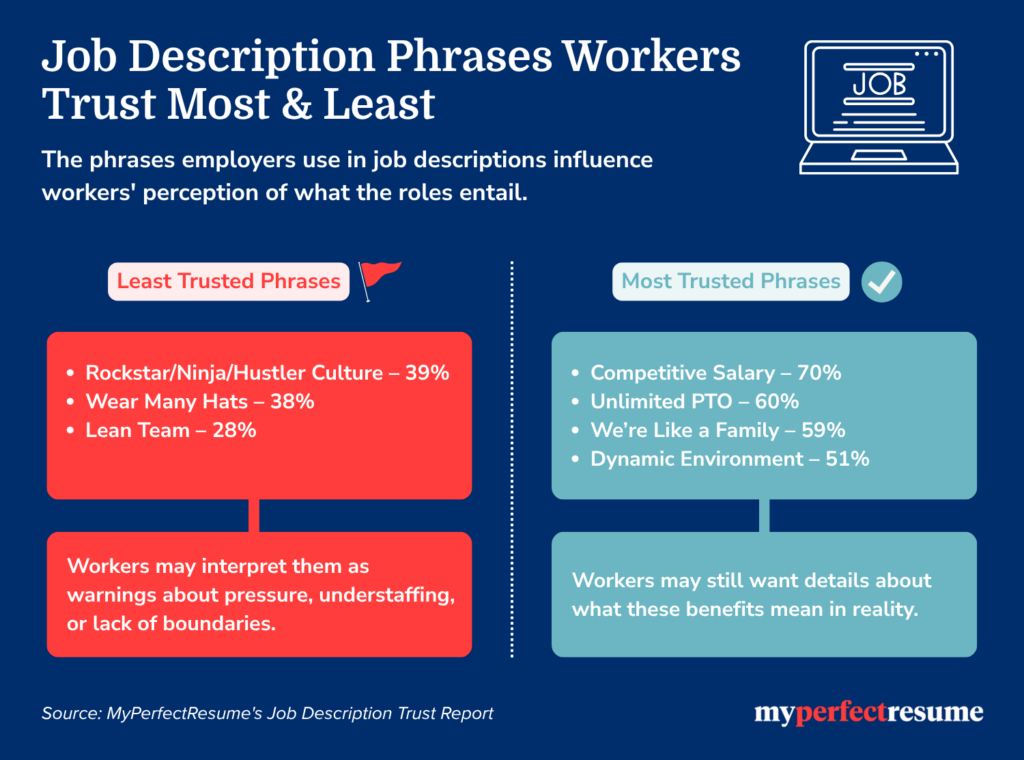
A positive response to a phrase doesn’t necessarily mean candidates will accept it without additional information. For example, “competitive salary” may attract interest, but applicants may still expect an employer to provide a clear salary range.
Similarly, policies such as unlimited PTO may sound appealing, but candidates may want details about how often employees take time off and whether managers encourage them to use the benefit.
What Employers Can Learn From the Findings
The results show that job descriptions influence more than application rates. They can shape candidate trust, employee expectations, and the likelihood that a new hire remains with the organization.
Employers can make postings more useful by clearly explaining:
- The position’s primary responsibilities
- Typical daily or weekly tasks
- Workload and performance expectations
- Reporting structure and management responsibilities
- Team size and available resources
- Schedule and workplace-location requirements
- Salary ranges and benefits
- Opportunities for advancement
- Challenges candidates should expect in the role
Transparency may cause some candidates to decide a position isn’t right for them. That, however, can be more valuable than attracting applicants who later discover the role doesn’t meet their expectations.
An effective job description shouldn’t simply persuade someone to apply. It should help candidates make an informed decision about whether they are prepared for the work and whether the position fits their professional needs.
What Job Seekers Should Look for in a Job Description
Candidates may not be able to determine everything about a position from a job posting alone, but they can look for signs that an employer is communicating clearly.
A detailed job description should explain the main responsibilities, required qualifications, reporting structure, schedule, compensation, and workplace expectations.
Job seekers may want to ask additional questions when a posting:
- Uses broad buzzwords without explaining what they mean
- Lists an unusually wide range of unrelated responsibilities
- Doesn’t include salary or benefit information
- Provides little information about the team or manager
- Describes the workplace culture without providing examples
- Emphasizes flexibility while remaining unclear about scheduling
- Avoids explaining how performance will be measured
Candidates can also use the interview process to ask what a typical day looks like, why the position is open, how success is measured, and what challenges the previous employee faced.
Getting specific answers before accepting an offer may reduce the likelihood of discovering that the position is meaningfully different from what was advertised.
For press inquiries, please contact Nathan Barber at nathan.barber@bold.com.
Methodology
The findings presented in this report are based on a national survey conducted by MyPerfectResume using Pollfish in May 2026. The survey collected responses from 1,000 U.S. workers. Respondents answered a mix of single- and multiple-selection questions about job description trust, job posting language, role expectations, experiences with job description mismatches, and the likelihood of leaving a role when the reality of the job does not match what was advertised.
Some questions allowed respondents to select more than one answer. For those questions, percentages may not total 100%. Combined figures, such as the share of workers who selected at least one strategic reason for vague workplace language, were calculated by grouping relevant response options.
Demographic Breakdown
The survey sample included 52% female respondents and 48% male respondents. Age distribution was broad, with 11% aged 18 to 24, 18% aged 25 to 34, 19% aged 35 to 44, 17% aged 45 to 54, 15% aged 55 to 64, and 20% aged 65 or older.
About MyPerfectResume
MyPerfectResume Resume Builder with professional templates is designed to help job seekers elevate their careers. The easy-to-use platform was created to eliminate the hassle of resume writing, offering professionally written examples, free expert tips, step-by-step guidance to make a resume, and valuable interview advice to create an outstanding job application effortlessly. Since 2012, MyPerfectResume’s Resume Builder has helped more than 11 million job seekers create their perfect resumes online. Its comprehensive employment surveys have been featured in Forbes, Yahoo! Finance, CNBC, USA Today, BBC, and more. Stay connected with MyPerfectResume’s latest LinkedIn, Instagram, and Facebook updates. Follow MyPerfectResume as a preferred source in Google to receive more workforce trends, career insights, and labor market research in your personalized search experience.
Rate this article
Job Description Trust Report

Jasmine is a certified career coach and recognized expert in job search strategy. She is committed to helping job seekers navigate the job market and succeed in their careers.
More Articles by Jasmine EscaleraShare this page
 Add MyPerfectResume as a preferred source on Google
Add
Our customers have been hired at:*Foot Note