AI Is Now Deciding Who Gets Hired & Who Gets Cut: 73% of Employers Say They Use AI in Hiring Decisions


Our customers have been hired at: *Foot Note


Table of Contents
Get started with MyPerfectResume today!
- Build a resume on any device
- Pick an ATS-friendly template
- Tailor with AI copy suggestions
Artificial intelligence is no longer just a behind-the-scenes hiring tool. It’s now shaping who gets seen, who gets filtered out, and even who stays employed.
A new MyPerfectResume AI Hiring and Layoffs survey of 1,000 U.S. hiring managers reveals that AI is embedded across hiring and workforce decision-making. From screening resumes to influencing layoffs and restructuring, these systems are playing a growing role in high-stakes decisions, often with uneven confidence in their fairness and accuracy.
The findings highlight a shift in how organizations operate: faster and more automated, but not always more reliable.
What This Report Covers
This report examines how employers are using AI across hiring, candidate evaluation, and broader workforce planning decisions. It explores adoption rates, candidate filtering practices, employer confidence in AI fairness, and where these systems may be falling short.
Key Findings at a Glance
- AI is widely used in hiring. 73% of employers say they use AI in hiring decisions.
- AI filters candidates before human review. 65% say AI automatically rejects applicants before a person sees them.
- High rejection rates are common. 14% say AI rejects more than half of applicants.
- Potentially qualified candidates are being missed. 47% say AI may have filtered out candidates they would have advanced.
- AI is expanding into workforce planning. 52% use it for decisions like restructuring and role planning.
- Confidence in fairness is split. 51% say AI is fair in layoffs, while 23% express doubts.
- AI is making subjective judgments. 51% use it to flag “risky” candidates.
AI Has Become the First Gatekeeper in Hiring
For most job seekers today, the first “decision-maker” isn’t a recruiter, it’s an algorithm.
Nearly two-thirds of employers (65%) say AI automatically rejects candidates before any human review. That means a significant portion of applicants never reach a hiring manager at all.
Rejection levels vary:
- 26% of employers say AI rejects 1%–25% of applicants.
- 25% say it rejects 26%–50%.
- 11% say it rejects 51%–75%.
- 3% say it rejects over 75%.
Here’s a visualization of the data from above:
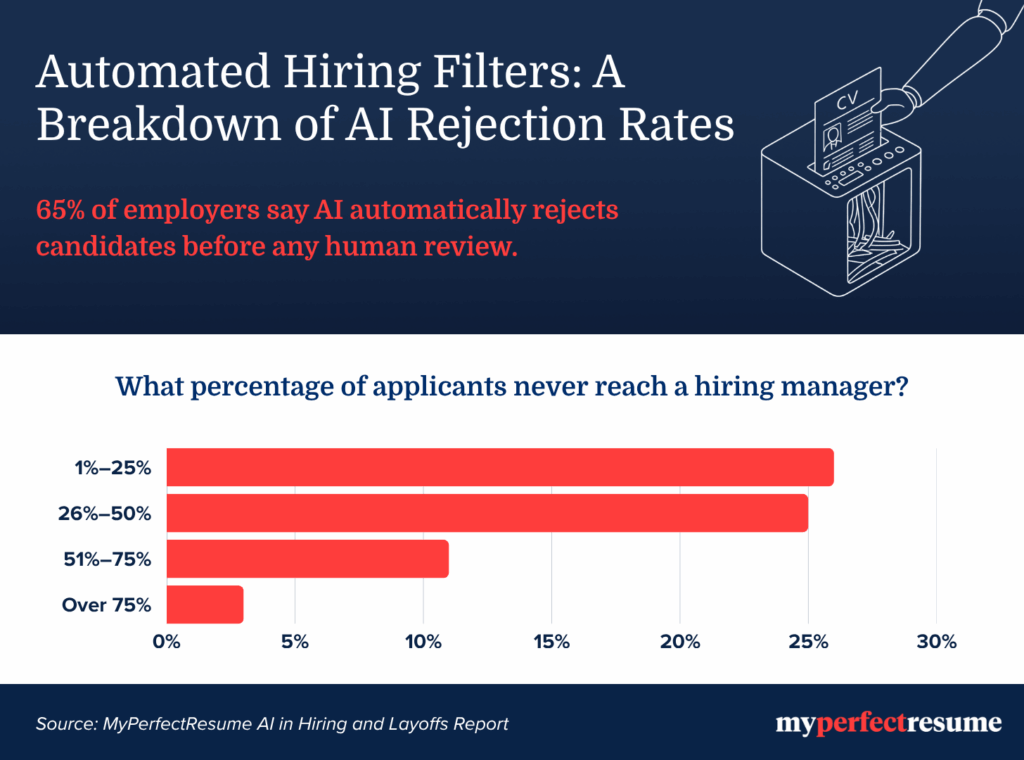
The AI resume screening statistics for 2026 reveal that only 5% of employers report that AI does not reject candidates at all.
Why this matters: AI is designed to increase efficiency, but it’s also narrowing the funnel earlier than ever. When filtering happens before human oversight, even strong candidates can be excluded based on incomplete or overly rigid criteria.
Employers Know AI Doesn’t Always Get It Right
Despite widespread adoption, many employers acknowledge that AI systems aren’t consistently accurate.
Nearly half (47%) say AI may have filtered out candidates they would have moved forward in the hiring process. While 17% say this happens rarely and 7% say it never happens, the overall trend points to a clear concern: Automation can come at the cost of missing qualified talent.
Why this matters: The trade-off between speed and accuracy is becoming more visible. Employers gain efficiency but risk overlooking candidates who don’t perfectly match algorithmic criteria.
AI Is Expanding Beyond Hiring Into Workforce Decisions
AI is no longer limited to recruitment; it’s now influencing broader organizational strategy.
More than half of employers (52%) say they use AI for workforce planning decisions, including restructuring and role evaluation. Another 28% are considering adopting AI for these purposes.
Meanwhile, 20% say they don’t plan to use AI in workforce planning at all.
Here’s a visualization of the data from above:
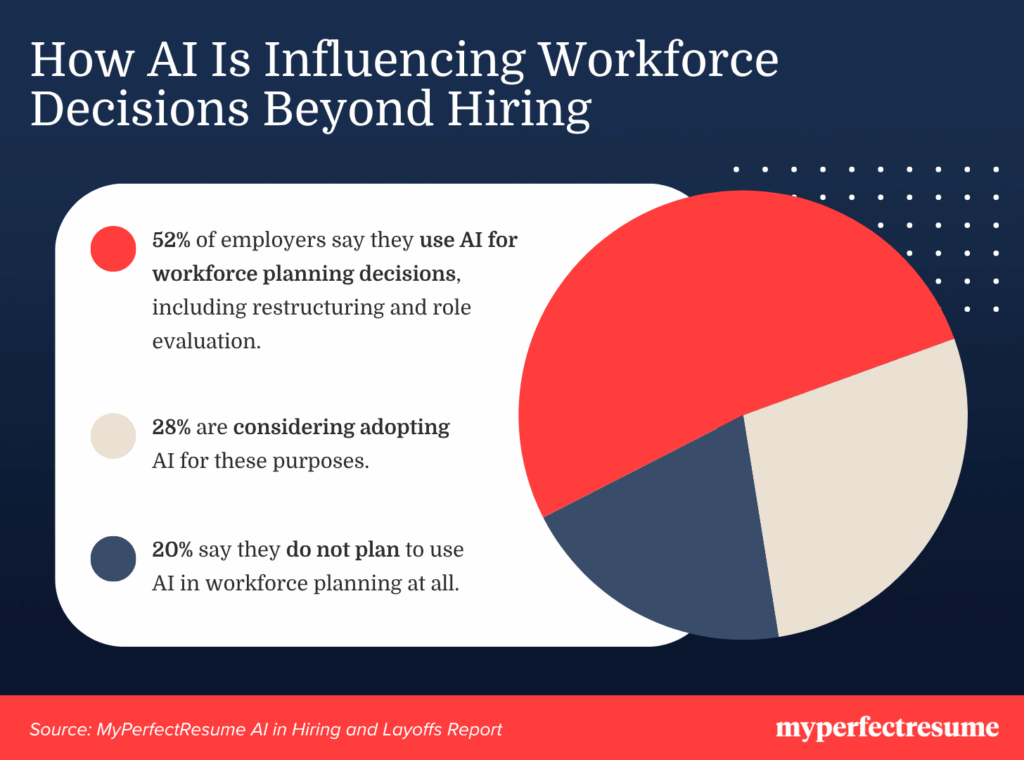
Why this matters: As AI moves into areas like restructuring and layoffs, its impact extends beyond hiring into job security itself. These are high-stakes decisions, where errors or bias can have long-term consequences for workers.
AI Is Being Used to Make Subjective Judgments
Beyond qualifications, AI is increasingly evaluating behavior and career patterns.
More than half of employers (51%) use AI to flag “risky” candidates, such as job-hoppers or those with employment gaps. Another 12% are considering implementing this capability.
Why this matters: These judgments introduce a level of subjectivity into automated systems. Instead of simply matching skills to roles, AI is now making assumptions about candidate reliability and fit—areas that are often nuanced and context-dependent.
Confidence in AI Fairness Is Divided
As AI takes on a larger role in workforce decisions, confidence in its fairness remains uneven:
- 51% of employers say they’re confident AI is used fairly in layoffs.
- 23% express doubts.
- 26% don’t use AI in layoff decisions.
Why this matters: The divide highlights a lack of consensus around how trustworthy these systems are, especially in decisions that directly impact livelihoods.
The Bigger Picture: Speed vs Accuracy in the Hiring Process
Taken together, the findings point to a clear shift in how hiring and workforce decisions are being made.
AI is accelerating processes and reducing manual workload, but it’s also introducing new risks:
- Qualified candidates may be filtered out before being seen.
- Hiring decisions are increasingly shaped by automated systems.
- Workforce planning is becoming more data-driven—but not always more transparent.
What This Means for Workers
Key AI layoff statistics in 2026 reveal that job seekers must now navigate a system where visibility depends on how well they align with algorithmic criteria, not just human judgment.
What This Means for Employers
Organizations face a balancing act: leveraging AI for efficiency while ensuring that accuracy, fairness, and human oversight aren’t lost in the process.
For press inquiries, please contact Nathan Barber at nathan.barber@bold.com.
Methodology
The findings presented in this report are based on a nationally representative survey conducted by MyPerfectResume using Pollfish in March, 2026. The survey collected responses from 1,000 U.S. human resources employees involved in hiring and workforce decision-making. Respondents answered a mix of yes/no, single-selection, and multiple-choice questions about their organization’s use of artificial intelligence in hiring, candidate evaluation, diversity outcomes, and workforce planning decisions, including layoffs and restructuring.
Demographic Breakdown
The survey sample included employers across a range of age groups. The largest share of respondents was aged 44–60 (44%), followed by 28–43 (36%), 61–79 (12%), and 18–27 (8%). Respondents represented a mix of organizations with varying levels of AI adoption, including those actively using AI in hiring and workforce planning, those exploring adoption, and those not currently using AI tools.
About MyPerfectResume
MyPerfectResume Resume Builder with professional templates is designed to help job seekers elevate their careers. The easy-to-use platform was created to eliminate the hassle of resume writing, offering professionally written examples, free expert tips, step-by-step guidance to make a resume, and valuable interview advice to create an outstanding job application effortlessly. Since 2012, MyPerfectResume’s Resume Builder has helped more than 11 million job seekers create their perfect resumes online. Its comprehensive employment surveys have been featured in Forbes, Yahoo! Finance, CNBC, Newsweek, USA Today, BBC, Workable, and more. Stay connected with MyPerfectResume’s latest Facebook, LinkedIn, Instagram, X, and Pinterest updates.
Rate this article
AI Hiring and Layoffs Survey

Jasmine is a certified career coach and recognized expert in job search strategy. She is committed to helping job seekers navigate the job market and succeed in their careers.
More Articles by Jasmine EscaleraShare this page
 Add MyPerfectResume as a preferred source on Google
Add
Our customers have been hired at:*Foot Note