Most U.S. Workers Say They’re Behind in Their Careers—Both vs Their Goals & Their Peers

Our customers have been hired at: *Foot Note


Table of Contents
Get started with MyPerfectResume today!
- Build a resume on any device
- Pick an ATS-friendly template
- Tailor with AI copy suggestions
A growing share of U.S. workers say they’re feeling left behind in their careers, not just compared to their own expectations, but also compared to others their age.
According to a new national Comparison Pressure survey from MyPerfectResume, nearly three in four workers (72%) say they’re not where they expected to be professionally. At the same time, 75% say they’re not ahead of others in their age group.
Together, these findings point to a workforce that increasingly measures career success against both personal timelines and external benchmarks.
This dual pressure—internal expectations and peer comparison—is shaping how workers evaluate their progress and their confidence about what comes next.
Key Findings
- Feeling behind peers is common. 75% say they’re not ahead of others their age, including 36% who say they feel behind.
- Feeling behind personal expectations is also widespread. 72% say they’re not where they expected to be professionally, including 34% who feel behind.
- Comparison is routine. 53% compare their career progress to friends or peers at least occasionally, including 27% who do so often or constantly.
- Milestone pressure is widespread. 53% feel at least some pressure to hit career milestones because people around them are reaching them.
- Social media can distort the benchmark. 60% say online career content presents an unrealistic picture of success.
Most Workers Aren’t Ahead of Their Own Expectations
For many workers, a gap in career expectations vs reality is a key source of dissatisfaction.
Nearly three in four (72%) say they’re not ahead of where they expected to be in their careers. Within that group, more than one-third (34%) say they feel behind their original expectations:
- 18% say they’re slightly behind
- 16% say they’re far behind
Another 38% say they’re about where they expected to be, suggesting that even meeting expectations does not necessarily translate into feeling ahead.
A smaller share report exceeding their expectations:
- 16% say they’re slightly ahead
- 12% say they’re far ahead
Here’s a visualization of the data from above:
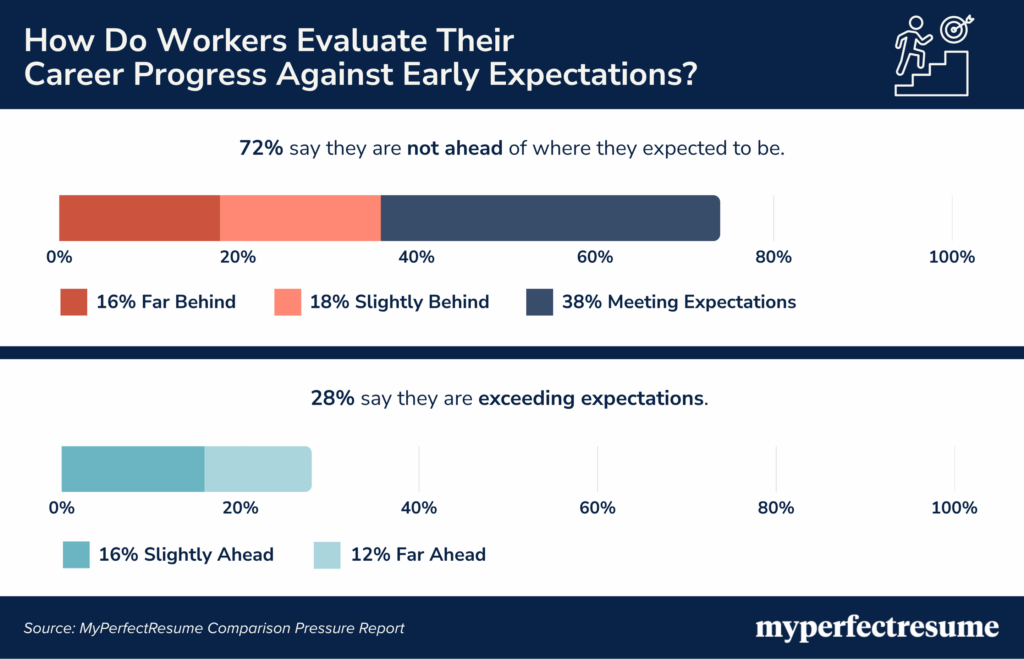
Overall, the data shows that most workers aren’t experiencing career acceleration relative to their earlier goals.
Most Workers Also Don’t Feel Ahead of Their Peers
In addition to personal expectations, many workers are also evaluating their progress against others in their age group.
Three in four (75%) say they’re not ahead of their peers. More than one-third (36%) report feeling behind:
- 20% say they’re slightly behind
- 16% say they’re far behind
Another 39% say they feel about on track compared to others their age.
Only a minority feel ahead:
- 16% say they’re slightly ahead
- 10% say they’re far ahead
These findings suggest that even when workers feel stable and satisfied in their careers, they may still perceive themselves as falling short when compared to others.
More Than Half Compare Their Progress to Others
Career comparison is a common habit among many workers, reinforcing perceptions of falling behind, which can lead to workplace burnout and dissatisfaction.
More than half (53%) say they compare their career progress to friends or peers:
- 26% compare occasionally
- 18% compare often
- 9% compare constantly
At the same time, a notable portion of workers engage in comparison less frequently:
- 22% compare rarely
- 25% never compare
Here’s a visualization of the data from above:
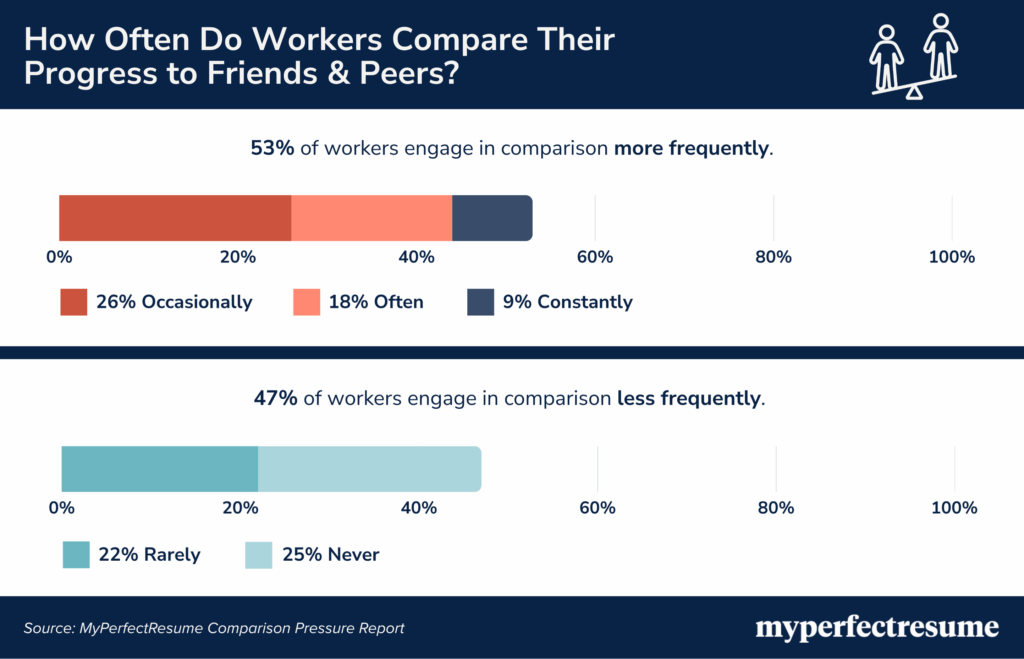
Even occasional comparison can influence how workers interpret their progress, especially in environments where career milestones are highly visible.
Pressure to Reach Milestones Varies
Beyond direct comparison, many workers also feel pressure to keep pace with others’ career achievements.
More than half (53%) report feeling at least some pressure when people around them reach milestones such as promotions, salary increases, or new roles:
- 11% feel a lot of pressure
- 18% feel some pressure
- 24% feel a little pressure
Meanwhile, 47% report little to no pressure:
- 19% say not much pressure
- 28% say no pressure
This split highlights that while comparison pressure is widespread, its intensity varies significantly across individuals.
Views on Social Media Are Mixed
Social media plays an increasingly important role in shaping how workers perceive career success, but many question the realism of those portrayals.
- 60% say social media presents an unrealistic view of career success (34% say it’s somewhat unrealistic, and 26% say it’s very unrealistic)
- 40% say social media presents a realistic view (29% say it’s somewhat realistic, and 11% say it’s very realistic)
At the same time, 35% of workers say they don’t follow career-related content on social media at all.
These findings suggest that while social media can influence perceptions of success, many workers remain skeptical of the standards it presents.
The Growing Impact of Comparison Pressure
Taken together, the data points to a workforce navigating multiple layers of comparison at once. Workers are not only assessing their progress against their own expectations, but also against peers, social norms, and highly visible online benchmarks.
Even when workers are meeting their goals or staying on track, comparison can create the perception of falling behind. As a result, career satisfaction is increasingly shaped not just by individual progress but by how that progress is perceived relative to others.
For press inquiries, please contact Nathan Barber at nathan.barber@bold.com.
Methodology
The findings are based on a nationally representative survey conducted by MyPerfectResume using Pollfish in February 2025. The survey collected responses from 1,000 U.S. adults currently employed full-time.
The sample included 56% women and 44% men. Age distribution included 6% aged 18–24, 14% aged 25–34, 21% aged 35–44, 17% aged 45–54, 19% aged 55–64, and 23% aged 65–99.
Rate this article
Comparison Pressure Report

Jasmine is a certified career coach and recognized expert in job search strategy. She is committed to helping job seekers navigate the job market and succeed in their careers.
More Articles by Jasmine EscaleraShare this page
 Add MyPerfectResume as a preferred source on Google
Add
Our customers have been hired at:*Foot Note