Application Drop Off Rate: 67% Have Abandoned a Job Application Because of Lengthy Hiring Tests


Our customers have been hired at: *Foot Note


Table of Contents
Get started with MyPerfectResume today!
- Build a resume on any device
- Pick an ATS-friendly template
- Tailor with AI copy suggestions
Job seekers may be willing to prove they can do the work, but many draw the line at lengthy, unpaid hiring assignments.
A new MyPerfectResume survey of 1,000 employed U.S. workers found that 67% of respondents have abandoned a job application because of a lengthy test or assignment.
The findings point to a growing boundary in the hiring process: Candidates may accept assessments designed to verify their skills, but many say employers can ask too much before making an offer.
Overall, 4 in 10 respondents have been asked to complete an unpaid test, assignment, or project as part of a job application, while 54% have suspected a company of using a hiring assignment or project-based test to obtain free labor, ideas, or business solutions.
At the same time, 63% believe employers are asking more of candidates than before the rise of AI-generated resumes and applications, adding a new dimension to the debate over how much applicants should reasonably be expected to prove during the hiring process.
Key Findings
- 67% have abandoned a job application because of a lengthy test or assignment.
- 84% say employers should either avoid unpaid assignments entirely or keep them under one hour.
- 54% have suspected a company of using hiring assignments or project-based tests to obtain free labor, ideas, or business solutions.
- 40% have been asked to complete an unpaid interview assignment, test, or project as part of a job application.
- 63% believe employers are asking more from candidates than they did before the rise of AI-generated resumes and applications.
- 80% say all hiring assignments should be paid or payment should be required when significant time is involved.
Lengthy Hiring Assignments Are Driving Applicants Away
For many respondents, lengthy assessments aren’t just an inconvenience; they’re enough to end the application process.
When asked about their experiences with hiring assignments:
- 67% have abandoned a job application because of a lengthy test or assignment.
- 40% have been asked to complete an unpaid test, assignment, or project as part of a job application.
- 18% say they’ve been asked to do so multiple times.
- 24% have not personally been asked but have seen job postings mentioning unpaid assignments.
Candidates also report a range of concerns about hiring assessments:
- 48% say they require too much unpaid time.
- 46% are concerned about sharing personal or proprietary information.
- 41% worry companies are using applicants for free work.
- 37% believe tests may be used to collect ideas or strategies.
- 36% are concerned assignments are unrelated to the actual role.
- 35% cite a lack of feedback after completing the work.
Why it matters: Employers may have legitimate reasons to verify a candidate’s abilities, but these job application abandonment statistics reveal that lengthy or poorly defined assignments can create enough friction to push applicants out of the process altogether.
Candidates Draw a Clear Line on Unpaid Time
Respondents have strong views about how much unpaid work employers should reasonably request during the hiring process.
When asked what amount of unpaid time is reasonable:
- 30% say employers shouldn’t require any unpaid assignments.
- 32% say less than 30 minutes is reasonable.
- 22% say 30 minutes to less than 1 hour is reasonable.
- 11% say 1 hour to less than 2 hours is reasonable.
- 3% say 2 hours to less than 4 hours is reasonable.
- 2% say 4 hours or more is reasonable.
Combined, 84% say employers should either avoid unpaid assignments altogether or keep them under one hour. Only 5% say two hours or more is a reasonable amount of time for an unpaid hiring assignment. Additionally, 59% describe unpaid hiring assignments or competency tests as somewhat or completely unreasonable.
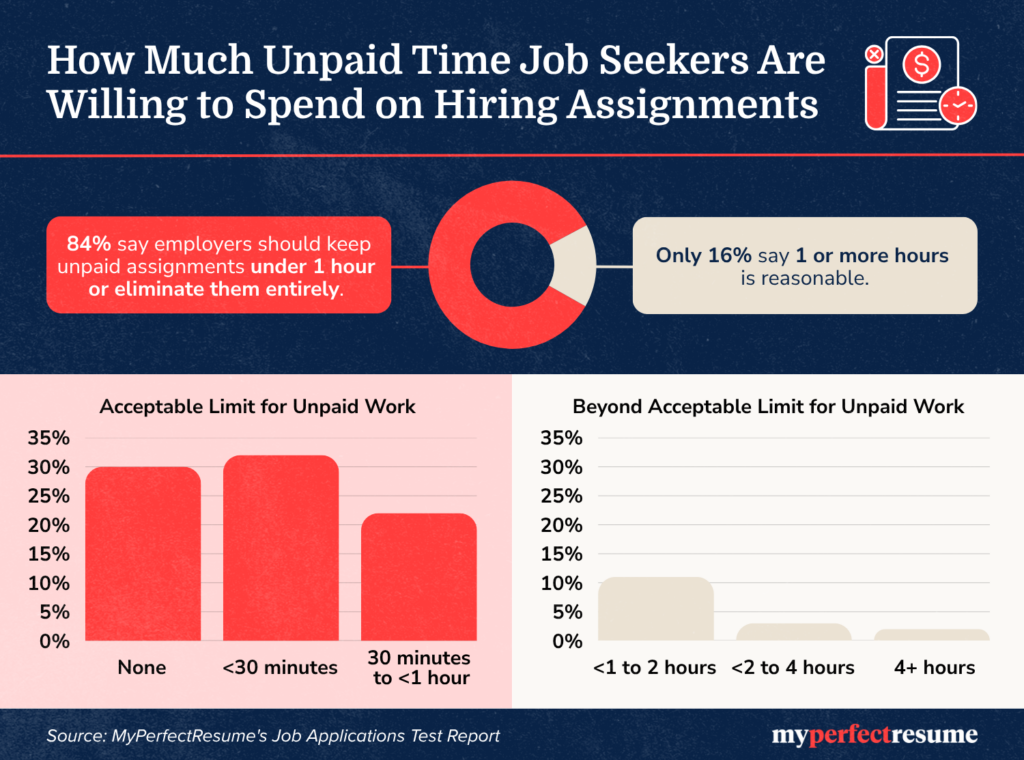
Why it matters: The issue isn’t necessarily whether candidates are willing to complete an assessment. The data suggest the bigger question is how much unpaid time employers can reasonably expect applicants to invest before the process feels excessive.
More Than Half Have Suspected Employers of Seeking Free Work or Ideas
Candidates aren’t only concerned about the time involved in hiring assignments. Many also question how employers will use their work.
More than half of respondents (54%) have suspected a company of using a hiring assignment or project-based test to obtain free labor, ideas, or business solutions. That includes 24% who say they’ve definitely suspected this.
Separately, 41% cite the possibility that companies are using applicants for free work as a concern about hiring assignments.
Why it matters: This concern is especially relevant for take-home assignments and project-based assessments that closely resemble on-the-job work. Employers can reduce uncertainty by explaining what an assignment is intended to measure, how they will evaluate submissions, and whether they will use candidates’ work beyond the hiring process.
80% Say Significant Hiring Assignments Should Be Paid
Respondents also draw a line on compensation.
When asked when candidates should receive payment for hiring assignments:
- 36% say all hiring assignments should be paid.
- 44% say candidates should be paid when an assignment requires significant time.
- 12% say compensation should be limited to highly specialized or professional roles.
- 8% say unpaid assignments are acceptable.
Combined, 80% say either all hiring assignments should be paid, or compensation should be required when significant time is involved.
In total, 92% believe compensation is appropriate in at least some circumstances.
Why it matters: Candidates appear to distinguish between a brief skills check and a substantial work product. As an assignment’s time and complexity increase, respondents are much more likely to believe compensation should be part of the process.
Candidates Say the Hiring Bar Has Risen in the AI Era
The rise of AI-generated resumes, cover letters, and other application materials may also be shaping how candidates view the hiring process.
Nearly two-thirds of respondents believe employers now ask more of candidates than they did before AI-generated resumes and applications became common.
- 20% say employers are asking significantly more.
- 43% say employers are asking somewhat more.
- 33% say expectations are about the same.
- 4% say employers are asking less.
Collectively, 63% believe the demands placed on candidates have increased.
Why it matters: Employers may be turning to assessments, take-home assignments, and other screening methods to confirm that applicants can perform the work described in their resumes. But this added verification is one reason why candidates abandon job applications, particularly when it requires substantial unpaid time.
The Hiring Process Is Becoming a Test for Employers, Too
The findings reveal a tension likely to grow as hiring practices evolve.
Employers have legitimate reasons to assess whether candidates can perform the job, especially as AI makes it easier to create polished resumes and application materials. But candidates also appear increasingly aware of the value of their time and expertise.
The strongest message from respondents isn’t that hiring assessments should disappear—it’s that employers should be thoughtful about how much they ask candidates to do for free.
With 67% reporting that they’ve abandoned an application because of a lengthy assessment, 84% saying unpaid assignments should take less than an hour or not be required at all, and 40% reporting that they’ve been asked to complete unpaid work during an application, the assessment itself can become part of how candidates judge a prospective employer.
For employers, keeping assignments relevant, clearly explaining their purpose, setting realistic time expectations, protecting candidates’ work, and compensating for substantial projects may help make the process feel more balanced.
For job seekers, the hiring process can also offer an early look at how an employer communicates, sets expectations, and values candidates’ time.
For press inquiries, please contact Nathan Barber at nathan.barber@bold.com.
Methodology
This report’s findings are based on a MyPerfectResume survey of 1,000 employed U.S. workers conducted using Pollfish in July 2026.
Respondents answered single-selection and multiple-response questions about hiring assessments, unpaid assignments, application abandonment, compensation, and perceived changes in hiring expectations.
Because the survey included employed workers rather than screening specifically for people who had applied for a job recently, findings about hiring practices reflect respondents’ reported experiences and perceptions rather than the prevalence of those practices across all employers.
Demographic Breakdown
The survey sample included 50% who identified as female and 49% as male. Age distribution was broad:
- 13% aged 18–24
- 20% aged 25–34
- 17% aged 35–44
- 17% aged 45–54
- 15% aged 55–64
- 18% aged 65 or older
Rate this article

Jasmine is a certified career coach and recognized expert in job search strategy. She is committed to helping job seekers navigate the job market and succeed in their careers.
More Articles by Jasmine EscaleraShare this page
 Add MyPerfectResume as a preferred source on Google
Add
Our customers have been hired at:*Foot Note