

Our customers have been hired at: *Foot Note


For generations, the promise of hard work was simple: put in the effort, and the financial rewards will follow. But a new national survey reveals that promise is fading quickly for today’s workers.
According to MyPerfectResume’s latest Cost of Staying Afloat Report, nearly two-thirds of U.S. workers say increased effort at work over the past three years has produced little to no financial benefit. Despite remaining employed and working harder, many workers find themselves stuck, able to cover basic expenses but unable to build savings, get ahead, or achieve the long-term goals they’re working toward.
Key Findings
- Working harder isn’t paying off. 62% say increased effort at work has produced little to no meaningful financial progress.
- Saving is becoming out of reach. 59% are not meaningfully saving money.
- Coping behaviors are widespread. 72% have adopted financial coping behaviors—like side hustles, overtime, or debt—to keep up with rising costs.
- Major life decisions are on hold. 68% have delayed at least one major life decision due to financial pressure.
- Affordability is a near-universal concern. 80% report at least one affordability challenge.
Workers Are Staying Afloat, but Not Getting Ahead
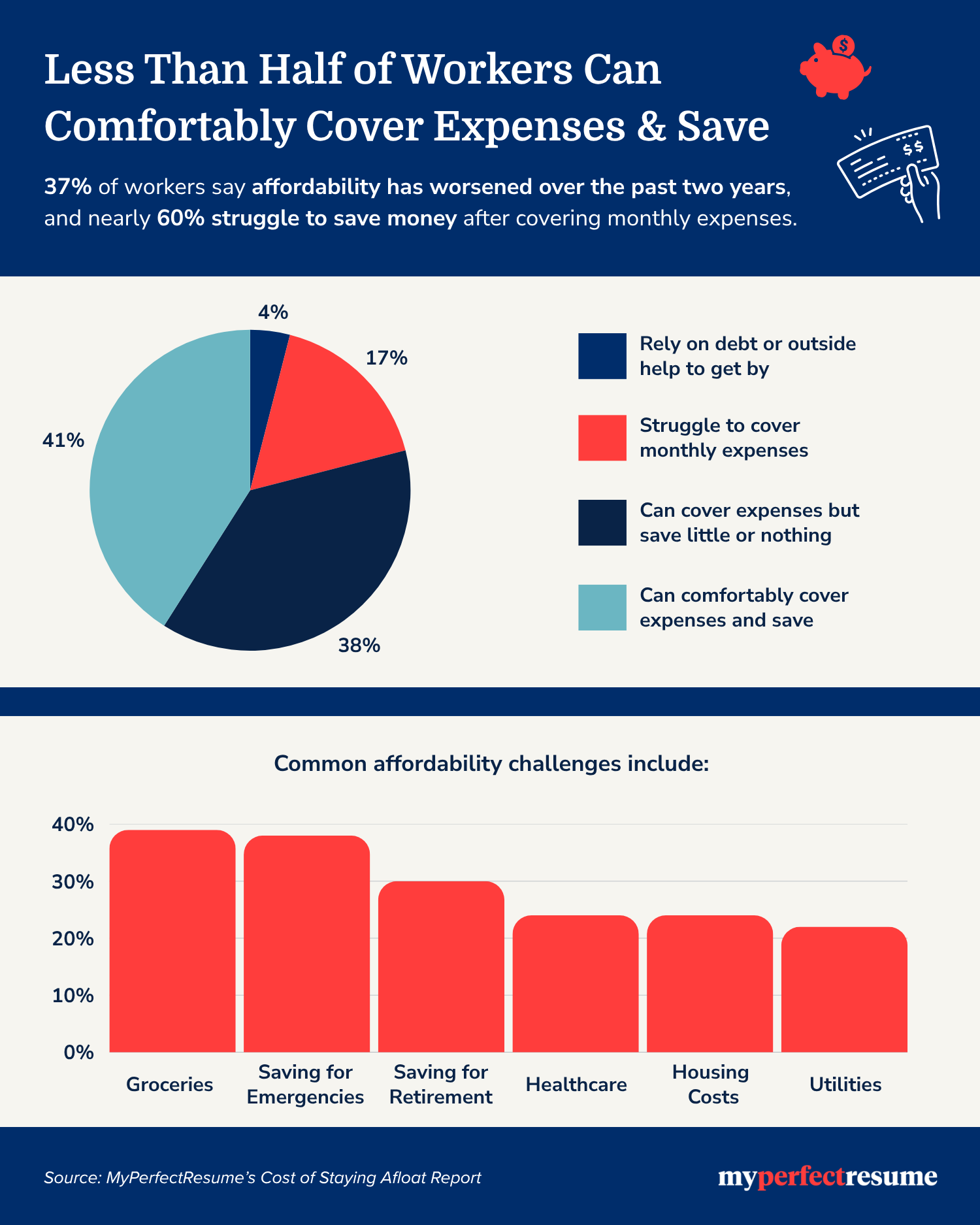
Most workers aren’t experiencing a cost-of-living crisis, but they’re not making progress either. While 73% say their income usually covers their monthly cost of living, nearly 6 in 10 (59%) say they’re not meaningfully saving money.
When asked to describe their current financial situation, workers reported the following:
- 4% rely on debt or outside help to get by.
- 17% struggle to cover monthly expenses.
- 38% can cover expenses, but save little or nothing.
- 41% can comfortably cover expenses and save.
And when compared to two years ago, 37% say affordability has worsened, while only 36% say it has improved.
The most common affordability challenges workers face include groceries (39%), saving for emergencies (38%), saving for retirement (30%), healthcare (24%), rent or mortgage (24%), and utilities (22%).
Hard Work Is No Longer Guaranteed to Pay Off
Perhaps the most striking finding is how workers feel about effort itself. Nearly two-thirds (62%) say working harder has made little to no difference in their financial situation over the past three years.
Specifically:
- 20% say working harder didn’t improve their finances at all.
- 7% say it provided little improvement.
- 35% say it made no real difference.
- 24% say it somewhat improved their finances.
- 14% say it significantly improved their finances.
For many workers, financial stability no longer guarantees financial mobility. People remain employed and cover basic expenses, but many still feel unable to build savings, move ahead financially, or achieve long-term goals. Workers increasingly feel that effort alone is no longer enough to create economic progress.
Workers Increasingly Feel Underpaid
The disconnect between effort and reward is compounded by a growing sense that compensation doesn’t reflect qualifications. Four in 10 workers (40%) are feeling underpaid at work and say their income doesn’t reflect their education, skills, and experience.
- 19% strongly disagree that their pay reflects their qualifications.
- 22% somewhat disagree that their pay is commensurate with their qualifications.
- 37% somewhat agree that their salary is aligned with their experience and skills.
- 23% strongly agree that their compensation matches their experience and skills.
Side Hustles, Overtime, & Debt Are Becoming Survival Tools
To keep up financially, nearly three-quarters of workers (72%) report taking at least one coping action:
- 29% used credit cards for basic expenses.
- 29% took on a second job or side hustle.
- 28% worked overtime or extra hours.
- 21% delayed paying bills.
- 20% borrowed money from others.
- 20% sold possessions to keep up financially.
These aren’t aspirational financial moves. They’re signs that many workers aren’t getting ahead financially, but rather existing in maintenance mode and doing what it takes just to stay even.
Financial Pressure Is Reshaping Life Plans
The strain isn’t only financial; it’s personal. 68% of workers say they’ve delayed at least one major life decision because of financial pressure:
- 32% delayed vacations or time off.
- 29% delayed retirement savings.
- 21% delayed moving or upgrading housing.
- 19% delayed buying a home.
- 17% delayed medical care.
- 13% delayed leaving a job.
- 12% delayed changing careers.
Who Feels the Strain Most?
While financial pressure affects workers broadly, women report experiencing greater strain. Women represented 70% of workers relying on debt or outside help to get by, and 70% of workers who said increased effort did not improve their finances at all. Women were also more likely to report worsening affordability conditions and limited savings security, while men were more likely to report financial comfort and stronger perceived financial progress.
What This Means for Workers
Today’s workforce isn’t giving up. They’re grinding harder than ever. But for a growing share of workers, the traditional equation of effort equaling reward no longer holds. Financial progress has become less about working and more about navigating a system where the goalposts keep moving.
Understanding where you stand and how to position yourself for better opportunities starts with clearly presenting your value. A strong resume that accurately reflects your skills, experience, and accomplishments is one of the few tools workers can control in an uncertain economy.
For press inquiries, please contact Nathan Barber at nathan.barber@bold.com.
Methodology
MyPerfectResume commissioned Pollfish to survey 1,000 U.S. workers in April 2026 about financial well-being, affordability pressures, compensation, savings, and career-related financial stress. The survey explored how rising living costs and economic conditions are affecting workers’ ability to manage everyday expenses, build savings, and make long-term financial progress. The survey sample included 50% female and 49% male respondents. Age distribution included 14% aged 18 to 24, 16% aged 25 to 34, 20% aged 35 to 44, 18% aged 45 to 54, 12% aged 55 to 64, and 20% aged 65 or older.
About MyPerfectResume
MyPerfectResume Resume Builder with professional templates is designed to help job seekers elevate their careers. The easy-to-use platform was created to eliminate the hassle of resume writing, offering professionally written examples, free expert tips, step-by-step guidance to make a resume, and valuable interview advice to create an outstanding job application effortlessly. Since 2012, MyPerfectResume’s Resume Builder has helped more than 11 million job seekers create their perfect resumes online. Its comprehensive employment surveys have been featured in Forbes, Yahoo! Finance, CNBC, USA Today, BBC, and more. Stay connected with MyPerfectResume’s latest LinkedIn, Instagram, and Facebook updates. Follow MyPerfectResume as a preferred source in Google to receive more workforce trends, career insights, and labor market research in your personalized search experience.
Rate this article

Jasmine is a certified career coach and recognized expert in job search strategy. She is committed to helping job seekers navigate the job market and succeed in their careers.
More Articles by Jasmine EscaleraShare this page
 Add MyPerfectResume as a preferred source on Google
Add
Our customers have been hired at:*Foot Note