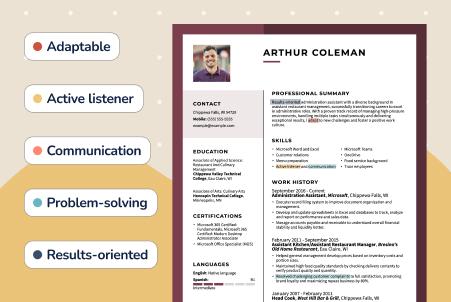
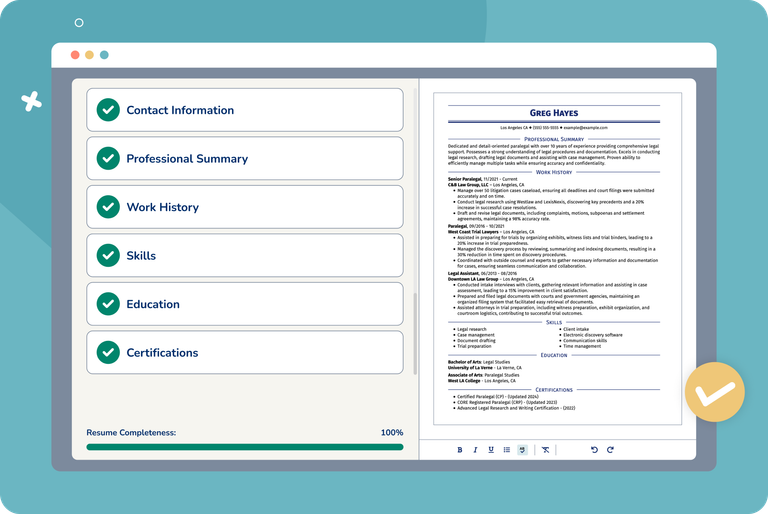
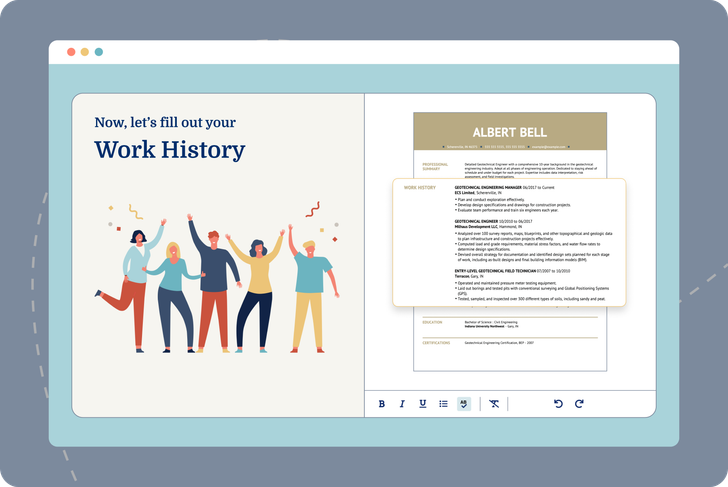
How to Describe Work Experience on a Resume (Samples & Guide)

Our customers have been hired at: *Foot Note


Table of Contents
Get started with MyPerfectResume today!
- Build a resume on any device
- Pick an ATS-friendly template
- Tailor with AI copy suggestions
What to Expect
- A strong work experience section focuses on achievements, relevant skills, and measurable results rather than simply listing job responsibilities.
- Your work history should generally appear in reverse-chronological order, with your most recent or current position first.
- The best resume format depends on your career history, skills, and goals, with chronological resumes generally being the strongest default for most job seekers.
- Complex work histories, including employment gaps and career changes, can be presented strategically to highlight relevant qualifications.
- ATS-friendly work experience uses standard headings, relevant keywords, clear job titles, and simple formatting that makes your qualifications easy to parse.
Your work experience section is where your resume comes to life. It’s not just a list of past jobs—it’s your chance to show how you’ve made an impact and grown in your career.
When written well, a resume work experience section tells a clear story about your strengths and helps hiring managers see why you’re a strong fit for the role.
In this guide, you’ll learn how to describe work experience on a resume to highlight your achievements in a way that grabs attention and supports your overall career story.
How to Highlight Work Experience on a Resume (Step by Step)
Highlight your work experience by focusing on achievements, responsibilities, and skills that are most relevant to the job you want. Start with your most recent role, use strong action verbs, and quantify results when possible. This helps employers quickly understand your qualifications and the value you could bring to their organization.
Follow these steps to create an impactful work history resume section:
STEP 1
Prepare Your Information
Start by gathering your employers, job titles, employment dates, responsibilities, skills, and accomplishments for each relevant role. Having these details ready makes it easier to build an accurate, achievement-focused work experience section.
Here’s what to collect before you begin writing your resume:
- List your employers, job titles, employment dates, and key responsibilities for each relevant role.
- Gather your most relevant experience, typically from the last 10 to 15 years. If you have limited formal work experience, include internships, volunteer work, community service, academic projects, or relevant personal projects.
- Identify your key skills and accomplishments for each role, focusing on those that relate to the job you want.
- Write down specific examples of problems you solved and results you achieved. Include numbers, percentages, time saved, revenue generated, or other measurable outcomes when possible.
- Note the accomplishments you’re most proud of and consider what they demonstrate about your skills, strengths, and value as an employee.
STEP 2
List Your Experience in Reverse-Chronological Order
List your work experience starting with your current or most recent job and work backward. Reverse-chronological order makes your most relevant and recent experience easy for employers to find, helping them quickly understand your career progression and current qualifications.
STEP 3
Add Essential Information About Each Job
For each position, include your job title, company name and location, and dates of employment. These details help employers quickly understand where and when you gained your experience.
Here’s an overview of the key information to note:
- Job title: Use the official title you held. If it was uncommon or unclear, you can add a brief clarifying title in parentheses.
- Company name and location: List the employer’s name, followed by the city and state.
- Dates of employment: Include the month and year you started and ended each position (e.g., June 2022–Present).
STEP 4
Showcase Key Achievements for Each Job
Highlight three to five achievements for each job rather than simply listing your responsibilities. Start each bullet with an action verb and focus on what you did, how you did it, and the result. Quantify your impact with numbers, percentages, dollar amounts, or other measurable outcomes when they strengthen the example.
→ Designed marketing assets for a client’s social media platforms.
→ Designed and launched more than 50 marketing assets for clients, increasing social media engagement by 30%.
→ Collaborated with the marketing team on a rebranding campaign that increased brand recognition by 25% and customer retention by 15%.
→ Implemented new design software and streamlined the production process, cutting production time by 20%.
Choosing the Right Resume Format to Highlight Your Work Experience
The best resume format for highlighting work experience depends on your career history, skills, and goals. Chronological resumes emphasize a consistent career progression, combination resumes balance skills with experience, and functional resumes focus on skills rather than employment history. Choose the format that makes your strongest qualifications easiest for employers to find.
Work Experience on a Chronological Resume
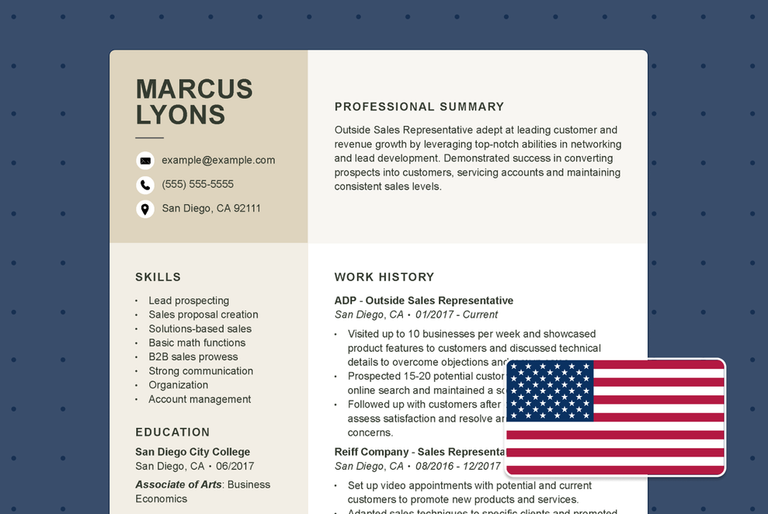
A chronological resume is a strong choice when you have several years of relevant experience and a consistent employment history. It places your work history prominently below your resume summary, making your most recent roles, career progression, and increasing responsibilities easy for employers to see.
Here’s a resume work experience example on a chronological resume:

Work Experience on a Functional Resume
A functional resume puts skills ahead of employment history. It can make sense in limited circumstances, such as when you’re emphasizing transferable skills or have significant gaps, but a chronological or combination format is generally a stronger choice for most job seekers.
For this format, the work history section is typically brief and appears below the skills-focused sections. Keep it accurate and include your employers, job titles, and dates of employment, even when your skills are the primary focus.
Here’s an example of work experience on a functional resume:

Work Experience on a Combination Resume
A combination resume (also known as a hybrid resume) balances skills and work experience, making it useful for candidates who want to showcase relevant abilities while maintaining a clear career history. It typically begins with a summary of qualifications or skills section, followed by a reverse-chronological work history.
This format can work particularly well for career changers, experienced professionals with transferable skills, or candidates whose qualifications extend beyond their job titles.
Here’s an example of work experience on a combination resume:

Whether you’re a seasoned professional or a recent graduate, our resume templates can help you showcase your work experience in a clear, organized format that highlights your most relevant skills, achievements, and career progression.
Work History Examples by Career Level
The best way to present work history depends on your career level and the experience you have to highlight. Entry-level candidates should emphasize relevant skills, internships, and projects, while experienced professionals should focus on accomplishments, career progression, and measurable results. Use the examples below to see what to prioritize at each stage of your career.
Entry-Level
If you’re entry-level, focus your work history on relevant skills, achievements, and experiences that demonstrate your potential, even if you haven’t held many full-time jobs. Include internships, part-time jobs, volunteer work, academic projects, and other relevant experience.
Here’s an example:
Food Server
Burger Shack Unlimited | Newark, NJ
May 2026–Present
- Greet up to 40 customers per hour and take accurate orders at the register.
- Prepare food items for a 36-dish menu using restaurant-supplied recipes, accurately measuring and mixing ingredients.
- Use a POS system to calculate customer order totals and process 50+ cash and credit card transactions per day.
- Serve hundreds of customers daily while addressing questions and resolving concerns to support a positive dining experience.
- Follow all proper on-the-job safe food-handling procedures and cleaning regulations when working with raw ingredients and serving.
Mid-Career
If you’re mid-career, use your work history to demonstrate career progression, relevant expertise, and measurable accomplishments. Prioritize recent roles and achievements that align with your target position, while giving less space to older or less relevant experience. Show how your responsibilities have grown and quantify your impact whenever possible.
Here’s an example:
Content Writer
The Art of Digital Content | Anaheim, CA
March 2025–Present
- Create high-impact messaging for all marketing media, contributing to a 35% increase in revenue and market share.
- Provide editorial guidance to four other cross-functional departments, including the marketing team, ensuring delivery of top-quality content.
- Authored online display ads that drove click-conversion rates of 2.35% in two months.
Copy Editor
The Art of Digital Content | Anaheim, CA
August 2021–February 2025
- Edited 100+ pieces of content produced by senior executives, modifying the text to conform to company-wide branding standards and publication guidelines.
- Wrote advertising copy for online content, adhering to employers’ overarching brand identity and personality, and increasing click-through rates by 25%.
- Incorporated between 11.5k and 30.3k SEO keywords into copy to increase search result rankings, producing high conversion rates.
Experienced
If you’re an experienced professional, focus your work history on leadership, specialized expertise, and high-impact achievements that demonstrate your value. Prioritize your most recent and relevant roles, emphasizing measurable results and increasing responsibility.
You don’t need to detail every responsibility from your career; instead, give the most space to accomplishments that support your current career goals.
Here’s an example:
Senior UI/UX Designer
TechSphere Innovations | San Francisco, CA
January 2026–Present
- Lead the design and implementation of 15+ mobile and web applications, resulting in a 25% increase in user engagement and a 30% reduction in bounce rates.
- Spearhead a comprehensive redesign of the company’s flagship product, increasing user retention by 20% within the first six months post-launch.
- Establish a design system that improved cross-functional collaboration and reduced design cycle time by 40%.
UI/UX Lead
PixelCraft Studio | Seattle, WA
May 2024–December 2025
- Directed a team of five designers to create intuitive interfaces for 10+ client projects, achieving a 98% satisfaction rate in client feedback surveys.
- Designed an ecommerce platform that increased conversion rates by 35% and earned an award for innovation in digital retail.
- Developed A/B testing strategies that optimized product design, resulting in a 22% improvement in task completion rates.
UI/UX Designer
Bright Ideas Agency | New York, NY
June 2021–April 2024
- Designed and prototyped user interfaces for 20+ websites, contributing to a 15% average increase in client revenue post-launch.
- Conducted user research and usability testing for multiple projects, reducing average user pain points by 25%.
- Implemented responsive design practices that boosted mobile traffic by 40% across all projects.
Impress Recruiters With Your Work History
How to Handle Complex Work Experience Scenarios
The key with complex work histories is to present your experience honestly while emphasizing the skills and achievements most relevant to your target job. Whether you have no formal experience, employment gaps, multiple roles at one company, a career change, or freelance work, use the approach that best explains your background and qualifications.
No Work Experience
If you have no formal work experience, focus your resume on relevant skills and experiences that demonstrate your potential. Include internships, volunteer work, academic or personal projects, extracurricular activities, and other experiences that relate to the job.
For each experience, emphasize what you did, the skills you developed, and any results you achieved. For example, a school fundraising project can demonstrate organization, teamwork, communication, and project management skills.
Here’s how to structure a resume when you have no work experience:

Employment Gaps
If you have employment gaps, emphasize your relevant skills and accomplishments alongside your work history rather than making your timeline the sole focus. A combination resume can help you do this while keeping your employment history clear and accurate.
You can also briefly explain longer gaps when they’re relevant to your career goals, helping employers understand how you used that time.
For gaps lasting longer than a year, consider including relevant activities such as caring for family, volunteering, earning a certification, or completing short-term projects or freelance work.
Here’s an example of a resume with employment gaps:

Career Change
If you’re changing careers, use your work history to emphasize transferable skills and achievements that apply to your new field.
A combination resume can be particularly effective because it highlights relevant skills near the top while preserving your employment history. Focus on accomplishments that demonstrate how your existing experience can help you succeed in your target career.
The following is a good example of a resume for a career change:

Freelance, Contract, or Gig Work
Present freelance, contract, and gig work like professional experience by highlighting your role, dates, relevant skills, responsibilities, and measurable results. Group similar projects under a single heading when appropriate, and prioritize the clients or projects most relevant to your target job.
When listing freelance or contract work, include your role, dates, and the type of work you performed. For project-based work, highlight notable clients or projects, relevant accomplishments, and measurable outcomes while protecting confidential client information.
Here’s an example of a resume with contract work:

Real-World Resume Work Experience Examples by Job Title
The strongest work experience examples show how you contributed, what skills you used, and what results you achieved in a specific role. Reviewing resume examples by job title can help you tailor your experience to the position you want.
History Teacher

Property Manager

Radio Host

Resident Assistant

Sales Associate

Zumba Instructor

How to Optimize Your Work Experience for ATS
To optimize your work experience for an applicant tracking system (ATS), use standard headings, relevant keywords, clear job titles, and simple formatting. Tailor your experience to the job description and describe your accomplishments using language that accurately reflects your qualifications.
Here are a few tips to help ATS software parse your resume:
- Use standard section headings. Choose familiar headings, such as “Work Experience,” “Professional Experience,” or “Employment History,” so ATS software can easily identify your employment history.
- Keep job titles clear and recognizable. Use your official job title, or add a commonly understood equivalent in parentheses if your internal title may be unclear to employers.
- Highlight relevant skills in your bullet points. Rather than simply listing skills, show how you used them to complete projects, solve problems, or achieve results.
- Use keywords from the job description. Incorporate relevant skills, qualifications, tools, certifications, and industry terms naturally throughout your work experience.
- Use simple formatting. Avoid putting important work experience information in tables, text boxes, graphics, headers, or footers, which some ATS platforms may not parse consistently.
- Tailor your experience to each job. Prioritize the responsibilities, skills, and accomplishments that most closely match the position rather than using identical work experience for every application.
Key Takeaways
- Turn responsibilities into achievements by showing what you did, how you did it, and the results you produced.
- Quantify your accomplishments with numbers, percentages, dollar amounts, or other measurable results whenever possible.
- Tailor your work history to each job by prioritizing experience, skills, and achievements that align with the job description.
- Choose a resume format that supports your career story, using chronological or combination formats in most cases and considering a functional format only when it fits your specific circumstances.
- Keep your work experience easy to scan with clear job information, concise bullet points, strong action verbs, and ATS-friendly formatting.
Frequently Asked Questions
How do you describe work experience on a resume?
Describe work experience on a resume by focusing on your most relevant responsibilities, skills, and measurable achievements. Start each bullet with a strong action verb, explain what you accomplished, and quantify the results whenever possible. Include your job title, employer, location, and dates of employment, then tailor your bullet points to the role you’re applying for.
What are examples of work experience?
Examples of work experience include full-time and part-time jobs, internships, freelance or contract work, volunteer positions, apprenticeships, and other relevant professional experiences.
For candidates with limited formal employment, academic projects, extracurricular activities, and personal projects can also demonstrate valuable skills. Choose experiences that show relevant abilities, accomplishments, and results related to the job you want.
How many years of work experience should be on a resume?
You should generally focus on the most relevant work experience on your resume, often covering roughly the last 10 to 15 years. Include older positions when they demonstrate skills, accomplishments, or experience that strengthen your application.
How can I make my work experience stand out?
You can make your work experience stand out by focusing on measurable achievements rather than listing routine responsibilities. Use strong action verbs, quantify your results with numbers or percentages, and tailor your bullet points to the job description.
Prioritize accomplishments that demonstrate relevant skills, problem-solving ability, and the value you brought to previous employers.
How We Reviewed This Article
Since 2012, we have helped more than 11 million job seekers. We want to make your career journey accessible and manageable through our services and Career Center’s how-to guides and tips. In our commitment to bring you a transparent process, we present our Editorial Process.
Rate this article
Resume Work Experience


Natalia is a Certified Professional Resume Writer (CPRW) and member of the Professional Association of Resume Writers & Career Coaches. Her work focused on helping job seekers navigate the job market and succeed in their careers.
More Articles by Natalia Merced, CPRWShare this page
 Add MyPerfectResume as a preferred source on Google
Add
Our customers have been hired at:*Foot Note