How to Make a Resume for Your First Job (Step by Step Guide)

Our customers have been hired at: *Foot Note


Table of Contents
Get started with MyPerfectResume today!
- Build a resume on any device
- Pick an ATS-friendly template
- Tailor with AI copy suggestions
Applying for your first job can feel overwhelming, especially if you’ve never written a resume before. The good news is that employers don’t expect first-time job seekers to have years of experience. They want to see your skills, education, volunteer work, extracurricular activities, and potential. Even if you’ve never had a traditional job, you probably have more relevant experience than you realize.
In this guide, you’ll learn how to make a resume for your first job step by step. We’ll show you how to create a resume that can be parsed by applicant tracking systems (ATS), highlight your strengths, and use examples to help you stand out, even if you’ve never had a paid job.
What Should You Put on a Resume for Your First Job?
A first job resume should include your contact information, a targeted objective or summary, relevant skills, education, and any experience that demonstrates your qualifications, such as volunteer work, internships, school projects, extracurricular activities, or informal work. Then, tailor those qualifications to the job description and use a simple, ATS-friendly format.
Step 1: Prepare Your Information
Before writing your resume, gather the job description, education details, skills, activities, volunteer work, projects, awards, certifications, and other experiences you can use to demonstrate your qualifications.
Then, think carefully and honestly about what you offer. You could discover that you picked up valuable skills and relevant experience through activities such as:
- School activities, such as participating in sports or band/orchestra
- Clubs or organizations, such as student council or a college sorority/fraternity
- Community activities, such as volunteering at a soup kitchen or another nonprofit
- Hobbies and personal projects, such as writing, photography, coding, or leading a neighborhood group
- Informal work, such as babysitting, pet sitting, tutoring, or helping with a family business
As you reflect on your experiences, note awards, honors, and other significant accomplishments, like graduating magna cum laude, becoming student body president, or earning academic recognition.
Consider the skills you gained through those experiences, especially transferable skills such as research, organization, teamwork, problem-solving, and time management, along with interpersonal skills like communication and active listening.
Step 2: Choose the Right Format
Choosing the right resume format can help employers quickly see your most relevant qualifications, even if you don’t have any traditional work experience.
A functional resume can work in limited situations because it emphasizes skills instead of work history, but it isn’t the best choice for every first-time job seeker. Functional formats can be harder for some ATS platforms to parse, and recruiters may prefer to see your experience timeline quickly.
A combination (hybrid) resume is often a better option because it highlights relevant skills while still providing a clear experience section. This format is generally more compatible with ATS, which many employers use to organize and screen resumes before a recruiter reviews them.
If you’ve already gained experience through internships, summer jobs, or part-time work, a chronological resume may also be a good fit because it emphasizes your work history and career progression.
Step 3: Select a Professional Resume Template
Choose a simple template with standard section headings and a clean, easy-to-scan layout. Avoid complex graphics, tables, and text boxes that may make your resume harder for ATS software to parse.
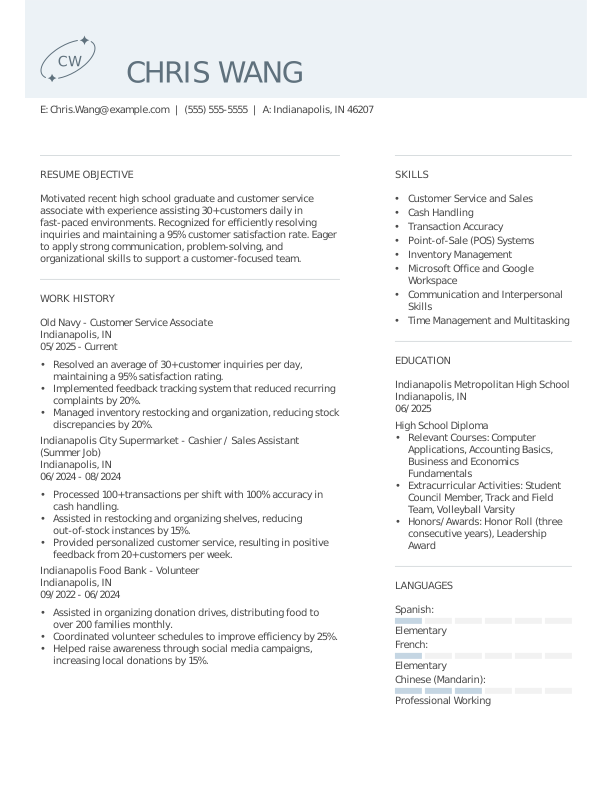
Here’s an example:
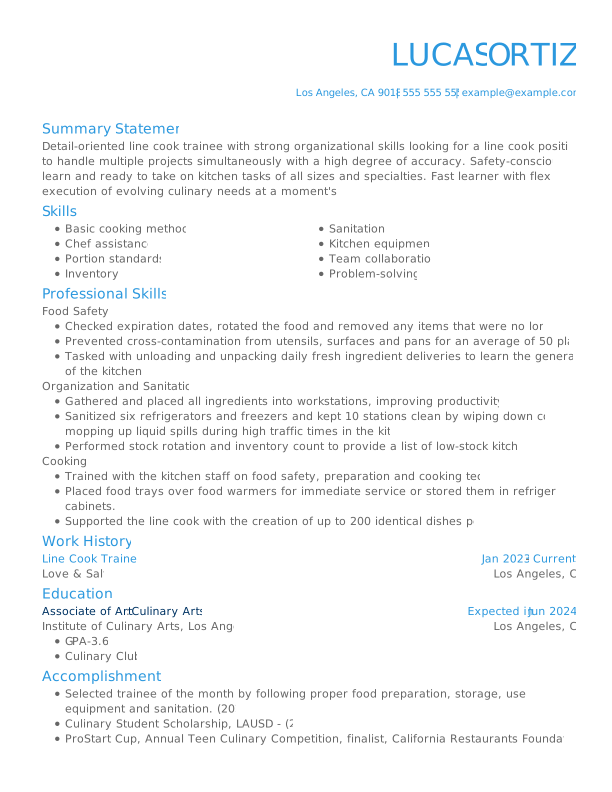
Resume templates can make it easier to organize your information and create a polished, professional first resume. They provide a clear structure for your qualifications while helping you maintain consistent formatting.
Step 4: Add Your Contact Information
When you make a resume with no experience, include a header with contact information so recruiters and potential employers can reach you. You can also add a resume headline under your name that describes your professional focus or target role.
Your contact information must be professional, up to date, and easy to find. Include the following information:
- Full name
- Phone number
- Professional email address
- City and state
- Professional profile, website, or portfolio
For example:
ALEX RIVERA
(555) 123-4567 | alex.rivera@email.com | Philadelphia, PA
linkedin.com/in/alexrivera
Step 5: Highlight Strengths in Your Objective or Summary
Use a resume objective or summary to quickly explain what you’re seeking and what relevant qualifications you bring to the role. A resume objective focuses on your career goals and the skills you can offer an employer, while a resume summary emphasizes your most relevant qualifications, experience, and accomplishments.
Here are examples of each:
Example resume objective:
Recent high school graduate seeking a customer service position where I can use strong communication, teamwork, and problem-solving skills to provide excellent customer experiences.
Notice how this resume objective for a candidate with no experience focuses on the type of role the applicant is seeking and the skills they can bring to it. It highlights transferable skills while explaining the applicant’s goal of providing excellent customer experiences.
Example resume summary:
Motivated high school graduate with experience leading student organizations and volunteering at community events. Strong communication, organization, and teamwork skills with a proven ability to collaborate with diverse groups and meet deadlines.
This resume summary takes a different approach by emphasizing the candidate’s relevant qualifications and experience rather than primarily focusing on their career goal. Choose the option that best showcases your background and aligns with the job you’re applying for.
Explore our library of student resume examples to see sample objective statements and summaries for students with no experience.
Step 6: Showcase Transferable Skills
Focus on five to 10 relevant skills in your resume skills section. Match your skills to the job requirements and naturally incorporate relevant keywords from the job description when they accurately reflect your qualifications.
For example, a first-time job seeker applying for a customer service position might include:
SKILLS
- Communication
- Customer service
- Teamwork
- Problem-solving
- Time management
- Organization
- Active listening
- Microsoft Office
Step 7: Emphasize Your Education
Display your educational background prominently to emphasize your readiness for the job. Highlight relevant coursework, academic awards and honors, scholarships, or participation in study abroad programs in this section.
Your education section should look like this:
EDUCATION
Bachelor of Science in Media Writing, Dickinson College, Carlisle, PA – 2026
- Graduated magna cum laude
- 3.95 GPA
- University Honors
Step 8: Add Certifications or Licenses
If you’re working toward or have specialized certifications and licenses for a job like nursing, accounting, or teaching, you can create a separate section on your resume labeled “Licenses and Certifications” and place it just below your education section.
Create a bullet point for every license or certification you have and list them in reverse-chronological order, including:
- The title of the certification, course, or license
- The name of the certifying agency or body
- The date you obtained each certification
- The expiration date of your credential, if applicable
- An “In progress” label and the expected date of completion, if you haven’t yet finished the course
Here’s an example of how to list certifications on a resume:
CERTIFICATIONS
- CPR & First Aid Certification, American Red Cross (June 2026)
- Google Analytics Certification, Google (May 2026; expires May 2028)
- Microsoft Office Specialist: Excel, Microsoft (March 2026)
Step 9: Include Relevant Experience
One of the biggest challenges when writing your first resume is filling out the work experience section. The good news is that relevant experience doesn’t have to come from a traditional job.
Relevant experience can come from:
- Internships
- Student teaching
- Coaching or mentoring
- A role in a student organization
- Community service
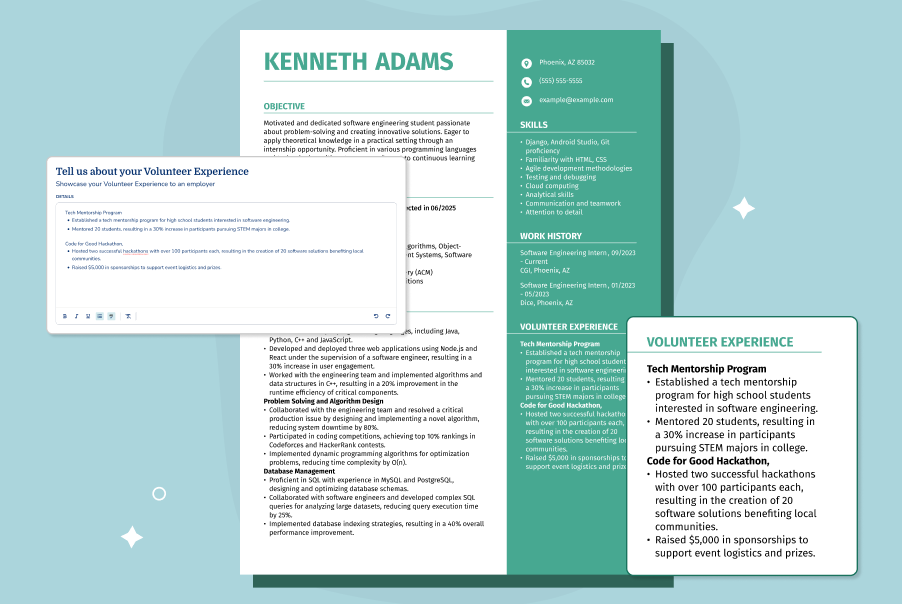
- Volunteer experience
- Freelance work
- Neighborhood jobs
- Personal projects
Hiring managers want to know your contributions. For each experience you add to your first resume, add one to three bullet points that highlight measurable accomplishments.
Use this simple formula to write stronger resume bullet points:
[Action verb] + [Duty/task] + [Measurable impact]
For example:
- Organized a school fundraiser that raised $1,500 for local charities.
- Assisted teachers with classroom activities for 25 students.
- Managed social media for the student council, increasing event attendance by 30%.
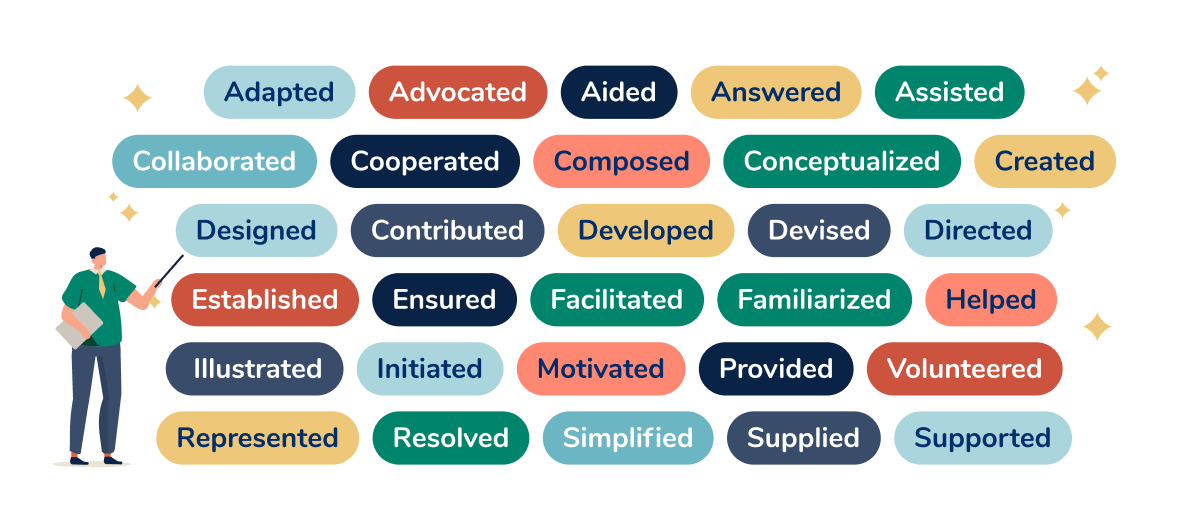
Here are some action verbs you can include in your resume:
- Advocated
- Aided
- Answered
- Assisted
- Collaborated
- Composed
- Conceptualized
- Cooperated
- Contributed
- Created
- Designed
- Developed
- Devised
- Directed
- Ensured
- Established
- Facilitated
- Familiarized
- Helped
- Illustrated
- Initiated
- Motivated
- Provided
- Represented
- Resolved
- Simplified
- Supplied
- Supported
Step 10: Add Optional Sections to Stand Out
If you have room on a one-page resume, consider adding optional sections that highlight relevant accomplishments, interests, or qualifications.
Here’s a suggestion for an optional awards section:
AWARDS & HONORS
- Academic Excellence Award, Dickinson College (2025)
- Dean’s List (Spring 2025, Fall 2024)
- Student Leadership Award (2024)
Browse our collection of high school resume templates for additional examples of first-time resumes with no experience samples and tips to guide your writing process.
Step 11: Proofread Your First Resume
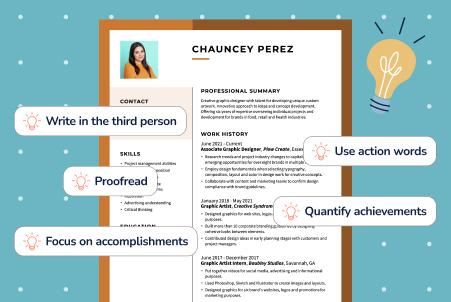
Typos and grammatical errors can make a poor impression on potential employers. After you finish writing your resume, proofread it more than once and ask someone else to check it for you before sending it to a potential employer.
Once you’ve proofread your resume, you’re ready to save it in the appropriate file format and submit your application.
Step 12: Save & Download Your Resume
Before submitting your resume, check the job description for the preferred file type. Follow the employer’s instructions whenever a specific format is requested. If the employer doesn’t specify a file type, PDF or DOCX are commonly accepted options.
Use this formula to name your resume: Your Name-Job Title-Resume-Company Name-Date. For example, Alex-Rivera-Customer-Service-Representative-Resume-ABC-Company-August-2026.
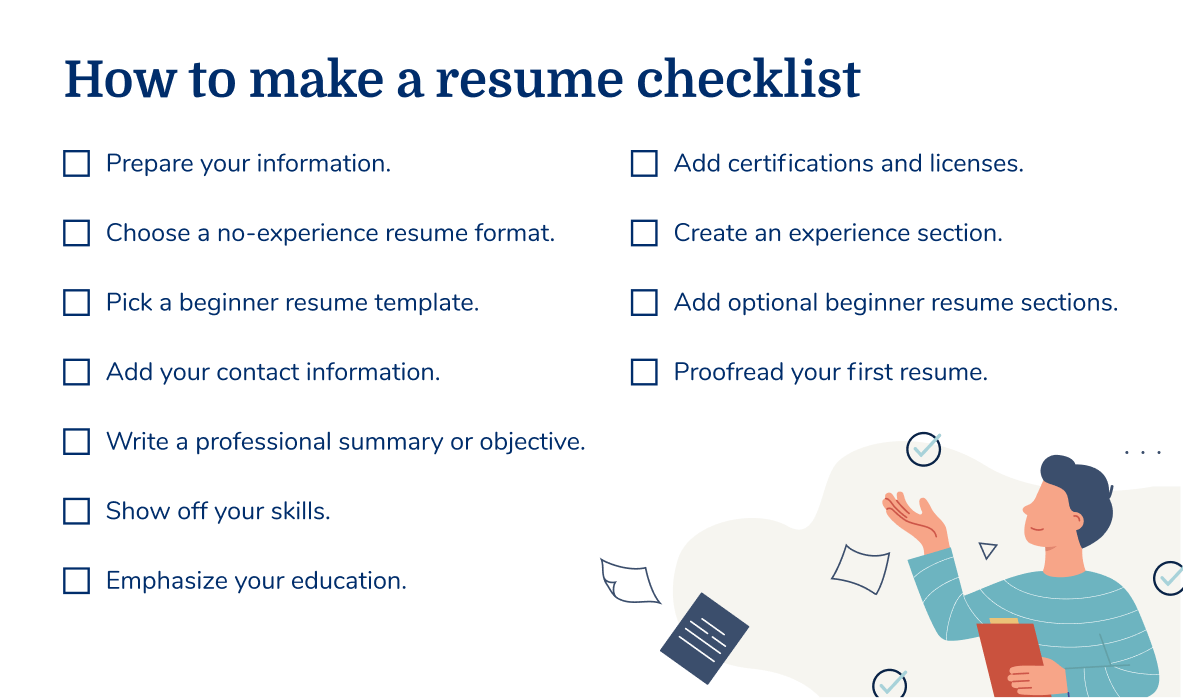
First Job Resume Checklist
Before submitting your resume, make sure you’ve completed these final checks:
- Gather your education, skills, activities, and relevant experience.
- Choose a resume format.
- Select a simple, ATS-friendly template.
- Add your contact information.
- Write a targeted objective or summary.
- Highlight relevant skills.
- Add your education.
- Include certifications or licenses.
- Add relevant experience, projects, and volunteer work.
- Add optional sections, such as awards or languages.
- Proofread your resume.
- Save it in the employer’s requested format.
Step into your next role with confidence
First Job Resume Template: Copy, Paste, & Customize
Writing your first resume doesn’t have to be overwhelming. Use the template below as a starting point, then personalize it with your education, skills, volunteer work, extracurricular activities, and other experiences that show employers what you can contribute.
[Your Name]
[Phone Number] | [Professional Email] | [City, State]
Resume Objective or Summary
[Write 2–3 sentences explaining who you are, the type of job you’re seeking, and the skills or qualities you can bring to the role.]
Skills
- [Skill]
- [Skill]
- [Skill]
- [Skill]
- [Skill]
Education
[School Name]
Expected Graduation: [Month Year]
Optional:
- GPA: [X.XX]
- Relevant coursework: [Course]
- Academic honors: [Award]
Relevant Experience
[Volunteer role, internship, club, or project]
[Organization Name]
[Month Year–Month Year]
- [Action verb] + [Task] + [Result]
- [Action verb] + [Task] + [Result]
- [Action verb] + [Task] + [Result]
Activities
- [School club]
- [Sport]
- [Leadership role]
Certifications
- [Certification]
- [Certification]
Awards
- [Award]
First Job Resume Examples With No Experience
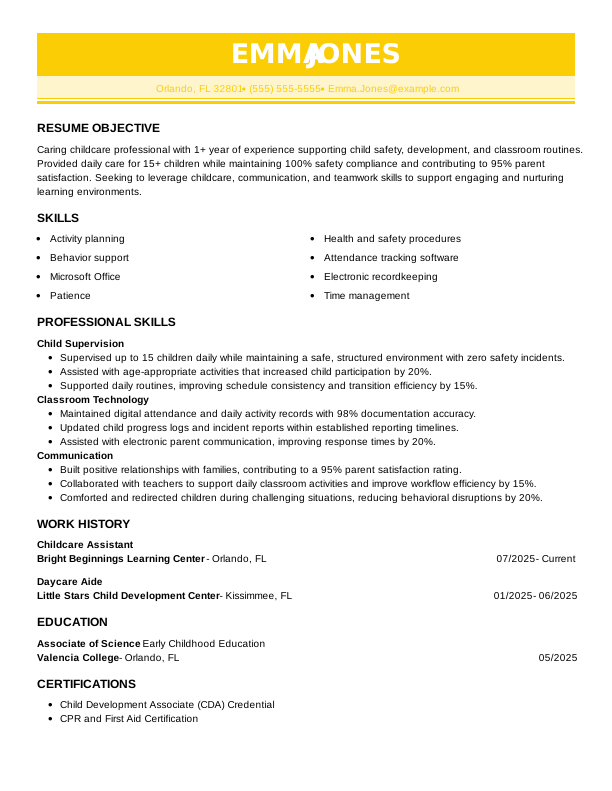
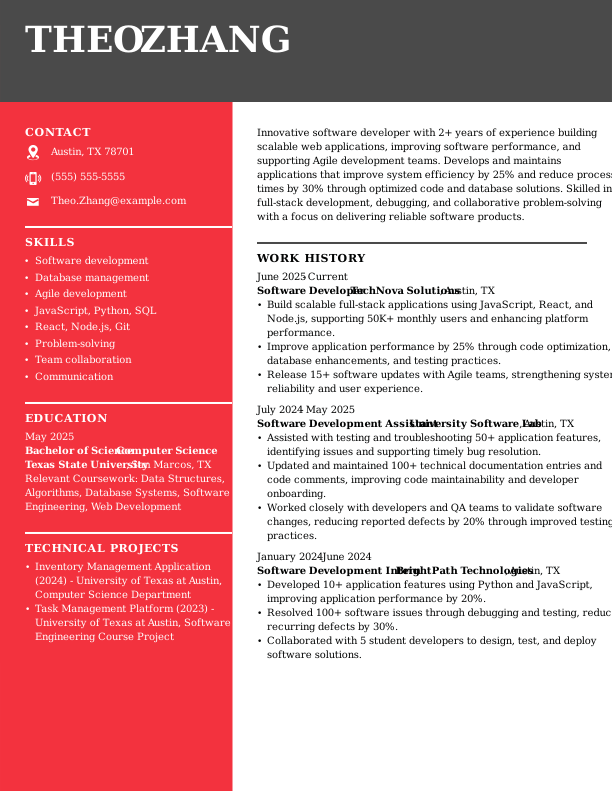
These first-time resume with no experience samples show how to present your education, skills, and relevant experience when you don’t have much traditional work experience. Use these resume examples for inspiration, but tailor your resume to the specific job you’re applying for.
Accounting

Marketing

Nursing

Retail

Security

Software Development
Formatting Tips for a Resume With No Experience
To start, here are some basic formatting tips to ensure your resume looks polished and professional, as well as easily readable:
- Set margins to 1 inch on all sides of your document.
- Choose an appropriate resume font type and size, and stick to it throughout your resume. Good font choices include Arial, Calibri, Helvetica, and Times New Roman. Use a readable font size (around 12 points) and keep it consistent throughout the body of your resume.
- Ensure proper spacing between sections of your document. The best practice is to use a single space, but adding extra space between section headers and section body text can sometimes look better, depending on font type and how much content you add to your resume.
- Left-align your page content.
- Use bullet points to emphasize your skills and achievements.
Create a Cover Letter for Your First Job
Landing a job interview takes more than a perfect first job resume. If you want to beat the competition, you need a strong cover letter to complement your resume.
Writing a strong cover letter shows motivation and allows you to tell employers more about your background than a resume can, a bonus for first-job applicants.
Use a cover letter as a chance to introduce yourself and connect with prospective employers by telling them why you want the job and why you’re the best match for it.
We can show you how to write a cover letter inspired by our professional cover letter examples. When you’re ready, choose a template and use our Cover Letter Generator to effortlessly make a professional cover letter with no experience.
Key Takeaways
Now you know how to make a resume for your first job. Before you start applying, keep these key takeaways in mind:
- Choose the resume format that best fits your background. A combination resume can be a strong choice for emphasizing skills while still showcasing volunteer work, internships, or other relevant experience. A functional resume may work in limited situations where a skills-focused format makes sense.
- When creating a resume with no job experience, highlight transferable skills that align with the job you’re applying for.
- Many employers use ATS to organize and screen resumes. Using standard section headings and simple formatting can make your resume easier for ATS to parse accurately.
- Add optional resume sections like awards or important coursework if they apply to you, and you can’t fit them into other sections of your resume.
- A resume template, combined with our Resume Builder, can simplify the process of creating and formatting a resume without work experience.
Frequently Asked Questions
How do I write a resume for my first job with no experience?
To write a resume for your first job with no experience, focus on your skills, education, and relevant experience, even if it wasn’t paid. Volunteer work, school projects, extracurricular activities, leadership roles, and internships can demonstrate valuable abilities. Choose a format that fits your background, highlight transferable skills, and tailor your resume to the job description by including relevant keywords that accurately reflect your qualifications.
What should you put on a resume for your first job?
A first job resume should include your contact information, objective or summary, relevant skills, education, and experience that demonstrates your qualifications. This can include volunteer work, projects, extracurricular activities, internships, certifications, and awards. Even without paid work experience, these sections can help employers understand your strengths, skills, and potential.
What skills should I put on my resume for my first job?
For a first job resume, include transferable and interpersonal skills that are relevant to the position you’re applying for. Common skills include communication, teamwork, time management, organization, problem-solving, adaptability, attention to detail, customer service, and technology skills. Whenever possible, match your skills to those listed in the job description so employers can quickly see how your qualifications align with the role.
How long should a first job resume be?
A first job resume should usually be one page. Since most first-time job seekers have limited work experience, a single page provides enough space to showcase your education, skills, volunteer work, projects, and other relevant accomplishments without overwhelming employers.
Should I use a resume template for my first resume?
Yes, you can use a resume template for your first resume, especially if you’re unsure how to organize your information. A simple template can help you use standard sections and formatting that ATS software can more easily parse. Choose a template that’s easy to read and customize, and tailor your resume to each job before submitting it.
How can a 16-year-old make a resume with no experience?
A 16-year-old can make a resume with no experience by focusing on education, volunteer work, extracurricular activities, sports, clubs, babysitting, tutoring, and other responsibilities that demonstrate relevant skills. Skills such as communication, teamwork, reliability, and time management can help show what you can contribute. A resume objective can also explain your goals and enthusiasm for the position.
Should I include references on a first job resume?
No, you generally shouldn’t include references on a first job resume. Instead, keep a separate reference list available in case an employer requests it. Use the space on your resume to highlight your skills, education, experience, and other qualifications that are directly relevant to the position.
Rate this article
How to Write a Resume With No Experience

Marla is a professional resume writer. She is committed to helping job seekers navigate the job market and succeed in their careers.
More Articles by Marla FigueroaShare this page
 Add MyPerfectResume as a preferred source on Google
Add
Our customers have been hired at:*Foot Note