How to List Volunteer Experience on a Resume


Our customers have been hired at: *Foot Note


Table of Contents
Get started with MyPerfectResume today!
- Build a resume on any device
- Pick an ATS-friendly template
- Tailor with AI copy suggestions
Including volunteer experience on your resume can be a powerful way to showcase relevant skills, bridge gaps in employment, and set yourself apart from your competition.
In this guide, we’ll cover how to list volunteer work on a resume, including where to put it and how to tailor it to the specific role you’re applying for.
Get started with our user-friendly Resume Builder and expert tips on leveraging your volunteer experience to stand out to potential employers.
Should You Include Volunteer Experience on a Resume?

You should include volunteer experience on a resume when it highlights relevant skills, leadership, or industry knowledge.
Volunteer work can strengthen your application by showing initiative and real-world experience, especially if you’re changing careers, entering the workforce, or have employment gaps.
Whether or not you include volunteer experience on your resume, however, depends on your level of experience and the relevance of the volunteer work to your target role.
When to Include Volunteer Experience on Your Resume
You should include volunteer experience on your resume when it adds value to your application and highlights qualities that align with the job you’re seeking.
Here are examples of when it can be beneficial to include volunteer work on your resume:
- When you’re early in your career: If you’re a student or recent graduate writing a resume with no work experience, volunteer roles can help expand your background and highlight your skills and abilities.
- To showcase transferable skills: Many volunteer roles require transferable skills, such as communication, teamwork, and problem-solving. If your volunteer work demonstrates these skills, it can strengthen your candidacy, even if it’s not in the same industry.
- When it’s relevant to the job: Include volunteer experience if it directly relates to the job. For example, if you’re applying for a position in nonprofit management, volunteer experience with similar organizations shows relevant management skills and expertise.
- To fill employment gaps: If you’ve had periods of unemployment, listing volunteer work can demonstrate that you remained active during those employment gaps and continued to develop your skills.
- When you’re changing careers: When transitioning to a new career, including volunteer experience can help you write a strong career change resume by bridging the gap between your previous work and the new field.
When Not to Include Volunteer Experience on Your Resume
You shouldn’t include volunteer experience on your resume if it’s outdated, unrelated to the job, or takes space away from stronger professional accomplishments.
Here are some instances when you should not include volunteer experience on your resume:
- When you have extensive professional experience: If you have a long work history of relevant paid experience, prioritize your professional accomplishments unless the volunteer work significantly enhances your application or shows a unique qualification.
- When it’s not relevant to the job: If your volunteer work doesn’t demonstrate skills, experience, or qualifications that are directly transferable to the job you’re applying for, it’s best to leave it off your resume.
- When it’s too dated: Volunteer work from many years ago, especially if it’s no longer relevant or if you have more recent experience, may not add value. Focus on volunteer experience from the past five to 10 years to keep your resume concise and up to date.
- When it takes up space without adding value: If your resume is already packed with relevant experience and accomplishments, volunteer experience might increase the length of your resume unnecessarily.
- When it could cause bias or controversy: Don’t include your volunteer work if it involves sensitive political, religious, or social causes that might introduce bias or distract from your qualifications.
Explore our library of resume examples to learn how to showcase volunteer and professional experience based on your industry, role, and career level.
How Do You Put Volunteer Work on Your Resume?
Put volunteer work on your resume using clear job-style bullet points that focus on achievements, responsibilities, and measurable impact. Treat it like paid work by highlighting transferable skills, such as leadership, teamwork, and communication, and explain what you accomplished and the impact it had.
Here’s what to include when listing volunteer experience on your resume:
- Position title: Include the full title of your volunteer position.
- Organization name: Include the name of the organization you volunteered for.
- Location: If relevant, list the city and state (or country) where the organization is based.
- Dates of involvement: Mention the time period you volunteered, including the month and year (e.g., June 2024–May 2026). If it’s ongoing, use “Present” as the end date.
- Responsibilities and achievements: Use bullet points to describe your tasks and accomplishments, just as you would for paid work experience.
- Key skills developed or demonstrated: Tailor your description to emphasize hard skills and soft skills that are relevant to the job you’re applying for.
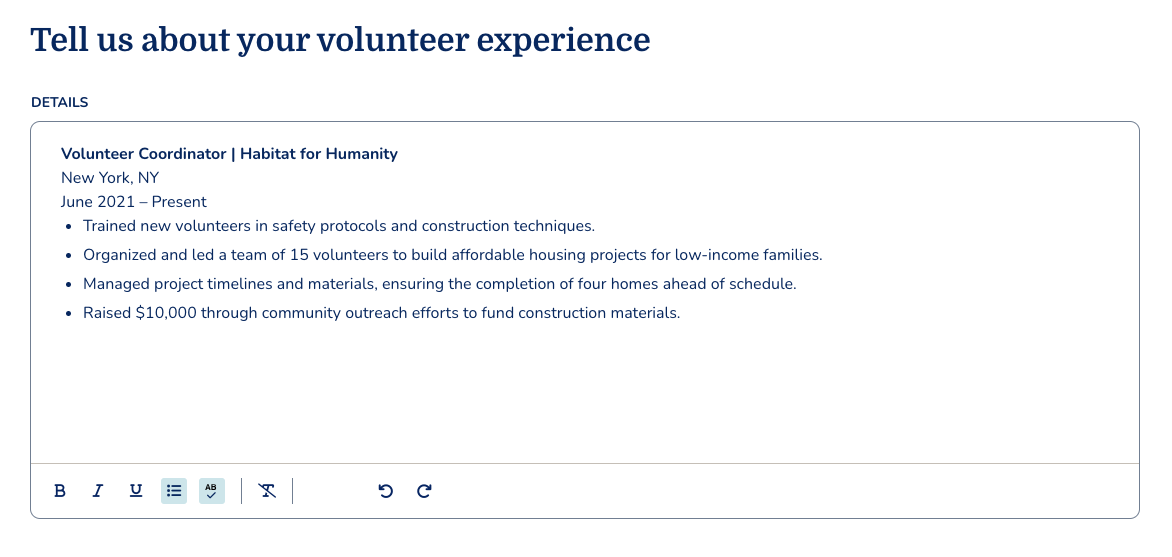
You can use our Resume Builder to quickly and easily add a volunteer experience section to your resume. Here’s an example:
Where Does Volunteer Experience Go on a Resume?
Volunteer experience typically goes in a dedicated section after your work experience if you’ve held professional roles. It can also be grouped with paid roles in your work experience section when it’s closely related to your target job or demonstrates highly relevant skills.
In a Separate “Volunteer Experience” Section
List your volunteer experience in a separate section if you have relevant work experience but still want to include supplemental volunteer positions that relate to your target role.
This keeps your resume organized and ensures hiring managers can quickly scan it. It works best when volunteer roles are ongoing, varied, or support your overall experience.
Keep this section brief and tailor it to the role by including keywords from the job description. Here’s an example volunteer experience resume section:
VOLUNTEER EXPERIENCE
Volunteer Program Coordinator
Second Harvest Food Bank, Los Angeles, CA
April 2024–Present
- Coordinate weekly food distribution programs, providing meals to over 500 families in need each month.
- Recruit, train, and manage a team of 30 volunteers, which has improved operational efficiency by 15%.
- Develop partnerships with local businesses to secure food donations, which has increased contributions by 20%.
Community Outreach Volunteer
Habitat for Humanity, San Francisco, CA
June 2023–March 2026
- Engaged with community members to promote volunteer opportunities and increase participation by 10%.
- Assisted in building and renovating homes for low-income families, contributing over 100 volunteer hours.
- Organized fundraising events that raised $5,000 for local housing projects.
In Your Work Experience Section
If your volunteer experience is closely related to the position you’re applying for, you can include it in the work experience section of your resume.
Make sure you clearly differentiate between paid work and volunteer experience in your role titles so hiring managers can quickly understand your experience, for example, by listing “Volunteer Project Coordinator, Habitat for Humanity” to indicate an unpaid role.
You can use “Experience” as the section heading to encompass both paid and volunteer work. Here’s an example of an experience section that features a paid position and a volunteer role:
EXPERIENCE
Marketing Coordinator
BrightWave Solutions, Chicago, IL
January 2022–Present
- Develop and execute marketing campaigns that have increased brand awareness by 25% over six months.
- Manage social media accounts, growing follower base by 15%, and increasing engagement through targeted content.
- Collaborate with the sales team to design promotional materials, leading to a 10% boost in client acquisition.
Volunteer Event Coordinator
Hope Haven Foundation, Chicago, IL
May 2021–December 2025
- Led a team of 15 volunteers in organizing a charity event that raised $10,000 for local community programs.
- Coordinated logistics, including venue booking, vendor management, and promotion, attracting over 300 attendees.
- Designed marketing materials and promoted the event through social media, increasing awareness by 20%.
Explore how to write a resume for step-by-step guidance and examples to help you craft each section of your resume.
Examples of Volunteer Work on a Resume
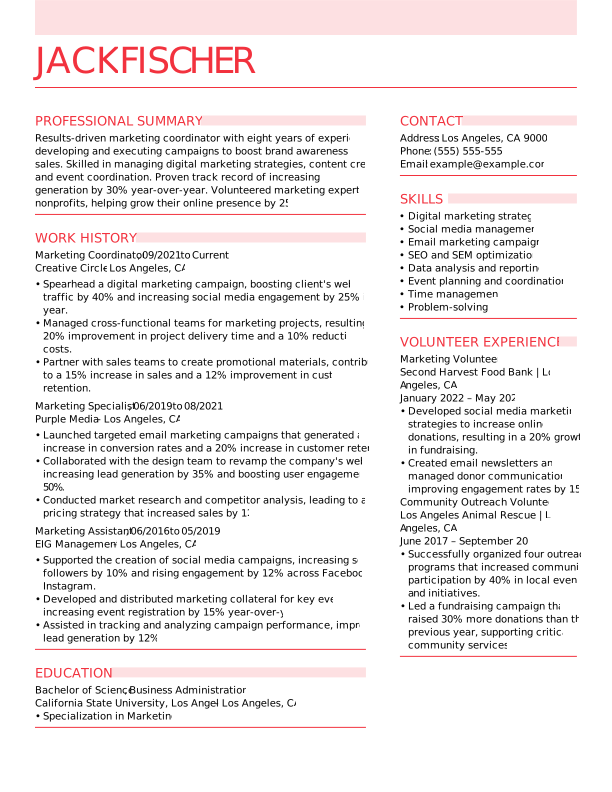
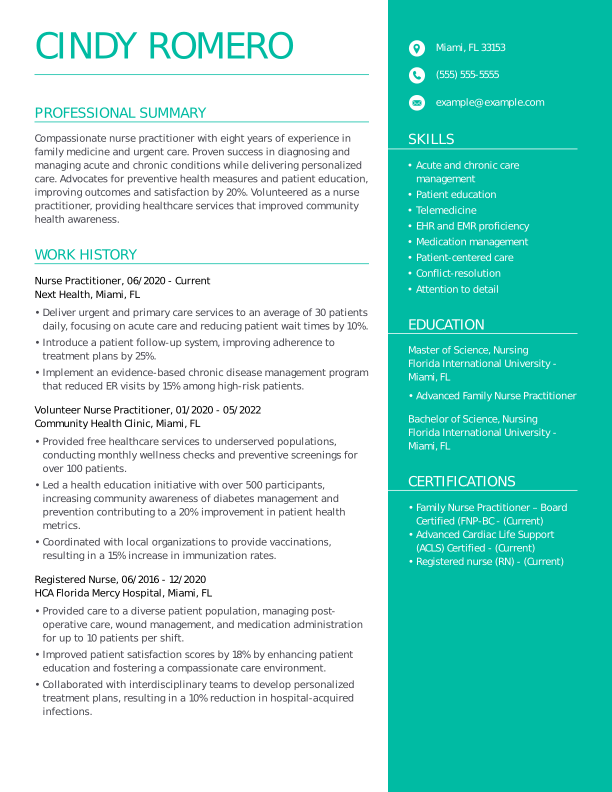
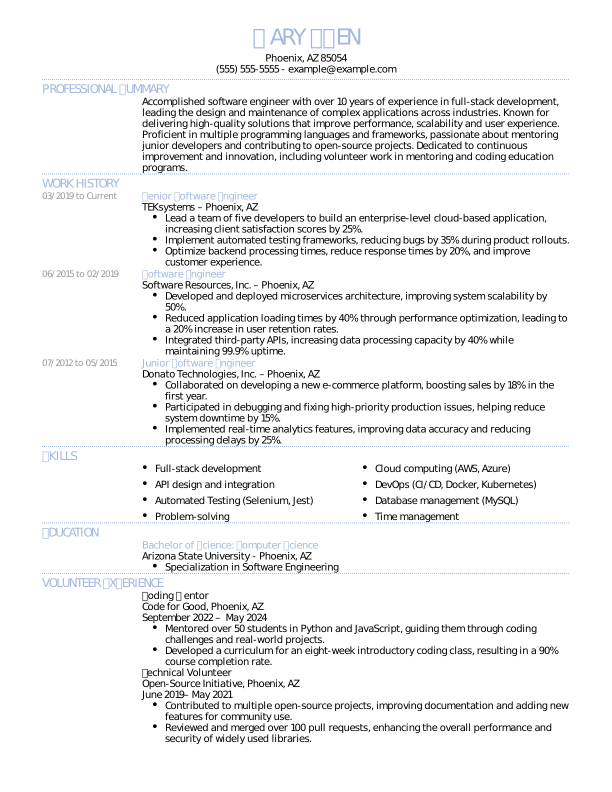
Example resumes are an excellent resource for highlighting transferable skills and impact when listing volunteer work on a resume.
Here are a few volunteer resume examples for popular roles:
Marketing Coordinator
Nurse Practitioner
Software Engineer
You can use our professional resume templates and builder to create or update your resume with custom sections, such as volunteer experience.
Tips for Listing Volunteer Experience on a Resume
List volunteer experience on your resume by focusing on relevance, clarity, and impact so each entry highlights skills that match the job you’re applying for. Use action-oriented bullet points, include organization names and dates, and emphasize measurable results when possible.
- Treat it like a job. Format volunteer experience the same way you would paid work experience. If it’s relevant to the job you’re applying for, you can list it in the main “Experience” section rather than under a separate heading.
- Focus on relevant skills. Highlight the technical skills and achievements from your volunteer experience that align with the position you’re applying for. Tailoring your resume to the job description ensures your volunteer work adds value.
- Quantify your impact. Whenever possible, include numbers to showcase the impact of your work. For example, “Raised $15,000 in donations” or “Managed a team of 10 volunteers.” Quantifiable results make your contributions stand out.
- Highlight leadership and initiative. If you held leadership roles or took the initiative to start projects, make sure to mention that. Employers value strong leadership skills, teamwork, and problem-solving, even in a volunteer setting.
- Keep it relevant. If you have extensive volunteer experience, only include what’s relevant to the job or what demonstrates critical skills. You don’t need to list every volunteer activity, just those that are relevant.
- Use action verbs. Start your bullet points with strong action verbs like “Organized,” “Managed,” and “Coordinated.” Succinct and action-oriented language conveys your impact in your volunteer roles.
Key Takeaways
- Volunteer experience can be included on a resume when it’s highly relevant to your target role or when you have limited professional experience.
- Focus on highlighting transferable skills, such as leadership, teamwork, communication, and project management, that you gained through your volunteer experience.
- You can list volunteer roles in the work experience section of your resume or in a separate section dedicated to volunteer experience.
- Tailor the volunteer experience you list to the job you’re applying for by emphasizing responsibilities and achievements that match the job description.
Frequently Asked Questions
What volunteering looks best on a resume?
Volunteer experience that looks best on a resume is relevant to the job, demonstrates measurable impact, and shows transferable skills, such as leadership, teamwork, or communication. Employers value volunteer roles where you took on responsibility or supported a recognized organization because they signal initiative and real-world capability beyond paid work.
How do you describe volunteer experience on a resume?
Describe volunteer experience on a resume by focusing on impact, achievements, and transferable skills rather than just duties. Highlight what you accomplished and the skills you developed to show how your experience translates into workplace strengths. This helps employers understand your contributions and how you can add value in a professional role.
What can count as volunteer experience?
Any unpaid work where you contribute time, effort, or skills to an organization, community group, or cause can count as volunteer experience. Volunteer experience examples include formal nonprofit roles as well as informal work like tutoring, event support, or fundraising.
Volunteer experience matters because it demonstrates initiative, responsibility, and transferable skills employers value, such as effective communication and problem-solving.
How do you list volunteer work with no title?
You can list volunteer work with no title by creating a clear role label based on your contribution, such as “Volunteer,” “Community Volunteer,” or a descriptive title like “Event Support Volunteer.” This ensures your experience is clear to employers while highlighting your responsibilities and contributions.
Is it okay to put volunteer work in the experience section?
Yes, it’s okay to put volunteer work in the experience section if it’s relevant to the job or demonstrates strong skills, leadership, or measurable impact. Many employers accept this because it treats unpaid and paid experience equally. This approach works especially well when volunteer roles closely match your target position or help explain employment gaps.
Does volunteer experience count as work experience?
Yes, volunteer experience can count as work experience when it includes relevant skills, responsibilities, or measurable outcomes. Employers often value unpaid roles because they demonstrate initiative, teamwork, leadership, and real-world impact similar to paid positions. Include volunteer work in your experience section when it’s relevant to the job you’re applying for.
How far back should volunteer experience go on a resume?
The amount of volunteer experience you include depends on relevance, but most should come from the past five to 10 years. Focus on experiences that are closely related to the job you’re applying for.
Older volunteer roles can still be included if they demonstrate key skills, long-term commitment, or help explain employment gaps.
How We Reviewed This Article
Since 2012, we have helped more than 11 million job seekers. We want to make your career journey accessible and manageable through our services and Career Center’s how-to guides and tips. In our commitment to bring you a transparent process, we present our Editorial Process.
Rate this article
Volunteer Experience


Elizabeth is a Certified Professional Resume Writer (CPRW) and a member of the Professional Association of Resume Writers & Career Coaches. She is committed to helping job seekers navigate the job market and succeed in their careers.
More Articles by Elizabeth Muenzen, CPRWShare this page
 Add MyPerfectResume as a preferred source on Google
Add
Our customers have been hired at:*Foot Note