

Our customers have been hired at: *Foot Note


Table of Contents
Get started with MyPerfectResume today!
- Build a resume on any device
- Pick an ATS-friendly template
- Tailor with AI copy suggestions
If it feels like employees are staying put despite feeling unhappy or disengaged, there’s a reason for that. Our latest survey of 1,000 U.S. workers, the Quit Tomorrow Test, found that many employees are financially trapped at work—they aren’t staying because they’re satisfied; they’re staying because leaving feels financially impossible.
Today’s workforce is navigating a difficult balance between confidence and caution. Many workers believe they could land a similar or better role quickly, but limited savings, rising costs, and the fear of financial disruption are keeping them in place.
Key Findings

- Half of workers would leave if they felt financially secure. 50% say they would quit within three months.
- Financial pressure is keeping workers in place. 69% say financial strain influences their decision to remain in their current role.
- Nearly half have little savings to fall back on. 45% say their savings wouldn’t last longer than three months without income.
- Confidence isn’t the problem. 60% say they could find a similar or better job within three months, but they’re staying at their jobs for financial reasons.
- More than half are disengaged. 53% say they are coasting, disengaged, or already planning to leave.
- Pay remains the biggest motivator. 60% say higher pay would motivate them to leave, while 78% cite compensation as a top reason for changing jobs.
Half of Workers Would Leave If They Felt Financially Secure
One of the clearest findings from the survey is that 50% of workers say they would quit their current job within the next three months if they had enough savings to cover a year of expenses.
At the same time, 69% say they want to quit but can’t afford to, and financial strain influences their decision to remain in their current role. That means job retention is being shaped less by loyalty and more by economic pressure.
Why it matters: If employees had stronger financial stability, turnover could rise quickly. Companies relying on economic uncertainty to retain talent are on unstable ground.
Confidence Isn’t the Problem
Many workers feel confident about their career prospects. In fact, 60% say they could find a similar or better job within three months.
This shows that workers don’t necessarily feel stuck due to a lack of job-relevant skills or opportunity. Instead, they’re weighing the risks of making a move.
Why it matters: Employers shouldn’t assume that the reason employees stay at jobs is a lack of options. Workers may feel able to leave, but they’re weighing the financial cost.
Limited Savings Is Restricting Career Mobility
Savings levels reveal why many employees hesitate to make a change. Our survey found the following:
- 45% say their savings would last less than three months without income.
- 30% say their savings would last three to eleven months.
- 25% say they have one year or more saved.
Without a financial cushion, even a short employment gap can feel too risky.
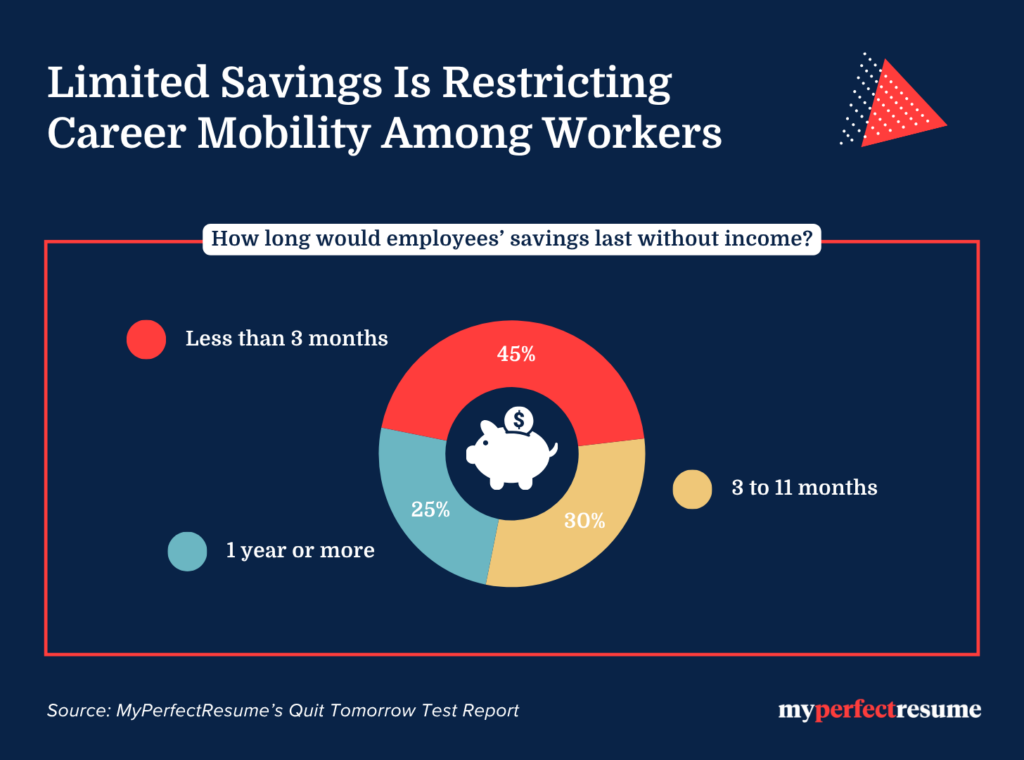
Why it matters: Career mobility is increasingly tied to personal finances. Workers without savings may stay in roles that no longer fit simply because they can’t afford transition time.
Disengagement Is Widespread
More than half of workers report feeling disconnected from their current jobs. Here are a few key employee disengagement statistics:
- 34% say they are doing their job but not going above and beyond.
- 11% say they are actively disengaged.
- 8% say they are already planning to leave.
That means 53% of employees describe themselves as coasting, disengaged, or preparing to exit. These quiet quitting statistics indicate widespread workplace burnout and disengagement.
Why it matters: Disengagement and employee burnout affect productivity, morale, innovation, and customer experience long before an employee resigns.
Compensation Is Driving Career Decisions
Pay remains the strongest motivator in today’s labor market. Of the workers responding to the survey:
- 60% would leave for higher pay
- 78% view compensation as a top factor when considering a new role
When asked why they stay:
- 76% cite financially driven reasons such as pay, benefits, or security
- 34% cite fear-based reasons like layoffs or job market uncertainty
- 14% say they stay for career growth
- 9% say they stay out of loyalty
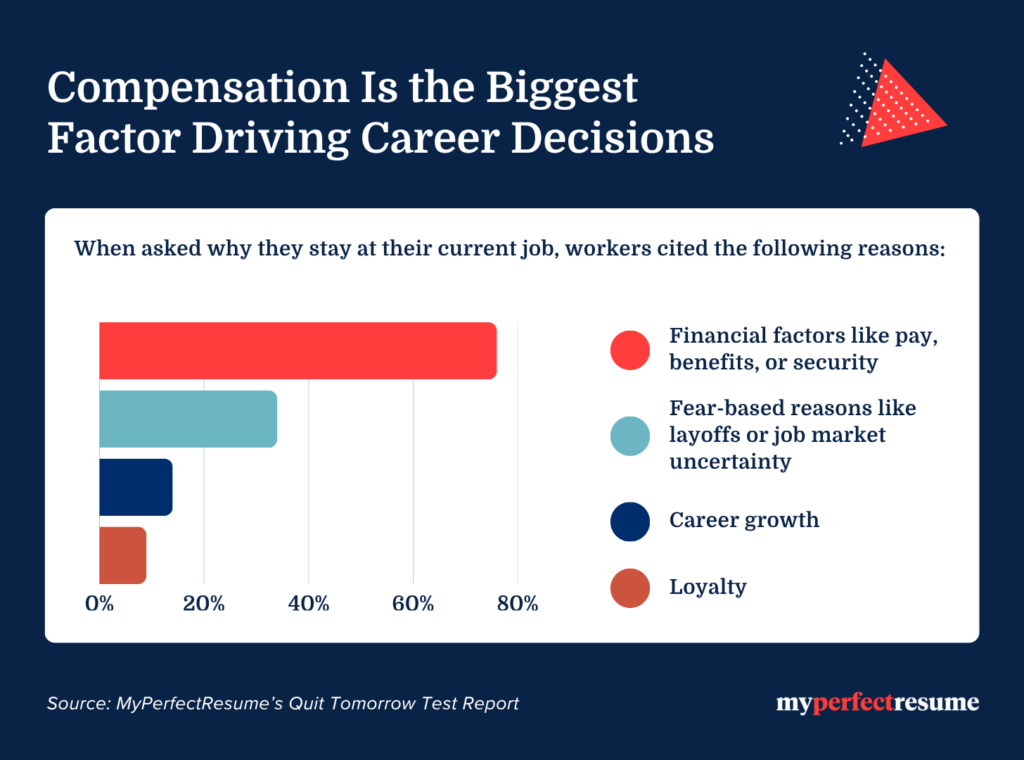
Why it matters: Compensation is no longer just one part of the employee value proposition—it’s often the deciding factor.
The Cost of Leaving Still Feels Too High
Workers also pointed to real-life financial responsibilities that keep them tied to their current jobs:
- 43% cite rent or mortgage costs.
- 36% cite health insurance or benefits.
- 31% point to limited savings.
- 23% cite family or caregiving costs.
- 15% cite debt or student loans.
- 13% fear layoffs elsewhere if they switch jobs.
Why it matters: Employees aren’t making career decisions in a vacuum. Housing, healthcare, debt, and family obligations all influence whether someone feels safe enough to move on.
Workers Are Split on Staying Another Year
When asked how they would feel about remaining in their current role for another year:
- 56% say they would feel satisfied
- 45% feel neutral or dissatisfied
This suggests many workers are uncertain about their future and may be staying only until conditions improve.
Why it matters: A workforce that feels neutral is still at risk. Employees who aren’t actively satisfied are often open to better opportunities.
The Quit Tomorrow Test highlights a workforce that feels capable yet cautious and financially constrained. Employees may appear stable on paper, but many are quietly reassessing their next move.
For employers, the takeaway is clear: retention strategies built solely on economic fear won’t last forever. Organizations that invest in fair pay, benefits, career growth, and employee well-being will be better positioned when workers feel financially ready to act.
For press inquiries, please contact Nathan Barber at nathan.barber@bold.com.
Methodology
The findings presented in this report are based on a nationally representative survey conducted by MyPerfectResume using Pollfish in April 2026. The survey collected responses from 1,000 U.S. adults currently employed full-time. Respondents answered a mix of single-selection and multiple-choice questions about financial security, job mobility, workplace engagement, and career decision-making. Participants were asked about their savings, confidence in finding new employment, reasons for staying in or leaving their current roles, and overall mindset at work.
Demographic Breakdown
The survey sample included 53% female and 46% male respondents, with a small percentage selecting another option or preferring not to answer. Age distribution was broad, with 11% aged 18–24, 17% aged 25–34, 18% aged 35–44, 17% aged 45–54, 16% aged 55–64, and 21% aged 65 or older, providing a balanced view across career stages.
About MyPerfectResume
MyPerfectResume Resume Builder with professional templates is designed to help job seekers elevate their careers. The easy-to-use platform was created to eliminate the hassle of resume writing, offering professionally written examples, free expert tips, step-by-step guidance to make a resume, and valuable interview advice to create an outstanding job application effortlessly. Since 2012, MyPerfectResume’s Resume Builder has helped more than 11 million job seekers create their perfect resumes online. Its comprehensive employment surveys have been featured in Forbes, Yahoo! Finance, CNBC, Newsweek, USA Today, BBC, Workable, and more. Stay connected with MyPerfectResume’s latest LinkedIn, Instagram, and Facebook updates.
Rate this article
Quit Tomorrow Test

Jasmine is a certified career coach and recognized expert in job search strategy. She is committed to helping job seekers navigate the job market and succeed in their careers.
More Articles by Jasmine EscaleraShare this page
 Add MyPerfectResume as a preferred source on Google
Add
Our customers have been hired at:*Foot Note