Our customers have been hired at: *Foot Note


Table of Contents
Get started with MyPerfectResume today!
- Build a resume on any device
- Pick an ATS-friendly template
- Tailor with AI copy suggestions
Your resume is often your first impression with potential employers — so make it count!
A well-crafted resume can open doors, while common mistakes can send it straight to the rejection pile. Knowing what to include (and what to avoid) is key to standing out.
In this article, we’ll explore the top resume do’s and don’ts to help you showcase your skills, land interviews, and move one step closer to your dream job.
Do’s and Don’ts of Resume Preparation
The first step in making a professional resume is gathering all the necessary information. Here are five do’s and don’ts to start preparing your resume:
- Research the job market to learn about the industry expectations and tailor your resume accordingly.
- Read the job posting carefully and identify relevant keywords that point to the qualifications the employer seeks.
- Gather all your employment history and credentials to choose which ones apply to the desired role.
- Select a resume format that best showcases your strengths and aligns with your career goals.
- Learn formatting guidelines to ensure your resume can pass applicant tracking systems (ATS).
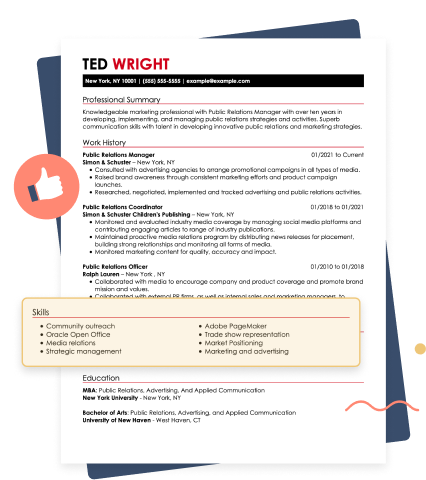
Resume Building Tips: Do’s and Don’ts
Creating an effective resume relies on optimizing each section to show employers you have the qualifications to excel in the role. Let’s review each section:
Resume header
- Place it at the top of your resume so recruiters can quickly read your contact details to set up an interview.
- Include essential information, such as your full name, email, and phone number, in your resume header.
- Add a LinkedIn or Bold.pro profile link, if applicable.
- Aim for three to five sentences highlighting your top skills, experience, and accomplishments.
- Customize your summary to align with the specific role by incorporating relevant keywords and qualifications.
- Quantify key accomplishments, skills, or outcomes demonstrating your value (e.g., “Increased sales by 30% in one year”).
- Use vague or generic language. Avoid overused phrases like “hardworking professional” without specific details to back them up.
- List job duties. Your resume summary should highlight your strengths and impact, not just repeat what’s in your experience section.
- Make it too long. A professional summary should be brief and engaging; avoid large blocks of text that may lose the reader’s attention.
Work experience
- Present responsibilities and achievements in concise bullet points to make them easy to read.
- Use numbers to describe your workplace achievements and show impact.
- Start each bullet point with action verbs like “led,” “developed,” “implemented,” or “optimized” to display initiative.
- List every job you’ve ever had. Focus on relevant positions that showcase your skills and experience related to the job you’re applying for.
- Use vague descriptions. Avoid generic phrases like “Handled tasks” or “Responsible for.” Instead, specify what you did and how it contributed to success.
- Include outdated or irrelevant work experience. Jobs from over 10-15 years ago (unless highly relevant) or unrelated roles can clutter your resume and distract from key qualifications.
Skills
- Focus on skills directly applicable to the job you’re applying for, including both hard and soft skills.
- Incorporate industry-specific terms to improve your chances of passing the ATS.
- Add a summary of qualifications section if you have minimal work experience and want to describe your skills further.
- Overload it with too many skills. Listing 20+ skills can overwhelm the reader; prioritize the most important ones, focusing on eight at most.
- Exaggerate or list skills you don’t have. Be honest about your abilities; claiming expertise in something you’re not proficient in can backfire during an interview or on the job.
- Skip technical skills. These specialized skills are highly sought-after and can be what the hiring manager wants to see when setting up an interview.
Education
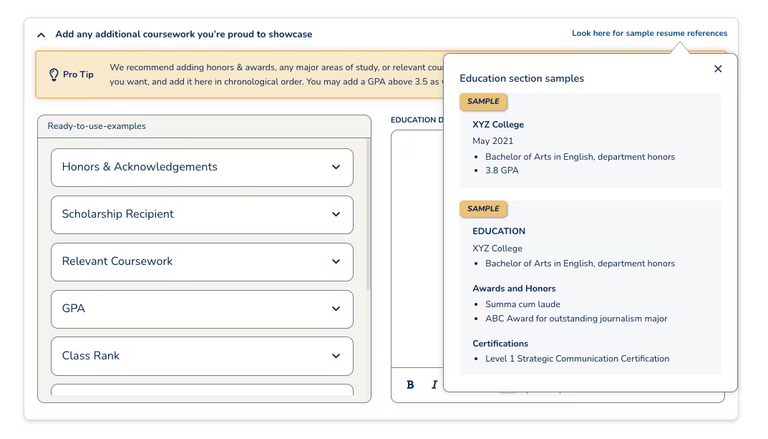
- Arrange degrees in reverse-chronological order, starting with the most recent.
- Mention the degree earned, school name, and graduation year.
- Highlight relevant coursework if you’re a recent graduate or changing careers.
- Include high school unless it’s your highest level of education. Your high school diploma is unnecessary if you have a college degree or higher.
- List incomplete degrees without context. If you didn’t complete a degree, specify “Coursework completed in [field]” rather than leaving it vague.
- Include your GPA. Only add your GPA if it’s high (3.5 or higher) and you’re a recent graduate; otherwise, it’s not usually relevant.
- Stick to a simple layout with clear headings and avoid tables, text boxes, or graphics that ATS systems may not read properly.
- Use relevant industry-specific and job-related keywords in the job posting to increase your chances of passing ATS scans.
- Submit your resume as a Word document (.doc or .docx) or a PDF to ensure ATS compatibility.
- Use ATS-friendly fonts like Arial, Calibri, or Times New Roman and structure information with standard bullet points rather than special symbols.
- Scan your resume with our ATS Resume Checker to get your resume score and actionable improvement suggestions.
- Use images, logos, or graphics. ATS software cannot process images, so crucial information may get lost.
- Overuse complex formatting. Avoid columns, colored text, or complex layouts that can confuse the ATS and cause information to be misread or skipped.
- Use headers or footers for important information. Some ATS systems ignore content in headers and footers, so keep key details in the main body of the resume.
- Stuff keywords unnaturally. While keywords are important, avoid excessive or irrelevant keyword stuffing — use them naturally within context only.
- Forget to proofread. ATS may not recognize misspelled words, which can cause your resume to miss out on keyword matches and lower your ranking.
- Use a simple, easy-to-read layout with straightforward headings, consistent spacing, and a logical flow of information.
- Organize your sections in a resume format that matches your experience level — chronological if you’re experienced, combination if you’re mid-level, or functional if you’re entry-level.
- Organize your information in a creative resume template if you’re applying for a role in advertising, arts, music, and editorial writing.
- Limit your resume to one page if you have less experience and two pages if you have extensive experience (10+ years).
- Stuff too much detail into one section. For a functional resume, keep the skills section clear and well-spaced; for a chronological resume, avoid listing every job you’ve ever had if it’s irrelevant.
- Overcrowd the resume. Leave adequate white space between sections to prevent a cluttered look and improve readability.
- Forget to use a resume template that aligns with your industry. For example, opt for a simple resume template if you’re in law or finance.
- Mix multiple formatting styles. Avoid inconsistencies in font sizes, alignments, or bullet point styles, which can make your resume look unprofessional.
Check out these resume examples to see how job seekers apply our resume tips to boost their job applications.
Healthcare administrator
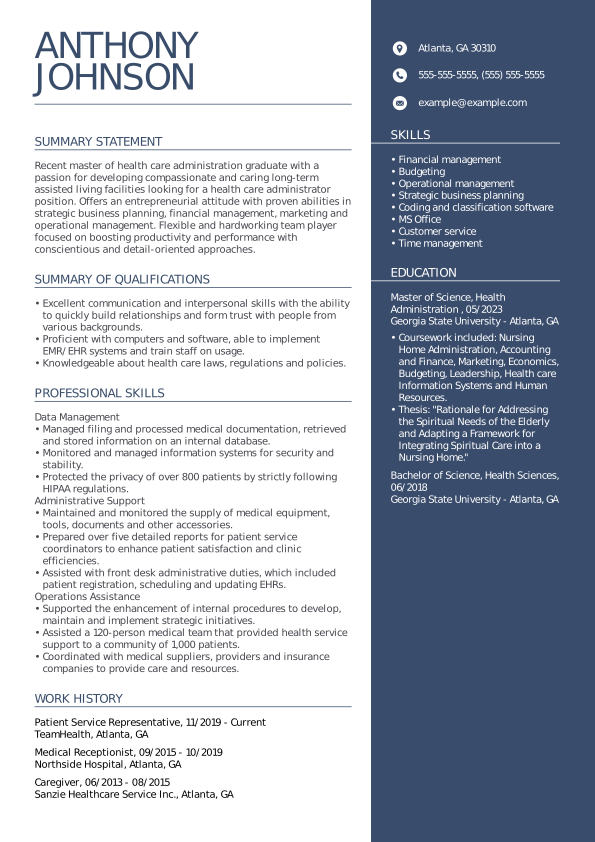
This healthcare administrator’s resume uses a summary of qualifications to showcase the candidate’s credentials further.
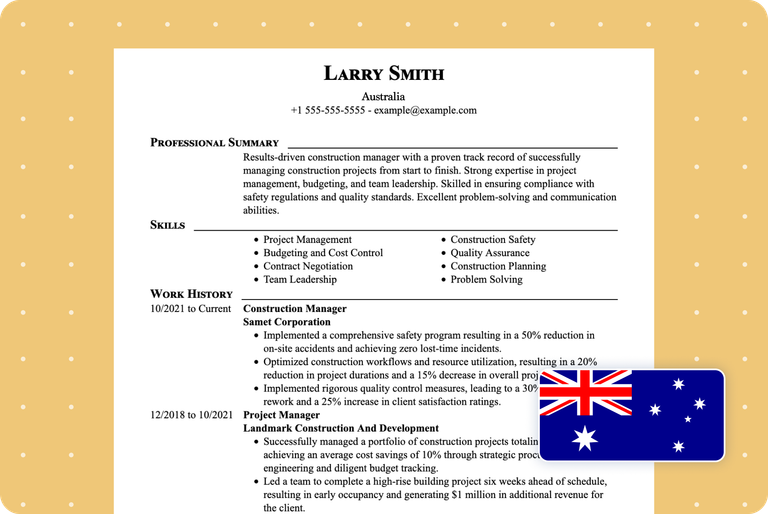
Construction manager
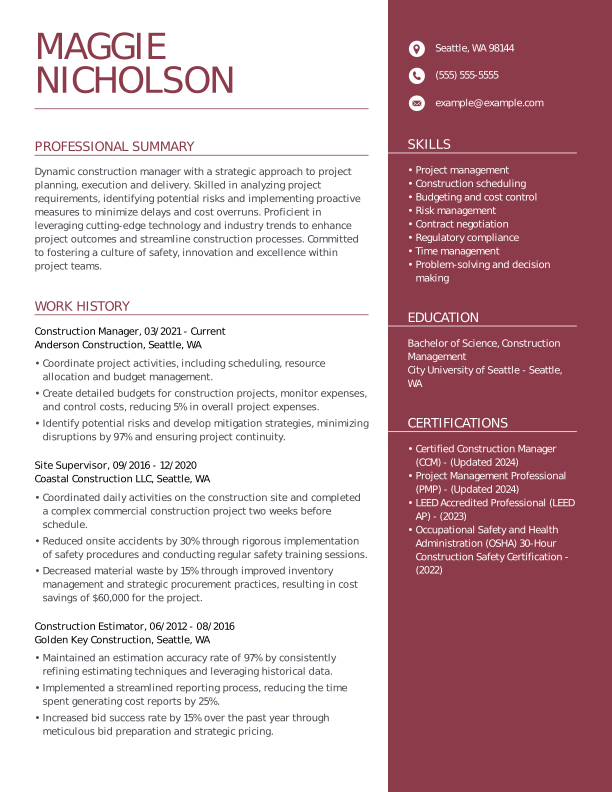
This construction manager opted for a combination resume format to equally emphasize their experience and skills.
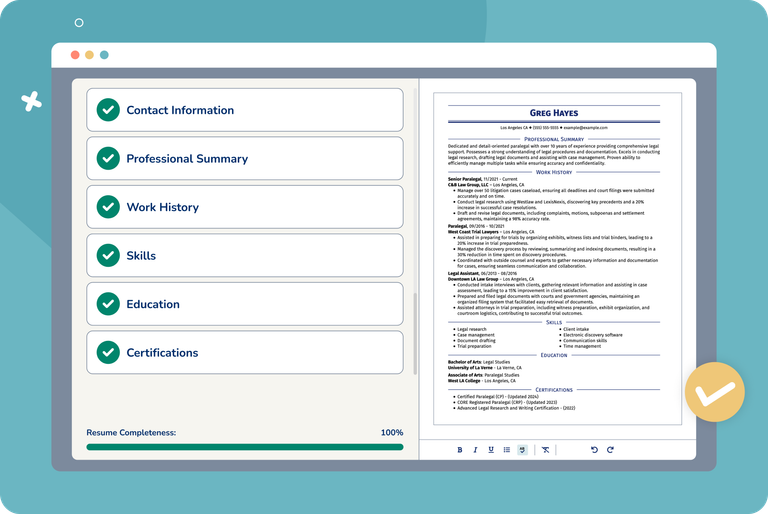
Paralegal
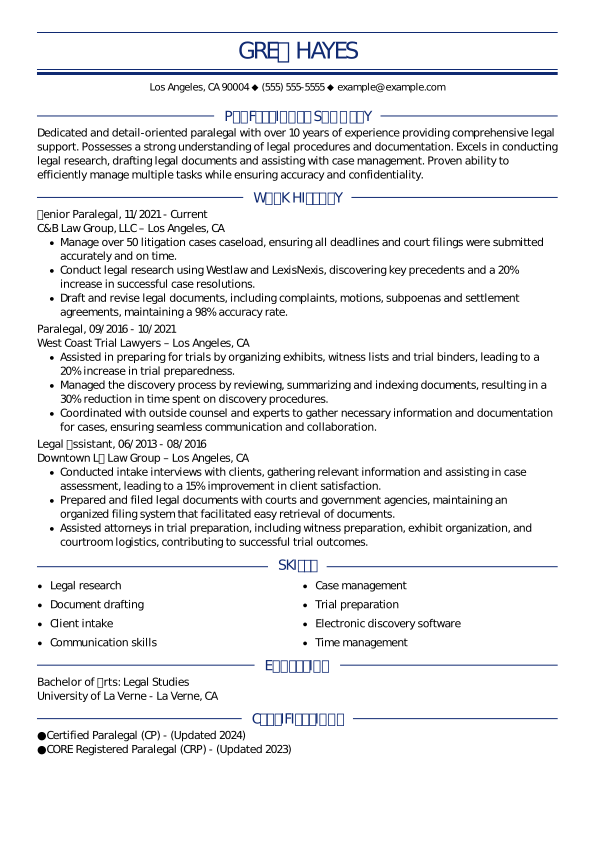
This paralegal’s work history is front and center to clearly demonstrate their career trajectory.
Don’t see your job title here? Our resume examples library has over 800 sample resumes for jobs across industries and experience levels!
Key Takeaways
- Keep each section well-structured, easy to read, and relevant to the job you’re applying for.
- Customize your professional summary, skills, and work experience to align with job descriptions and industry expectations.
- Use quantifiable metrics and action verbs to showcase your impact in previous roles.
- Organize information logically, use bullet points for readability, and avoid excessive design elements that may clutter the resume.
- Avoid vague language, outdated information, irrelevant details, and excessive personal information.
- Optimize for applicant tracking systems by incorporating relevant keywords from job descriptions.
- Use a professional email, avoid exaggerations, and double-check for typos or grammar mistakes.
FAQ
What are five common resume mistakes?
- Typos and grammar errors: Spelling mistakes and poor grammar can make you appear careless. Always proofread your resume or use a grammar-checking tool.
- Using a generic resume: Sending the same resume to multiple jobs without tailoring it to each position reduces your chances of getting noticed.
- Including irrelevant information: Avoid listing every job you’ve ever had. Focus on experience and skills that directly relate to the job you’re applying for.
- Poor formatting and readability: Overly complex designs, small fonts, or dense paragraphs make your resume difficult to read. Keep it clean, organized, and easy to scan.
- Not showcasing achievements: Simply listing job duties isn’t enough. Use action verbs and quantifiable results (e.g., “Increased sales by 20%”) to highlight your impact.
How long should my resume be?
Your resume should typically be one page if you have less than 10 years of experience and two pages if you have extensive experience. If you’re unsure how far back your resume should go, focus on your last 15 years of experience or your most relevant roles.
Should I include a photo on my resume?
In most cases, no. Including a photo for jobs in the U.S. is unnecessary and can lead to potential bias. However, some industries (such as acting or modeling) may require one. For most professional roles, it’s best to focus on your skills and experience.
That said, if you’re applying to a job in a country where photos on a resume are the norm, it’s best to include one. Research the resume standards in the country you’re applying for a job to ensure your application meets expectations.
Rate this article
Do's and Don'ts


Natalia is a Certified Professional Resume Writer (CPRW) and member of the Professional Association of Resume Writers & Career Coaches. Her work focused on helping job seekers navigate the job market and succeed in their careers.
More Articles by Natalia Merced, CPRWShare this page
 Add MyPerfectResume as a preferred source on Google
Add
Our customers have been hired at:*Foot Note