Harvard Resume: Templates, Examples, & Formatting Rules


Our customers have been hired at: *Foot Note


Table of Contents
Get started with MyPerfectResume today!
- Build a resume on any device
- Pick an ATS-friendly template
- Tailor with AI copy suggestions
What to Expect
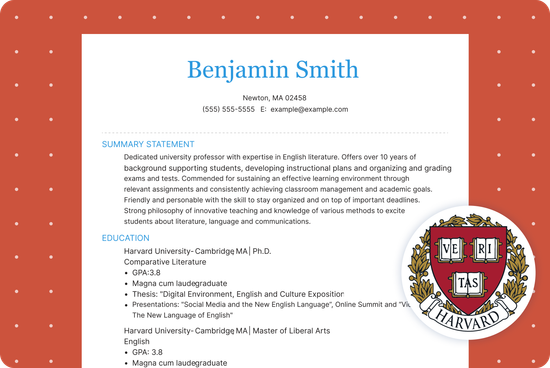
- Harvard-style resumes use a clean, single-column layout that prioritizes readability, professional experience, and measurable achievements.
- The standard Harvard resume includes sections for education, experience, leadership, activities, skills, and interests, with section order tailored to career stage.
- Strong resume bullet points lead with action verbs and quantify results to demonstrate impact rather than simply list responsibilities.
- Undergraduate resumes typically omit summary and objective statements, while experienced professionals and career changers may benefit from a concise summary.
- Simple formatting, job-specific keywords, and a plain-text copy test help ensure your resume is readable by applicant tracking systems (ATS) and aligned with the role.
A Harvard-style resume can help job seekers present relevant experience clearly for roles across finance, consulting, technology, law, and corporate sectors while staying ATS-compatible.
The clean, straightforward design may look simple, but creating an effective resume requires careful attention to detail. From presenting academic credentials to demonstrating the impact of professional experience, each element must serve a clear purpose.
Harvard’s career center guidelines provide a foundation for making these choices and translating your qualifications into a resume that communicates your strengths with clarity and precision.
What Should a Harvard Resume Look Like?
A Harvard resume looks clean and minimal, with a single-column layout, clearly defined sections, consistent formatting, and concise, achievement-focused bullet points. The format prioritizes readability and relevant qualifications, making it a useful model for students, recent graduates, and experienced professionals.
Plain-Text Harvard Resume Template (Copy & Paste)
A Harvard-style resume organizes academic credentials, work history, extracurricular involvement, and relevant skills into distinct sections. The following copy-and-paste template follows this general structure and can be adapted to different career stages. Include only relevant details, and prioritize accomplishments that demonstrate your qualifications for the target role.
[Your Full Name]
[City, State] | [Phone Number] | [Email Address] | [LinkedIn URL]
EDUCATION
[University Name], [City, State]
[Degree and Concentration] | Expected Graduation: [Month Year]
GPA: [X.XX/4.00] (if relevant)
[Honors, Thesis, or Study Abroad] (if applicable)
EXPERIENCE
[Current or Most Recent Company], [City, State]
[Job Title] | [Month Year–Month Year]
- [Action verb] + [task or responsibility] + [measurable result].
- [Action verb] + [contribution] + [outcome].
- [Action verb] + [project or initiative] + [quantified impact].
[Previous Company or Organization], [City, State]
[Job Title] | [Month Year–Month Year]
- [Action verb] + [task or responsibility] + [measurable result].
- [Action verb] + [contribution] + [outcome].
- [Action verb] + [project or initiative] + [quantified impact].
LEADERSHIP & ACTIVITIES
[Organization Name], [City, State]
[Leadership Role] | [Month Year–Month Year]
- [Describe contributions, initiatives, and measurable impact].
SKILLS & INTERESTS
Technical Skills: [Relevant software, tools, or programming languages]
Languages: [Language and proficiency level]
Interests: [Relevant personal or professional interests]
Downloadable Harvard Resume Examples
These editable Harvard resume examples let you customize your resume in Google Docs or Microsoft Word while keeping a professional layout. Use them as a starting point for organizing experience and achievements, replacing the sample content to reflect your skills and experience.
Harvard Resume Example (Google Docs)
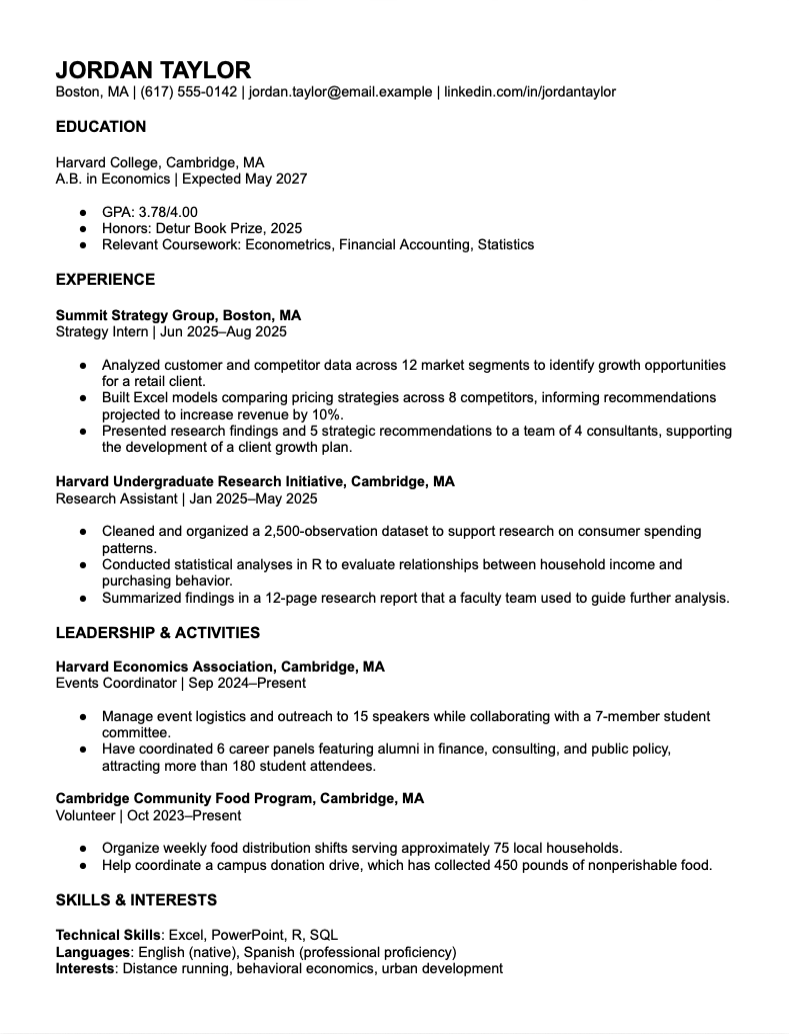
Why this example works: Education appears first because the candidate is still in college. The bullet points emphasize analytical skills, research, leadership, and measurable contributions—qualities relevant to internship applications.
Harvard Resume Example (Microsoft Word)
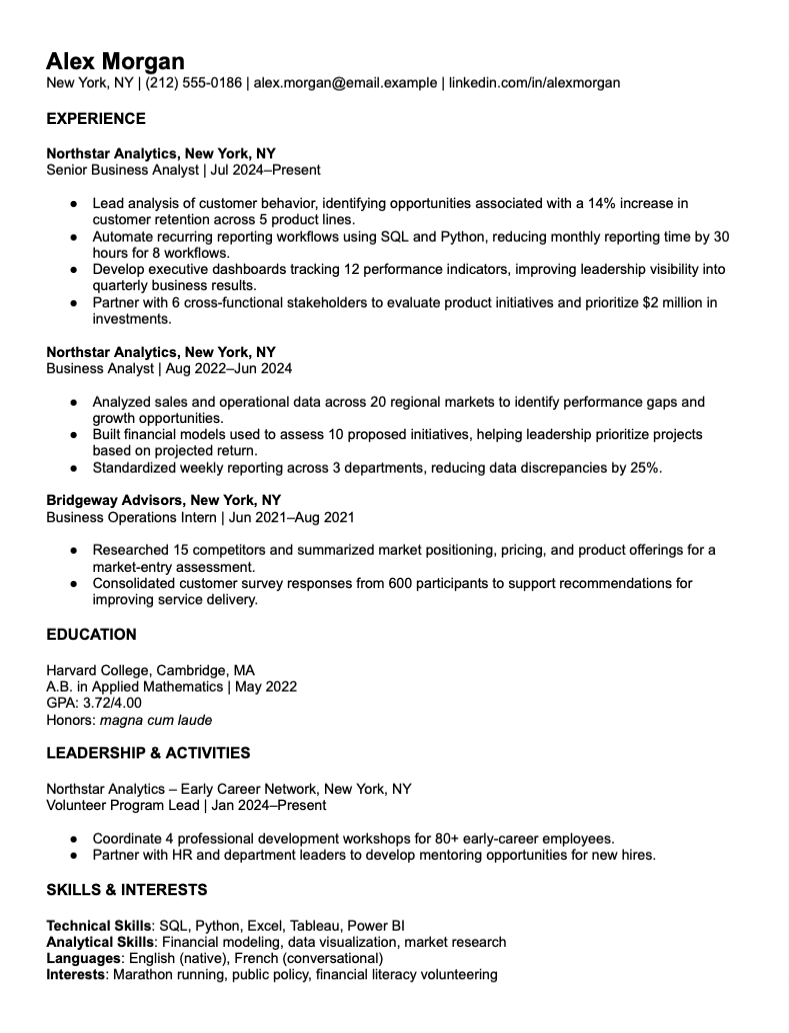
Why this example works: Professional experience leads because the candidate has several years of relevant work history. The resume demonstrates career progression, technical capabilities, collaboration, and business impact before presenting education.
Harvard Resume Format: Standards for Fonts, Margins, & ATS
A Harvard-style resume should use consistent formatting, readable fonts, balanced margins, and a simple, single-column layout. These choices make your qualifications easier for recruiters to scan and help ATS interpret your resume. Although exact specifications can vary by career center and employer, standard formatting provides a reliable starting point.
Margins, Fonts, & Font Sizes
Set margins between 0.5 and 1 inch on all sides to balance readability and available space. Choose a standard resume font, such as Arial, Calibri, Georgia, or Times New Roman, and use 10–12 points for body text. Make your name slightly larger (14–16 points) and use bold section headings for clear visual hierarchy.
Layout & ATS Compatibility
Use a single-column layout with clearly labeled section headings. Avoid photos, icons, tables, text boxes, and skill-rating graphics, which can interfere with how some ATS platforms parse information. Keep dates consistently formatted and clearly associated with the relevant role or credential.
File Naming & the Plain-Text Copy Test
Save your resume as a PDF unless the employer requests another format. Use a clear file name, such as “Firstname_Lastname_Resume.pdf,” to make the document easy to identify.
Before submitting, copy the PDF’s text into a plain-text editor. Check that headings, dates, and bullet points appear in the correct reading order and that no important information is missing or scrambled. This quick test can reveal formatting issues before you apply.
How to Structure Your Harvard Resume: Section-by-Section Guidance
Your Harvard-style resume should organize education, experience, leadership, and skills to highlight your strongest qualifications. Students and recent graduates can lead with education, while experienced professionals should prioritize work history. Within each section, clear headings and focused bullet points help recruiters quickly assess your fit for the role.
Structuring Your Resume by Career Stage
For current students and recent graduates, education typically belongs near the top of a Harvard resume because academic credentials are central to their qualifications.
Professionals with three to five or more years of relevant experience may put experience first, especially when their work history better demonstrates their qualifications. The best section order depends on which information most strongly supports the target role.
Here are a few quick guidelines to help you:
- Students and recent graduates: List education first, including your institution, degree, expected graduation date, and relevant honors.
- Experienced professionals: Move work experience above education when your employment history better demonstrates your qualifications.
- Career changers: Choose the order that best highlights your transferable skills and relevant credentials.
Degrees, Joint Concentrations, & Honors
A Harvard resume should list degrees, concentrations, and academic honors using accurate, consistent formatting that reflects the candidate’s actual academic record.
Clearly distinguish joint concentrations, double concentrations, and concurrent bachelor’s and master’s degrees, and use Latin honors, honors theses, and study abroad experiences to provide additional evidence of academic achievement and subject expertise.
Here’s how to format academic distinctions effectively:
- Joint or double concentrations: Use the official designation shown on the transcript or degree record. If the university formally recognizes a joint concentration, use that terminology rather than implying two separate degrees.
- Concurrent degrees: List both credentials using the institution’s approved degree abbreviations where applicable. Confirm the exact designation for the program.
- Latin honors: Include distinctions such as cum laude, magna cum laude, or summa cum laude only when officially awarded. Italicize the Latin phrase, and keep the style consistent.
- Honors thesis: Include the thesis title when it demonstrates relevant research, analytical skills, or subject expertise. Students completing a thesis may also include the department or an awarded thesis distinction, if applicable.
- Study abroad: List the host institution, location, and dates or term. Add relevant coursework or research only when it strengthens your application.
Use the following examples as formatting models, adapting degree titles and distinctions to match the official academic record:
| Credential | Example Resume Formatting |
| Single concentration | A.B. in Economics, Harvard College, May 2026 |
| Joint concentration | A.B. with a joint concentration in Computer Science and Statistics, Harvard College, May 2026 |
| Two separate degrees | A.B. in Economics, Harvard College, May 2022; A.M. in Regional Studies—East Asia, Harvard University, May 2024 |
| Concurrent bachelor’s and master’s | A.B./S.M. in Computer Science, Harvard University, May 2026 |
| Latin honors | A.B. in Government, magna cum laude, Harvard College, May 2026 |
| Honors thesis | Senior honors thesis: “The Effects of Remote Work on Urban Labor Markets” |
| Study abroad | Study abroad, University of Oxford, Oxford, UK, Spring 2025 |
Harvard uses Latin degree abbreviations such as A.B. (Artium Baccalaureus, equivalent to a BA) and S.B. (Scientiae Baccalaureus, equivalent to a BS). Other universities may use these designations, but many award degrees under English abbreviations such as BA or BS. Use the official degree title or abbreviation awarded by your institution, as shown on your diploma.
Writing High-Impact Work Experience Bullets
Strong resume bullets explain what you did, the context or scope of your work, and the resulting impact. Start with an active verb, describe a specific task, and quantify the outcome whenever possible. This structure replaces vague responsibilities with evidence of skills, initiative, and measurable contributions.
A useful formula is:
Action verb + specific task + quantified result
For example:
- Weak: Assisted with marketing campaigns and social media.
- Strong: Coordinated 3 digital marketing campaigns that increased website traffic by 25% over 2 months.
Avoid personal pronouns such as “I” and “my,” and remove unnecessary introductory phrases. Never invent metrics; use verified figures or describe the scope of your contribution when exact numbers are unavailable.
Effective Action Verbs by Skill Category
Choose action verbs that accurately reflect the work performed and the skills demonstrated. Specific verbs make bullet points more informative and help connect your experience to job description keywords.
| Skill Category | Action Verbs |
| Leadership and strategy | Led, directed, launched, coordinated |
| Quantitative and data analysis | Analyzed, modeled, forecasted, quantified |
| Research and technical | Engineered, developed, tested, investigated |
| Communication and media | Presented, authored, promoted, negotiated |
| Operations and execution | Streamlined, implemented, optimized, delivered |
| Finance and business | Evaluated, budgeted, reconciled, projected |
| Collaboration and service | Partnered, mentored, facilitated, advised |
Before-and-after example:
- Before: Assisted with data reporting.
- After: Automated 4 weekly reporting processes, reducing manual data entry by 6 hours per month.
Use stronger verbs only when they accurately describe your responsibility. For example, “led” implies ownership, while “supported” may be more accurate for a contributing role.
Showcase Leadership & Activities Beyond the Classroom
The leadership and activities section highlights relevant experience beyond paid employment, including student organizations, volunteer work, athletics, and independent projects. Format each entry with the organization name, location, role, and dates, followed by achievement-focused bullet points that demonstrate initiative, collaboration, leadership, or measurable impact.
For example:
Harvard Student Research Institute (SRI), Cambridge, MA
Research Assistant | Sep 2024–May 2025
- Analyzed 150 survey responses to identify trends in student access to campus mental health resources.
- Synthesized findings into a 12-page research brief that informed recommendations to improve student outreach.
Use this section to show transferable skills and meaningful contributions, not simply list memberships. Prioritize activities that support your target role, and use the same concise, results-oriented writing style as your experience section.
Highlight Relevant Skills & Interests
The skills and interests section gives recruiters a quick overview of relevant technical abilities, language proficiency, specialized tools, and selected personal interests. Group information under clear labels so employers can identify job-related qualifications quickly. Include skills that match the job description, and describe proficiency accurately rather than relying on vague claims.
For example:
- Technical Skills: Excel, SQL, Python, Tableau
- Languages: Spanish (professional proficiency), French (conversational)
- Research Tools: SPSS, MATLAB
- Interests: Distance running, public policy, behavioral economics
Prioritize skills that are relevant to the position and use the employer’s terminology when it accurately describes your abilities. Avoid generic traits such as “hardworking” or “team player”; demonstrate those qualities through your work experience bullets instead. Interests are optional, so include them when they add personality or provide a useful conversation starter.
Should You Include a Resume Summary or Objective?
A Harvard-style resume typically doesn’t need a summary or objective statement, especially for undergraduate students and recent graduates.
Harvard’s Mignone Center for Career Success generally recommends using resume space to showcase relevant education, experience, skills, and accomplishments instead. A brief professional summary may, however, benefit experienced candidates whose career history needs context, including career changers and working professionals with extensive experience.
Why Recent Graduates Should Skip the Objective Statement
Undergraduate students and entry-level applicants should generally skip resume summaries and objective statements because they take up valuable space without adding much beyond the rest of the resume. Recruiters can assess your qualifications more effectively through specific examples of coursework, internships, projects, leadership, and measurable achievements.
An objective statement such as “Seeking an entry-level marketing role where I can grow my skills” describes what you want rather than what you offer. Instead, use the space to show relevant qualifications and results.
This also aligns with the concise, evidence-focused approach of Harvard-style resumes, which favors concrete accomplishments over narrative introductions.
When Experienced Professionals Should Include a Summary
A professional summary can be useful for mid-career candidates, career changers, and Harvard Extension School students with substantial work histories. In these cases, a concise, factual introduction helps connect previous experience to a new role or clarify a career trajectory.
Harvard’s guidance emphasizes specific, fact-based language over narrative-style writing, so keep the summary focused on relevant qualifications.
Aim for two to three lines that highlight your area of expertise, relevant experience, and strongest qualifications for the target position. Avoid generic claims, personal pronouns, and unsupported descriptions such as “highly motivated professional.”
For example:
Operations professional with 6+ years of experience improving supply chain efficiency, managing cross-functional projects, and reducing operating costs. Skilled in process optimization, data analysis, and vendor management.
A summary is optional, not a requirement based on years of experience alone. Include one only when it adds context or makes your fit for the role clearer than your experience and achievements would on their own.
Using AI Tools to Draft & Polish Your Bullets
AI tools can help refine your resume bullets by strengthening action verbs, improving clarity, and highlighting measurable results. Use AI as an editor, not a substitute for your own experience: The goal is to communicate your actual contributions clearly.
AI Prompts to Improve Your Bullet Points
Try these ready-to-use prompts with ChatGPT or another AI writing assistant. Include the original bullet and enough context to preserve the meaning of your work.
Prompt 1: Strengthen a Resume Bullet
Rewrite this resume bullet to start with a strong action verb, use concise and professional language, and emphasize the result or impact where supported by the information provided. Keep it to one line if possible. Do not invent metrics, responsibilities, or outcomes.
Original bullet: [Paste your bullet here]
Prompt 2: Identify Opportunities to Quantify Impact
Review this resume bullet and suggest ways to make the impact more specific or measurable. Identify what information would strengthen the bullet, such as time saved, number of people served, project scope, or percentage improvement. Do not estimate or invent figures. If information is missing, ask me questions.
Original bullet: [Paste your bullet here]
Verify Every AI-Generated Suggestion
AI can introduce inaccurate numbers, exaggerate your role, or imply results you didn’t achieve. Verify every metric, title, responsibility, and outcome before using a revised bullet. If you can’t substantiate a number, remove it or use a truthful description of the scope of your work.
Keep the final wording specific to your experience and relevant to the job description. Your resume should reflect what you actually did, not what AI assumes you did.
Formatting a Matching Harvard Cover Letter
A Harvard-style cover letter should complement your resume with consistent formatting and a tailored explanation of why your qualifications fit the role.
Use the same contact header, font family, and overall visual style across both documents to create a cohesive application. Keep the letter concise, professional, and focused on the employer’s needs rather than repeating your resume word for word.
Match Your Resume Header & Formatting
Use the same name, phone number, email address, and other relevant contact details in the header of both documents. Keep font choices, text color, and spacing consistent, and use a simple layout that’s easy to read. Use a more traditional paragraph format for your cover letter, while your resume uses section headings and bullet points.
Tailor the Letter to the Employer
A strong cover letter connects your most relevant experience to the employer’s needs. Identify a key qualification from the job description, support it with a specific example, and explain how it could contribute to the team or organization. Avoid repeating every resume bullet or relying on broad claims, such as “I’m a hardworking and motivated candidate.”
Personal pronouns are natural in a cover letter, so there’s no need to eliminate “I” entirely. Instead, vary sentence structure and focus on evidence. For example, replace “I believe I would be a great fit” with a specific example of relevant experience, such as “My experience streamlining reporting processes could help your team improve efficiency and make faster, data-driven decisions.”
Before submitting, check that both documents use consistent contact information, contain no errors, and are tailored to the same position.
Key Takeaways
A strong Harvard-style resume combines a clean layout with clear evidence of your qualifications and achievements. Use this checklist to build a resume that’s easy for recruiters to scan, tailored to the role, and compatible with ATS.
- Choose a template. Start with a clean, single-column Google Docs or Microsoft Word template that you can easily edit.
- Organize your sections. Put education first if you’re a student or recent graduate; prioritize experience if you’re an established professional.
- Write achievement-focused bullets. Use the formula action verb + specific task + measurable result whenever the impact can be quantified.
- Test your PDF. Copy the text from your saved PDF into a plain-text editor and confirm that headings, dates, and bullet points appear in the correct order.
- Tailor every application. Incorporate relevant keywords from each job description naturally, and make sure your experience supports the skills you highlight.
Frequently Asked Questions
How should I list Harvard Extension School on my resume?
To list Harvard Extension School on your resume, use the institution’s official name and accurately identify the program, credential, or degree you completed or are pursuing.
Use “Harvard University” only when it accurately reflects the institution or credential as officially designated. Don’t imply that you earned a degree if you completed only individual courses or a certificate. For example:
Harvard Extension School, Cambridge, MA
Data Analytics Graduate Certificate | May 2026
Can I include online Harvard certificate courses on my resume?
Yes, you can include online Harvard certificate courses on your resume if they’re relevant to the job. List completed certificates under education, certifications, or professional development, depending on their scope and relevance.
Include the official course or certificate title, issuing institution, and completion date. Verify the credential through the issuing program’s official records, and distinguish a completed certificate from an individual course or an unfinished program.
Where does GPA belong on a Harvard resume?
On a Harvard-style resume, place your GPA directly below your degree and concentration in the education section. As a general rule of thumb, consider including your GPA if it’s 3.5 or higher on a 4.0 scale, especially if you’re a student or recent graduate applying for competitive internships or entry-level roles. Follow any employer-specific requirements, report the scale accurately, and never round your GPA in a way that misrepresents your academic record.
What font and size should I use for a Harvard-style resume?
For a Harvard-style resume, use a standard, readable font, such as Arial, Calibri, Times New Roman, or Georgia, with body text around 10–12 points. Keep font choices and sizes consistent throughout the document, use bold text to distinguish section headings, and maintain balanced white space. A simple, single-column layout improves readability for recruiters and helps ATS interpret your information accurately.
How do I list high school information on a Harvard resume?
Remove high school information after your sophomore year of college, when your university education, experience, and achievements provide stronger evidence of your qualifications.
An exception may apply when you’re pursuing local summer jobs, internships, or opportunities that specifically value your high school connections or achievements. If you include high school details, keep them brief and prioritize more recent, relevant accomplishments.
How We Reviewed This Article
Since 2012, we have helped more than 11 million job seekers. We want to make your career journey accessible and manageable through our services and Career Center’s how-to guides and tips. In our commitment to bring you a transparent process, we present our Editorial Process.
Rate this article
Harvard Resume


Toni is a Certified Professional Resume Writer (CPRW) and member of the Professional Association of Resume Writers & Career Coaches. She is committed to helping job seekers navigate the job market and succeed in their careers.
More Articles by Toni Frana, CPRWShare this page
 Add MyPerfectResume as a preferred source on Google
Add
Our customers have been hired at:*Foot Note