

Our customers have been hired at: *Foot Note


Table of Contents
Get started with MyPerfectResume today!
- Build a resume on any device
- Pick an ATS-friendly template
- Tailor with AI copy suggestions
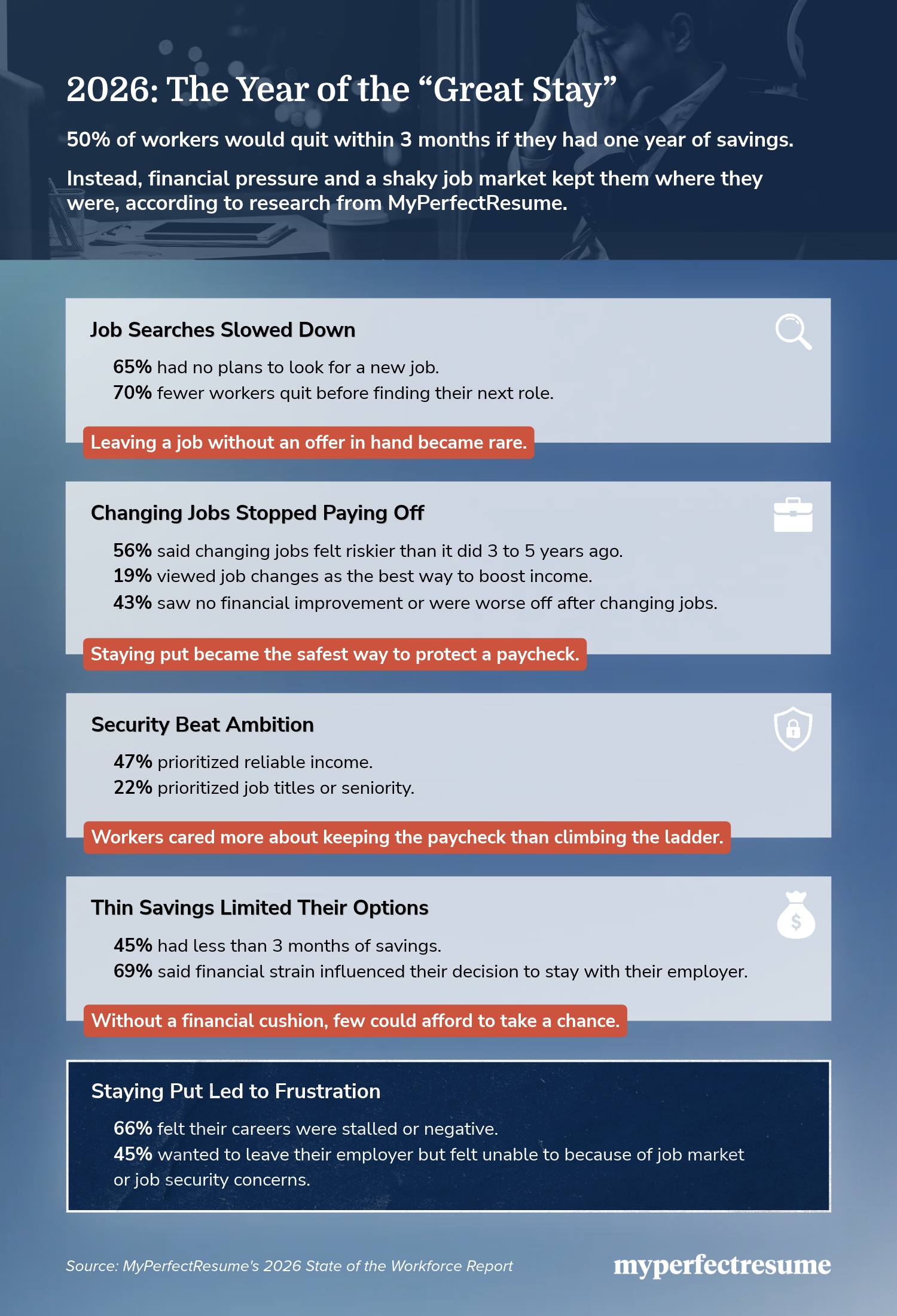
American workers spent much of 2026 caught between wanting change and feeling unable to risk it. Half of workers said they would quit their current job within three months if they had enough savings to cover one year of expenses. Yet 65% had no plans to look for a new job.
That gap between wanting to leave and actually leaving sits at the center of MyPerfectResume’s 2027 State of the Workforce Report, a year-end analysis that brings together six national studies conducted throughout 2026.
Across the research, one pattern stood out: Workers increasingly chose stability over mobility. Financial pressure, limited savings, labor market concerns, and doubts about whether changing jobs would pay off made leaving feel riskier.
Workers still wanted better pay, stronger career growth, or a different job, but many didn’t feel financially secure enough to make a move. The result wasn’t necessarily a more satisfied workforce. It was a more cautious one.
Key Findings
- Among workers with enough savings to cover one year of expenses, 50% would quit within three months.
- While 65% had no plans to look for a new job, 32% feared losing their current job, and 49% expected the labor market to worsen.
- Workers became significantly less likely to quit before securing their next position, with the reported rate falling by 70%.
- More than half (56%) said changing jobs was riskier than it had been 3–5 years earlier, while just 19% viewed changing employers as the best way to increase their income.
- Workers’ decisions to remain with their employer were influenced by limited savings (45% had less than three months of savings) and overall financial strain (69%).
- Two-thirds (66%) described their careers as stalled or negative, while 45% wanted to leave their employer but felt unable to act due to job market or stability concerns.
Workers Chose Stability Over Job Searching
One of the clearest signs of the “Great Stay” came from MyPerfectResume’s Great Stay Report. The study revealed key statistics:
- 65% had no plans to look for a new job.
- 49% expected the labor market to worsen.
- 32% feared losing their current job.
Job security took precedence over career mobility for many workers. Even workers who were unhappy or interested in something new appeared reluctant to test an uncertain job market. Keeping a steady paycheck became more important than making a career move.
For many workers, staying put wasn’t a sign of confidence in their current role. It reflected caution about what might happen if they left.
Quitting Before Securing Another Job Became Far Less Common
Caution also changed how workers approached a potential departure. MyPerfectResume’s Job Security Report found a 70% decline in the share of workers who said they would quit before starting their next job search.
In the study’s career-stage comparisons:
- Mid- to late-career workers were 70% less likely to quit preemptively.
- Early-career workers were 63% less likely to quit before securing another role.
Workers became less willing to give up a steady paycheck without another income source lined up. These job-hopping statistics showed that instead of quitting first and searching later, many stayed employed while exploring their options.
Job-Hopping Lost Its Financial Appeal
Changing employers has often been seen as a way to increase pay, but many workers no longer viewed it as a reliable financial move.
According to The Job-Hopping Payoff Is Over Report:
- 56% said changing jobs was riskier than it had been 3–5 years earlier.
- 49% said staying with their current employer was the safest way to maintain their income.
- 29% of recent job changers saw no meaningful financial improvement.
- 19% believed changing employers was the best way to increase their income.
- 14% said they were financially worse off after changing jobs.
When the financial upside of changing employers feels less certain, staying in a familiar role becomes easier to justify. That was especially true for workers who already felt financially stretched or unsure about the broader labor market.
Limited Savings Kept Workers From Leaving
For many workers, staying wasn’t simply a preference. It was also about financial capacity.
MyPerfectResume’s Quit Tomorrow Test found:
- 50% would quit within three months if they had enough savings to cover one year of expenses.
- 45% had savings that would last less than three months without income.
- 69% said financial strain influenced their decision to remain in their current role.
Limited savings reduced how much risk workers could afford to take.
Someone with only a few months of financial runway may want to leave a job but still decide that remaining employed is the safer choice. The desire for change doesn’t always translate into action when an income gap could create immediate financial pressure.
Workers Redefined Success Around Security & Balance
As mobility felt less attainable, workers also reconsidered what a successful career looked like.
According to The Stability Shift Report:
- 53% said their definition of career success had shifted toward balance, health, or reliable work.
- 47% cited reliable income as an important measure of success.
- 42% cited work-life balance.
- 31% cited job stability.
- 22% cited job title or seniority.
Reliable income and stability became more important as workers grew more cautious about career moves.
For many, success was no longer defined only by promotions, titles, or higher pay. It increasingly meant having predictable income, manageable work, and greater control over day-to-day life.
Staying Put Left Many Workers Feeling Stuck
Choosing stability didn’t mean workers felt good about where their careers were heading.
MyPerfectResume’s Career Fog Report found:
- 66% described their careers as stalled or negative, including feeling stuck, behind, or on autopilot.
- 52% lacked a clear direction for their professional future.
- 54% had considered leaving their employer.
- 45% wanted to leave but felt unable to act due to job market or stability concerns.
- 9% were actively planning to leave.
Workers could remain in their jobs while still feeling uncertain, dissatisfied, or disconnected from their long-term career direction. For many, staying didn’t mean their current job was working well. It signaled that leaving felt even riskier.
Why 2026 Became the Year of the Great Stay
Financial pressure, labor market anxiety, limited savings, and weaker confidence in job-hopping all pushed workers toward caution. Many still wanted higher pay, stronger career growth, or a fresh start. But the potential benefits of leaving often didn’t feel large enough to outweigh the financial risk.
At the same time, workers valued reliable income, job stability, and work-life balance more. The Great Stay wasn’t about workers losing interest in change. It was about workers becoming more careful about when and how they pursued it.
For press inquiries, please contact Nathan Barber at nathan.barber@bold.com.
Methodology
MyPerfectResume compiled findings from six national studies conducted throughout 2026 in the State of the Workforce 2027 Report.
The year-end analysis examined job mobility, financial security, job search behavior, career expectations, and workers’ perceptions of the labor market. It didn’t represent a separate survey. Each source report linked above includes its own methodology, including sample sizes, fielding dates, respondent criteria, and question wording.
Rate this article

Jasmine is a certified career coach and recognized expert in job search strategy. She is committed to helping job seekers navigate the job market and succeed in their careers.
More Articles by Jasmine EscaleraShare this page
 Add MyPerfectResume as a preferred source on Google
Add
Our customers have been hired at:*Foot Note