Our customers have been hired at: *Foot Note


Table of Contents
Get started with MyPerfectResume today!
- Build a resume on any device
- Pick an ATS-friendly template
- Tailor with AI copy suggestions
A strong cover letter starts with a plan. Before focusing on the perfect opening line or how to sign off, it helps to know exactly what your letter should include—and in what order.
That’s where a cover letter outline comes in. Think of it as a roadmap that keeps your message focused, relevant, and tailored to the role you want. In this guide, we’ll break down how to write a clear, effective outline that works for any job application.
You’ll learn what each section should accomplish, how to organize your ideas, and how to use your cover letter outline to draft a compelling letter that wins interviews.
What Is a Cover Letter Outline?
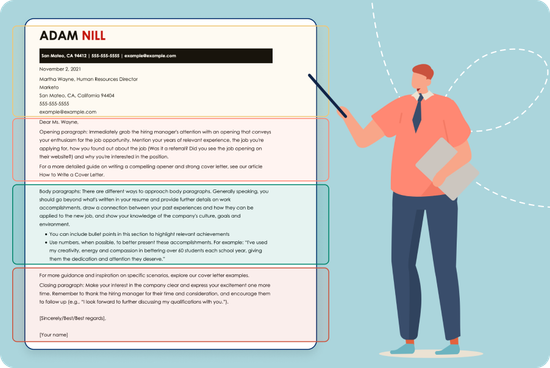
A cover letter outline is a simple structure that organizes what you want to say in your cover letter before you start writing.
It breaks your letter into clear sections, such as the introduction, body paragraphs, and closing, so you know the direction you want to take with your letter.
Think of it as a blueprint for crafting a compelling narrative and prioritizing your most relevant skills and experiences for each position you apply for.
Benefits of Using a Cover Letter Outline
Using a cover letter outline helps you save time, highlight your most relevant qualifications, and organize your thoughts to avoid missing key information.
It’s like planning a speech; you want to ensure your message is clear and impactful, without unnecessary fluff. Here’s a closer look at the key benefits of using a cover letter outline:
- Save time when applying to multiple positions by reusing your outline.
- Tailor your message to match each role by building on your outline.
- Organize your thoughts to prevent overlooking important details.
A strong outline makes writing a cover letter faster and easier, especially when you’re tailoring your cover letter for different roles. Instead of starting from a blank page each time, you can follow the same proven framework and adjust the details to fit each job.
When to Use a Cover Letter Outline
A cover letter outline is useful when you want to write a clear, focused letter; for example, if you’re changing careers, reentering the workforce, or applying for multiple roles.
If you’re not sure how to start, an outline gives you direction and keeps you from leaving out important details. Here are a few instances when you’ll find an outline particularly useful:
- Writing your first cover letter: If you’ve never written a cover letter, an outline helps organize your thoughts and create a framework for what to include in each section.
- Writing multiple cover letters: A reusable outline allows you to quickly tailor your letter for different roles without starting from scratch each time.
- Meeting specific employer requirements: Some employers ask for specific information or a nontraditional format. Creating an outline in advance makes it easier to structure your letter and address those requests confidently.
- Switching careers: If you’re moving into a new field or haven’t written a cover letter in years, an outline can help you clearly connect your experience to a new role.
Unlock the Door to Your Next Opportunity
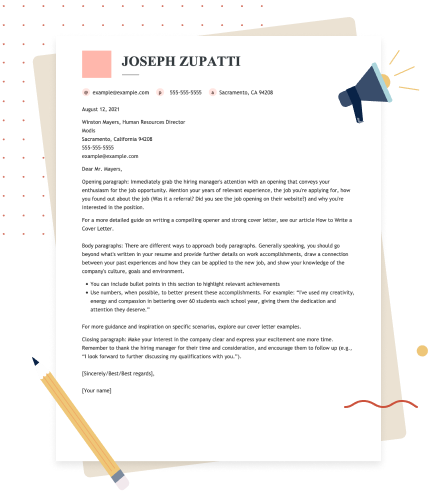
How to Outline a Cover Letter in 5 Steps
To write an outline for a cover letter, start by identifying the key sections you need to include and summarizing the content you’ll cover in each one. Follow the steps below to get the basic structure and flow in place before you start writing.
Step 1: Start With the Header & Greeting
Begin your outline by detailing the information you’ll include in your cover letter header—your full name, phone number, email address, location, and any relevant links—followed by the date, the employer’s contact information, and a professional salutation.
Organizing these details in advance ensures your letter looks polished and is easy for the employer to reference. Here’s a template you can use to get started:
[Your Name]
[Your Address (City, State)] [Your Email] | [Your Phone Number] | [LinkedIn or Portfolio URL]
[Date]
[Hiring Manager’s Name]
[Company Name]
[Company’s Full Address]
Dear [Hiring Manager’s Name],
Whenever possible, address your cover letter to a specific person. If you can’t find a name, you can use a general greeting like “Dear [Hiring Manager’s Name]” or “Dear [Team/Department].”
Step 2: Plan a Strong Introduction
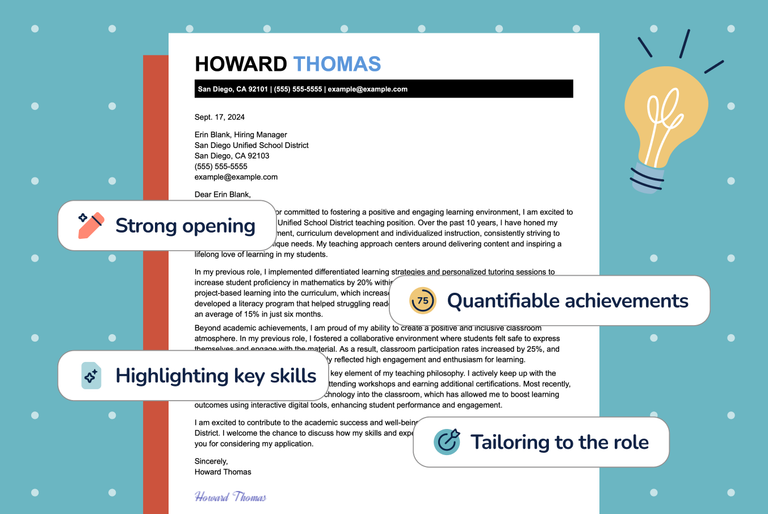
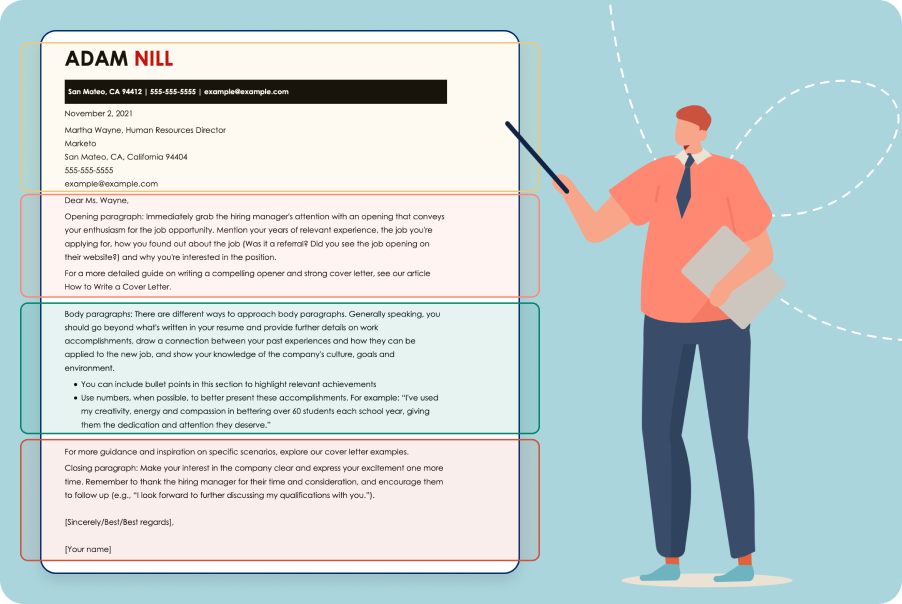
Outline an impactful cover letter introduction that states the role you’re applying for and explains why you’re interested in the position or company. Your opening paragraph should quickly capture the hiring manager’s attention and give them a reason to continue reading your letter.
When outlining your introduction, note that you’ll want to include the following:
- Opening sentence: State the job you’re applying for and where you found the listing.
- Interest statement: Briefly explain why the role or company appeals to you.
- Value hook: Highlight one key skill, achievement, or qualification that makes you a strong fit and encourages the hiring manager to keep reading.
Here’s an example starting point for your cover letter outline:
Introduction: State the job title you’re applying for and mention where you found the job posting. Briefly explain why the role or company interests you, referencing its mission, values, or the type of work involved. End by introducing one key skill, experience, or achievement that directly relates to the role and signals the value you would bring if hired.
Review how to start a cover letter for expert strategies and examples to help you stand out.
Step 3: Map Out the Body Paragraph(s)
Use one to three body paragraphs to highlight your most relevant skills, experience, and accomplishments. Your body paragraphs are also where you’ll add any requirements the employer has for a cover letter, such as experience managing a team or using specific software.
You can organize your body paragraphs in several effective ways, such as:
- Grouping experience from previous roles chronologically or by relevance
- Focusing each paragraph on a separate example or accomplishment
- Structuring your content to respond to any questions outlined in the job posting
In your outline, note specific examples that align with the job description and show how you can add value, rather than listing everything from your resume. Here’s an example:
First body paragraph: Highlight your most relevant experience and skills for the role. Briefly describe a specific responsibility, project, or achievement and explain how it relates to the job requirements, focusing on the results you achieved or the value you delivered.
Second body paragraph: Expand on another key qualification or strength, such as technical skill, soft skill, or industry knowledge. Connect this experience to the employer’s needs by explaining how it would help you succeed at the company or support a team, goal, or objective mentioned in the job description.
Adapt the outline to fit your requirements. For a simple cover letter, you’ll likely only have one body paragraph, whereas longer cover letters could include up to three body paragraphs.
Step 4: Include a Clear Closing Paragraph
End your outline with a closing that reinforces your interest in the role and invites the employer to take the next step, such as reviewing your resume or scheduling an interview. This section should sound confident and courteous, without repeating earlier points. For example:
Closing paragraph: Briefly restate your interest in the role and reinforce why you’re a strong fit for the position. Thank the employer for their time and consideration, and include a polite call to action—such as expressing interest in discussing your application further or meeting for an interview—to end your letter on a confident, professional note.
See our guide on how to end a cover letter for additional tips and examples.
Step 5: Plan a Professional Sign-Off
For your sign-off, plan a brief, professional closing that matches the tone of your cover letter. Choose a standard closing such as “Sincerely” or “Best regards,” followed by your full name.
If you’re submitting a digital application, you may also note where your signature or typed name will appear to ensure the letter feels complete and polished. Here’s an example:
Sincerely,
[Your Full Name]
[Your Signature]
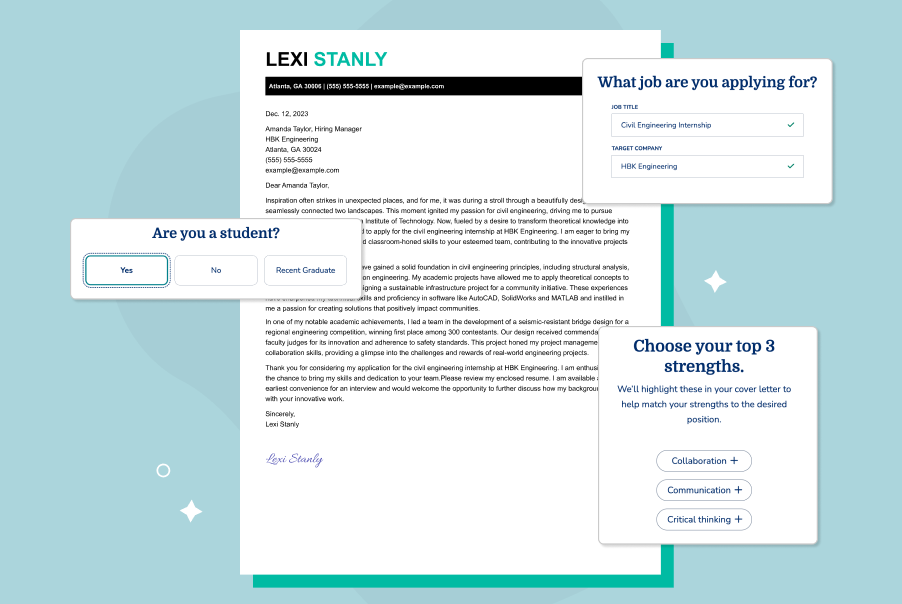
Our Cover Letter Generator guides you through each section of your letter with personalized prompts and ready-made content, so you can quickly turn your outline into a polished letter.
Cover Letter Outline Example
You can use the simple cover letter outline below as a base to structure your cover letter, highlight your most relevant experience, and communicate your value to employers.
[Your Name]
[Your Address (City, State)] [Your Email] | [Your Phone Number] | [LinkedIn or Portfolio URL]
[Date]
[Hiring Manager’s Name]
[Company Name]
[Company’s Full Address]
Dear [Hiring Manager’s Name],
Introduction: I am excited to apply for the [job title] position at [company name]. With my background in [your field/experience] and my passion for [relevant skill, industry, or mission of the company], I am confident in my ability to contribute positively to your team.
First body paragraph: In my previous role at [previous company or organization], I [briefly describe a key accomplishment or responsibility that relates to the job]. This experience allowed me to [explain a skill or quality you developed that matches the job requirements], which aligns with the [specific company or team goal] of [company name].
Second body paragraph: I am particularly drawn to [company name] because of [specific reason you admire the company, such as its mission, projects, culture, or achievements]. I am eager to bring my skills in [key skills or expertise] to support [company goal, team, or project], and I am confident that my proactive approach and commitment to excellence will make a meaningful impact on the future of the company.
Closing paragraph: I welcome the opportunity to discuss how my experience and skills can benefit your team. Thank you for considering my application. I look forward to contributing to [company name] and am available at your convenience for an interview.
Sincerely,
[Your Name]
Formatting Guidance for Your Cover Letter
Once your outline is complete, it’s time to focus on writing and formatting your cover letter. A proper cover letter format ensures your letter looks professional, is easy to read, and makes a strong impression. Follow these tips to ensure a polished letter:
- Header design: Include your name, address, phone number, email, and optional LinkedIn or portfolio link. Make sure your information is clear and professional.
- Font style and size: Use clean, professional fonts like Calibri, Arial, or Times New Roman. Body text should be 10 to 12 pt., and your name should be 14 to 16 pt.
- Alignment and layout: Left-align all text (header can be centered). Avoid excessive formatting, only using bold or italics for emphasis or in your header.
- Length: The ideal cover letter length is between half a page and one full page—around 250 to 400 words and 3 to 6 paragraphs.
- Margins and spacing: Stick to 1-inch margins. Single-space your paragraphs with a double space between sections. Keep paragraphs short (three to five sentences).
- Consistency: Keep fonts, spacing, and formatting uniform throughout. Use a matching resume and cover letter template for a cohesive application.
- Proofreading: Double-check alignment, spacing, and font consistency. Make sure there are no typos, extra spaces, or formatting glitches.
- File format: When submitting digitally, save your cover letter as a PDF or DOCX to preserve formatting and ensure it opens correctly for the recipient.
Key Takeaways
- Start with a strong structure. Use a cover letter outline to organize your cover letter into clear sections and ensure your message is easy to follow.
- Tailor it to the job. Customize your outline to highlight the skills and experiences that align with the specific position and company.
- Showcase your value. Use the outline to plan how you’ll demonstrate how you can solve problems or contribute to the organization.
- Keep it concise and focused. A well-structured outline helps you avoid unnecessary details and maintain a professional, readable letter.
- Use it as a roadmap. Your outline acts as a guide for writing the final draft, making the writing process faster, more organized, and more confident.
FAQ
Do I need to make a cover letter outline?
You don’t have to create a cover letter outline, but doing so can be very beneficial. An outline helps you organize your ideas, highlight your most relevant skills, and ensure your letter flows logically. Even a simple plan can make writing faster, reduce errors, and result in a more polished, focused cover letter that better captures hiring managers’ attention.
How long should my cover letter outline be?
A cover letter outline doesn’t need to be long—usually one page or even a few bullet points is enough. The goal is to map out your key sections, main achievements, and points you want to emphasize. Keep it concise so it serves as a clear roadmap without overwhelming you, helping you write a focused, organized, and compelling cover letter.
Should I create a separate outline for every job?
You don’t always need to create a new cover letter outline for every job. For highly targeted applications, a detailed, customized outline ensures your cover letter highlights the most relevant skills and achievements. For other roles, a simpler, template-style outline can work, and you can adapt key sections for different positions to save time.
How detailed should my cover letter outline be?
The level of detail in your cover letter outline depends on your approach and the job. For highly tailored applications, a detailed outline, including specific achievements, keywords, and examples, can guide a strong, focused letter.
For more general applications, a simpler outline with main sections and key points is sufficient. The goal is to create a roadmap that makes writing easier without restricting your natural, professional tone when it’s time to write your full letter.
Can a cover letter outline help me write faster?
Yes, a cover letter outline can help you write faster. By mapping out your key points, structure, and examples beforehand, you reduce time spent figuring out what to include or how to organize your ideas.
An outline acts as a roadmap, keeping your writing focused and efficient, so you can produce a polished, professional cover letter more quickly than starting from scratch.
How we reviewed this article
Since 2012, we have helped more than 11 million job seekers. We want to make your career journey accessible and manageable through our services and Career Center’s how-to guides and tips. In our commitment to bring you a transparent process, we present our Editorial Process.
Rate this article
Cover Letter Outline


Elizabeth is a Certified Professional Resume Writer (CPRW) and a member of the Professional Association of Resume Writers & Career Coaches. She is committed to helping job seekers navigate the job market and succeed in their careers.
More Articles by Elizabeth Muenzen, CPRWShare this page
 Add MyPerfectResume as a preferred source on Google
Add
Our customers have been hired at:*Foot Note