How to List Projects on a Resume (Examples & Tips)

Our customers have been hired at: *Foot Note


Table of Contents
Get started with MyPerfectResume today!
- Build a resume on any device
- Pick an ATS-friendly template
- Tailor with AI copy suggestions
Projects on a resume help demonstrate hands-on experience, highlight key skills, and show employers how you apply knowledge in real-world situations.
Whether you’re a student, recent graduate, career changer, or experienced professional, adding relevant projects can strengthen your resume and make your qualifications more concrete.
In this guide, you’ll learn how to list projects on a resume, where to place them, and how to write effective project descriptions that highlight measurable results.
What Does “Projects” Mean on a Resume?
“Projects” on a resume refer to specific pieces of work—academic, professional, or personal—that show how you applied skills to achieve a result. These can include anything from building a website to completing a research study or leading a marketing campaign.
What Are Examples of Projects to Include on a Resume?
When considering what projects to include on a resume, focus on work that shows skills, tools, and measurable impact aligned with the job.
Common types of resume projects include:
- Academic and capstone projects, such as research papers, case studies, group assignments, or capstone projects that apply classroom learning to real-world problems and demonstrate foundational skills.
- Internship and work-based projects, such as process improvements, marketing campaigns, or data analysis work that shows measurable impact in a professional setting.
- Technical and portfolio projects, such as apps, websites, UX/UI designs, data dashboards, or GitHub contributions that showcase technical ability and problem-solving.
- Freelance and client projects, such as building websites, creating designs, or providing consulting services that demonstrate real-world results and client-facing experience.
- Personal and self-initiated projects, such as blogs, self-taught coding builds, content creation, or experimental work that demonstrates skill development and initiative.
- Volunteer and community projects, such as event planning, fundraising, outreach, or skills-based support, which highlight leadership and transferable skills.
Should You List Projects on a Resume?
Yes, you should list projects on a resume when they strengthen your qualifications, demonstrate relevant skills, or help fill gaps in experience.
Before adding a project, ask yourself:
- Is this project relevant to the job I’m applying for?
- Does it demonstrate a specific skill the employer is looking for?
- Did I use tools, technologies, or methods that are valued in this industry?
- Can I show measurable results, impact, or improvements from this project?
- Is it a recent, high-quality example of my work?
Who Should Include Projects in a Resume?
Including project descriptions in resumes is valuable for almost any candidate, but especially for:
- Students writing a resume with no experience who need to demonstrate applied skills
- Recent graduates looking to show job readiness through academic or capstone projects
- Career changers who want to prove transferable skills in a new field
- Freelancers who rely on project-based work to showcase client results and experience
- Job seekers in technical fields, such as engineering, where hands-on work is essential
- Creative professionals, like designers, with portfolio-style work samples
- Candidates with employment gaps who use projects to show skill development
Benefits of Adding Projects to a Resume
Adding resume project details helps you:
- Demonstrate real-world application of skills
- Highlight initiative and problem-solving ability
- Strengthen your resume when work experience is limited
- Provide measurable proof of impact
- Differentiate yourself from other candidates
How Do You List Projects on a Resume?
List projects on a resume in a clear, structured format that quickly shows employers what you accomplished, what skills you used, and why the work is relevant to the role.
Each project entry should be concise, easy to scan, and focused on measurable results or practical applications of your skills. Strong project descriptions in a resume focus on results, relevant tools, and your direct contribution. Depending on your experience level, projects can appear in a dedicated projects section, under work experience, or within your education section.
To list projects on a resume effectively, include:
- The project name or title
- Your role or level of involvement
- The dates or timeframe of the project
- Relevant tools, technologies, or skills used
- A brief description of the project objective or task
- Measurable outcomes, achievements, or results
Here’s an example:
Customer Sales Dashboard | Data Analytics Project | 2025
- Developed an interactive sales dashboard using Excel and Power BI to track monthly revenue trends.
- Automated reporting processes, reducing manual reporting time by 30%.
- Analyzed customer purchasing data to identify top-performing product categories.
When writing project descriptions, focus on action verbs, relevant keywords, and specific accomplishments rather than vague responsibilities. Employers should be able to quickly understand what you contributed and the value the project delivered.
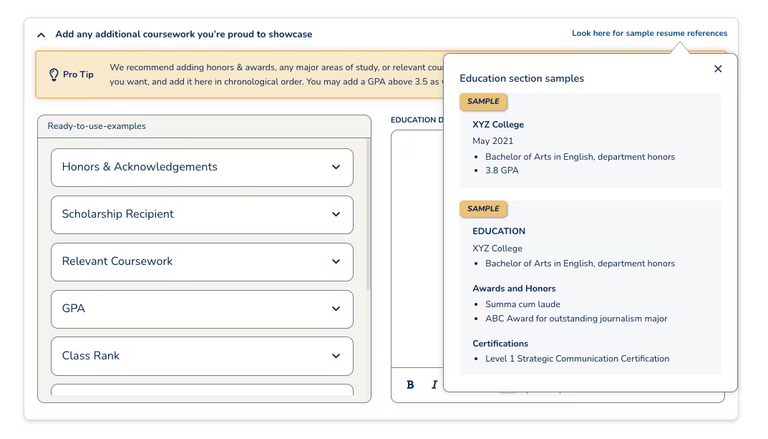
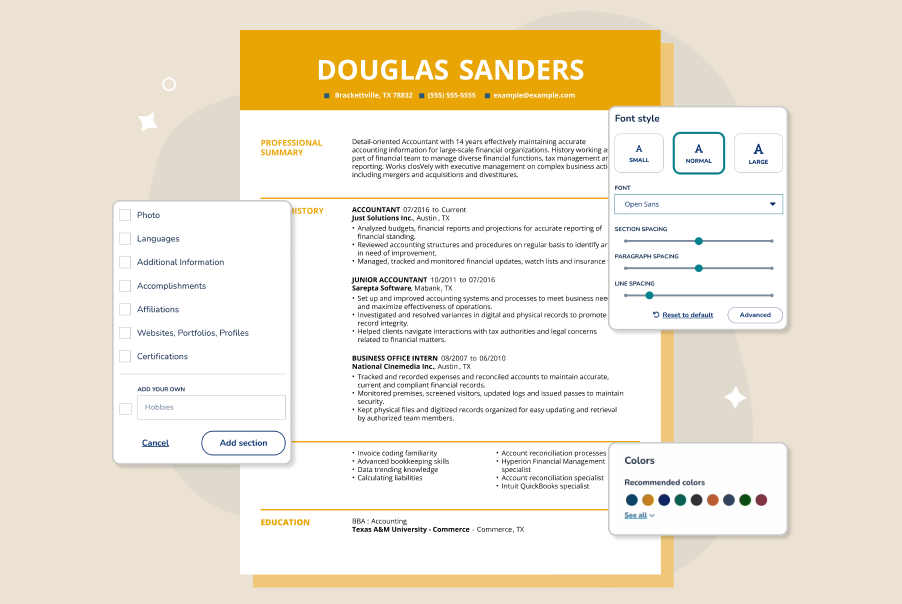
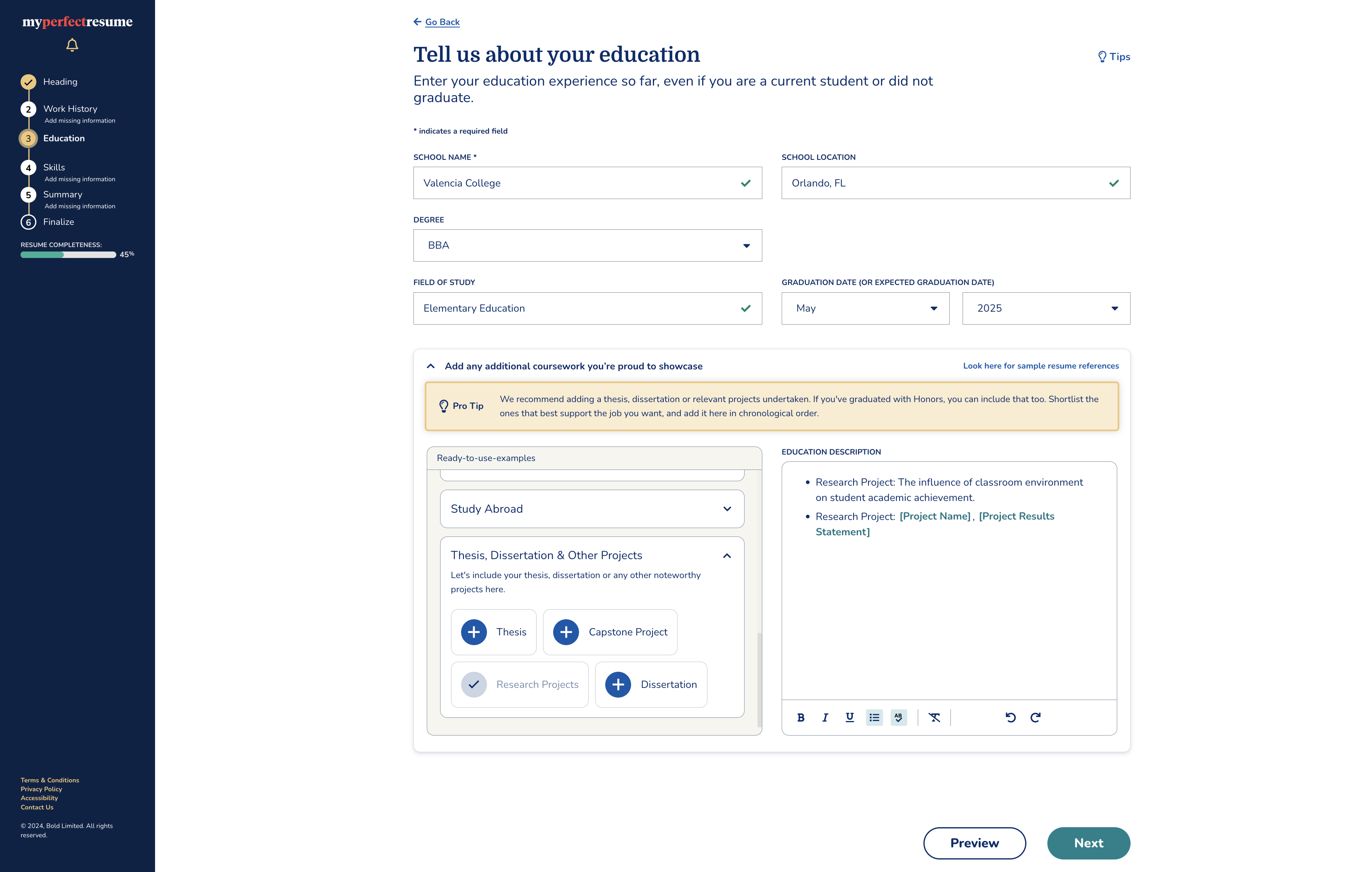
Our Resume Builder includes an option to add additional sections, such as projects. Alternatively, you can incorporate projects into core resume sections, such as education:
Where Can You Put Projects on a Resume?
Projects should be placed in the section of your resume where they best support your qualifications, are easiest for employers to find, and are most relevant to the job.
Depending on your experience level and the type of project, they may appear in a dedicated projects section, under work experience, within education, or near the top of the resume to maximize visibility.
In Your Resume Summary
Projects can be included in your resume summary when they’re highly relevant and demonstrate your strongest, most job-aligned achievements upfront. This establishes credibility quickly by highlighting measurable outcomes from real-world or applied experience.
For example:
“Data Analyst with 8+ years of experience building automated dashboards and predictive models that improve reporting efficiency and decision-making. Led a customer retention analysis project at Northbridge Retail Group, identifying churn trends using Python and Power BI. Reduced reporting time by 35% through automation and streamlined data workflows. Experienced in translating complex datasets into actionable business insights.”
Under Your Work Experience
Projects completed as part of a job or internship can be listed under the corresponding work experience entry. This approach works well for professionals who want to showcase major accomplishments, initiatives, or measurable contributions tied to a specific role.
Including projects within work experience helps demonstrate how you applied your skills in a professional environment and contributed to business results.
Here’s an example:
WORK HISTORY
Marketing Coordinator
Evergreen Digital Solutions | Seattle, WA | June 2023–May 2026
- Led a social media campaign project that increased engagement by 40% over three months.
- Coordinated email marketing automation using HubSpot, improving lead nurturing efficiency.
- Collaborated with design and sales teams to launch targeted product promotion campaigns across digital channels.
In a Dedicated Projects Section
A dedicated projects section is one of the best ways to highlight relevant experience or transferable skills that may not fit within traditional work history. A separate section also makes projects easier to scan and allows you to emphasize work that directly supports your target role.
You can choose a captivating title, such as “Property Management Projects” or “Creative Projects,” to grab the reader’s attention and emphasize the subject.
Or, you can simply list it as “Projects.” Whichever you choose, be sure to include all the relevant information for each project.
Here’s an example of a dedicated projects section:
PROJECTS
Ecommerce Website Redesign | UX Design Project | 2026
- Redesigned a small business website using Figma and Adobe XD.
- Improved mobile navigation and user flow based on usability testing.
- Increased average session duration by 22% during the testing phase.
In Your Education Section
Academic, research, and capstone projects are commonly listed within the education section, particularly for students and recent graduates with limited work experience. This placement helps employers quickly see how coursework and academic work translate into practical skills.
It’s especially effective for technical, scientific, and research-focused roles where academic projects closely relate to job responsibilities.
Here’s an example:
EDUCATION
BS in Computer Science | University of Washington | 2026
Capstone Project: Inventory Management System
- Developed a cloud-based inventory tracking application using Python and SQL.
- Built reporting dashboards to monitor supply levels and order trends.
- Presented the final project to faculty and industry mentors.
In a Portfolio or Technical Skills Section
Technical, creative, and portfolio-based projects can also appear alongside links to GitHub repositories, personal websites, design portfolios, or published work.
This format is common in fields such as software development, UX/UI design, writing, marketing, and graphic design because it allows employers to directly view examples of your work and technical abilities. Here’s an example of how to structure this entry:
TECHNICAL SKILLS & PORTFOLIO
- GitHub: github.com/janedoe
- Portfolio: janedoedesign.com
Featured Project: Sales Analytics Dashboard | Harborview Analytics
- Created an interactive Tableau dashboard analyzing regional sales performance.
- Automated reporting processes and visualized quarterly trends.
Examples of Projects on a Resume by Industry
Projects should always reflect the expectations of your target industry, showing employers that you can apply relevant tools, methods, and problem-solving approaches in real-world contexts. Below are examples of how projects can be adapted across different fields.
Customer Service
In customer service roles, projects should demonstrate how you improved the customer experience through better systems, streamlined processes, or more effective team workflows.
Here’s an example for a customer experience manager’s resume:
CRM System Implementation Project | Customer Service Operations
- Served as project lead for the implementation of a new customer relationship management (CRM) system across customer service operations.
- Defined system requirements, managed data migration, and coordinated cross-functional rollout planning.
- Delivered end-user training and adoption support, improving customer data accuracy and increasing service efficiency across teams.
Education
For education, training, or development-focused roles, projects should demonstrate program design, facilitation skills, and measurable improvements in participant outcomes or engagement.
Projects in this field are most effective when they show both structure and measurable impact on learners or participants.
Here’s an example for a high school teacher’s resume:
Student Leadership Development Program | High School Leadership Initiative
- Designed and implemented a student leadership development program to increase student engagement in leadership roles across the school community.
- Facilitated workshops focused on communication, collaboration, and decision-making skills.
- Increased student participation in leadership activities by 25% and improved collaboration and communication skills by 30%.
Healthcare
Healthcare projects should emphasize accuracy, compliance, system integration, and improvements in patient care or operational efficiency. Technical tools and regulatory standards are especially important here.
Here’s an example project entry:
EHR Implementation Project | Clinic Solutions | May 2021–Present
Spearheaded the transition from paper-based records to an electronic health records (EHR) system across a multispecialty clinic using Epic Systems, HL7, and SQL.
- Reduce patient record retrieval time by 50% through digitization and workflow optimization.
- Improve data accuracy and accessibility across departments by standardizing health record processes.
- Enhance interoperability between systems through structured data integration.
Marketing
In marketing and creative roles, projects should highlight strategy, execution, brand impact, and measurable performance improvements across campaigns or design initiatives. Effective project entries often combine leadership responsibilities with clear, quantifiable results.
For example:
Brand Strategy & Design Leadership | Creative Agency Inc. | June 2021–Present
Led multiple high-impact branding and design initiatives for client accounts, combining strategy, team leadership, and execution.
- Develop and execute a brand strategy that has increased brand recognition by 25% and sales by 20% within six months.
- Manage a team of four designers, improving turnaround times by 15% through workflow optimization and mentorship.
- Direct a product packaging redesign that has increased shelf visibility by 50% and boosted sales by 10%.
- Lead a website redesign that has improved user engagement by 45% and reduced bounce rate by 30% to date.
Sales
In sales roles, projects should focus on revenue impact, pipeline growth, process improvements, and cross-functional collaboration. Employers prioritize measurable business outcomes. Strong entries typically lead with results, followed by supporting actions and strategies.
Here’s an example project entry for a general sales manager’s resume:
Product Line Launch Initiative | Fancy Enterprises | August 2019–March 2026
- Led the launch of a new product line that generated $2M in revenue and exceeded sales targets by 30%.
- Partnered with marketing and product development teams to align go-to-market strategy and messaging.
- Achieved 20% market penetration and a 15% increase in customer engagement within six months.
Tips to Make Resume Projects Stand Out
Resume projects stand out when they go beyond listing tasks by highlighting measurable results, using strong action verbs, and aligning directly with the job description. To make your projects more compelling, focus on clarity, specificity, and outcomes that demonstrate real value.
- Always keep it relevant to the application. Whether you’re applying for graduate school or your next career role, each project should directly support the knowledge, skills, and experience the employer is looking for.
- Include numbers and measurable results. Quantifying outcomes shows impact and credibility. Use metrics such as percentages, revenue growth, time saved, or efficiency improvements to demonstrate what your project achieved.
- Use bullet points and clear, simple language. Structure your project descriptions so they’re easy to scan and understand quickly. Avoid unnecessary jargon, especially in technical fields, since hiring managers may not be deeply familiar with your work.
- Add links when possible. If your project is available online, include links to portfolios, live sites, GitHub repositories, or published work so employers can review your results and assess your capabilities directly.
- Run an ATS resume check. After adding projects, test your resume with an ATS Resume Checker to ensure applicant tracking systems (ATS) can accurately parse them, and that formatting doesn’t interfere with keyword recognition or readability.
Key Takeaways
- Projects are a valuable addition to your resume because they demonstrate your skills, experience, and impact in practical, real-world, or applied scenarios.
- You can include any project on your resume as long as it’s relevant to the role or program you’re applying for and strengthens your overall qualifications.
- Choose the most appropriate section for each project, such as education for academic or student work, work experience for job-related projects, or a dedicated projects section.
- Always include the project name, your role or level of involvement, and the outcomes or results achieved, regardless of where the project is placed on your resume.
- Use strong action verbs and quantifiable metrics wherever possible to clearly communicate your contribution and keep the reader engaged.
Frequently Asked Questions
What can I put for projects on a resume?
You can include academic, freelance, technical, volunteer, and personal projects on a resume if they demonstrate relevant skills and measurable results.
This can include capstone projects, internships, client work, technical builds, research assignments, and self-initiated projects that align with the role you’re applying for.
What is a good example of a project?
A good project example clearly explains what you accomplished, the skills you used, and the measurable results achieved.
For example, a data analytics project where you built a sales dashboard using Power BI and SQL that reduced reporting time by 30% demonstrates both technical ability and business impact.
What are examples of personal projects?
Examples of personal projects include self-initiated work that demonstrates your skills, interests, and ability to learn independently outside of formal employment or education.
These can include building a personal website or app, creating a blog or YouTube channel, developing a data analysis project using publicly available datasets, designing digital artwork or branding concepts, or contributing to open-source software.
What are the three C’s of a resume?
The three C’s of a resume are clarity, consistency, and conciseness, and they’re especially important when listing projects.
Clarity ensures each project clearly explains what you did, the tools you used, and the outcome you achieved. Consistency keeps formatting, structure, and tone uniform across all project entries. Conciseness focuses on including only relevant project details and measurable results without unnecessary description.
Should you include school project details in a resume?
You should include school project details in a resume if they’re relevant to the job and demonstrate useful skills or practical experience. School projects are especially valuable for recent graduates and students’ resumes because they show applied learning, problem-solving ability, and familiarity with tools or concepts used in the field.
Focus on projects that have clear outcomes and help strengthen your overall qualifications rather than listing every assignment.
What are red flags on a resume?
Red flags on a resume are warning signs that may cause employers to question your experience, credibility, or attention to detail.
When it comes to projects, common red flags include vague descriptions with no clear outcome, a lack of measurable results, or listing irrelevant projects that don’t align with the role. Other concerns include inconsistent formatting, exaggerated claims, or failing to explain your specific contribution, which can make your experience hard to evaluate.
Can I include a group project in my resume?
Yes, you can include a group project in your resume as long as it’s relevant to the role and clearly explains your individual contribution.
Group projects are especially useful for demonstrating soft skills like teamwork, collaboration, and problem-solving gained in academic, internship, or professional settings.
Be specific about what you personally worked on, the tools you used, and the outcomes achieved, so employers can clearly understand your role within the project.
Rate this article
Projects on a Resume


Elizabeth is a Certified Professional Resume Writer (CPRW) and a member of the Professional Association of Resume Writers & Career Coaches. She is committed to helping job seekers navigate the job market and succeed in their careers.
More Articles by Elizabeth Muenzen, CPRWShare this page
 Add MyPerfectResume as a preferred source on Google
Add
Our customers have been hired at:*Foot Note