Table of Contents
Get started with MyPerfectResume today!
- Build a resume on any device
- Pick an ATS-friendly template
- Tailor with AI copy suggestions
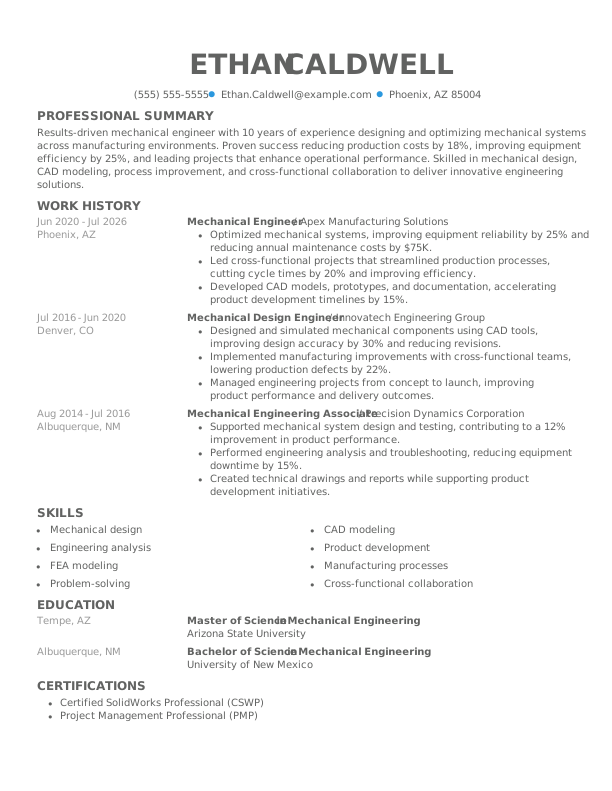
Why this resume works
- Quantifies accomplishments: Including measurable accomplishments, such as improving equipment reliability by 25%, the applicant highlights their tangible impact and value.
- Showcases career progression: Progressing through various engineering roles with growing responsibility and expertise, and driving project success and cost reductions along the way, demonstrates the applicant’s steady career growth.
- Uses action-oriented language: Through action verbs such as “developed” and “implemented,” this mechanical engineering resume example conveys the applicant’s initiative and a results-oriented approach.
More Engineering Resume Examples
See our engineering resume examples to learn how to showcase your technical skills, project experience, and problem-solving abilities. These samples will help you create a resume that meets industry standards and highlights your engineering expertise effectively.
Entry-Level Engineering Resume

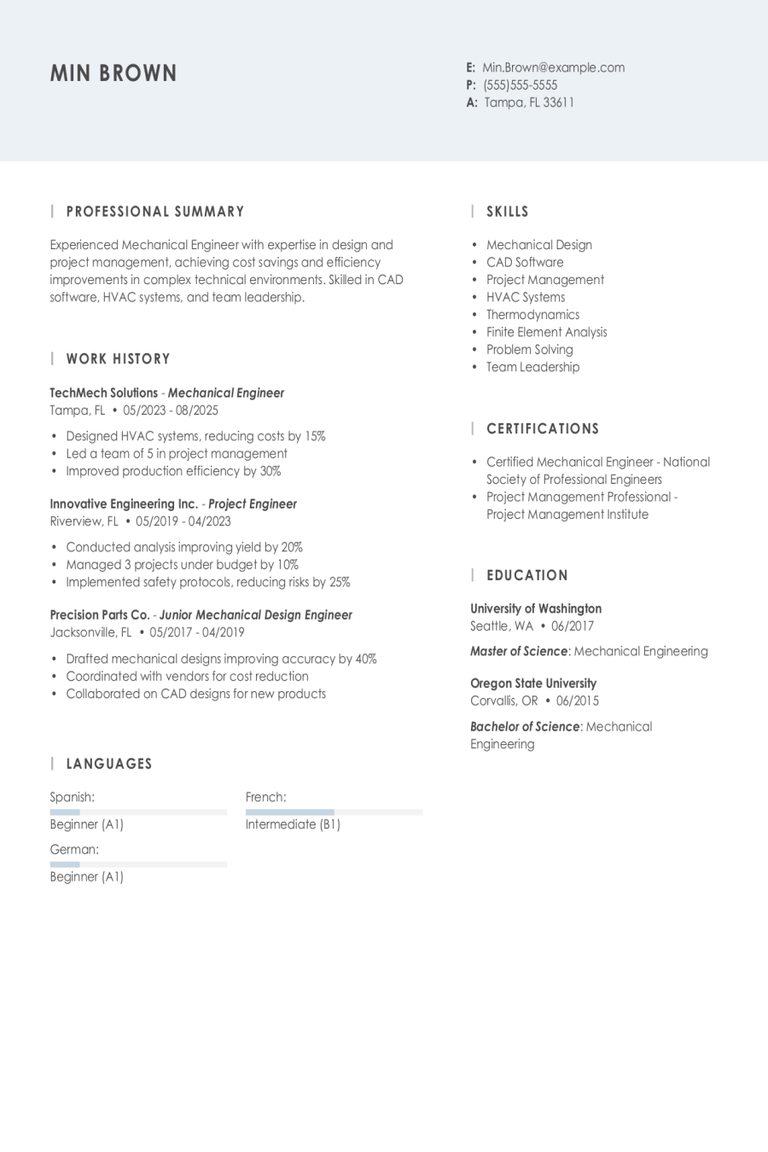
Why this resume works
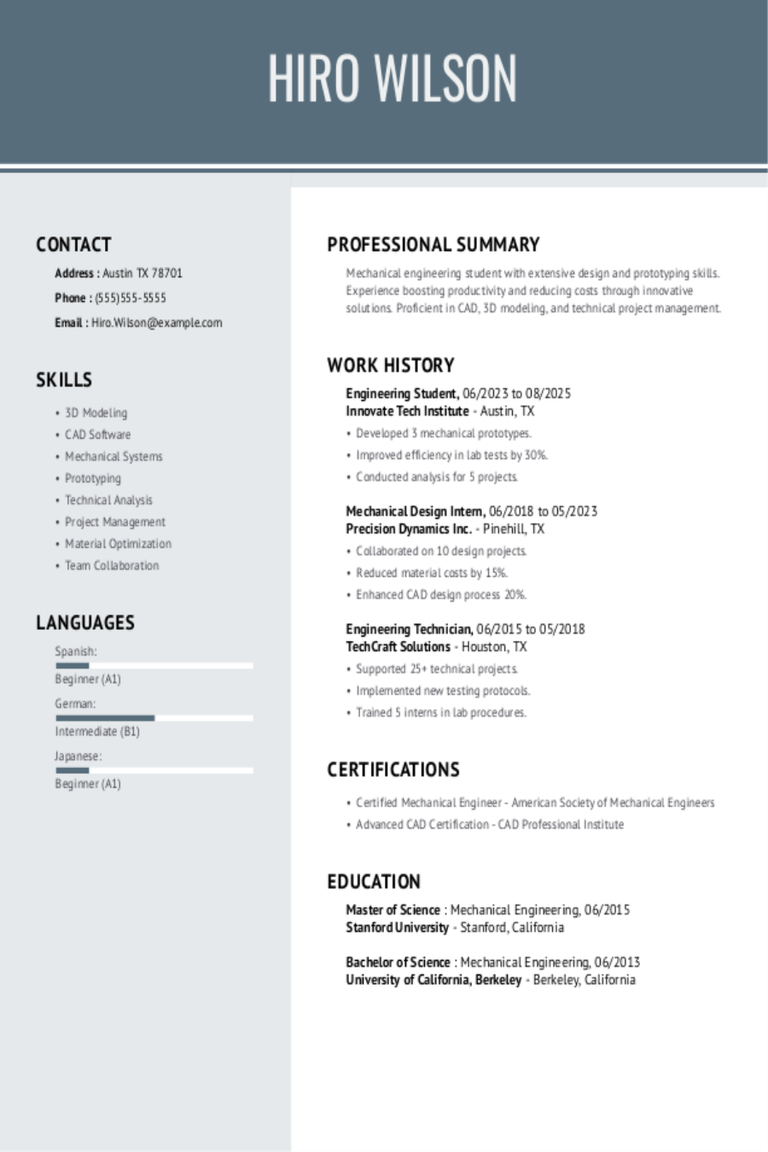
- Effective use of keywords: By weaving in industry-specific keywords like “project scheduling” and “engineering solutions,” the applicant ensures their resume is optimized for applicant tracking systems (ATS).
- Shows digital literacy: The inclusion of CAD software skills alongside data analysis indicates the applicant’s computer skills are well-suited for tech-driven environments.
- Centers on academic background: Emphasizing a bachelor’s degree in mechanical engineering in the education section highlights academic excellence, which is important for those early in their career.
Mid-Level Engineering Resume

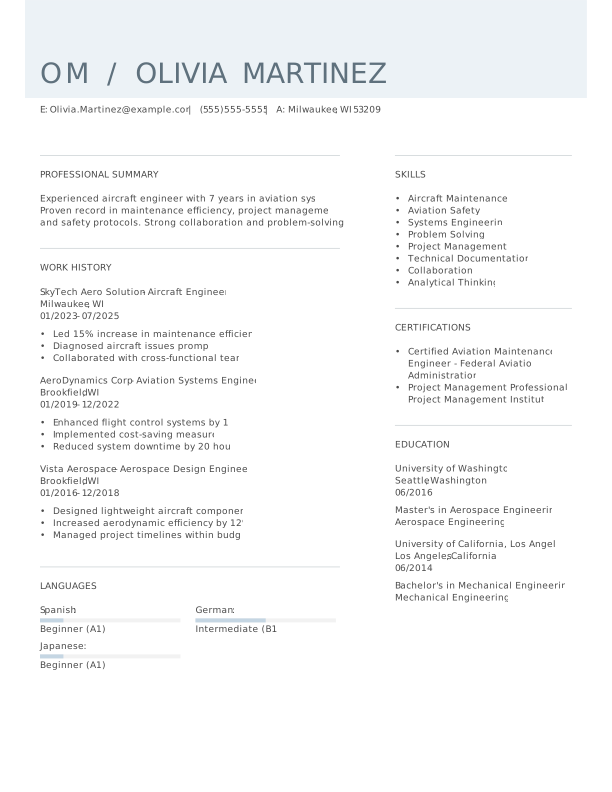
Why this resume works
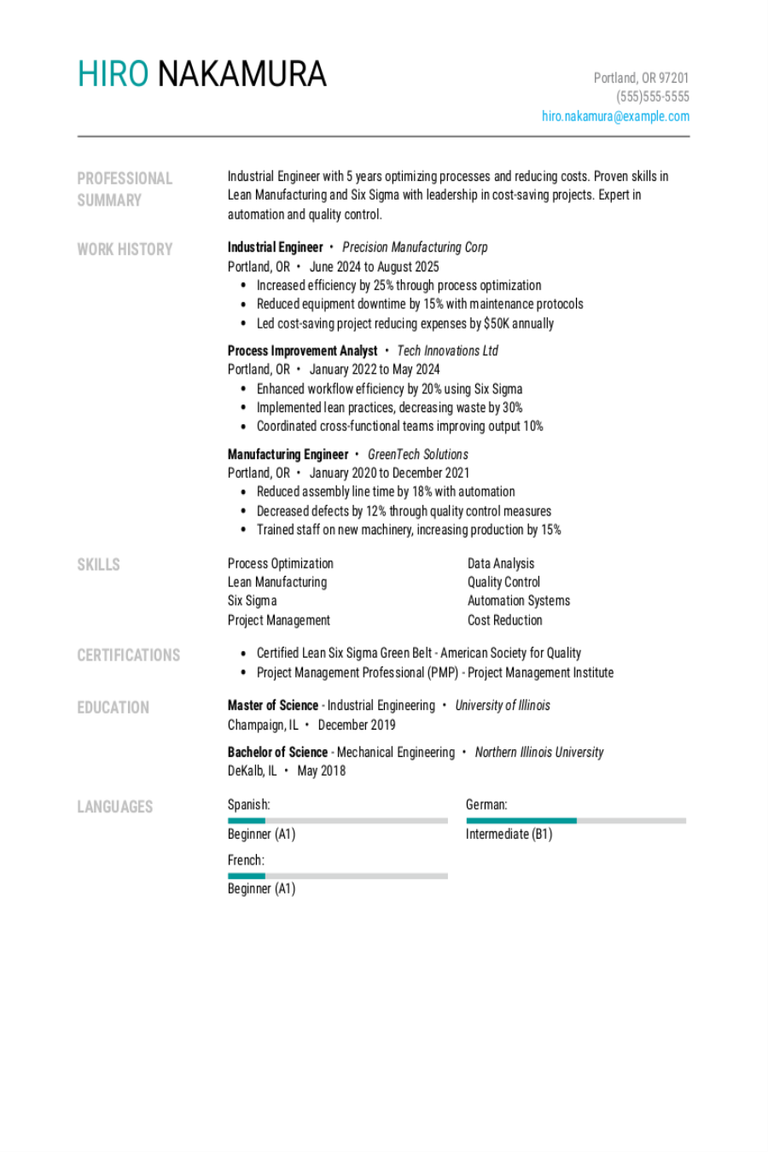
- Points to measurable outcomes: Designing a system that improved infrastructure efficiency by 25% showcases the applicant’s knack for delivering measurable outcomes in engineering environments.
- Demonstrates language abilities: Language skills in Spanish, French, and German improve cross-cultural communication in diverse work settings.
- Includes a mix of soft and hard skills: Combining technical prowess in mechanical design with strong interpersonal skills like staff training, the applicant presents a well-rounded skill set ready for complex challenges.
Experienced Engineering Resume

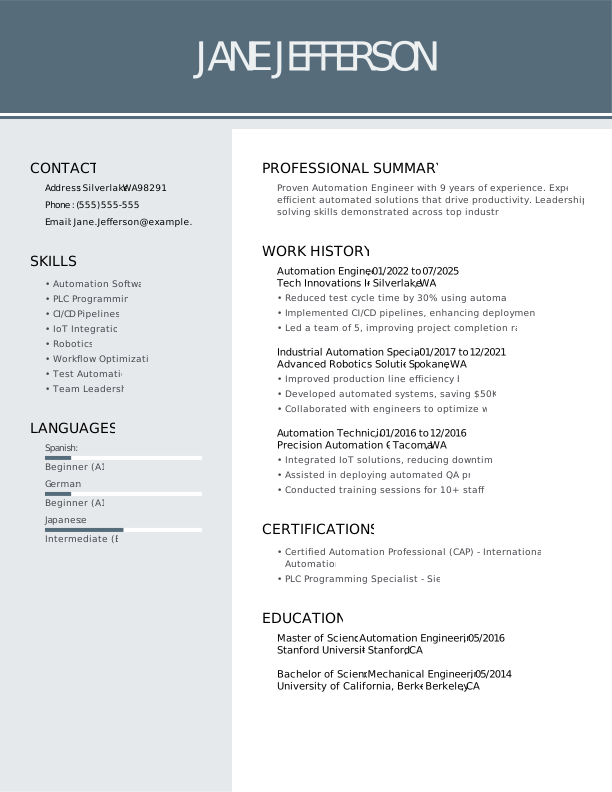
Why this resume works
- Focuses on work history: Using a chronological resume format, the applicant effectively charts a journey from civil engineering technician to civil engineer, showcasing career progression and impact.
- Sections are well-organized: Headers and bullet points make sections easy to scan, guiding readers through the applicant’s accomplishments, like achieving a 97% on-time delivery rate and improving project efficiency by 30%.
- Lists relevant certifications: Listing certifications such as Project Management Professional (PMP) and Professional Engineer (PE) shows the applicant’s dedication to mastering engineering techniques and continuous learning.
Explore Even More Engineering Resumes
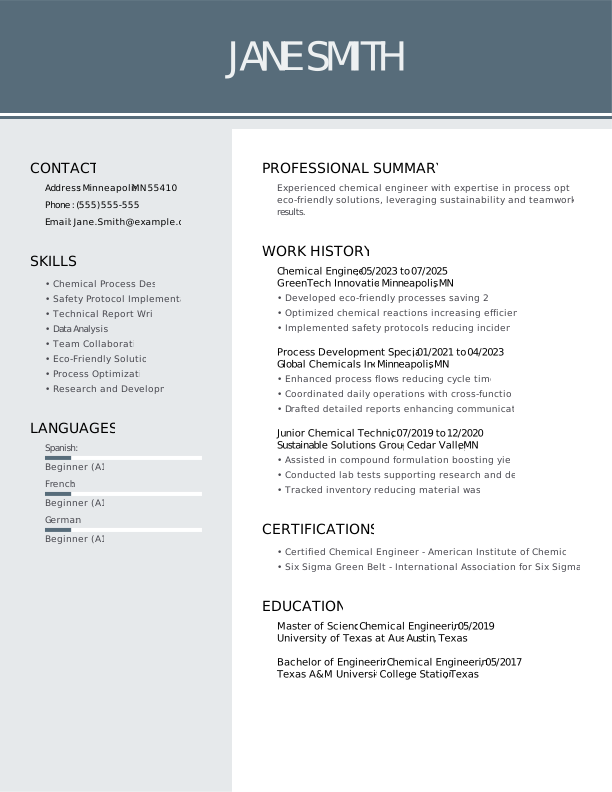
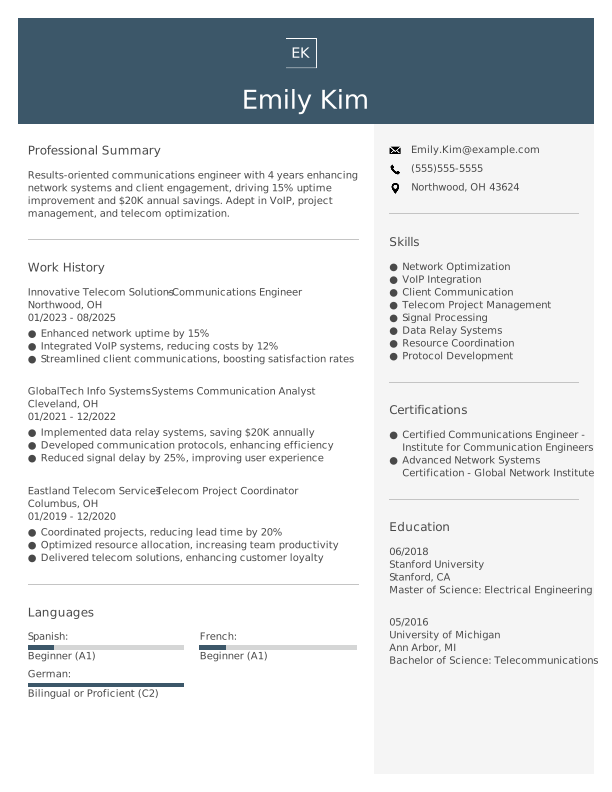
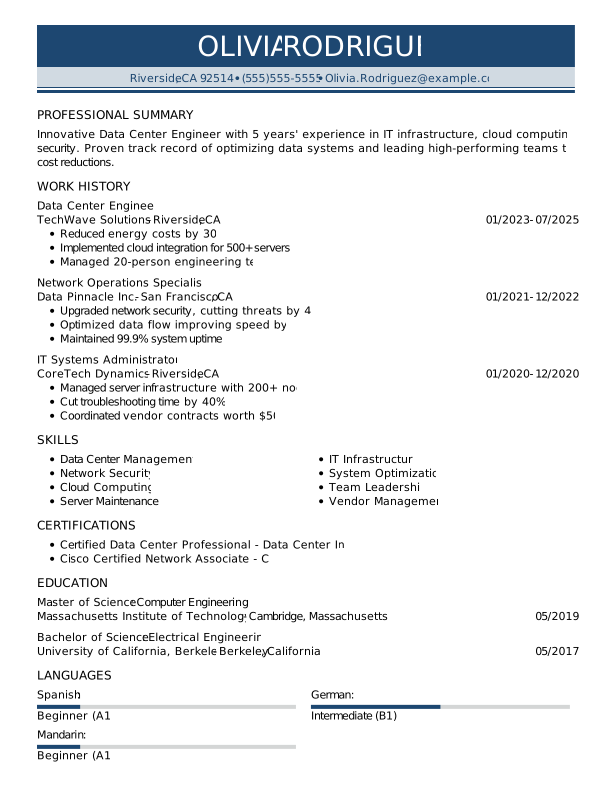
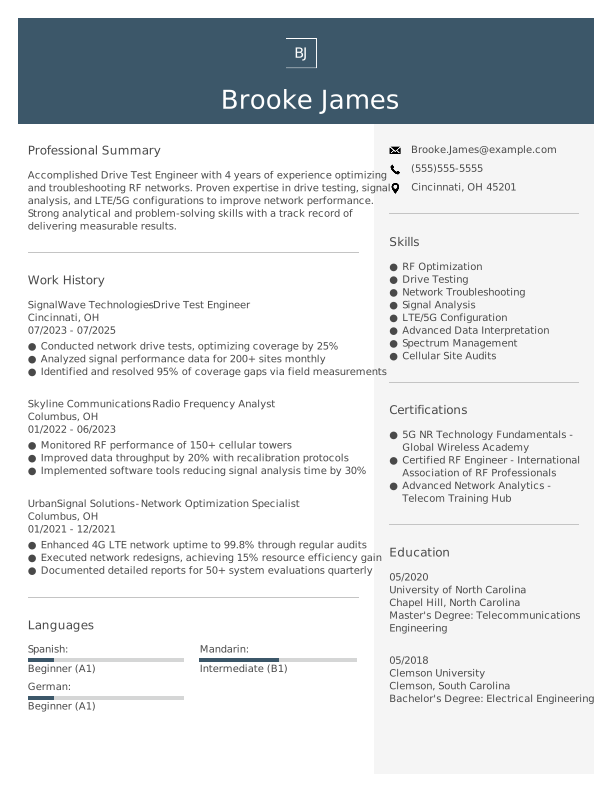
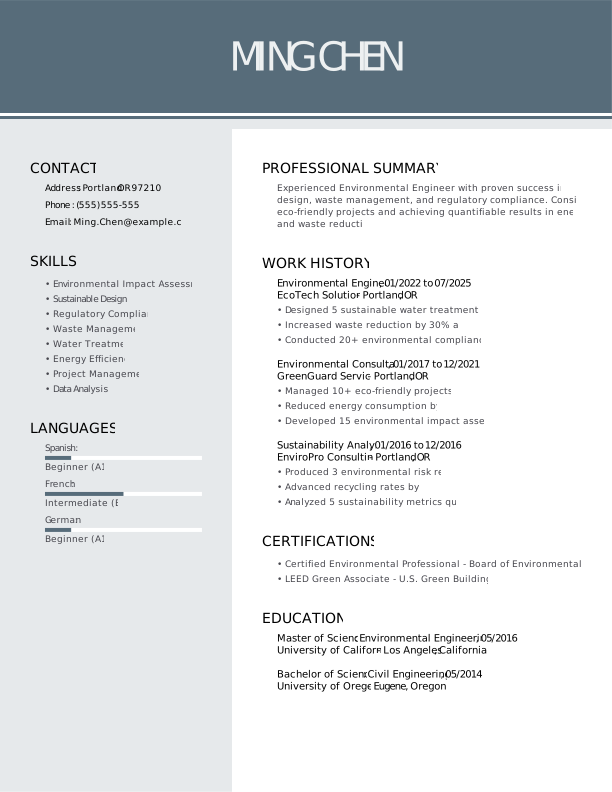
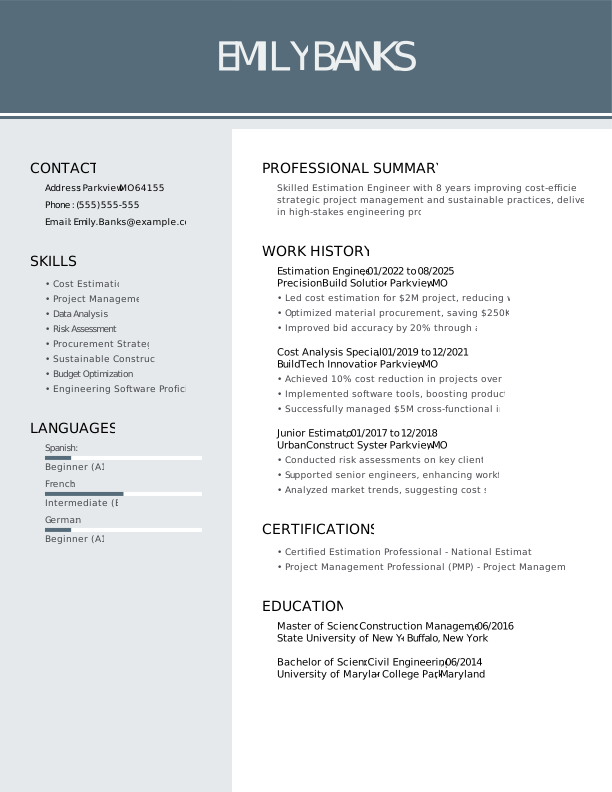
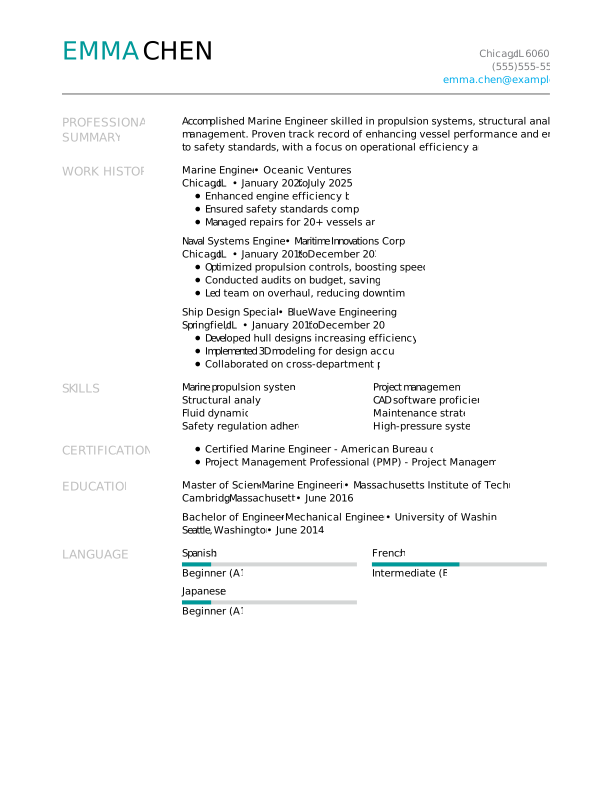
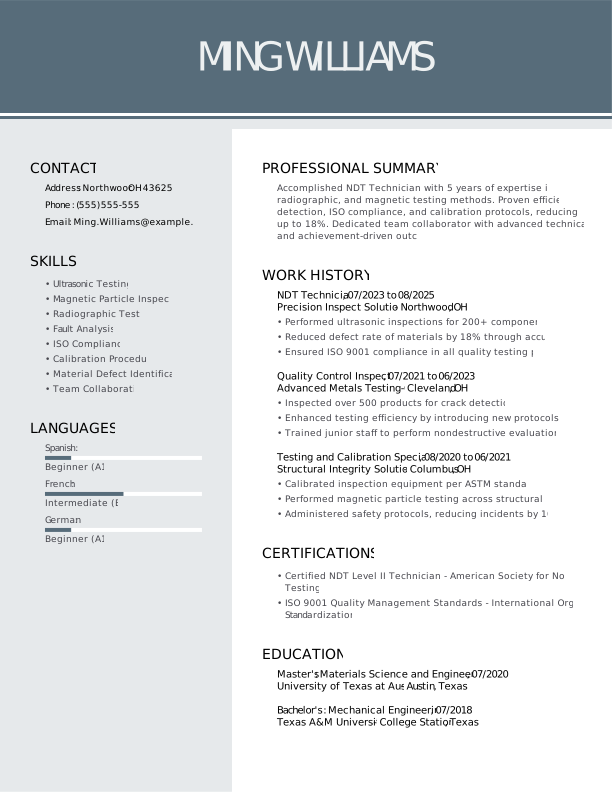
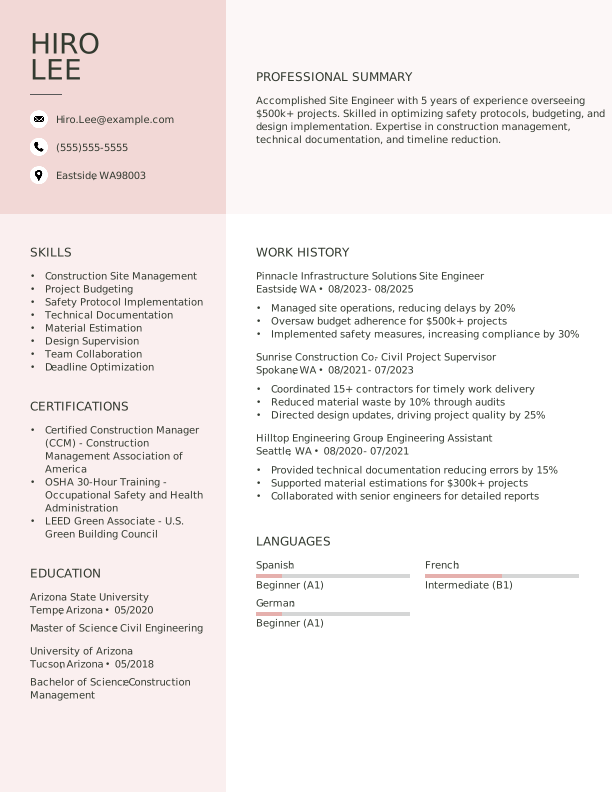
Engineering Resume Template (Text Version)
Copy the text below and customize it quickly. If you want more, check out our resume templates.
Ethan Caldwell
Phoenix, AZ 85004
(555) 555-5555
Ethan.Caldwell@example.com
Professional Summary
Results-driven mechanical engineer with 10 years of experience designing and optimizing mechanical systems across manufacturing environments. Proven success reducing production costs by 18%, improving equipment efficiency by 25%, and leading projects that enhance operational performance. Skilled in mechanical design, CAD modeling, process improvement, and cross-functional collaboration to deliver innovative engineering solutions.
Work History
Apex Manufacturing Solutions – Phoenix, AZ
Mechanical Engineer
June 2020 – July 2026
- Optimized mechanical systems, improving equipment reliability by 25% and reducing annual maintenance costs by $75K.
- Led cross-functional projects that streamlined production processes, cutting cycle times by 20% and improving efficiency.
- Developed CAD models, prototypes, and documentation, accelerating product development timelines by 15%.
Innovatech Engineering Group – Denver, CO
Mechanical Design Engineer
July 2016 – June 2020
- Designed and simulated mechanical components using CAD tools, improving design accuracy by 30% and reducing revisions.
- Implemented manufacturing improvements with cross-functional teams, lowering production defects by 22%.
- Managed engineering projects from concept to launch, improving product performance and delivery outcomes.
Precision Dynamics Corporation – Albuquerque, NM
Mechanical Engineering Associate
August 2014 – July 2016
- Supported mechanical system design and testing, contributing to a 12% improvement in product performance.
- Performed engineering analysis and troubleshooting, reducing equipment downtime by 15%.
- Created technical drawings and reports while supporting product development initiatives.
Skills
- Mechanical design
- CAD modeling
- Engineering analysis
- Product development
- FEA modeling
- Manufacturing processes
- Problem-solving
- Cross-functional collaboration
Education
Arizona State University, Tempe, AZ
Master of Science in Mechanical Engineering
University of New Mexico Albuquerque, NM
Bachelor of Science Mechanical Engineering
Certifications
- Certified SolidWorks Professional (CSWP)
- Project Management Professional (PMP)
Browse Resume Examples by Industry
- Aviation
- Banking
- Billing And Collections
- Biology
- Boating
- Business Operations
- Casino
- Chemistry
- Child Care
- Civil Engineering
- Compliance
- Computer Hardware
- Computer Software
- Construction
- Copywriting
- Cosmetology
- Costco
- Culinary
- Customer Service
- Dance
- Data Systems Administration
- Deloitte
- Dentistry
- Driving
- Education
- Electrical
- Electrical Engineering
- Energy
- Entertainment
- Entrepreneur
- Entry Level
- Environmental
- Environmental Science
- Event Planning
- Executive
- Fashion
- Film
- Finance
- Fitness & Nutrition
- Food Service
- Freelancing
- General Laborer
- Goldman Sachs
- Government
- Graphic Design
- Healthcare Support
- Hospitality
- Human Resources
- HVAC
- Industrial Engineering
- Information Technology
- Insurance
- Interior Design
- Inventory Management
- Janitorial
- Landscaping
- Language Services
- Law
- Law Enforcement
- Library
- Logistics
- Maintenance
- Marketing
- McKinsey
- Mechanical Engineering
- Mechanics
- Media And Communication
- Medical
- Mental Health
- Meta
- Metal Work
- Military
- Mining
- Museum
- Music
- Netflix
- Non Profit
- Nursing
- Pharmaceutical
- Photography
- Physical Therapy
- Plumbing
- Politics
- Production
- Program Manager
- Project Manager
- Psychology
- Purchasing
- Quality Control
- Real Estate
- Religion
- Retail
- Safety And Security
- Sales
- Sciences
- Shipping
- Social Services
- Special Education
- Sports
- Statistics
- Student
- Teaching
- Team Lead
- Tesla
- Training And Development
- Transportation
- Travel
- Veterinary
- Walgreens
- Walmart
- Web Development
Advice for Writing Your Engineering Resume
Explore our tips on how to write a resume for an engineering role and discover how to highlight your technical skills and problem-solving abilities. Whether you’re just starting or looking to advance, tailoring your resume to the unique demands of engineering will set you apart in the job market.
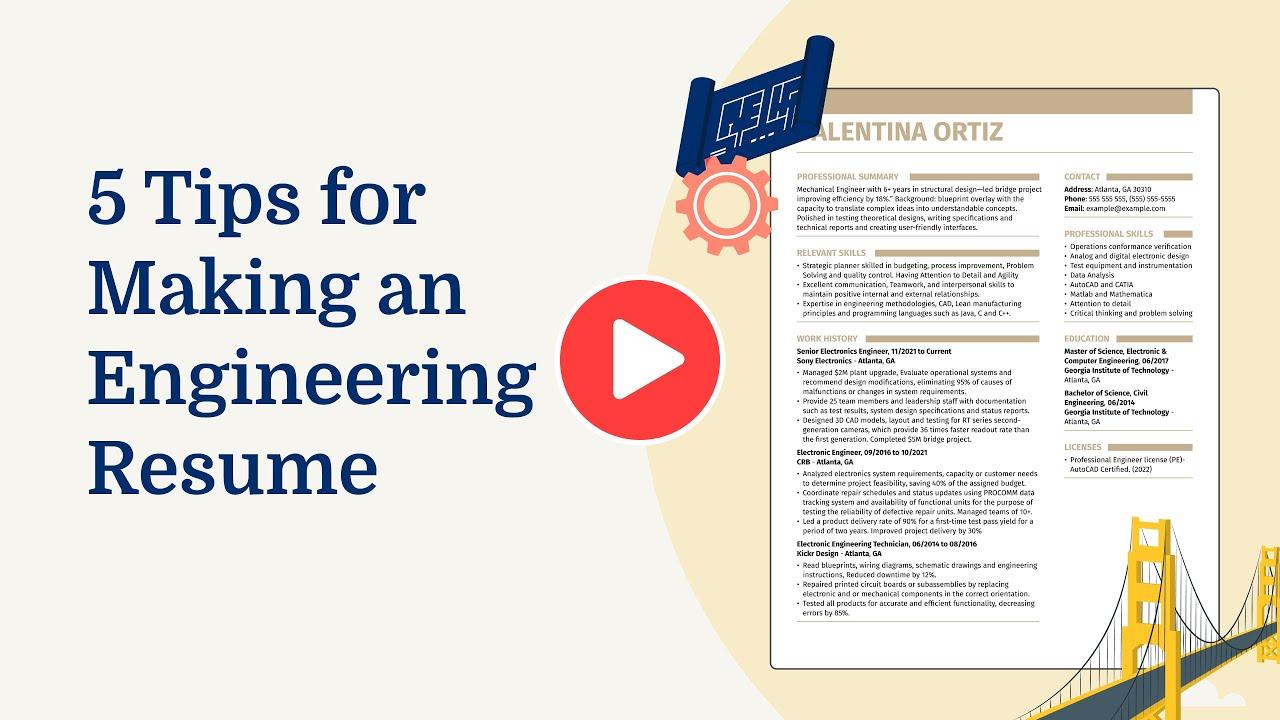
Highlight relevant technical skills
In engineering roles, technical skills are essential because they demonstrate your ability to handle the job’s complex requirements. A dedicated skills section on your resume allows employers to quickly identify your capabilities. This section should list skills that are directly relevant to the position you’re applying for.
You can also reinforce these abilities by incorporating them into your work experience descriptions, showing how you’ve applied them in real-world projects.
For an engineering role, valuable technical skills might include proficiency with CAD software such as AutoCAD or SolidWorks, programming languages like Python or C++, and experience with systems such as PLCs or IoT devices. Other in-demand skills can include data analysis tools, project management software, circuit design, thermodynamics, or materials science, depending on your specialization.
When selecting which skills to feature, focus on those emphasized in the job description and that align with your background. A targeted, well-organized skills section helps demonstrate that you’re a strong match for the role and are equipped with the hands-on expertise needed to excel in engineering.
Example of a technical skills section
- CAD software (AutoCAD, SolidWorks, CATIA)
- Finite element analysis (FEA)
- Thermodynamics & heat transfer
- Lean manufacturing & Six Sigma
- MATLAB & Python for engineering calculations
You can use our Resume Builder to craft a resume that highlights technical skills such as AutoCAD, SolidWorks, MATLAB, Python, CAD software, LabVIEW, Simulink, or engineering simulation tools. Specific software experience helps employers quickly understand your technical capabilities.
Quantify your accomplishments
Quantifying accomplishments in your resume makes it more engaging and informative. Instead of just listing tasks, you show what you achieved in your engineering role. In the work experience section, start by detailing your job title, employer name, location, and employment dates.
Then focus on turning duties into achievements with measurable results. For example, if you improved a process, mention how much time or money was saved. Using specific numbers like percentages or cost reductions gives a clear picture of your contributions.
Action verbs combined with metrics create a strong impression. Words like “increased,” “reduced,” or “improved” paired with data make your resume results-driven. This approach helps hiring managers quickly see your impact and skills without needing to read between the lines.
Quantified accomplishments are especially important in engineering jobs where efficiency and innovation are key. By highlighting these successes, you stand out as someone who not only does their job but also makes significant improvements that benefit the company.
5 engineering work history bullet points
- Developed a new hydraulic system design, increasing system efficiency by 25% and reducing maintenance costs by 15%.
- Led a cross-functional team in the implementation of lean manufacturing techniques, resulting in a 20% reduction in production time.
- Conducted structural analysis using Finite Element Analysis (FEA) software, improving product durability by 30%.
- Managed end-to-end project lifecycle for a $2 million construction project, completing it under budget and within the 6-month timeline.
- Coordinated with suppliers to improve material quality, decreasing defect rates by 40% and boosting overall product reliability.
Engineering employers want to understand the scope and impact of your work. Instead of only listing a project name or responsibilities, describe what you designed, improved, tested, or built, along with measurable results such as cost savings, performance improvements, efficiency gains, or successful project completion.
Write a powerful professional summary
A professional summary on a resume introduces hiring managers to your skills and achievements, offering a snapshot of your professional background. Choosing between a summary and an objective depends on your career goals and experience level.
A professional summary is a concise paragraph that highlights your skills, experience, and key achievements. It’s ideal for seasoned applicants who wish to showcase their professional identity and value swiftly. The aim is to briefly communicate what you’ve accomplished in the engineering field and how you can replicate that success in a new role.
On the other hand, resume objectives are suited for entry-level workers, career changers, or those with employment gaps, as they emphasize career goals. While summaries focus on past accomplishments (“what I’ve done”), objectives highlight future contributions (“what I plan to offer”).
Next, we’ll present examples of both professional summaries and resume objectives tailored for different industries and experience levels. This guidance will assist you in crafting the right introduction for your engineering career path.
Engineering resume summary examples
Entry-level
Recent Bachelor of Science in Mechanical Engineering graduate with foundational knowledge in CAD design, thermodynamics, and materials science. Completed internship at XYZ Engineering, where hands-on experience was gained in project management support and prototype testing. Eager to contribute strong analytical skills and a passion for innovation to a dynamic engineering team.
Mid-career
Mechanical engineer with over seven years of experience specializing in product development and manufacturing processes. Proven track record of leading cross-functional teams to improve production efficiency by integrating advanced automation systems. Holds a Six Sigma Green Belt certification and recognized for delivering cost-effective solutions that align with company goals.
Experienced
Senior electrical engineer with extensive expertise in power distribution and renewable energy projects. Over 15 years of experience managing large-scale projects from conception through execution, driving innovation in sustainable energy solutions. Known for leadership abilities, strategic planning, and successfully reducing operational costs through technology enhancements while maintaining high safety standards.
Engineering resume objective examples
Recent graduate
Detail-oriented recent graduate with a Bachelor of Science in mechanical engineering seeking an entry-level engineering role to apply academic knowledge in design principles and problem-solving. Passionate about contributing to innovative projects that drive efficiency and sustainability.
Career changer
Dedicated professional transitioning into the engineering field, leveraging previous experience in project management and analytical thinking. Eager to apply newly acquired skills in CAD software and materials science to support development teams in creating impactful solutions.
Specialized training
Aspiring engineer with certifications in 3D modeling and renewable energy systems seeking a role within a forward-thinking organization. Committed to using specialized training to develop cutting-edge technologies that address environmental challenges while improving operational performance.
Lead with your most relevant projects, internships, research, or professional experience. For early-career engineers, academic projects and hands-on work can be just as valuable as traditional employment when they demonstrate technical skills and problem-solving.
Showcase your credentials
Listing certifications, licenses, and specialized training is especially valuable in engineering because it demonstrates both your technical expertise and your commitment to professional development.
Employers want proof that you can handle complex, high-stakes projects, and industry-recognized credentials help validate your skills.
A dedicated certifications section on your resume makes these qualifications easy to find, and placing it near your education section gives hiring managers a complete view of your capabilities.
Examples of valuable engineering-related certifications include:
- AWS Certified Solutions Architect
- Google Professional Cloud Engineer
- Microsoft Certified: Azure Solutions Architect Expert
- Certified Kubernetes Administrator (CKA)
- CompTIA Security+
- Certified Engineering Technician (CET)
- Professional Engineer (PE) License
- AutoDesk Certified Professional (AutoCAD or Revit)
- Lean Six Sigma Green Belt or Black Belt
These credentials signal that you are staying current in a rapidly evolving industry and that you possess specialized knowledge in tools, systems, and methodologies commonly used in engineering.
Featuring them prominently on your resume can set you apart from other applicants and strengthen your case for technical roles.
Example of a certifications section
Certified Professional Engineer (PE)
Issued by: National Society of Professional Engineers (NSPE)
Issued 2023
AWS Certified Solutions Architect
Issued by: Amazon Web Services (AWS)
Expires 2026
Six Sigma Green Belt Certification
Issued by: International Association for Six Sigma Certification (IASSC)
Issued 2022
Certified LabVIEW Developer (CLD)
Issued by: National Instruments
Issued 2021
AutoCAD Professional Certification
Issued by: Autodesk
Expires 2024
Engineering roles can vary significantly, so customize your resume for the position. A mechanical engineering resume may emphasize CAD design and prototyping, while a software engineering resume may focus on programming languages, development frameworks, and technical projects.
FAQ
Do I need to include a cover letter with my engineering resume?
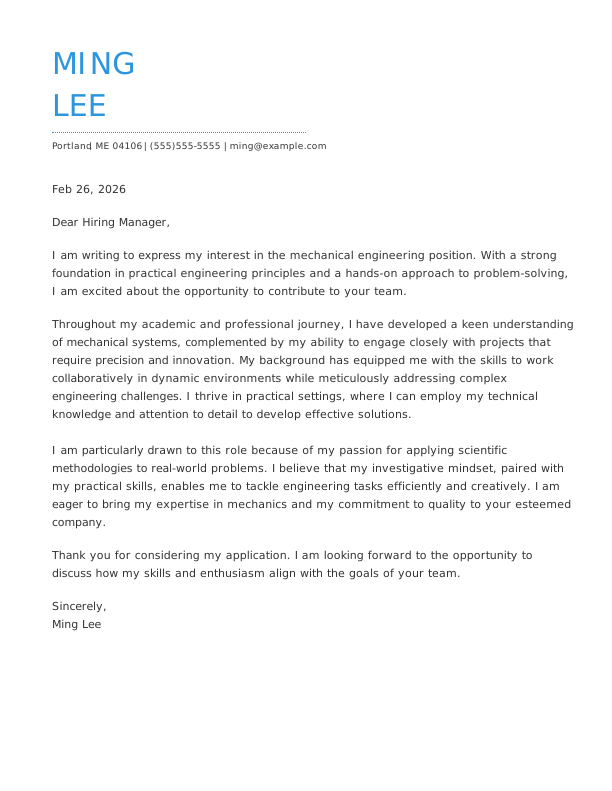
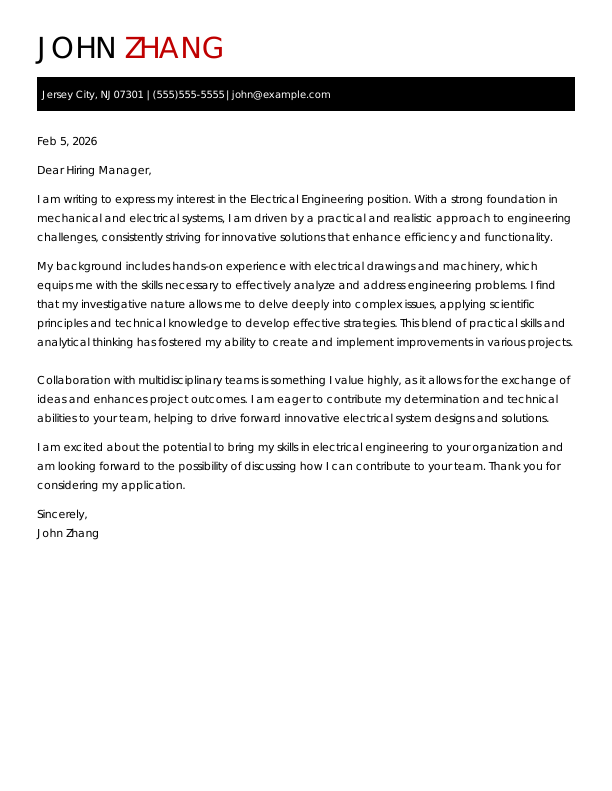
Yes—adding a cover letter to your engineering resume can significantly strengthen your application by highlighting the skills, experiences, and achievements that make you a strong fit.
An engineering cover letter gives you space to express your enthusiasm for the specific engineering role and company, while expanding on projects or accomplishments that may not be fully detailed in your resume.
If the company focuses on a particular branch of engineering or has noteworthy projects, connect your background, technical expertise, or passion to their work. This shows you’ve done your research and understand their priorities.
For a streamlined approach, you can use a Cover Letter Generator to create a tailored letter based on your resume, ensuring it has a professional format and compelling content.
Reviewing engineering-specific cover letter examples can also spark ideas, helping you adapt your letter to different roles, career levels, or engineering specialties. By pairing a strong resume with a well-crafted cover letter, you present a complete, persuasive application that sets you apart from other candidates.
How long should an engineering resume be?
For an engineering role, if you’re just starting, aim for a one-page resume focusing on key skills like problem-solving, technical expertise, and relevant software skills. Highlight internships or projects that showcase your hands-on experience.
If you have extensive experience or several specialized certifications and achievements, a two-page resume is acceptable. Ensure each detail matters and is directly related to your target roles. Highlight recent engineering projects or leadership roles to keep the reader’s interest.
Check out our guide on how long a resume should be for examples and tips tailored to different career stages in engineering.
How do you write an engineering resume with no experience?
When crafting a resume for an engineering role without experience, emphasize your education, skills, and any projects or internships that show your potential. Here are a few tips to help you get started:
- Emphasize your education: Start with your engineering degree, including the university name, graduation date, and any honors or relevant coursework. If you have a strong GPA or relevant academic projects, be sure to include them.
- Showcase technical skills: List programming languages, software tools, and technical skills you’ve learned during your studies. Skills like CAD software or coding in Python can catch an employer’s eye.
- Highlight project work: Include details of any academic projects where you applied engineering principles. Describe the problem-solving methods you used and the outcomes achieved.
- Include internships or volunteer work: If you’ve interned at an engineering firm or volunteered in roles requiring similar skills, detail these experiences to show practical application of your knowledge.
Check out our guide on writing a resume with no experience for more tips on writing resumes without professional experience, and see examples tailored for entry-level roles.
How do I make my engineering resume stand out?
Make your engineering resume stand out by focusing on the technical skills, projects, and achievements that are most relevant to the role.
Highlight specific engineering tools, software, certifications, and methodologies you’ve used, and show how your work contributed to measurable results.
Instead of only listing responsibilities, describe the problems you solved, designs you improved, systems you developed, or processes you optimized.
Including metrics such as cost savings, efficiency improvements, performance gains, or successful project outcomes can help demonstrate the impact of your engineering expertise.
Rate this article
Engineering


Elizabeth is a Certified Professional Resume Writer (CPRW) and a member of the Professional Association of Resume Writers & Career Coaches. She is committed to helping job seekers navigate the job market and succeed in their careers.
More Articles by Elizabeth Muenzen, CPRWShare this page
 Add MyPerfectResume as a preferred source on Google
Add