Table of Contents
Get started with MyPerfectResume today!
- Build a resume on any device
- Pick an ATS-friendly template
- Tailor with AI copy suggestions
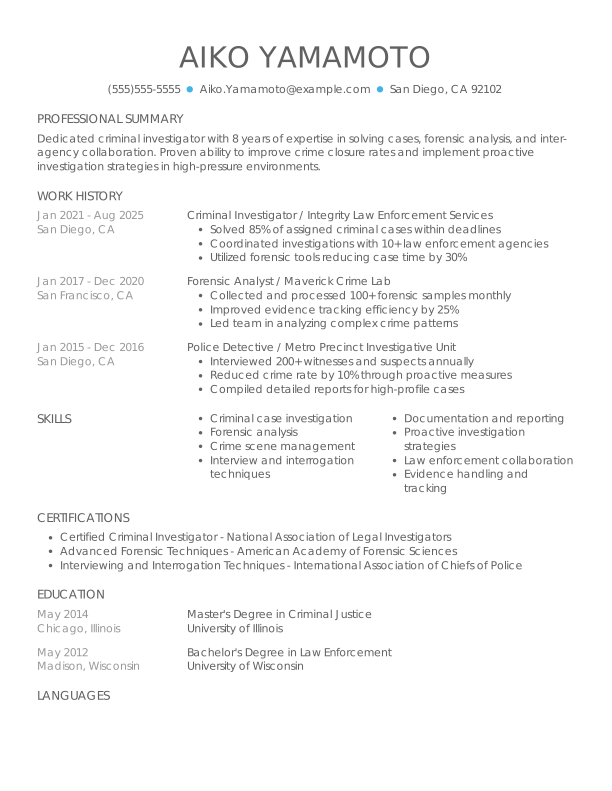
Why this resume works
- Highlights industry-specific skills: The applicant’s mastery in forensic analysis and criminal investigation illustrates their fit for roles demanding specialized law enforcement expertise, showcasing industry-specific skills effectively.
- Quantifies accomplishments: Solving 85% of cases and improving evidence tracking by 25% highlights the applicant’s tangible impact with measurable achievements.
- Showcases career progression: Progressing from police detective to criminal investigator showcases increasing responsibility, reflecting career growth through complex investigations and high-profile case management.
More Criminal Investigator Resume Examples
Browse our criminal investigator resume examples to discover how to highlight your analytical skills, field expertise, and case-solving experience. These law enforcement resume samples will help you craft a resume that captures employer attention.
Entry-Level Criminal Investigator
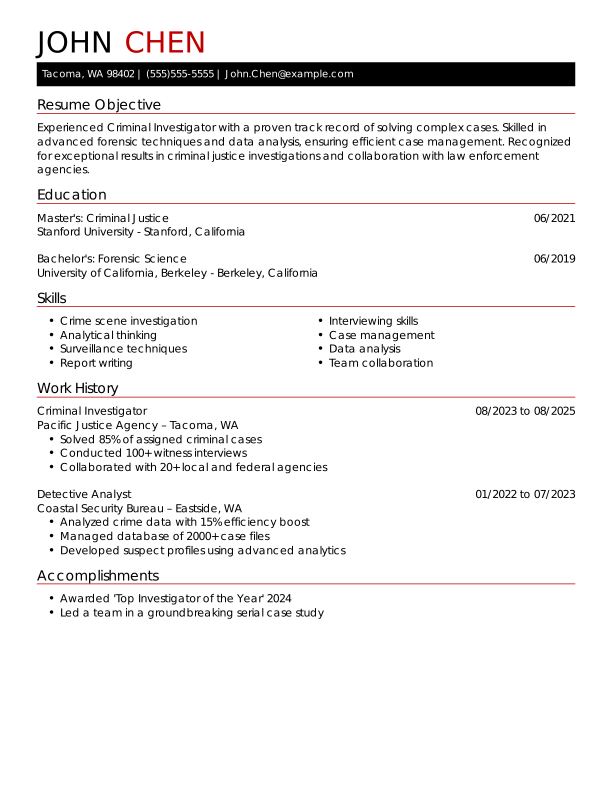
Why this resume works
- Centers on academic background: Highlighting a master’s degree in criminal justice in the education section shows the applicant’s strong academic foundation early in their career.
- Effective use of keywords: Keywords such as “crime scene investigation” and “data analysis” strategically boost the resume’s compatibility with keywords for applicant tracking systems (ATS) systems.
- Shows digital literacy: Managing databases and developing suspect profiles using advanced analytics showcase impressive computer skills essential for modern workplaces.
Mid-Level Criminal Investigator
Why this resume works
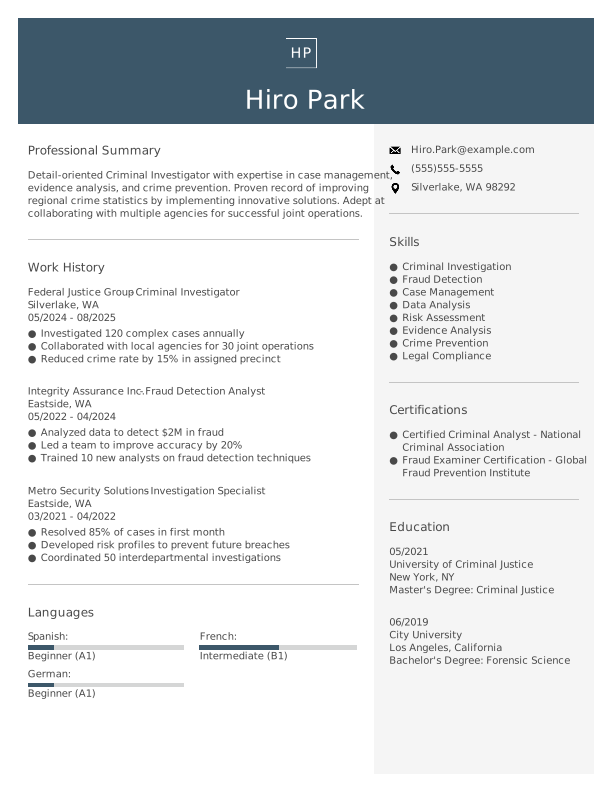
- Points to measurable outcomes: Reducing the crime rate by 15% in a specific precinct showcases the applicant’s effectiveness and tangible impact on community safety.
- Demonstrates language abilities: Language skills in Spanish, French, and German support cross-cultural communication, improving their ability to handle international cases.
- Displays technical expertise: Certifications like Certified Criminal Analyst and Fraud Examiner Certification highlight specialized knowledge essential for complex investigations.
Experienced Criminal Investigator
Why this resume works
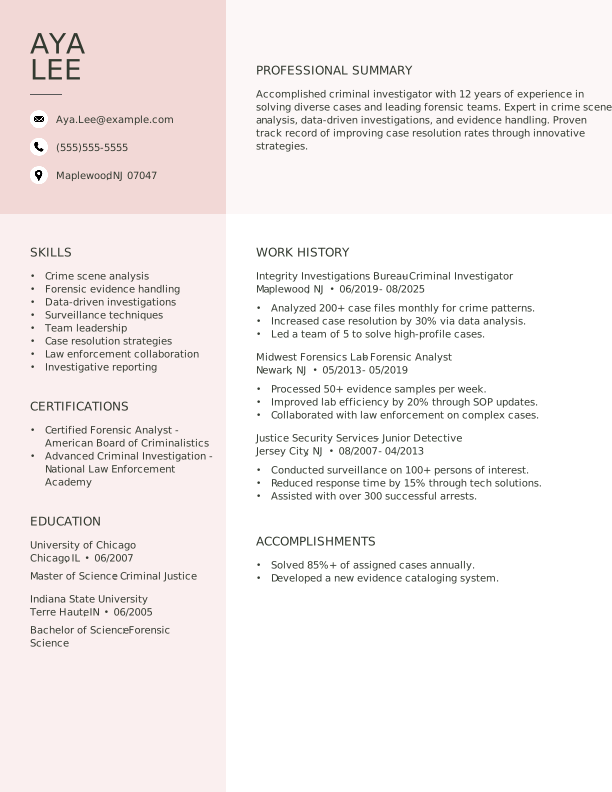
- Focuses on work history: By organizing roles from junior detective to criminal investigator, the applicant’s use of a chronological resume gives a clear view of career progression.
- Showcases impressive accomplishments: With achievements like boosting case resolutions by 30%, the applicant’s standout accomplishments clearly indicate senior-level impact and innovative problem-solving.
- Lists relevant certifications: Including certifications such as Certified Forensic Analyst and Advanced Criminal Investigation, the applicant emphasizes ongoing expertise and commitment to growth in their field.
Criminal Investigator Resume Template (Text Version)
Aiko Yamamoto
San Diego, CA 92102
(555)555-5555
Aiko.Yamamoto@example.com
Professional Summary
Dedicated criminal investigator with 8 years of expertise in solving cases, forensic analysis, and inter-agency collaboration. Proven ability to improve crime closure rates and implement proactive investigation strategies in high-pressure environments.
Work History
Criminal Investigator
Integrity Law Enforcement Services – San Diego, CA
January 2021 – August 2025
- Solved 85% of assigned criminal cases within deadlines
- Coordinated investigations with 10+ law enforcement agencies
- Utilized forensic tools reducing case time by 30%
Forensic Analyst
Maverick Crime Lab – San Francisco, CA
January 2017 – December 2020
- Collected and processed 100+ forensic samples monthly
- Improved evidence tracking efficiency by 25%
- Led team in analyzing complex crime patterns
Police Detective
Metro Precinct Investigative Unit – San Diego, CA
January 2015 – December 2016
- Interviewed 200+ witnesses and suspects annually
- Reduced crime rate by 10% through proactive measures
- Compiled detailed reports for high-profile cases
Skills
- Criminal case investigation
- Forensic analysis
- Crime scene management
- Interview and interrogation techniques
- Documentation and reporting
- Proactive investigation strategies
- Law enforcement collaboration
- Evidence handling and tracking
Education
Master’s Degree Criminal Justice
University of Illinois Chicago, Illinois
May 2014
Bachelor’s Degree Law Enforcement
University of Wisconsin Madison, Wisconsin
May 2012
Certifications
- Certified Criminal Investigator – National Association of Legal Investigators
- Advanced Forensic Techniques – American Academy of Forensic Sciences
- Interviewing and Interrogation Techniques – International Association of Chiefs of Police
Languages
- Spanish – Beginner (A1)
- French – Intermediate (B1)
- German – Beginner (A1)
Related Resume Guides
Advice for Writing Your Criminal Investigator Resume
Dive into our guide on how to write a resume tailored for a criminal investigator role and discover ways to highlight your investigative skills, attention to detail, and dedication to justice.
Write a strong professional summary
A professional summary on a resume acts as an introduction to hiring managers, offering them a quick glimpse of who you are as a criminal investigator.
Choose a professional summary if you’re an experienced applicant. Typically consisting of three to four sentences, it highlights your experience, skills, and achievements. The goal is to convey your professional identity and the value you bring, helping employers understand what you’ve accomplished so far in your career.
Conversely, resume objectives emphasize career goals and are ideal for those beginning their careers, switching fields, or having gaps in their work history. Think of it as “what I aim to contribute” versus “what I’ve accomplished.” While summaries showcase past successes, objectives highlight future aspirations.
Next, we’ll provide examples of both summaries and objectives catered to various industries and experience levels.
Criminal investigator resume summary examples
Entry-level
Recent criminal justice graduate with a focus on forensic science and criminology. Completed internships with local law enforcement agencies, gaining foundational skills in evidence collection and analysis. Certified in crime scene investigation techniques and eager to apply knowledge in real-world scenarios to aid investigative teams.
Mid-career
Proficient criminal investigator with over seven years of experience in conducting thorough investigations across various cases, including fraud and homicide. Known for strong analytical skills, attention to detail, and effective interviewing techniques. Successfully led a team that solved high-profile cases and consistently met departmental objectives.
Experienced
Veteran criminal investigator with 15+ years specializing in organized crime and cybercrime investigations. Recognized for leadership in managing complex multi-agency operations and training junior investigators. Holds advanced certifications in digital forensics and has significantly reduced crime rates through strategic initiatives and community partnerships.
Criminal investigator resume objective examples
Entry-level
Detail-oriented recent criminal justice graduate with a keen interest in investigative work seeking an entry-level criminal investigator position. Eager to apply strong analytical skills and knowledge of law enforcement procedures to support investigations and ensure justice is served.
Career changer
Motivated professional with a background in social work transitioning into the field of criminal investigation. Bringing strong interpersonal skills, experience in case management, and a passion for uncovering the truth to contribute effectively as a criminal investigator.
Entry-level
Recent graduate with a degree in criminology aiming to start a career as a criminal investigator. Committed to using research abilities, attention to detail, and understanding of criminal behavior to assist in solving cases and supporting law enforcement efforts.
You can use our AI Resume Builder to create your criminal investigator resume. It helps you highlight key skills like problem-solving and attention to detail with easy-to-edit templates.
Include relevant certifications and training
Certifications and specialized training are important for a criminal investigator because they show that you have the skills needed to handle complex cases. Many technical fields, including criminal investigation, rely on specific tools and knowledge that require proper certification.
Listing these credentials in a dedicated certifications section makes it easy for employers to see your qualifications right away. This can be a great addition to your education section.
- Certified Criminal Investigator (CCI)
- Crime Scene Investigator (CSI) Certification
- Certified Fraud Examiner (CFE)
- Digital Forensics Certified Practitioner (DFCP)
- Law Enforcement Analyst Certification
Having these certifications can help you stand out in the field of criminal investigation by proving your expertise and readiness for tough assignments. They show that you are committed to keeping up-to-date with the latest techniques and technologies. These credentials can boost your chances of success and advancement as a criminal investigator.
Example of a certifications section
Certified Criminal Investigator (CCI)
Issued by: American College of Forensic Examiners Institute (ACFEI)
Issued 2021
Certified Fraud Examiner (CFE)
Issued by: Association of Certified Fraud Examiners (ACFE)
Expires 2025
Crime Scene Investigator Certification
Issued by: International Association for Identification (IAI)
Issued 2023
Law Enforcement Instructor Certification
Issued by: National Law Enforcement Training Center (NLETC)
Expires 2026
Advanced Forensic Investigations Certification
Issued by: Forensic Science Society
Issued 2022
Take a look at our professional resume examples from fellow criminal investigators to learn how they effectively highlight their qualifications.
Showcase your work experience
Listing your work experience as a criminal investigator on a resume demonstrates to employers that you have the skills and knowledge they seek. It’s essential to list your jobs in reverse chronological order, starting with your most recent job and working backward.
For each position, include your job title, employer’s name, location, and employment dates. This approach makes it easy for employers to quickly see where you’ve worked and how long you’ve been engaged in this field.
When describing past jobs, use clear language that illustrates what you did and achieved. Begin sentences with action words like “investigated,” “analyzed,” or “solved.” Try to incorporate numbers or other measurable results to demonstrate your success.
For instance, if you helped solve a certain number of cases or improved crime-solving rates by a specific percentage, mention these achievements. This strategy will help show potential employers the impact you had in previous roles.
Include responsibilities related to key skills for criminal investigators such as conducting interviews, gathering evidence, writing detailed reports, and collaborating closely with law enforcement teams. By highlighting these core responsibilities, you’ll provide employers with a good understanding of what you’re capable of contributing to their organization.
5 criminal investigator work history bullet points
- Conducted thorough investigations into criminal cases, leading to a 40% increase in case closures.
- Interviewed witnesses and suspects, gathering critical information that resulted in a 25% rise in solved cases.
- Analyzed forensic evidence to identify perpetrators, contributing to a 30% reduction in unsolved crimes.
- Collaborated with local law enforcement agencies, improving inter-agency cooperation and improving response times by 20%.
- Prepared detailed reports for court presentations, aiding prosecutors and achieving a 35% conviction rate improvement.
Showcase your investigation skills, experience with law enforcement tools, and key achievements by using a resume format tailored for criminal investigators.
Match your resume with the job description
Tailoring your resume to job descriptions is essential for catching an employer’s attention and passing through ATS. To achieve this, create an ATS-friendly resume by focusing on specific keywords and phrases from job postings. This approach helps you stand out among other job seekers and ensures that your skills align with what employers are looking for.
An ATS-friendly resume should include keywords and phrases that match your skills and experiences. By incorporating these terms, you increase the chances of getting noticed by hiring managers, who often use ATS to filter applicants based on relevant criteria.
To identify keywords from job postings, look for skills, qualifications, and duties mentioned multiple times. For example, if a criminal investigator job posting frequently mentions “evidence analysis,” “case management,” or “interviewing witnesses,” make sure these phrases are included in your resume.
Incorporate these terms naturally into your content. Rather than copying the job description word-for-word, customize your resume to fit your experience. For instance, change “conduct interviews with witnesses” to “interviewed witnesses to gather critical information for case resolution.”
Targeted resumes improve ATS compatibility by ensuring that the key elements sought by employers are present in your application.
Make your resume stand out by using our ATS Score Checker; it scans for important details and gives you tips to boost your score right away.
Salary Insights for Criminal Investigators
Knowing salary data can give you an edge in planning your career path or deciding where to move.
Top 10 highest-paying states for criminal investigators
Criminal Investigators earn varying salaries across the United States, with a national average of $95,045. The table below highlights the states where criminal investigators command the highest compensation.
Our salary information comes from the U.S. Bureau of Labor Statistics’ Occupational Employment and Wage Statistics survey. This official government data provides the most comprehensive and reliable salary information for criminal investigators across all 50 states and the District of Columbia. The figures presented here reflect the May 2025 dataset, which is the most recent available as of this publication.
| State | Average Salary |
|---|---|
| Maryland | $127,850 |
| Alaska | $127,090 |
| Hawaii | $124,950 |
| California | $120,930 |
| Washington | $118,100 |
| Massachusetts | $118,660 |
| Virginia | $117,280 |
| New Jersey | $116,770 |
| Oregon | $114,240 |
| New York | $106,280 |
FAQ
Do I need to include a cover letter with my criminal investigator resume?
Yes, including a well-written cover letter with your criminal investigator resume can bolster your application and set you apart from other job seekers.
A cover letter gives you the opportunity to highlight your specific investigative skills and experiences that align with the role or agency’s needs, showcasing why you’re an excellent fit.
For instance, if the department emphasizes cyber crime or financial fraud investigations, you can detail your expertise or interest in those areas to capture the hiring manager’s attention.
Consider using a Cover Letter Generator to create a personalized document that aligns with your resume. It provides step-by-step guidance and expert suggestions for content.
Additionally, reviewing cover letter examples tailored to law enforcement and investigation roles can give valuable insights into crafting an effective document.
How long should a criminal investigator’s resume be?
For a criminal investigator, the length of your resume depends on your experience. If you’re just starting out or have limited professional history, a concise one-page resume works best to focus on key skills like investigative techniques, knowledge of criminal law, and attention to detail.
If you’re more experienced with an extensive background in law enforcement or specialized certifications, a two-page resume might be appropriate to fully showcase your expertise. Include only the most relevant accomplishments to maintain clarity and impact.
Consider exploring guidelines on how long a resume should be to better tailor its length based on where you are in your career and the depth of your experience.
How do you write a criminal investigator resume with no experience?
To write a criminal investigator resume with no experience, emphasize your education, relevant skills, and any training that can demonstrate your potential for the role. Here are some tips to help you create a compelling resume:
- Highlight your academic background: Start with your degree in criminal justice or related fields, mentioning the institution, graduation date, and any honors. Including coursework like criminology or forensic science can also add value.
- Showcase transferable skills: Identify skills obtained through volunteer work or internships that relate to investigation tasks like analytical thinking, attention to detail, and communication. These are critical for a criminal investigator.
- List relevant certifications or training: If you’ve completed workshops or certifications in areas such as crime scene investigation or legal procedures, be sure to include these on your resume as they demonstrate specialized knowledge.
Rate this article
Criminal Investigator


Elizabeth is a Certified Professional Resume Writer (CPRW) and a member of the Professional Association of Resume Writers & Career Coaches. She is committed to helping job seekers navigate the job market and succeed in their careers.
More Articles by Elizabeth Muenzen, CPRWShare this page
 Add MyPerfectResume as a preferred source on Google
Add