Writing an Indian Resume (Format & Examples)

Our customers have been hired at: *Foot Note


Table of Contents
Get started with MyPerfectResume today!
- Build a resume on any device
- Pick an ATS-friendly template
- Tailor with AI copy suggestions
An Indian resume is your marketing tool to enter the world’s fifth-largest economy. Crafting a strong resume is essential for landing interviews and standing out to local hiring managers.
Indian resumes follow specific formatting, section order, and content expectations that recruiters value. In this guide, we’ll explain the ideal structure and provide examples and writing tips to help you create a resume for the Indian job market.
What Is the Resume Format in India?
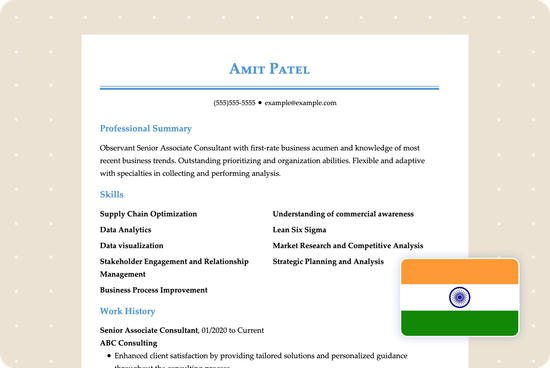
The standard resume format in India is a reverse-chronological layout that highlights your most recent experience first. It typically includes sections for contact information, a professional summary, education, work experience, skills, and certifications.
The Indian resume format tends to be more detailed than formats used in many Western countries, with an emphasis on education, job duties, and personal background.
It’s designed to present a complete picture of the candidate, often extending beyond professional achievements to include academic performance and personal information.
Key characteristics of the Indian resume format include:
- Personal details included: Many Indian resumes feature information such as date of birth, nationality, marital status, and sometimes family background details.
- Photograph often added: A passport-style photo is commonly included, particularly in traditional industries or formal job applications.
- Education-focused structure: Academic history is highly emphasized, often including grades, percentages, or exam scores.
- Detailed job descriptions: Work experience sections usually describe responsibilities in depth rather than focusing only on outcomes or metrics.
- Longer format: Indian resumes can extend to two to three pages, especially for experienced candidates with extensive education and work history.
How to Write a Resume for the Indian Job Market
To write a resume for India-based roles, create a clear, structured document that highlights your education, skills, and work experience in a detailed and organized way.
Step 1: Create Your Resume Header
To create your resume header for the Indian job market, include your full name, phone number, professional email address, and location at the top of the page.
This section should be clear, easy to read, and positioned prominently so recruiters can quickly identify and contact you.
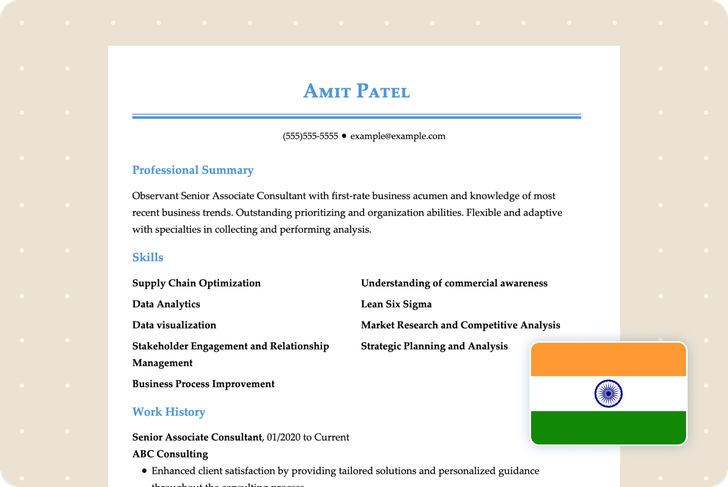
Here’s an example:

In India, your resume header may also include additional personal details, depending on industry norms. While modern resumes keep this section minimal, some employers still expect more background information.
Your resume header should typically include:
- Full name: Use a slightly larger font to make your name stand out.
- Phone number: Ensure it’s active and includes the correct country code if you’re applying internationally.
- Email address: Use a professional email (avoid nicknames or informal IDs).
- Location: City and state are usually sufficient; a full address isn’t necessary.
- LinkedIn profile (optional): Include LinkedIn on your resume if it’s updated and relevant.
- Photo (optional): A professional, passport-style photo may be added in some cases.
- Additional personal details (optional): Date of birth or nationality, depending on specific employer expectations.
Step 2: Add a Professional Statement
Add a three- to five-sentence professional summary to the top of your resume that summarizes your key skills and relevant experience. This section should quickly show employers why you’re a strong fit for the role and what value you bring.
Here’s an example:
Recent graduates (called “freshers” in the Indian job market) and candidates with little experience should use a resume objective. An objective focuses on your current skills, even if you have no experience, and goals for the role.
For example:
Step 3: Detail Your Work History
Include a detailed work experience section that lists your previous jobs in reverse-chronological order, starting with your most recent role.
Include your job title, company name, location, and employment dates, followed by bullet points that describe your responsibilities and key contributions. Start bullet points with strong action verbs to make a stronger impact.
Here’s an example:
If you’re a fresher writing a resume with no experience, you can focus on academic experiences, internships, and volunteer work. For example, you might include experience writing for the student newspaper at your school if you’re applying for an editorial position.
Step 4: Feature Job-Relevant Skills
Create a dedicated resume skills section that highlights abilities directly related to the role you’re applying for. This helps recruiters quickly assess whether you meet the job requirements.
Keep this section concise and easy to scan, using bullet points or short phrases rather than full sentences. Prioritize six to 12 of your most relevant skills first to align with the job description.
Here’s an example of a strong skills section for an Indian resume:
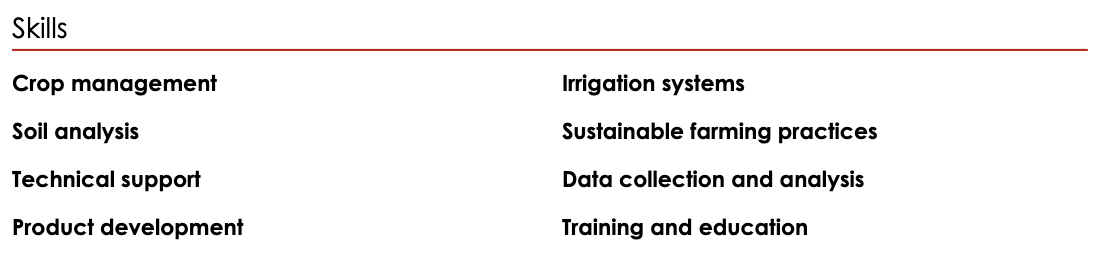
In India, this section should balance both hard and soft skills, depending on your field. It should be tailored for each application to ensure relevance and impact.
Here are some examples:
| Hard Skills | Soft Skills |
| AI and machine learning | Active listening |
| Business development | Adaptability |
| Cloud computing | Communication |
| Customer relationship management (CRM) | Decision-making |
| Cybersecurity | Emotional intelligence |
| Data science | Leadership |
| Financial analysis | Problem-solving |
| Robotic process automation | Time management |
| Strategic planning | Verbal and written communication |
Step 5: Include Your Educational Background
Include the name of your degree, university, and the campus location. Unlike a U.S. resume, you should include the years attended and your GPA if it’s above 3.4. You can also add optional information, such as relevant coursework, extracurriculars, and academic achievements.
Here’s an example education section for an Indian resume:
Education
Master of Science in Data Science
New York University | New York, NY, USA
2023–2025
- GPA: 3.9/4.0
- Relevant Coursework: Machine Learning, Data Mining, Statistical Modeling, Big Data Analytics
- Accomplishments: Dean’s List (2024), Capstone Project on predictive analytics for healthcare outcomes
Bachelor of Science in Computer Science
University of Illinois Urbana-Champaign | Urbana, IL, USA
2019–2023
- GPA: 3.7/4.0
- Relevant Coursework: Algorithms, Database Systems, Artificial Intelligence, Software Engineering
- Accomplishments: Graduated with Honors, developed a capstone project on web-based recommendation systems
Step 6: Incorporate Additional Sections
Add any relevant supporting information that strengthens your profile beyond education and work experience by showcasing extra skills, achievements, and qualifications.
Only include sections that add real value to your application, and avoid overcrowding your resume with unnecessary details. The goal is to present a strong, focused snapshot of your qualifications.
Here are a few examples of supporting information to include:
- Languages: Foreign or additional languages with proficiency levels (e.g., Native, Fluent, Conversational).
- Certifications: Professional courses or training programs (e.g., Google Analytics, AWS, or Excel certifications).
- Projects: Academic or professional work that demonstrates technical ability, problem-solving, or applied experience.
- Internships: Short-term professional experience, especially valuable for students and early-career candidates.
- Awards and honors: Recognitions (e.g., scholarships, distinctions, or industry or academic achievements).
- Memberships: Participation in professional organizations that reflect industry engagement and networking.
- Volunteer experience: Community or unpaid work that highlights leadership, initiative, and social contribution.
You can use one of our professional resume templates to create a polished resume and add custom sections tailored to your target role.
Indian Resume Examples for Top Jobs
See the Indian resume examples below to see how to structure your document and tailor your content to the specific job you’re applying for.
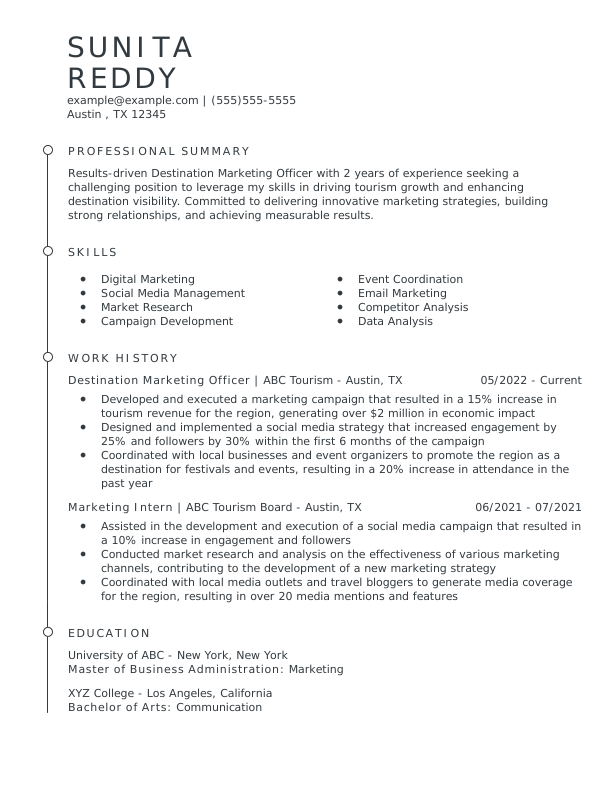
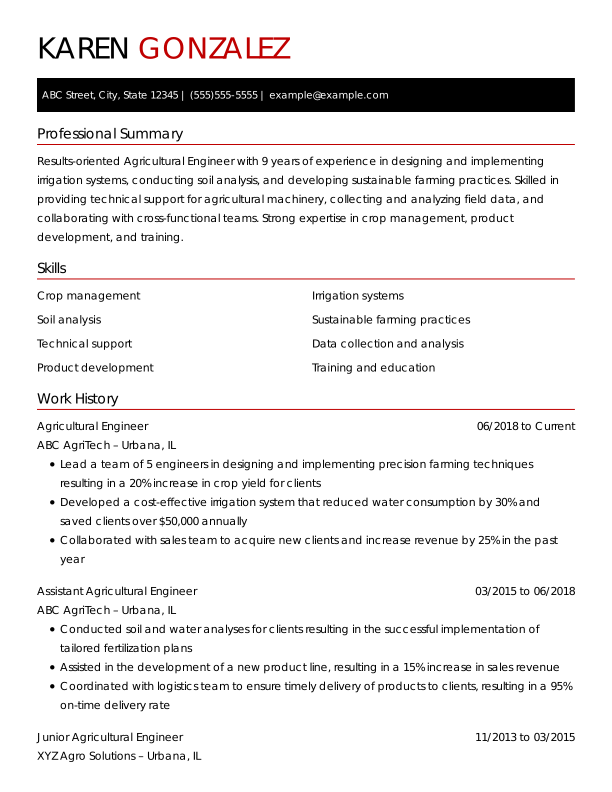
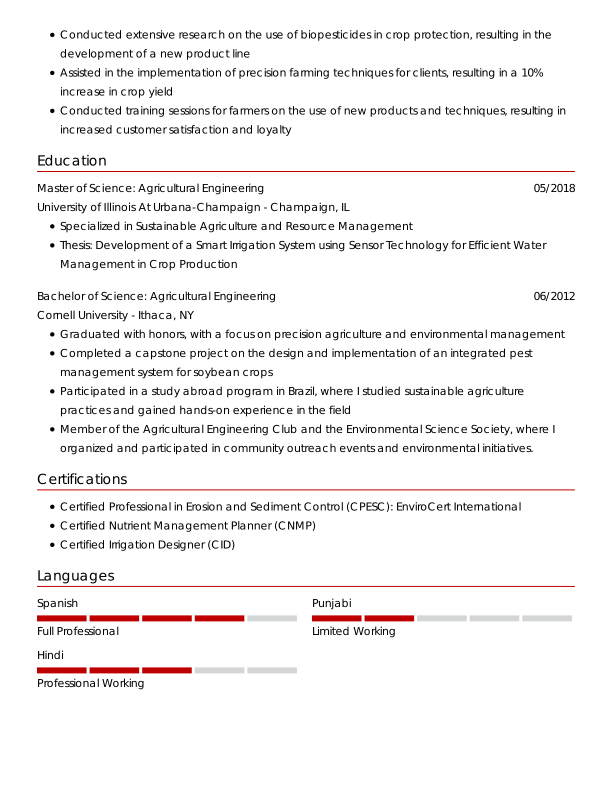
Marketing Officer
Explore our resume examples to find the perfect resume for your industry and career. Get inspiration and learn more about how to create a resume that works for you.
Adding Biodata to an Indian Resume
Biographical data, or biodata, is a resume section with personal background details that are sometimes expected in traditional or formal job applications. This section goes beyond standard resume content and may include information like date of birth, nationality, marital status, and other personal identifiers, depending on the employer or industry requirements.
A biodata section is more commonly used in India for government roles, academic positions, or legacy hiring processes, while modern private-sector resumes are increasingly minimal.
Typical biodata details include:
- Full name and contact information
- Date of birth and age
- Gender (if required by the employer)
- Nationality
- Marital status
- Languages spoken and proficiency levels
- Photograph (passport-style, if requested or industry-appropriate)
- Permanent and current address (in traditional formats)
- Father’s or guardian’s name (in older or formal applications)
In modern applications, especially in private companies or multinational firms, a simplified resume format without biodata is often preferred.
When to Include Biodata
Include biodata in an Indian resume only when it’s specifically requested or when applying for roles that follow traditional hiring practices.
Here are a few examples of when to include biodata on your resume:
- If the job advertisement clearly asks to include it in your Indian resume.
- When applying for a job in the Indian government, traditional industries, or rural employers.
- If you’re seeking a role in or applying to academia.
When Not to Include Biodata
Don’t include biodata in your Indian resume when applying for private-sector jobs, multinational companies, or modern startups that prefer a streamlined, skills-focused resume.
Here are a few examples of when not to include biodata on your resume:
- If you’re a foreigner applying to work in India, avoid including any personal information. The exception to this is a foreigner applying for a role at a smaller, local company.
- If you’re an Indian national seeking an international role, don’t include your biodata.
- If your career is in a modern industry, like technology or a startup.
- If the job advertisement asks for a resume without biodata.
How to Format the Biodata Section
To format the biodata section in an Indian resume, present personal details in a clean, structured list or simple, labeled format that’s easy to read.
You can place this information in your resume header, for example:
Jay Gupta
123 Main Street, City, State, Zip code
(123) 456-7890
email@example.com
Date of Birth: January 1, 1990
Sex: Male
Nationality: Indian
Marital Status: Single
Languages: English, Spanish
Alternatively, you can create a separate section titled “Personal Information” or “Biodata.”
Add this section to the bottom of your resume or, if you’re using a two-column resume layout, use the smallest column.
Here’s an example:
Personal Information
Date of Birth: January 1, 1990
Sex: Male
Nationality: Indian
Marital Status: Single
Languages: English, Spanish
Modifying a U.S. Resume for the Indian Job Market
Modifying a U.S. resume for the Indian job market involves expanding the content, adjusting the format, and adding personal and academic details that Indian employers often expect.
Indian resumes tend to be more detailed than U.S. resumes and sometimes include additional information, such as personal data, education scores, and more detailed work responsibilities.
Key modifications for adapting your U.S. resume include:
- Expand length. Extend your resume from one page to two or three pages, if necessary.
- Include education details. Add GPA, coursework, honors, and full institution location (city, state, country).
- Emphasize job responsibilities. Expand bullet points to include detailed descriptions of duties, not just achievements.
- Add personal details (if appropriate). Include information like date of birth, nationality, or marital status when required.
- Include a photograph (optional). Some Indian employers still expect a professional, passport-style photo.
- Highlight additional sections. Add certifications, projects, internships, languages, and volunteer work to strengthen your profile.
- Prepare references. Create a separate document using the same style as your resume to list references from your Indian professional network.
These changes can adapt your American resume to the Indian market. A candidate who shows respect and cultural understanding will not go unnoticed.
Adapting an Indian Resume to the U.S. Job Market
Adapting an Indian resume to the U.S. job market involves simplifying the document, removing personal details, and shifting the focus from duties to measurable achievements.
U.S. resumes are typically one page, highly concise, and designed to highlight impact, skills, and results rather than detailed job descriptions or personal background information.
To make your Indian resume suitable for U.S. applications, you should restructure it into a streamlined, achievement-focused format that aligns with American hiring expectations. This improves readability and ensures your experience is evaluated based on value and outcomes.
Key adjustments include:
- Shorten the resume. Limit yourself to a one-page resume, or two pages for extensive experience.
- Remove personal details. Exclude your date of birth, marital status, nationality, and photographs.
- Emphasize achievements. Reframe job duties into results-driven bullet points with metrics, where possible.
- Simplify education details. Remove percentages or unnecessary academic scores unless highly relevant.
- Highlight skills and keywords. Align your resume with job descriptions using relevant industry terms.
- Focus on relevance. Include only experience and sections that directly support the job you’re applying for.
Use MyPerfectResume’s AI Resume Builder to create a job-winning resume for your target role. Upload your current resume or start fresh with step-by-step guidance and content suggestions.
Tips for a Standout Indian Resume
A standout Indian resume is clear, tailored, and well-structured, showcasing your education, skills, and experience in a way that’s easy to scan and directly relevant to the role.
Here are a few resume tips to help you get started:
- Tailor your resume to each job. Adjust your skills, experience, and summary to match the specific role and company requirements instead of using a generic version.
- Use relevant keywords. Incorporate job-specific keywords from the description, especially technical skills, tools, and industry language, to improve ATS visibility.
- Keep formatting simple. Avoid overly complex designs, graphics, or tables that may not parse correctly in ATS systems.
- Maintain proper spacing. Use consistent line spacing (1.0 to 1.15) and clear section breaks to improve readability.
- Proofread carefully. Check for spelling, grammar, and formatting inconsistencies before submitting, as errors can reduce credibility.
- Include a cover letter when possible. A tailored cover letter can strengthen your application by explaining your interest and highlighting key qualifications in context.
- Check for ATS compatibility. Use our ATS Resume Checker to get personalized feedback to optimize your resume for automated scans.
Key Takeaways
- A reverse-chronological format is standard for Indian resumes, with the most recent education and work experience listed first.
- Personal details like date of birth, marital status, or a photo may be included in traditional formats but are often excluded in modern private-sector applications.
- Education is highly emphasized, often including GPA, coursework, and academic achievements.
- Work experience should be expanded with clear responsibilities and relevant accomplishments.
- Additional sections, such as certifications, projects, internships, languages, and volunteer work, can strengthen your profile.
- Biodata is only required for specific roles, such as government, academic, or traditional job applications.
- A strong resume should be tailored to each job using relevant keywords and clear, professional formatting.
FAQ
What is a resume called in India?
A resume is called a “resume” in India, but it’s also commonly referred to as a “curriculum vitae (CV),” especially in academic, government, and traditional job contexts.
In everyday use, the terms CV and resume are often used interchangeably, even though a CV is typically more detailed and longer. For most job applications in India, employers still expect a concise resume that summarizes education, skills, and work experience clearly.
How does an Indian resume look?
An Indian resume typically looks like a detailed, structured document that presents a candidate’s education, work experience, skills, and personal information in a clear format.
It follows a reverse-chronological layout and may include a photo and personal details, such as date of birth or marital status. Unlike shorter U.S. resumes, it tends to be longer and more descriptive.
Should I include a photo in my Indian resume?
Including a photo in an Indian resume depends on the industry and employer expectations, but it is still common in many traditional sectors.
Some recruiters may expect a professional, passport-style photo, especially in customer-facing roles. Others may prefer resumes without images to avoid bias. If included, the photo should be professional, recent, and placed neatly in the header.
How many pages should a resume be in India?
A resume in India is typically one to two pages long, but it can extend to three pages for experienced candidates with extensive education and work history.
Entry-level applicants should aim for one page, while mid- to senior-level candidates can use two pages to cover relevant details. The key when deciding on resume length is to keep content clear, relevant, and well-organized without adding unnecessary information.
Can ChatGPT write my resume?
ChatGPT can help you write your Indian resume by drafting, structuring, and tailoring content based on your experience and the job you’re targeting.
You can use ChatGPT resume prompts to generate summaries, bullet points, and skills sections quickly, but you should always review and personalize the content to ensure accuracy and authenticity. Using it as a starting point works best, not as a complete substitute for your input.
How We Reviewed This Article
Since 2012, we have helped more than 11 million job seekers. We want to make your career journey accessible and manageable through our services and Career Center’s how-to guides and tips. In our commitment to bring you a transparent process, we present our Editorial Process.
Rate this article
Indian Resume

Marla is a professional resume writer. She is committed to helping job seekers navigate the job market and succeed in their careers.
More Articles by Marla FigueroaShare this page
 Add MyPerfectResume as a preferred source on Google
Add
Our customers have been hired at:*Foot Note