Table of Contents
Get started with MyPerfectResume today!
- Build a resume on any device
- Pick an ATS-friendly template
- Tailor with AI copy suggestions
Why this resume works
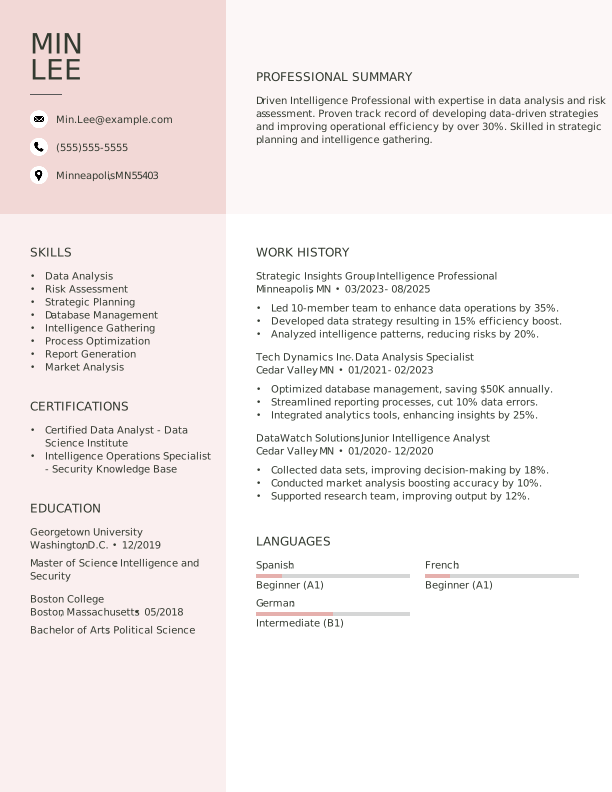
- Quantifies accomplishments: By showcasing measurable accomplishments, such as a 35% enhancement in data operations, the applicant effectively demonstrates their tangible impact and value.
- Highlights industry-specific skills: Expertise in intelligence gathering and strategic planning clearly highlights the applicant’s fit for roles requiring industry-specific skills in intelligence and security.
- Illustrates problem-solving ability: Integrating analytics tools to improve insights by 25% showcases the applicant’s innovative problem-solving skills and critical thinking.
More Intelligence Professional Resume Examples
Take a look at our intelligence professional resume examples to see the best ways to highlight your analytical, problem-solving, and research skills. These military resume examples will guide you in creating a resume that showcases your ability to interpret data and provide actionable insights.
Entry-Level Intelligence Professional
Why this resume works
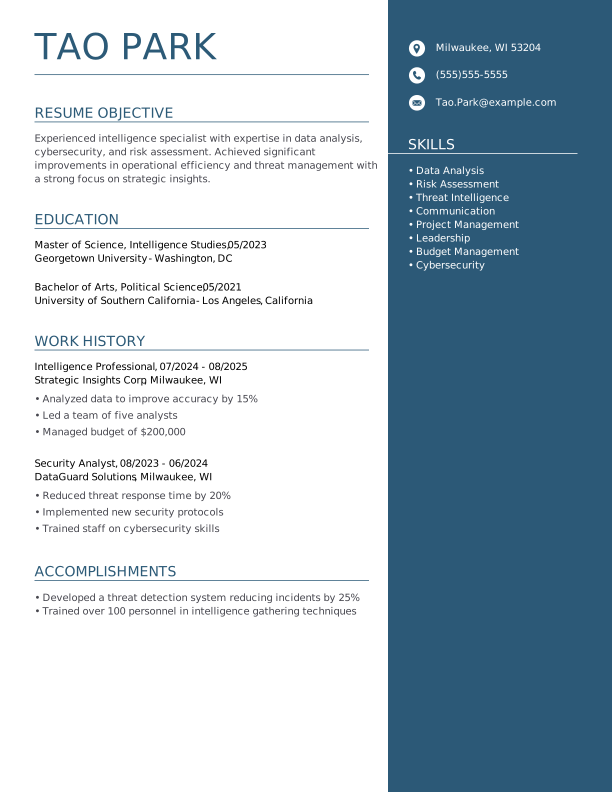
- Centers on academic background: A master’s degree in intelligence studies reflects a solid academic foundation, laying the groundwork for a promising career in intelligence.
- Effective use of keywords: Incorporating industry-specific keywords like “data analysis” and “cybersecurity” ensures alignment with ATS requirements, improving chances of getting noticed by employers.
- Shows digital literacy: Skill in data analysis and cybersecurity shows computer skills and digital literacy, which are important for modern workplaces.
Mid-Level Intelligence Professional
Why this resume works
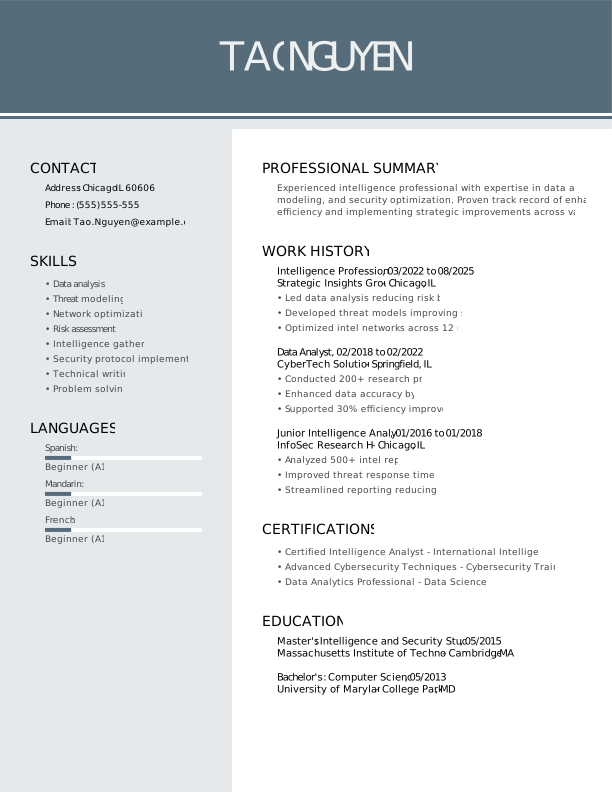
- Points to measurable outcomes: By showcasing achievements like reducing risk by 15% and improving efficiency, the applicant effectively emphasizes their impact through measurable outcomes.
- Demonstrates language abilities: Language skills in Spanish, Mandarin, and French improve cross-cultural communication for global intelligence operations.
- Displays technical expertise: Specialized certifications and a strong technical skill set highlight the applicant’s expertise in data analysis and cybersecurity, important for advanced intelligence roles.
Experienced Intelligence Professional
Why this resume works
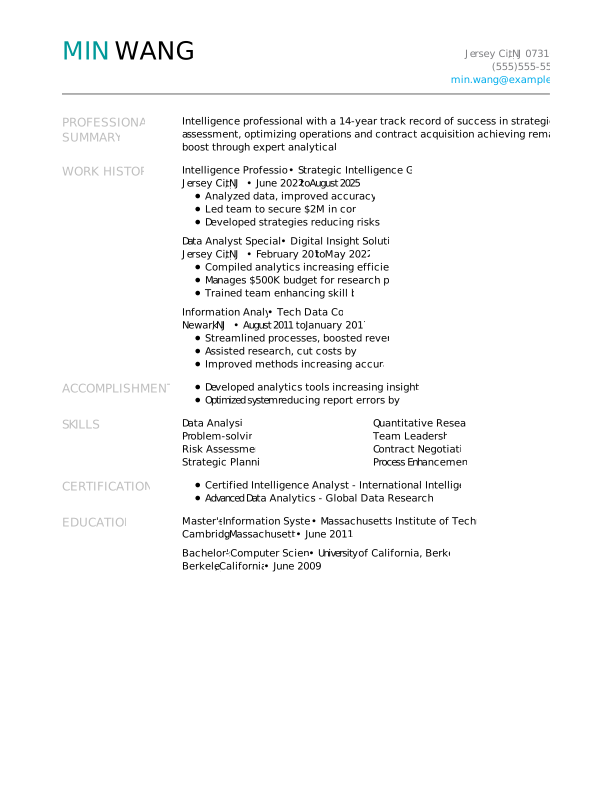
- Focuses on work history: By organizing experiences in a chronological resume format, from intelligence professional to information analyst, the applicant’s career progression shines through, ideal for showcasing their extensive history.
- Lists relevant certifications: Listing certifications like certified intelligence analyst and advanced data analytics reinforces the applicant’s dedication to mastering industry-specific skills.
- Showcases impressive accomplishments: Achievements such as securing $2M in contracts and boosting efficiency by 35% highlight impressive senior-level performance and significant business impact.
Intelligence Professional Resume Template (Text Version)
The text below is one solid option. For a larger library to explore, visit our resume templates.
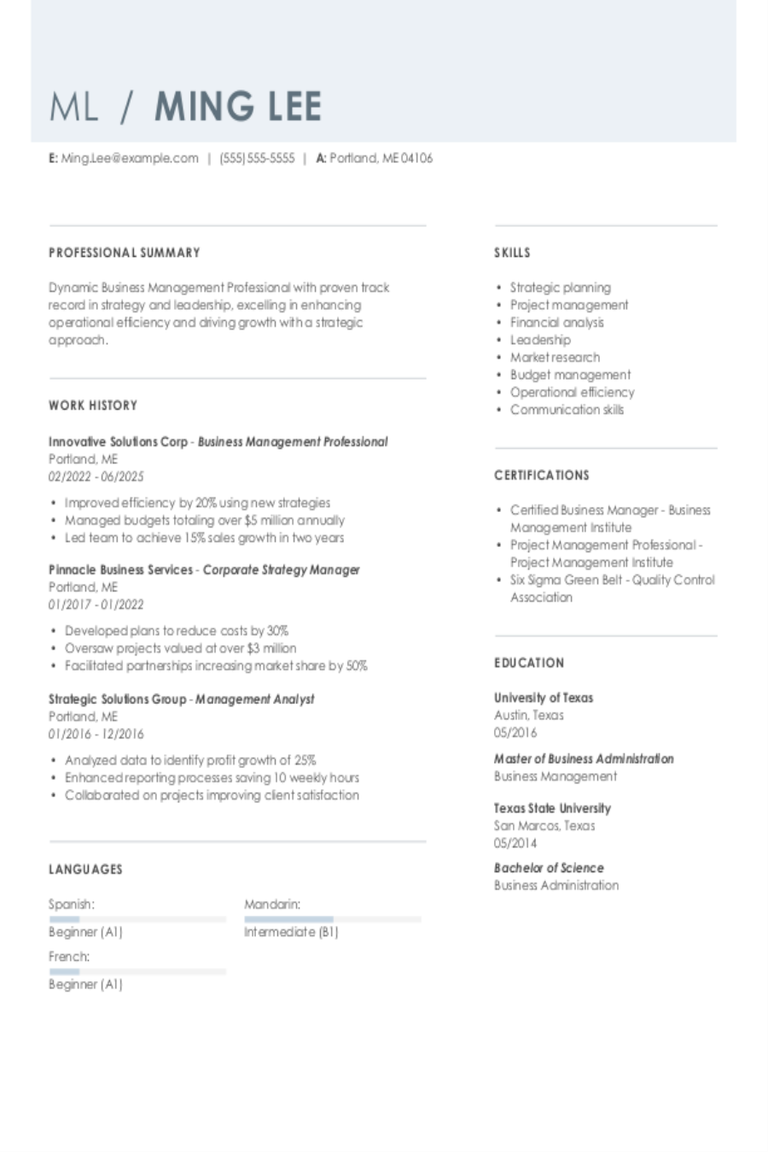
Min Lee
Minneapolis, MN 55403
(555)555-5555
Min.Lee@example.com
Professional Summary
Driven Intelligence Professional with expertise in data analysis and risk assessment. Proven track record of developing data-driven strategies and improving operational efficiency by over 30%. Skilled in strategic planning and intelligence gathering.
Skills
- Data Analysis
- Risk Assessment
- Strategic Planning
- Database Management
- Intelligence Gathering
- Process Optimization
- Report Generation
- Market Analysis
Certifications
- Certified Data Analyst – Data Science Institute
- Intelligence Operations Specialist – Security Knowledge Base
Education
Master of Science Intelligence and Security
Georgetown University Washington, D.C.
December 2019
Bachelor of Arts Political Science
Boston College Boston, Massachusetts
May 2018
Work History
Intelligence Professional
Strategic Insights Group – Minneapolis, MN
March 2023 – August 2025
- Led 10-member team to enhance data operations by 35%.
- Developed data strategy resulting in 15% efficiency boost.
- Analyzed intelligence patterns, reducing risks by 20%.
Data Analysis Specialist
Tech Dynamics Inc. – Cedar Valley, MN
January 2021 – February 2023
- Optimized database management, saving $50K annually.
- Streamlined reporting processes, cut 10% data errors.
- Integrated analytics tools, enhancing insights by 25%.
Junior Intelligence Analyst
DataWatch Solutions – Cedar Valley, MN
January 2020 – December 2020
- Collected data sets, improving decision-making by 18%.
- Conducted market analysis boosting accuracy by 10%.
- Supported research team, improving output by 12%.
Languages
- Spanish – Beginner (A1)
- French – Beginner (A1)
- German – Intermediate (B1)
Related Resume Guides
Advice for Writing Your Intelligence Professional Resume
Whether you’re diving into the world of data analysis or navigating complex intelligence operations, knowing how to write a resume that highlights your unique skills and experiences is essential. Explore our guide on how to write a resume and discover strategies to make your application stand out.
Highlight relevant certifications and training
Certifications and specialized training are important for intelligence professionals because they Certifications and specialized training are vital for intelligence professionals because they validate expertise in critical areas such as analysis, security, and operations.
A dedicated certifications section on your resume makes these credentials easy to find and highlights your commitment to professional growth. These qualifications demonstrate that you stay current with evolving methods, technologies, and security standards—skills that are essential in intelligence work.
Examples of relevant certifications for intelligence professionals include:
- Certified Intelligence Analyst (CIA)
- Certified Information Systems Security Professional (CISSP)
- CompTIA Security+
- Geospatial Intelligence (GEOINT) Certification
- Counterintelligence Fundamentals Certification
- Certified Ethical Hacker (CEH)
- Advanced Open Source Intelligence (OSINT) Training
- Cyber Threat Intelligence Certification
Including certifications in a prominent section of your resume emphasizes your readiness to meet industry standards and take on complex challenges. This not only strengthens your credibility but also helps set you apart as a well-prepared intelligence professional.
Example of a certifications & training section
Certified Intelligence Analyst
Issued by: International Association of Law Enforcement Intelligence Analysts (IALEIA)
Issued 2020
Advanced Cyber Threat Intelligence Certification
Issued by: Cybersecurity and Infrastructure Security Agency (CISA)
Completed 2023
Geospatial Intelligence Analysis Training
Issued by: National Geospatial-Intelligence Agency (NGA)
Expires 2024
Social Network Analysis for Intelligence Professionals
Issued by: Defense Intelligence Agency (DIA)
Completed 2022
Open Source Intelligence Gathering Workshop
Issued by: Central Intelligence Agency (CIA)
Issued 2021
Get ideas for your own resume by checking out our professional resume examples. They show you how to highlight your skills and experience effectively.
List your most relevant skills
For an intelligence professional, a balanced mix of technical and soft skills is key. Technical skills might include data analysis, knowledge of intelligence software, and the ability to interpret complex information. On the other hand, soft skills like critical thinking, communication, and teamwork are just as important. These help in making sense of data and working well with others to solve problems.
Including a dedicated skills section on your resume can be helpful. In this section, you could list your software skills and any unique artistic abilities that might set you apart. Use your work experience bullet points to show these skills in action. For example, if you’re good at using specific software for analyzing data, mention how it helped you complete a project successfully.
By weaving your skills into your work history, you give real-life examples of what you can do. This makes it easier for employers to see how you’d fit into their team as an intelligence professional. This approach not only highlights your capabilities but also shows how you have applied them effectively in previous roles.
Choose a resume format that highlights analysis, problem-solving, and confidentiality to show your strengths as an intelligence professional.
Write a strong professional summary
A professional summary is a brief introduction on a resume that helps hiring managers quickly understand who you are as an applicant. It serves as the first impression, so it’s critical to make it strong and engaging. When crafting this section, you need to decide between using a summary or an objective based on your experience level and career goals.
Typically three to four sentences long, a professional summary highlights your experience, skills, and achievements. It’s best suited for those with more experience, such as seasoned intelligence professionals. The purpose of a professional summary is to convey your professional identity and the value you bring to potential employers.
Conversely, resume objectives focus on career goals and are ideal for entry-level applicants, career changers, or those with employment gaps. While a summary describes “what I’ve accomplished,” an objective outlines “what I aim to contribute.”
Next, we will provide examples of both summaries and objectives tailored for different industries and levels of experience. These examples will guide you in showcasing your qualifications effectively.
Intelligence professional resume summary examples
Entry-level
Recent intelligence studies graduate with a Bachelor of Arts in Intelligence and National Security. Familiar with data analysis, open-source intelligence gathering, and cybersecurity fundamentals. Completed internships in government intelligence agencies, gaining exposure to threat assessment and strategic report writing. Eager to apply analytical skills and knowledge of geopolitical trends in a dynamic intelligence environment.
Mid-career
Results-driven intelligence analyst with over seven years of experience specializing in counterterrorism and geopolitical risk assessment. Proven track record in analyzing complex datasets to identify emerging threats and provide actionable insights for national security strategies. Holder of active Top Secret clearance; recognized for producing high-impact reports that influence policy decisions.
Experienced
Seasoned intelligence professional with two decades of experience leading teams in military intelligence operations. Expertise in signals intelligence (SIGINT) and human intelligence (HUMINT), with a strong background in developing comprehensive surveillance programs. Demonstrated success in improving information sharing across agencies, resulting in improved threat detection capabilities. Committed to mentoring the next generation of analysts while driving innovative solutions for national defense.
Intelligence professional resume objective examples
Recent graduate
Analytical and detail-oriented recent graduate with a degree in international relations seeking an entry-level position as an intelligence analyst. Passionate about using research skills and geopolitical knowledge to support intelligence operations and contribute to national security efforts.
Career changer
Adaptable professional transitioning from a background in data analysis into the field of intelligence. Possesses strong analytical and critical thinking skills, eager to apply these abilities to gather, evaluate, and interpret complex information to aid decision-making processes in a dynamic agency setting.
Specialized training
Aspiring intelligence professional with specialized training in cybersecurity analysis looking to join a forward-thinking intelligence team. Committed to leveraging technical expertise and problem-solving skills to identify threats and improve organizational cybersecurity measures.
Stand out from the crowd by using our AI Resume Builder to craft your resume. Easily add skills and experience that show off your intelligence and expertise.
Showcase your accomplishments and publications
Listing publications, conference presentations, and research accomplishments can greatly strengthen your resume as an intelligence professional. These details showcase your expertise, your dedication to advancing knowledge in your field, and your ability to share complex ideas effectively.
By highlighting peer-reviewed articles, book chapters, and conference papers, you offer solid evidence of thought leadership and authority in the domain.
In the publications section of your resume, create a structured format for each item. Include citation details such as journal name, volume, issue number, and year while following a professional style guide like APA, MLA, or Chicago.
This not only allows employers to locate your work but also demonstrates attention to detail. Be sure to mention any major awards or grants that support your research credibility, since these achievements emphasize recognition from respected institutions or peers.
Consider incorporating links to digital research profiles such as Google Scholar, ResearchGate, or ORCID when appropriate. These platforms provide a full view of your contributions and their influence on intelligence studies. Organizing this section thoughtfully ensures employers can easily assess the depth of your expertise in the field while appreciating how you advance knowledge within it.
Example of publications section
Publications
- “The Role of Counterintelligence in Modern Security Operations” – Defense and Security Research Journal, 2019
- “Emerging Cyber Threats and National Security Implications” – Journal of Strategic Intelligence, 2023
- “Open Source Intelligence (OSINT) Techniques for Field Analysts” – Intelligence Review Quarterly, 2022
- “Geospatial Analysis in Counterterrorism Operations” – International Journal of Security Studies, 2021
- “Data Analytics for Predictive Threat Assessment” – Journal of Intelligence and Analysis, 2020
Select a resume template with straightforward headings and simple fonts to ensure your skills and experience are highlighted effectively over flashy designs.
FAQ
Do I need to include a cover letter with my intelligence professional resume?
Yes, including a cover letter with your intelligence professional resume can significantly improve your application by providing context for your skills and experiences.
A cover letter offers the chance to express your interest in the specific role and organization while highlighting how your analytical abilities match their needs.
If you’ve worked on specialized projects or have expertise in certain intelligence areas, you can detail these experiences to create a stronger connection with the job requirements.
For assistance, consider using our Cover Letter Generator to craft a customized cover letter that aligns with your resume and career goals.
Additionally, reviewing cover letter examples can give insight into effective ways to present yourself as a top job seeker in the intelligence field.
How long should an intelligence professional’s resume be?
For an intelligence professional, a one-page resume can be effective if you’re early in your career or have limited experience. This format helps to present key skills like analytical abilities, attention to detail, and any relevant security clearances concisely.
However, if you have extensive experience or specialized expertise, opting for a two-page resume is acceptable. This allows room to detail significant projects, leadership roles, and advanced training important in the intelligence field.
Ultimately, understanding how long a resume should be depends on the depth of your experience and the relevance of your achievements to the role you’re pursuing.
How do you write an intelligence professional resume with no experience?
When crafting a resume with no experience for an intelligence professional role, focus on showcasing your education, skills, and any relevant coursework that align with the field. Here are some strategies to create a compelling entry-level intelligence professional resume:
- Emphasize education: Highlight your degree in areas like political science, international relations, or security studies. Include details such as your institution, graduation date, and any honors or relevant courses.
- Showcase analytical skills: Demonstrate strong analytical and critical thinking abilities gained through academic projects or research. Mention any specific methodologies or tools you’ve used.
- Highlight transferable skills: Focus on skills that are valuable in intelligence work, like attention to detail, problem-solving, data analysis, and effective communication. Use examples from volunteer work or part-time jobs where applicable.
Check out our detailed guide on writing a resume with no experience for further tips and inspiration from Certified Professional Resume Writers.
Rate this article
Intelligence Professional


Jasmine is a certified career coach and recognized expert in job search strategy. She is committed to helping job seekers navigate the job market and succeed in their careers.
More Articles by Jasmine EscaleraShare this page