Canadian Resume Format: Writing Guide & Examples

Our customers have been hired at: *Foot Note


Table of Contents
Get started with MyPerfectResume today!
- Build a resume on any device
- Pick an ATS-friendly template
- Tailor with AI copy suggestions
What to Expect
- Canadian resumes typically follow the same core structure as U.S. resumes, with a professional summary, work history, skills, and education.
- A reverse-chronological format works well for most Canadian job seekers because it puts recent experience and accomplishments first.
- Canadian resumes are typically one or two pages and should focus on relevant skills, experience, and measurable achievements.
- Leave out personal details such as your photo, age, and marital status, and use Canadian spelling and terminology where appropriate.
- If you’re applying from outside Canada, check whether your credentials, certifications, or licenses require Canadian recognition or equivalency.
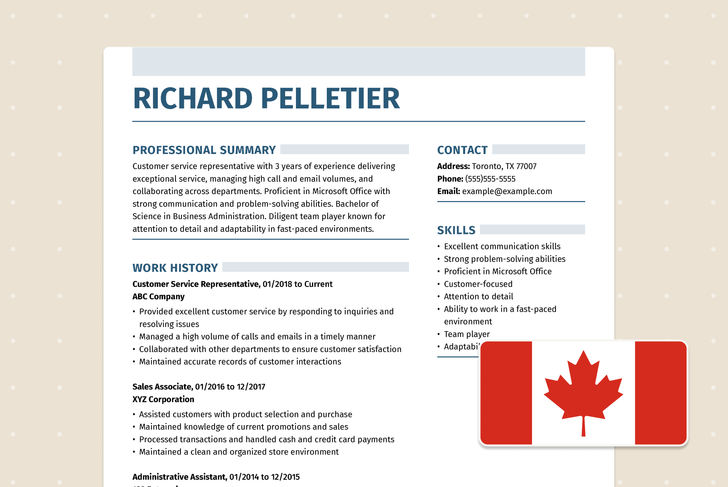
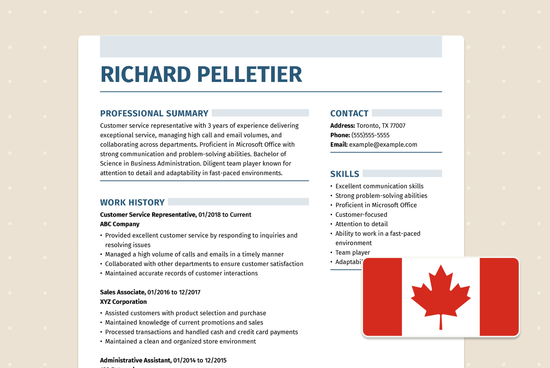
A Canadian resume is similar to a U.S. resume, but a few important details can help you align your application with Canadian hiring expectations. These include using Canadian terminology and spelling, emphasizing relevant accomplishments, and leaving out personal information such as your photo, age, or marital status.
This guide explains the Canadian resume format, what to include in each section, and how to adapt an existing U.S. resume for jobs in Canada. You’ll also find Canadian resume examples for popular roles.
What to Include in a Canadian Resume
A Canadian resume should include your contact information, a professional summary or objective, work experience, relevant skills, and education. Most job seekers should use a chronological resume format that puts their most recent experience first.
Additional sections, such as volunteer experience or languages, can strengthen your resume when they’re relevant to the role.
Start by choosing a resume template that aligns with your target industry and experience level, then follow the guidance below to learn how to write a Canadian resume, section by section.
Resume Header
Your resume header should make it easy for Canadian employers to identify you and get in touch to schedule an interview. Place it at the top of your resume and include:
- Full name
- Location (city and province)
- Phone number
- Professional website or digital portfolio, if applicable
- Networking profile
Professional Statement
Include a professional summary near the top of your resume that highlights your most relevant experience, skills, and accomplishments in a few concise sentences.
For example:
Results-driven software developer with 6 years of experience developing and maintaining high-quality applications. Experienced in managing every step of the development life cycle, from requirements gathering to deployment. Seeking a new challenge in Canada to apply expertise in Agile development and deliver impactful solutions for a forward-thinking company.
If you’re starting your career or changing fields, consider using a resume objective instead. It focuses on what you bring to the table, even with limited experience, along with your short-term career goal for this role.
For example:
Highly motivated and adaptable programmer with a strong foundation in Python and JavaScript, eager to leverage skills and passion for learning to contribute to a dynamic team in the vibrant Canadian tech scene.
Work History
Your work history should show Canadian employers what you accomplished in previous roles, not just what you were responsible for. For each position, include your job title, employer, location, and dates of employment, followed by three to five measurable achievements that demonstrate ability to deliver results. Be sure to start each bullet point with an action verb for stronger impact.
Here’s an example of how to write a Canadian resume work history section:
WORK EXPERIENCE
Physiotherapist
June 2021–Present
Central Hospital | Toronto, ON
- Increased patient satisfaction scores by 25% by implementing new treatment techniques and individualized care plans.
- Successfully treated over 100 patients with chronic back pain, resulting in a 75% reduction in pain and improved mobility.
- Developed and delivered a series of patient education workshops on injury prevention and management, resulting in a 30% reduction in re-injury rates.
If you’re concerned about writing a resume with no experience, include relevant volunteer work, projects, internships, or other experiences that demonstrate your qualifications. For example, volunteering as a web developer for a nonprofit can strengthen your application for a programming role.
Skills
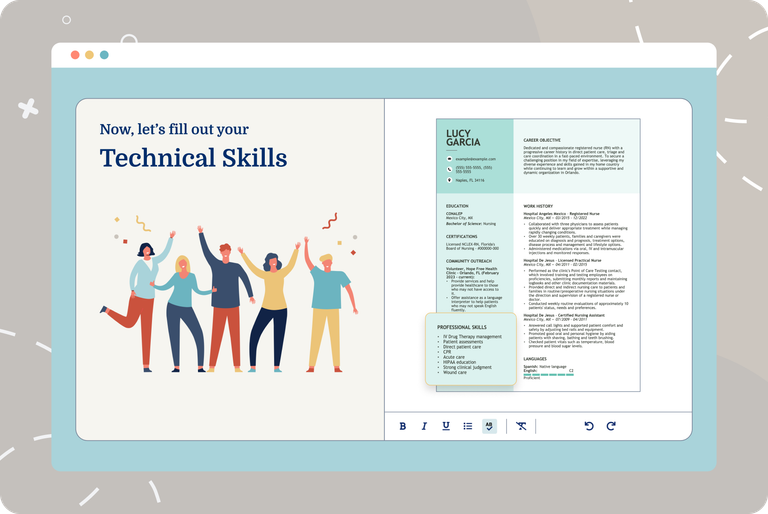
Your skills section should highlight the hard and soft skills most relevant to the Canadian job you’re targeting. Prioritize skills from the job description that you genuinely possess, balancing technical abilities with workplace strengths such as communication, adaptability, and problem-solving.
Here are some skill examples for a software developer role:
- AI tools and technologies
- Communication
- Continuous learning
- Creativity
- Critical thinking
- Cross-cultural competence
- Customer centricity
- Cybersecurity
- Data analytics
- Digital communications
- Emotional intelligence
- Problem-solving
- Programming languages
- Project management
- Time management
Try our AI Resume Skills Generator to instantly create a tailored skills section:
AI Resume Skills Generator

Education
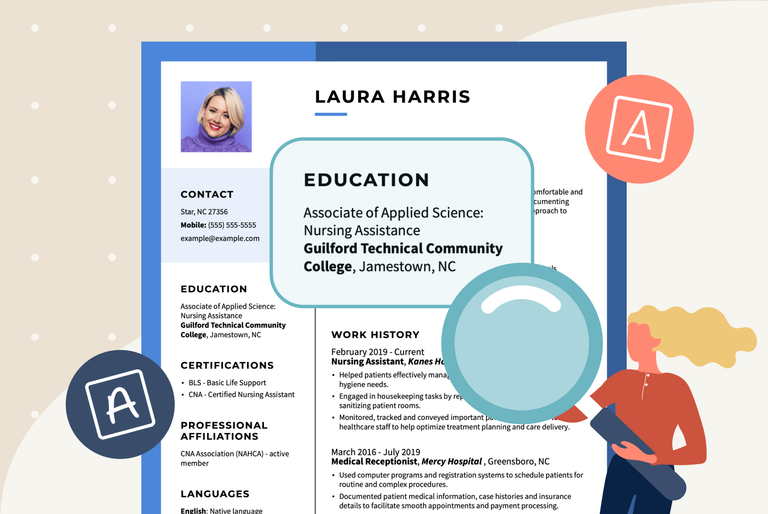
List your highest or most relevant degree first in your education section, followed by the institution and your graduation date if it’s recent. You can also include relevant certifications or credentials that strengthen your qualifications for the Canadian role.
If you’re still finishing your education, add “In progress” or the expected completion date.
For example:
EDUCATION
Criminology, Law, and Society
Honours Bachelor of Arts, University of Toronto, June 2023
Additional Sections
Additional resume sections can highlight qualifications that don’t fit neatly into your work history, skills, or education. Include them when they add relevant information about your experience or qualifications, such as:
- Volunteer experience: This information showcases your skills, dedication, and community involvement. It can also fill employment gaps and reflect your personal values.
- Awards: Featuring awards or recognitions emphasizes your achievements and the potential value you bring to an employer.
- Hobbies: Highlight personal interests and activities that reveal transferable skills or qualities that may benefit the job, demonstrating a well-rounded personality.
- Memberships: Listing professional or industry memberships demonstrates your commitment to your field, its standards, and the wider community.
- Foreign languages: With Canada’s diverse population, knowing foreign languages signals your ability to communicate with a multicultural community.
Canadian Resume Samples for Top Jobs
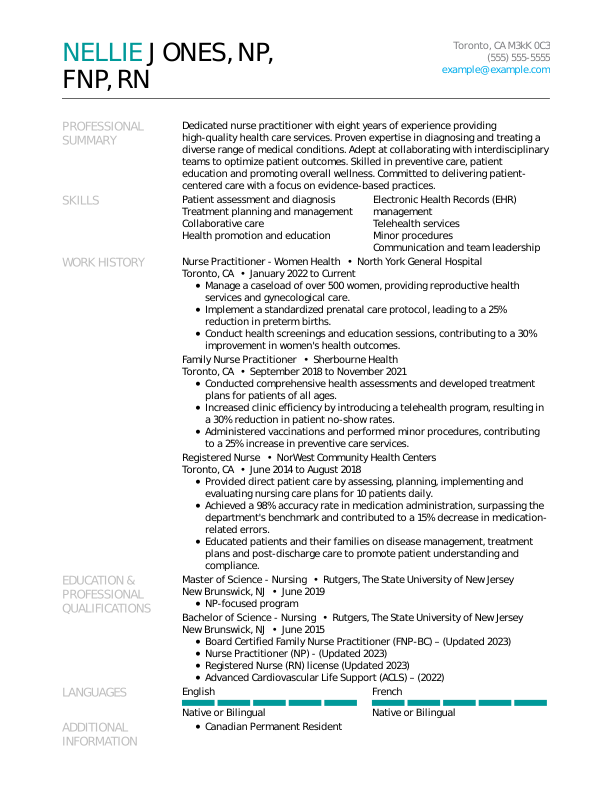
Canadian resume examples show how the standard sections and formatting come together for different roles. Explore the samples below to see how to write a resume that clearly presents your experience, skills, and education for Canadian employers.
Accountant
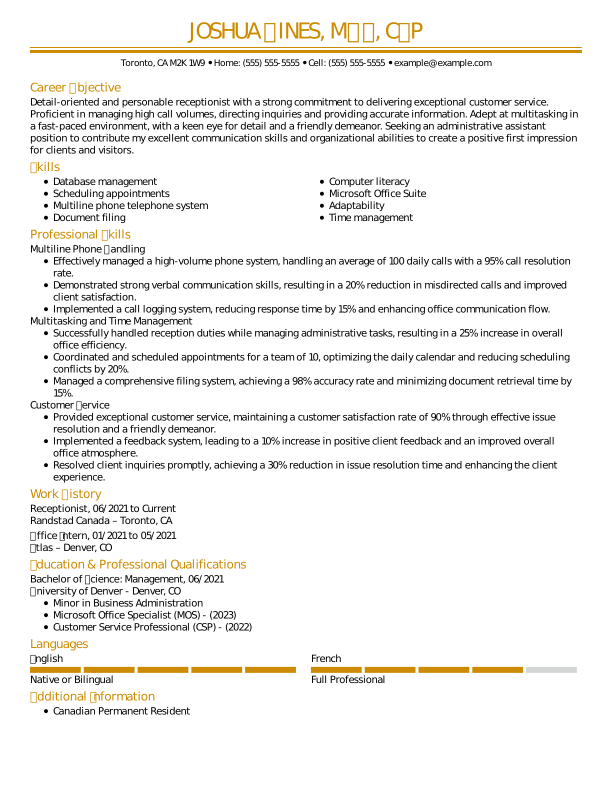
Receptionist
Continue exploring how to write a Canadian resume with our professional resume examples for any industry, job title, or career level.
How to Adapt Your U.S. Resume for Canadian Jobs
If you already have a U.S. resume, you don’t need to start from scratch. To adapt it for Canadian jobs, update spelling and terminology, tailor your skills and credentials to the region or province, and remove U.S.-specific details.
If you’re new to the Canadian job market, resources such as Canada InfoNet can help you learn more about Canadian workplace expectations and the job search process.
Adjust Terminology & Spelling
Canadian resumes generally use Canadian English, so review your spelling, terminology, and industry-specific language. For example, Canadian English typically uses “centre” instead of “center” and “colour” instead of “color.”
Also review units of measurement. Canada primarily uses the metric system, so convert weight, distance, and volume measurements to kilograms, metres, and litres.
Highlight Skills Relevant to Canadian Employers
Tailor your resume by aligning your skills and measurable accomplishments directly with the priorities in the job posting. Show how you’ve applied those skills and delivered results in previous roles, while accounting for regional or provincial requirements (such as French fluency in Quebec).
Be sure to verify whether your U.S. certifications, licenses, or degrees are recognized in your target province, or if you need an equivalency assessment—particularly in regulated fields like healthcare, engineering, accounting, and education. You can check recognition standards through the Canadian Information Centre for International Credentials (CICIC).
Remove U.S.-Specific Information
Remove or update details that apply specifically to the U.S. job market before submitting your resume in Canada.
Most importantly, update your location. If you’re already in Canada, list your current city and province. If you haven’t moved yet, state your target location and expected timeline (e.g., “Relocating to Vancouver, BC in [Month Year]”). Confirming you’re local—or actively moving—gives hiring managers confidence that you can start without work authorization delays.
6 Tips for a Standout Canadian Resume
A strong Canadian resume is concise, easy to scan, and tailored to the job you want. Choose a format that emphasizes your strongest qualifications, use straightforward formatting that works well with applicant tracking systems (ATS), and prioritize relevant skills and measurable accomplishments over unnecessary personal details.
- Choose the right format for your career stage. Select a chronological, functional, or combination format, depending on which one best highlights your experience and skills.
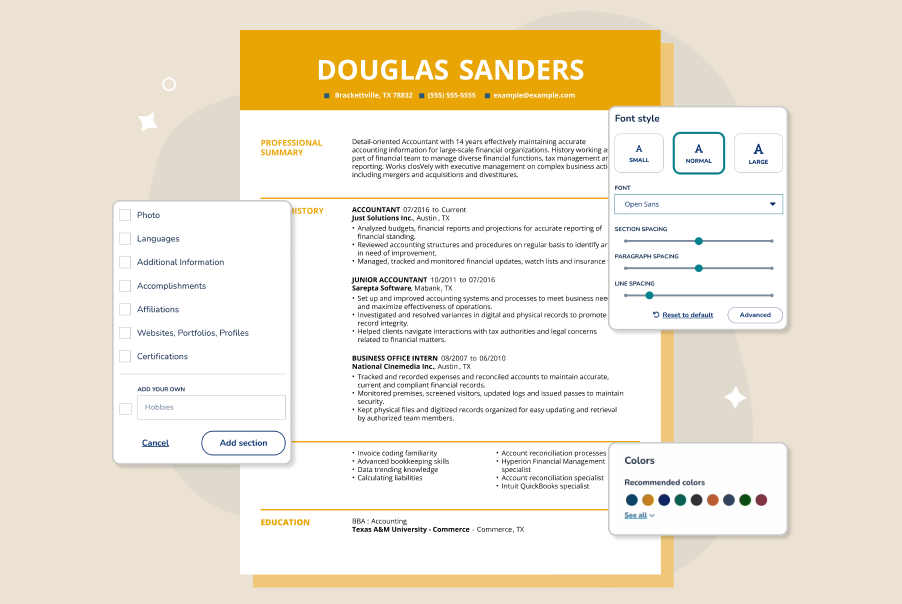
- Use professional formatting. Maintain 1-inch margins on all sides, 10 to 12 pt font for body content, and 12 to 14 pt font for headings to ensure readability.
- Include keywords from the job posting. Incorporate relevant keywords throughout your resume to pass ATS screening and increase your chances of reaching the hiring manager.
- Proofread carefully. Check grammar and spelling with our Resume Builder’s built-in spell-check, and have a trusted friend or family member review your resume for errors.
- Keep it concise. Limit your resume length to one or two pages, focusing on the most relevant information for the role you’re applying for.
- Complement your resume with a cover letter. Writing a cover letter allows you to expand on your qualifications and interest in the role.
Frequently Asked Questions
What is the best resume format for Canada?
The chronological format is the best choice for most Canadian job seekers. It lists your most recent work experience first, making it easy for employers and applicant tracking systems (ATS) to identify your experience and career progression.
A functional or combination format may be useful if you’re changing careers, have employment gaps, or want to emphasize transferable skills.
Does Canada use a CV or resume?
Most Canadian employers use resumes for standard job applications. A resume is typically one or two pages and focuses on the experience, skills, and accomplishments most relevant to a specific position. CVs are generally longer and more detailed and are commonly used for academic, research, medical, and other specialized roles.
How long should a Canadian resume be?
A Canadian resume should generally be one or two pages long. A one-page resume can work well for students, entry-level candidates, and job seekers with limited experience, while two pages may be appropriate for experienced professionals with relevant accomplishments to highlight. Focus on the information that supports your qualifications rather than trying to meet a specific page count.
What is the best Canadian resume format for ATS?
An ATS-friendly Canadian resume should use a straightforward layout with clearly labeled sections, readable fonts, and relevant keywords from the job description. Avoid complicated design elements that can make information difficult for applicant tracking systems to interpret. Tailor your resume for each position rather than using the same keywords and skills for every application.
What should you leave off a Canadian resume?
Leave off personal information that isn’t relevant to your qualifications, such as your photo, age or date of birth, marital status, and Social Insurance Number. You generally don’t need to list references directly on your resume either. Instead, use the available space to highlight relevant skills, accomplishments, work experience, and education.
How We Reviewed This Article
Since 2012, we have helped more than 11 million job seekers. We want to make your career journey accessible and manageable through our services and Career Center’s how-to guides and tips. In our commitment to bring you a transparent process, we present our Editorial Process.
Megan is a career industry editor. She is committed to helping job seekers navigate the job market and succeed in their careers.
More Articles by Megan DawkinsShare this page
 Add MyPerfectResume as a preferred source on Google
Add
Our customers have been hired at:*Foot Note