Table of Contents
Get started with MyPerfectResume today!
- Build a resume on any device
- Pick an ATS-friendly template
- Tailor with AI copy suggestions
Why this resume works
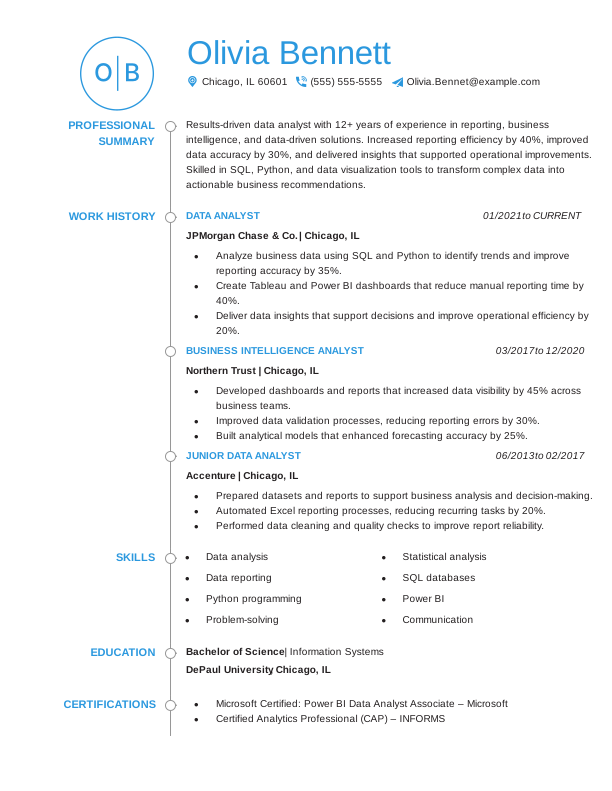
- Quantifies accomplishments: Showcasing impressive metrics like a 40% reduction in reporting time, the applicant quantifies their achievements to highlight their impact.
- Showcases career progression: The applicant’s rise from junior data analyst to data analyst reveals a journey of increasing responsibilities and expertise, highlighting impressive career progression over time.
- Highlights industry-specific skills: Skills such as SQL databases and Python programming highlight the applicant’s alignment with industry demands, emphasizing their readiness for roles requiring advanced data handling abilities.
More Data Analyst Resume Examples
Take a look at our data analyst resume examples to learn how to highlight your analytical skills, technical tools, and experience. These resume examples for data analyst roles will help you build a resume that stands out to employers in your industry.
Entry-Level Data Analyst

Why this resume works
- Centers on academic background: The applicant’s education section showcases a solid foundation in data science and statistics, emphasizing significant academic achievements important for early career development.
- Effective use of keywords: Incorporating essential keywords such as “financial analysis,” “market research,” and “performance measurement” demonstrates relevant expertise and aligns the resume with employer requirements and applicant tracking systems (ATS).
- Shows digital literacy: Experience with Python programming and Microsoft Excel illustrates the applicant’s computer skills, highlighting readiness for tech-centric environments.
Mid-Level Data Analyst
Why this resume works
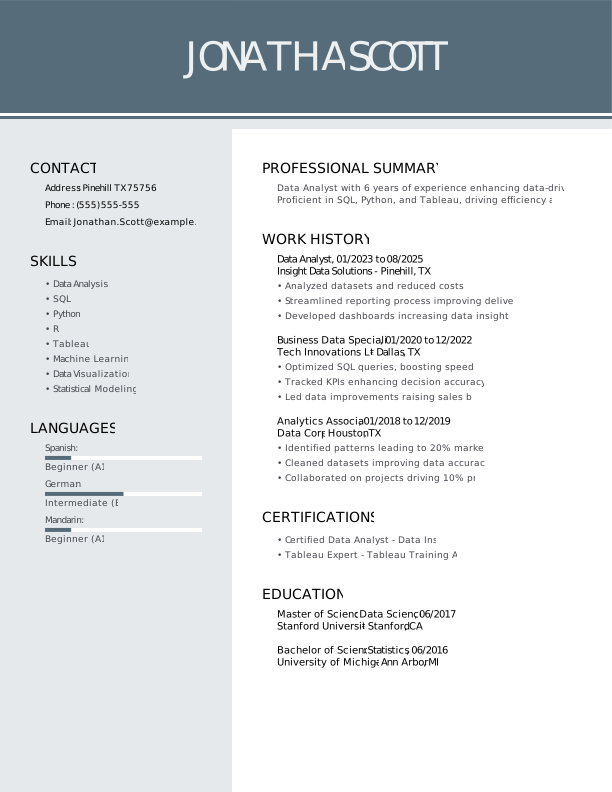
- Points to measurable outcomes: Transforming data processes that led to increased sales and reduced costs, the applicant emphasizes their ability to achieve measurable outcomes effectively.
- Demonstrates language abilities: The applicant’s language skills in Spanish, German, and Mandarin improve cross-cultural communication within diverse teams.
- Displays technical expertise: Holding certifications like Certified Data Analyst and Tableau Expert, the applicant showcases a strong grasp of technical skills important for mid-level data analysis roles.
Experienced Data Analyst
Why this resume works
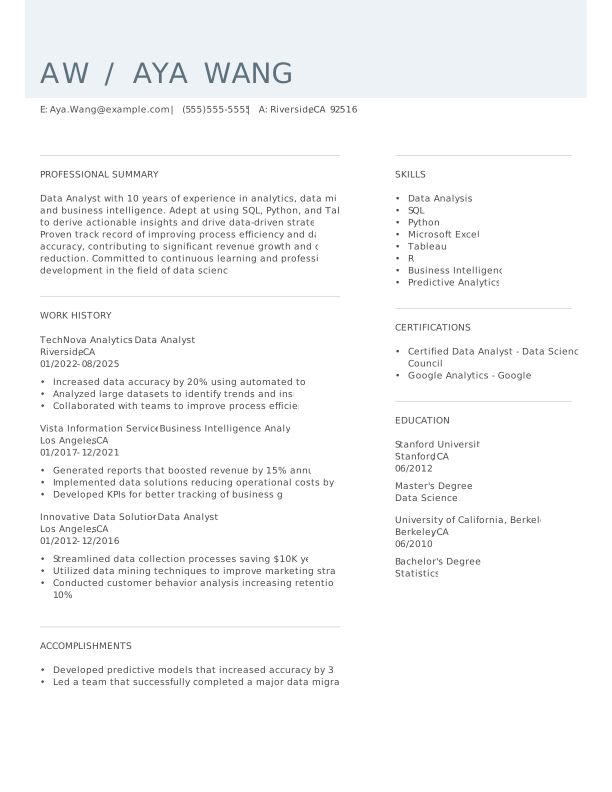
- Showcases impressive accomplishments: Highlighting accomplishments like boosting revenue by 15% and increasing data accuracy by 20%, the applicant reflects exceptional senior-level performance.
- Sections are well-organized: Using bullet points for each role clearly presents key responsibilities, making work experience easy to scan and the resume reader-friendly.
- Emphasizes leadership skills: Leading a team in successful data migration showcases leadership skills, emphasizing the applicant’s ability to manage projects effectively.
Data Analyst Resume Template (Text Version)
Copy and paste the text version of a data analyst resume below and check out our resume templates for more structure ideas on how to format your resume.
Olivia Bennett
Chicago, IL 60601
(555) 555-5555
Olivia.Bennet@example.com
Professional Summary
Results-driven data analyst with 12+ years of experience in reporting, business intelligence, and data-driven solutions. Increased reporting efficiency by 40%, improved data accuracy by 30%, and delivered insights that supported operational improvements. Skilled in SQL, Python, and data visualization tools to transform complex data into actionable business recommendations.
Work History
January 2021 – Current
JPMorgan Chase & Co. – Chicago, IL
Data Analyst
- Analyze business data using SQL and Python to identify trends and improve reporting accuracy by 35%.
- Create Tableau and Power BI dashboards that reduce manual reporting time by 40%.
- Deliver data insights that support decisions and improve operational efficiency by 20%.
March 2017 – December 2020
Northern Trust – Chicago, IL
Business Intelligence Analyst
- Developed dashboards and reports that increased data visibility by 45% across business teams.
- Improved data validation processes, reducing reporting errors by 30%.
- Built analytical models that enhanced forecasting accuracy by 25%.
June 2013 – February 2017
Accenture – Chicago, IL
Junior Data Analyst
- Prepared datasets and reports to support business analysis and decision-making.
- Automated Excel reporting processes, reducing recurring tasks by 20%.
- Performed data cleaning and quality checks to improve report reliability.
Skills
- Data analysis
- Statistical analysis
- Data reporting
- SQL databases
- Python programming
- Power BI
- Problem-solving
- Communication
Education
DePaul University, Chicago, IL
Bachelor of Science in Information Systems
Certifications
- Microsoft Certified: Power BI Data Analyst Associate – Microsoft
- Certified Analytics Professional (CAP) – INFORMS
Related Resume Guides
Advice for Writing Your Data Analyst Resume
Delve into our expert advice on how to write a resume tailored for aspiring data analysts, ensuring you effectively showcase your expertise in data manipulation, statistical analysis, and problem-solving.
Highlight relevant technical skills
Technical skills are a key part of being a data analyst, as they form the foundation for working with data effectively. To showcase your abilities, create a technical skills section on your resume that lists tools, programming languages, and software you know well.
For example, include relevant skills like SQL for querying databases, Python or R for data analysis and visualization, and Excel for handling spreadsheets. If you’ve worked with specific tools like Tableau or Power BI to create dashboards or used statistical methods to interpret data sets, make sure to highlight them in this section.
You can also integrate these abilities into your work experience by describing how you’ve applied them in past roles. For instance, mention optimizing database queries to improve processing time or cleaning and analyzing large datasets to assist decision-making processes. Employers prioritize practical examples of how these tools have been used in real-world settings.
Some common technical skills for this role include knowledge of relational databases, scripting languages such as Python or R, data visualization tools like Tableau or Power BI, advanced Excel functions (e.g., pivot tables and macros), and familiarity with cloud platforms like AWS or Google Cloud. Tailor your list carefully based on the job description and focus on the skills most relevant to the position you’re pursuing.
Example of a technical skills section
- Data analysis tools (Excel, SQL)
- Statistical software (R, Python)
- Data visualization (Tableau, Power BI)
- Database management systems (MySQL, PostgreSQL)
- Machine learning algorithms
- ETL processes
- Big data technologies (Hadoop, Spark)
Instead of only listing these skills, connect them to accomplishments, such as building dashboards, automating reports, or analyzing datasets to uncover insights.
Quantify your accomplishments
Quantifying accomplishments on a resume makes it stand out because it shows exactly what you’ve achieved in your role, rather than just listing duties. For a data analyst, this means turning tasks into achievements with numbers and results.
In the work experience section, start with your job title, employer name, location, and employment dates. Then focus on how you made a difference by using measurable outcomes like percentages, time savings, cost reductions, or efficiency improvements. This approach helps tell your story clearly and powerfully.
Using action verbs combined with metrics gives your resume a results-driven edge. Instead of saying “responsible for analyzing data,” say “improved data processing speed by 30%,” or “reduced reporting errors by 15%.” This tells hiring managers exactly how you impacted the company and reveals your skills at a glance.
Quantified accomplishments make it easy for them to see your value quickly and understand the scope of your abilities as a data analyst. By focusing on these concrete achievements, you’ll create a compelling resume that highlights your success in past roles.
5 data analyst work history bullet points
- Analyzed complex datasets to identify trends, improving business decision-making and increasing revenue by 15%.
- Developed automated data visualization dashboards, reducing report generation time by 40%.
- Collaborated with cross-functional teams to refine data collection processes, improving data accuracy by 25%.
- Implemented statistical models to forecast sales performance, achieving a 20% increase in prediction reliability.
- Conducted A/B testing for marketing campaigns, optimizing strategies and boosting customer engagement by 10%.
Show the business impact of your analysis. Strong data analyst resumes go beyond describing tasks by highlighting outcomes. Use metrics to demonstrate your contributions, such as reducing reporting time, improving data accuracy, identifying cost savings, or increasing operational efficiency.
Write a powerful professional summary
A professional summary on a resume serves as an introduction to hiring managers, giving them a snapshot of your skills and achievements.
A professional summary is a short paragraph that highlights your experience, key skills, and notable achievements. It’s best for those who have been in their field for a while and want to showcase their professional identity and the value they bring. A strong professional summary can help you stand out by quickly showing what you’ve accomplished.
In contrast, resume objectives are brief statements outlining your career goals. They are ideal for entry-level job seekers, career changers, or those with employment gaps. While summaries focus on “what I’ve accomplished,” objectives emphasize “what I aim to contribute.”
Next, we’ll provide examples of both summaries and objectives tailored for different industries and levels of experience.
Data analyst resume summary examples
Entry-level
Recent graduate with a Bachelor of Science in data science and certified in Tableau. Experienced in data visualization, statistical analysis, and SQL through academic projects and internships. Eager to leverage foundational skills to support data-driven decision-making processes in fast-paced environments.
Mid-career
Data analyst with over five years of experience in the finance industry, specializing in predictive analytics and trend analysis. Proven track record of improving business operations through data insights and advanced Excel modeling. Known for strong problem-solving abilities and effective collaboration with cross-functional teams to drive strategic initiatives.
Experienced
Seasoned data analyst with a decade of expertise in machine learning models and big data technologies within the healthcare sector. Demonstrated leadership in managing projects that improve patient care through predictive analytics solutions. Holds a master’s degree in data analytics and is committed to mentoring emerging professionals while driving innovation.
Data analyst resume objective examples
Recent graduate
Detail-oriented recent graduate with a Bachelor of Science in data science, seeking an entry-level data analyst role to apply strong analytical and problem-solving skills. Passionate about leveraging statistical knowledge and skill in Python to extract insights and drive decision-making processes.
Career changer
Driven marketing professional transitioning into data analysis, equipped with a robust understanding of consumer behavior and data interpretation. Eager to contribute analytical skills and Excel expertise to uncover trends and support strategic planning in a collaborative team environment.
Entry-level applicant with certification
Certified data analyst with hands-on training in SQL and Tableau, seeking to join an innovative company as an entry-level data analyst. Committed to using data visualization techniques to transform complex datasets into actionable business intelligence.
Using a clear resume template helps employers focus on your skills. Opt for layouts with clean lines and easy-to-read fonts, avoiding flashy graphics that obscure important details.
Showcase your credentials
In the field of data analysis, having certifications can really help you stand out. They show you have specific skills and knowledge that are important for the job. Certifications are like proof that you know what you’re doing with data tools and systems.
By listing them in a separate certifications section on your resume, you make it easy for employers to see this right away. It’s a good idea to put this section near your education so they can see all your qualifications together.
- AWS Certified Solutions Architect
- Google Professional Cloud Engineer
- Microsoft Certified: Azure Solutions Architect Expert
- Certified Kubernetes Administrator (CKA)
- CompTIA Security+
These certifications show you’re ready for the technical challenges of being a data analyst. Employers will see that you’ve taken extra steps to learn and improve your skills. This can give you an edge over other applicants and help you succeed in getting the job.
Example of a certifications section
Certified Analytics Professional (CAP)
Issued by: Institute for Operations Research and the Management Sciences (INFORMS)
Issued 2021
Microsoft Certified: Data Analyst Associate
Issued by: Microsoft
Expires 2026
Google Data Analytics Professional Certificate
Issued by: Google
Issued 2022
Tableau Desktop Specialist
Issued by: Tableau Software
Issued 2023
SAS Certified Advanced Analytics Professional Using SAS 9
Issued by: SAS Institute
Make sure your resume passes ATS! Use our ATS Resume Checker to spot common errors and fix issues with our improvement suggestions.
FAQ
Do I need to include a cover letter with my data analyst resume?
Yes, including a cover letter with your data analyst resume can make a significant difference in your job application. A cover letter lets you highlight your analytical skills and how they align with the company’s needs, providing context to the numbers on your resume.
For instance, if a company is known for its work in predictive analytics or big data projects, you can mention any relevant experience or interest in these areas.
Consider using a Cover Letter Generator to craft an effective cover letter that complements your resume, ensuring it aligns well with industry standards and expectations.
Additionally, reviewing some cover letter examples tailored to data analysts can offer valuable insights into structuring and customizing your own document effectively.
How long should a data analyst’s resume be?
For a data analyst, a one-page resume is typically sufficient to highlight key skills like data visualization, statistical analysis, and tools such as SQL and Python.
However, if you have extensive experience or multiple significant projects showcasing your capabilities, opting for a two-page resume can be more fitting. This provides room to detail complex projects or certifications.
To determine how long a resume should be, ensure it effectively highlights your accomplishments without overwhelming the reader while staying tailored to your career stage.
How do you write a data analyst resume with no experience?
Crafting a resume with no experience for a data analyst role involves showcasing your relevant skills, education, and practical projects that illustrate your analytical abilities. Learn how to organize an entry-level resume effectively with these tips:
- Emphasize educational background: Start with your degree in fields like Statistics, Computer Science, or Mathematics. Mention any coursework or projects related to data analysis, like Data Mining or Statistical Analysis.
- Showcase technical skills: Highlight skills in tools such as Excel, SQL, Python, or R. Include any online courses or certifications you completed on platforms like Coursera or Udemy.
- Highlight academic projects: Use school projects where you applied data analysis techniques. Detail the problem-solving approach and tools used to show practical understanding.
- Include internships or volunteer work: If you’ve interned at a company or volunteered for an organization performing data-related tasks, describe those experiences even if they were brief.
Should a data analyst resume include projects?
Yes, including projects on a data analyst resume can help demonstrate your technical skills and ability to apply data analysis methods to real-world problems.
Projects are especially valuable for entry-level candidates or career changers who may have limited professional experience.
Highlight projects that showcase skills such as SQL querying, data cleaning, statistical analysis, data visualization, or dashboard creation using tools like Python, Tableau, Power BI, or Excel. Include the goal of the project, the tools you used, and the results or insights you produced.
Rate this article
Data Analyst


Elizabeth is a Certified Professional Resume Writer (CPRW) and a member of the Professional Association of Resume Writers & Career Coaches. She is committed to helping job seekers navigate the job market and succeed in their careers.
More Articles by Elizabeth Muenzen, CPRWShare this page