Table of Contents
Get started with MyPerfectResume today!
- Build a resume on any device
- Pick an ATS-friendly template
- Tailor with AI copy suggestions
Why this resume works
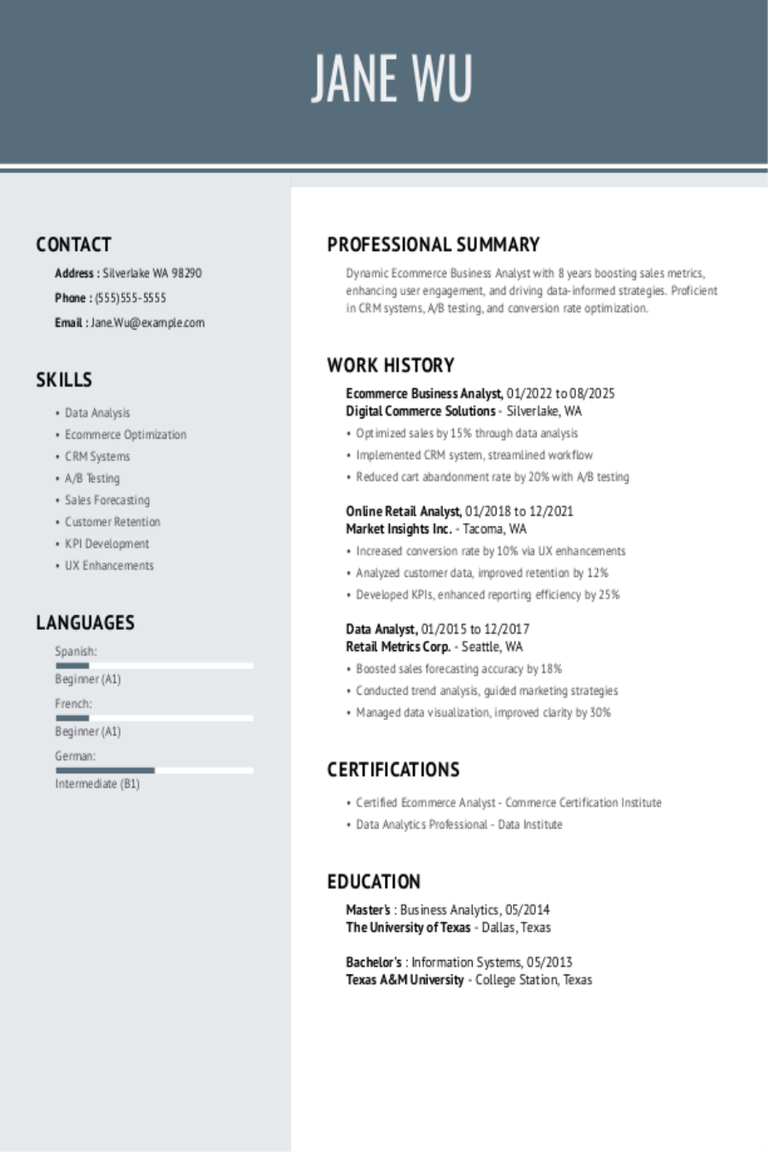
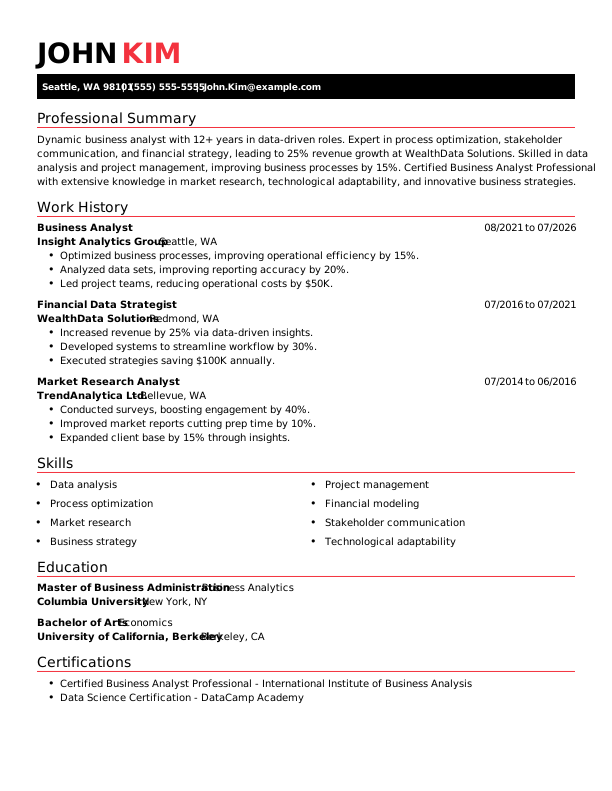
- Quantifies accomplishments: Listing measurable accomplishments, such as improving operational efficiency by 15%, the applicant reflects their business impact and value.
- Uses action-oriented language: Strong action verbs such as “improved” and “optimized” effectively convey initiative and drive on the resume.
- Illustrates problem-solving ability: Analyzing data sets to improve reporting accuracy by 20% showcases strong critical thinking and problem-solving skills.
More Business Analyst Resume Examples
See more business analyst resume samples to learn how to highlight your problem-solving skills, data analysis expertise, and strategic thinking. These business operations resume samples guide you in creating a resume that effectively showcases your analytical abilities.
Entry-Level Business Analyst
Why this resume works
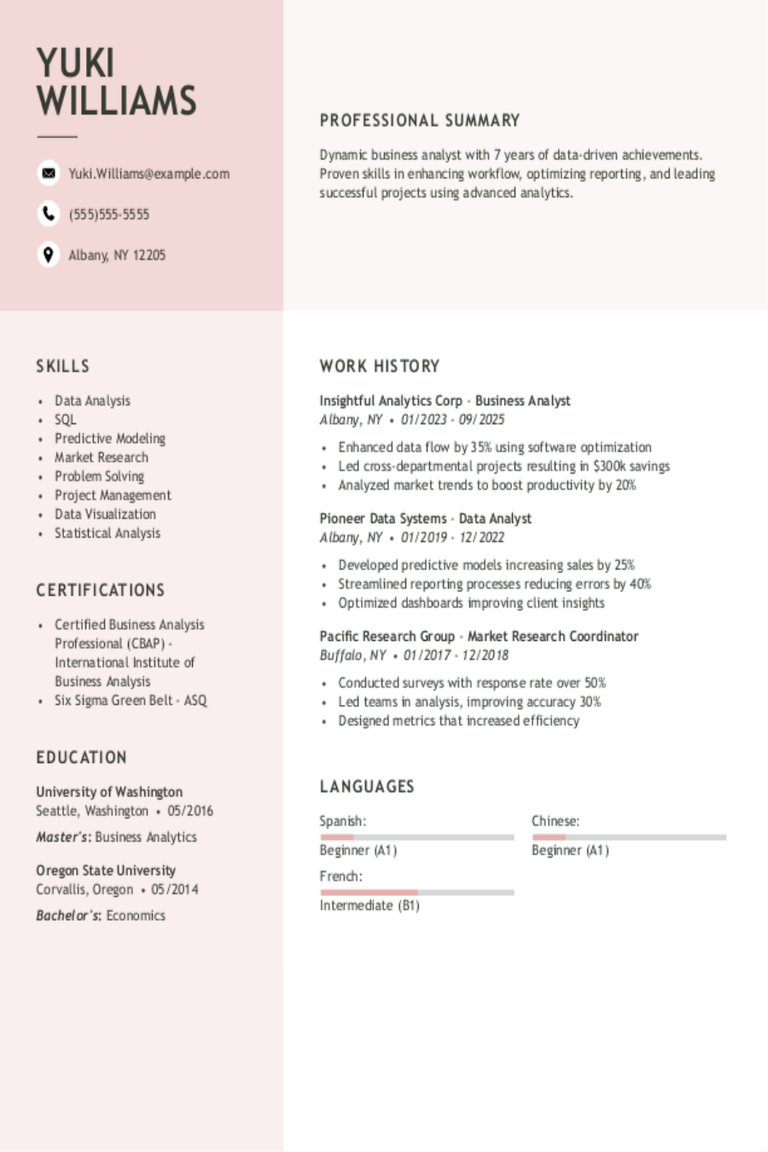
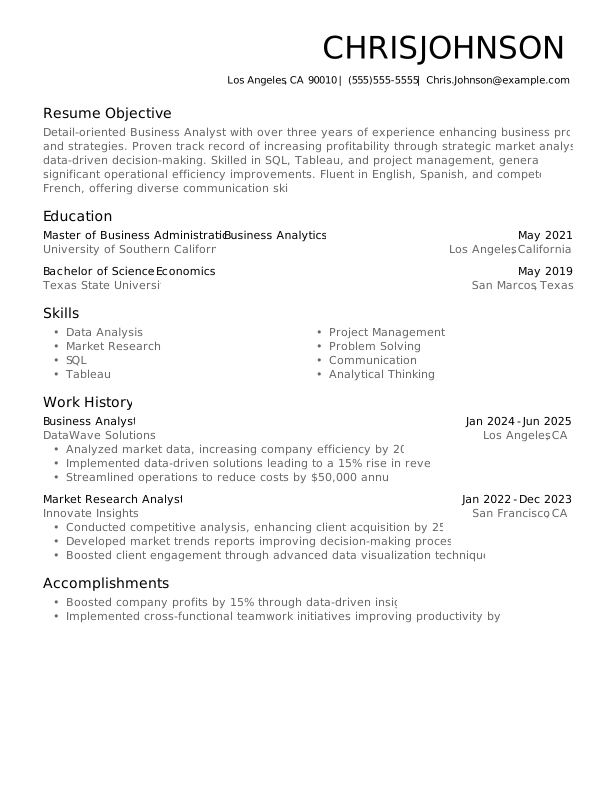
- Centers on academic background: By showcasing advanced degrees in the education section, the applicant emphasizes their strong academic foundation, essential for early career business analyst roles.
- Effective use of keywords: Integrating industry-specific keywords such as “data analysis” and “market research” ensures alignment with employer expectations.
- Shows digital literacy: Mastery in platforms like SQL and Tableau highlights the applicant’s computer skills, reflecting readiness for tech-driven business environments.
Mid-Level Business Analyst

Why this resume works
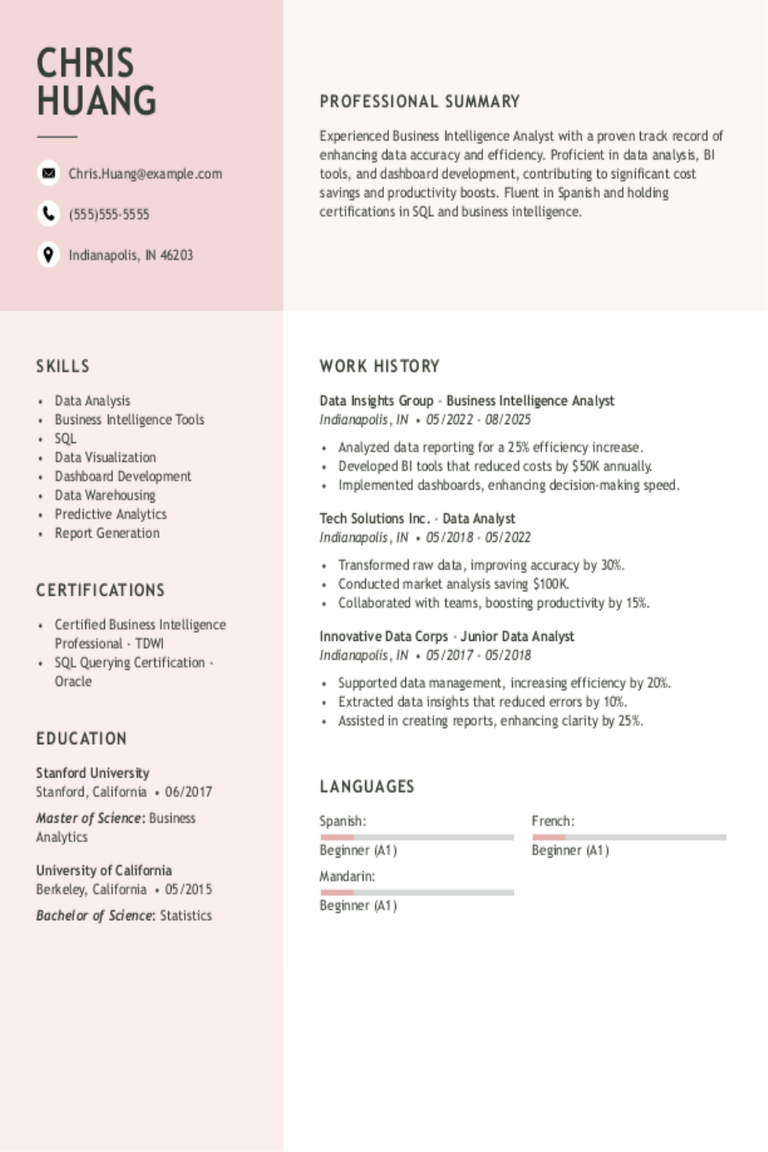
- Points to measurable outcomes: By listing measurable accomplishments like improving operational efficiency by 30%, the applicant effectively ties their efforts to measurable impacts that improve organizational processes and profitability.
- Includes a mix of soft and hard skills: The resume mixes technical strengths in data analysis with interpersonal skills, such as solution implementation and problem-solving, creating a balanced profile well-suited for dynamic business environments.
- Displays technical expertise: Highlighting certifications like Certified Business Analysis Professional shows the applicant’s ability to apply advanced technical knowledge to improve workflows across departments.
Experienced Business Analyst

Why this resume works
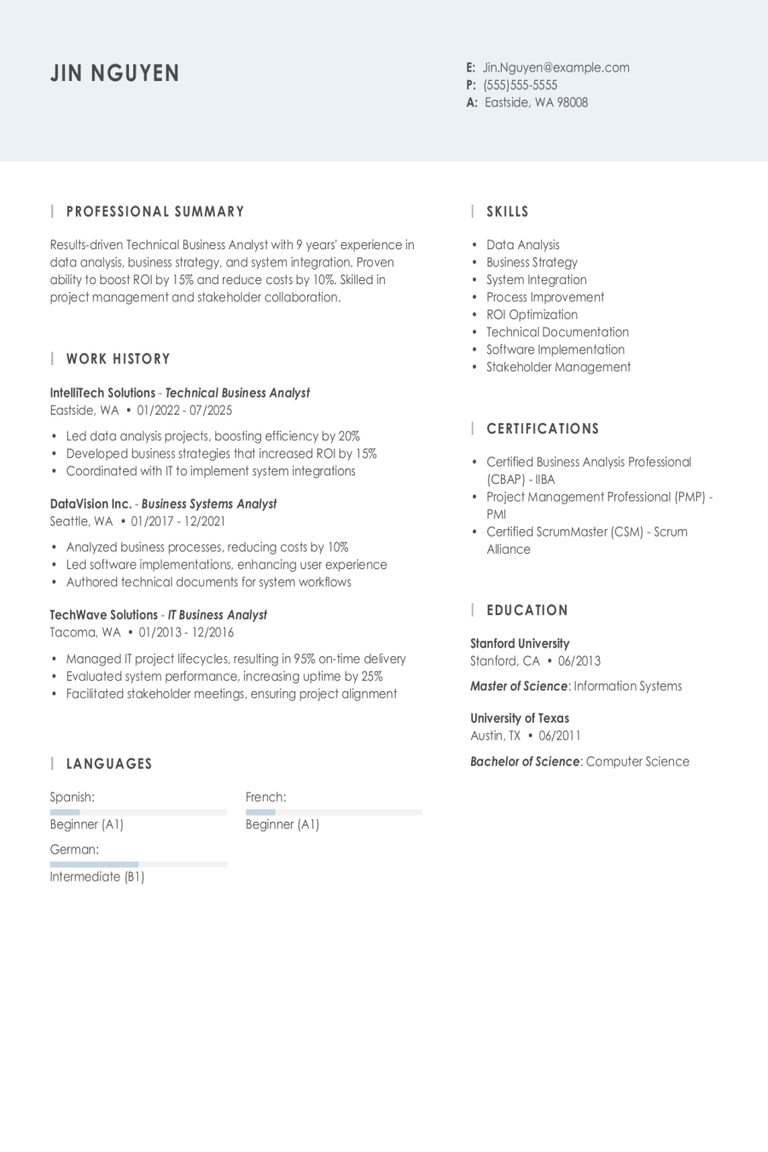
- Lists relevant certifications: By listing certifications like the Certified Business Analysis Professional and Microsoft Power BI Data Analyst Associate certification, the applicant showcases their ongoing commitment to professional growth and expertise.
- Focuses on work history: The applicant uses a chronological resume format to emphasize an extensive work history, making it easy to follow their impressive career progression from market research analyst to business analyst.
- Emphasizes leadership skills: Streamlining procedures with cross-functional teams to increase productivity by 20% illustrates leadership skills and the ability to drive improvements across teams.
Business Analyst Resume Template (Text Version)
Clean and minimal—this text version delivers, and so do our resume templates.
John Kim
Seattle, WA 98101
(555) 555-5555
John.Kim@example.com
Professional Summary
Dynamic business analyst with 12+ years in data-driven roles. Expert in process optimization, stakeholder communication, and financial strategy, leading to 25% revenue growth at WealthData Solutions. Skilled in data analysis and project management, improving business processes by 15%. Certified Business Analyst Professional with extensive knowledge in market research, technological adaptability, and innovative business strategies.
Work History
Insight Analytics Group – Seattle, WA
Business Analyst
August 2021 – July 2026
- Optimized business processes, improving operational efficiency by 15%.
- Analyzed data sets, improving reporting accuracy by 20%.
- Led project teams, reducing operational costs by $50K.
WealthData Solutions – Redmond, WA
Financial Data Strategist
July 2016 – July 2021
- Increased revenue by 25% via data-driven insights.
- Developed systems to streamline workflow by 30%.
- Executed strategies saving $100K annually.
TrendAnalytica Ltd. – Bellevue, WA
Market Research Analyst
July 2014 – June 2016
- Conducted surveys, boosting engagement by 40%.
- Improved market reports cutting prep time by 10%.
- Expanded client base by 15% through insights.
Skills
- Data analysis
- Project management
- Process optimization
- Financial modeling
- Market research
- Stakeholder communication
- Business strategy
- Technological adaptability
Education
Columbia University, New York, NY
Master of Business Administration, Business Analytics
University of California, Berkeley, Berkeley, CA
Bachelor of Arts, Economics
Certifications
- Certified Business Analyst Professional – International Institute of Business Analysis
- Data Science Certification – DataCamp Academy
Related Resume Guides
Advice for Writing Your Business Analyst Resume
Explore our tips on how to write a resume for a business analyst role and discover how to highlight your analytical skills, data-driven mindset, and ability to drive business improvements.
Highlight your most relevant skills
When applying for a business analyst role, highlighting your skills is key. A dedicated skills section helps you stand out and shows what you can bring to the team. Mixing technical skills like data analysis and SQL with soft skills such as communication and problem-solving makes your resume balanced.
Employers look for candidates who can not only crunch numbers but also work well in teams and explain their findings clearly. To make your resume even stronger, weave these skills into your work experience section.
For example, if you’ve used Excel to create reports that helped decision-making, mention it when describing past jobs. This approach gives real-world examples of how you use your skills, making them more than just words on a page. It paints a fuller picture of what you do best.
Remember, the goal is to show that you’re ready to tackle the challenges of a business analyst role. By carefully choosing which skills to highlight and showing how you’ve applied them before, you’ll present yourself as an all-around strong applicant.
Highlight your experience with business analysis tools and methodologies, such as SQL, Excel, Tableau, Power BI, Agile, Scrum, or requirements gathering. Including specific technologies and frameworks helps employers quickly understand your technical capabilities.
Showcase your accomplishments
When organizing your work experience as a business analyst, start with your most recent job and work backward. For each job, include your job title, the employer’s name, location, and dates of employment. This helps hiring managers see your career progression at a glance.
Listing jobs in reverse order makes it easy for them to focus on what you have done recently. Instead of just listing duties, make your resume stand out by highlighting achievements with numbers. Show how you improved things like efficiency or cost savings.
For example, instead of saying “responsible for data analysis,” say “analyzed data to reduce costs by 20%.” Using action-oriented words like “improved,” “developed,” or “increased” can turn simple tasks into impressive achievements.
Quantifying your accomplishments not only grabs attention but also shows the real impact you’ve made. It lets employers quickly see what skills you bring to the table. Focus on turning duties into results and use strong verbs to show what you’ve achieved as a business analyst.
This approach makes it easier for hiring managers to understand your contributions and potential value to their organization.
5 business analyst work history bullet points
- Analyzed customer behavior data to identify trends, increasing sales by 15% in the first quarter.
- Led cross-functional teams to streamline operations, reducing costs by $120,000 annually.
- Developed comprehensive reports on market research findings, aiding strategic decision-making and boosting conversion rates by 10%.
- Automated data processing workflows, improving productivity by 25% and saving over 200 hours of manual work monthly.
- Conducted risk assessments for new projects, mitigating potential losses and improving project success rate by 20%.
Go beyond listing responsibilities by showcasing your impact. Business analysts should highlight accomplishments like streamlining workflows, improving reporting accuracy, reducing costs, or supporting strategic decisions with data-driven insights.
Write a strong professional summary
A professional summary on a resume serves as an introduction to hiring managers, offering a snapshot of your skills and experience. This section gives employers a quick overview of your qualifications and helps them understand why you’re a strong fit before they review the rest of your resume.
Typically three to four sentences long, a professional summary focuses on your career achievements, areas of expertise, and measurable impact. It’s best suited for experienced professionals who want to showcase their skills, industry knowledge, and contributions to previous employers.
A resume objective, by contrast, focuses on your career goals and what you hope to contribute in your next role. Objectives are often a better fit for entry-level candidates, career changers, recent graduates, or professionals returning to the workforce. While summaries answer “What have I accomplished?”, objectives answer “What do I hope to contribute?”
The examples below include both professional summaries and resume objectives tailored to different industries, career stages, and job seekers’ goals.
Business analyst resume summary examples
Entry-level
Recent graduate with a Bachelor of Science in Business Administration and a concentration in data analytics. Completed internships focusing on data collection, market research, and process improvement. Skilled in using SQL and Excel for data analysis, with strong analytical skills and an eagerness to contribute to team success in dynamic business environments.
Mid-career
Business analyst with over six years of experience in the finance sector. Expert in conducting detailed financial analysis and leveraging business intelligence tools like Tableau and Power BI to drive strategic decision-making. Successfully led cross-functional projects resulting in a 20% increase in operational efficiency. Known for strong problem-solving abilities and effective stakeholder communication.
Experienced
Seasoned business analyst with more than 15 years of experience specializing in IT system optimization and process reengineering. Proven leader who has directed teams through complex digital transformation projects, achieving significant cost savings and improved productivity. Expert at aligning technology solutions with business objectives, fostering innovation, and mentoring junior analysts.
Business analyst resume objective examples
Recent graduate
Analytical and detail-oriented recent graduate with a Bachelor of Science in Business Administration seeking an entry-level business analyst position. Eager to leverage academic knowledge and internship experience to support data-driven decision-making and process improvements within a forward-thinking organization.
Career changer
Dedicated professional transitioning from sales into business analysis, bringing strong skills in market research, data interpretation, and client relationship management. Excited to apply analytical thinking and problem-solving abilities to contribute effectively to a team-focused environment while driving business success.
Entry-level applicant
Aspiring business analyst with hands-on experience in data analysis through coursework and project work, seeking an entry-level role to develop expertise in analyzing trends and optimizing business processes. Passionate about using technical skills and strategic insights to support organizational growth.
Create your business analyst resume with our AI Resume Builder to easily highlight key skills and experiences. It’s quick to customize and helps you stand out from the crowd.
Match your resume to the job description
Tailoring resumes to job descriptions is essential for job seekers. It helps them stand out to employers and pass through applicant tracking systems (ATS). To improve your chances, focus on creating an ATS-friendly resume, which includes keywords and phrases that align with the job posting.
An ATS-friendly resume incorporates terms that match the skills required for the role. By doing this, applicants can increase their visibility to hiring managers. Highlighting relevant experience and using language specific to the position makes a significant impact.
To identify keywords from job postings, pay close attention to skills, qualifications, and responsibilities mentioned multiple times. Common examples might include “data analysis,” “project management,” or “stakeholder communication.” Using exact terms from the posting signals that you meet their requirements.
Add these phrases naturally into your content. For instance, instead of copying “Analyze business processes” directly from the listing, write “Analyzed business processes to improve efficiency.” Such adjustments ensure your resume feels authentic while aligning with key phrases.
Customizing resumes shows employers you’ve tailored your application thoughtfully. If you’re unsure where to start, learn how to customize your resume in ways that optimize it for better results, helping you secure interviews for roles like business analyst more effectively.
Don’t let little mistakes stop you from getting a job! Try our ATS Resume Checker to find formatting problems, missing keywords, and layout issues before you send your resume.
FAQ
Do I need to include a cover letter with my business analyst resume?
Yes, including a cover letter with your business analyst resume can strengthen your application and increase your chances of getting noticed. A cover letter gives you the chance to highlight specific skills, such as data analysis or stakeholder communication, that directly match the role’s needs.
It’s also a great spot to explain how your past projects or achievements have driven business outcomes, like boosting efficiency or cutting costs. If the company uses particular tools or methodologies (like SQL, Tableau, or Agile), mention your expertise in those areas to show alignment with their needs.
Check out these cover letter examples to get started. Tailoring your cover letter using a Cover Letter Generator to demonstrate interest in the company’s industry or challenges can showcase your enthusiasm and make your application more memorable.
How long should a business analyst’s resume be?
For a business analyst, a one-page resume is generally enough if you have less than 10 years of experience. This format lets you showcase key skills like data analysis and problem-solving without overwhelming the reader.
However, if you have extensive experience or multiple relevant certifications, a two-page resume can be acceptable. Ensure every detail included supports your qualifications for the business analyst role.
Check out our guide on how long a resume should be for examples and tips on finding your ideal length.
How do you write a business analyst resume with no experience?
To craft a business analyst resume with no experience, focus on highlighting your education, relevant skills, and any hands-on projects or coursework that match the position. Here are a few tips on how to write a resume with no experience:
- Highlight your education: Start with your degree in fields like Business Administration, Finance, or Information Systems. Include details such as the name of the institution, graduation date, and any honors or relevant coursework.
- Showcase relevant skills: Focus on key business analyst skills like data analysis, problem-solving, critical thinking, and skills in tools such as Excel, SQL, or Tableau. Make these prominent in your resume.
- Include academic projects: List any significant projects from your coursework where you analyzed data or solved business problems. Describe what you did and the outcomes to demonstrate your analytical abilities.
- Mention internships or volunteer work: If you’ve participated in internships or volunteer roles that involved analysis or project management tasks, include these experiences even if they were unpaid.
Tailor each section to reflect how your background prepares you for a business analyst role, and consider adding a strong objective statement at the top of your resume to highlight your career goals.
What are good keywords for a business analyst resume?
Common resume keywords for business analysts include requirements gathering, business process improvement, data analysis, stakeholder management, workflow optimization, user stories, Agile, Scrum, SQL, reporting, dashboards, and project management.
To improve your chances of matching employer expectations and ATS, tailor your resume keywords to the specific job description. Focus on the skills, tools, and terminology used by the employer while connecting them to measurable accomplishments, such as streamlining processes, improving reporting accuracy, or supporting successful business initiatives.
Rate this article
Business Analyst


Toni is a Certified Professional Resume Writer (CPRW) and member of the Professional Association of Resume Writers & Career Coaches. She is committed to helping job seekers navigate the job market and succeed in their careers.
More Articles by Toni Frana, CPRWShare this page
 Add MyPerfectResume as a preferred source on Google
Add