Table of Contents
Get started with MyPerfectResume today!
- Build a resume on any device
- Pick an ATS-friendly template
- Tailor with AI copy suggestions
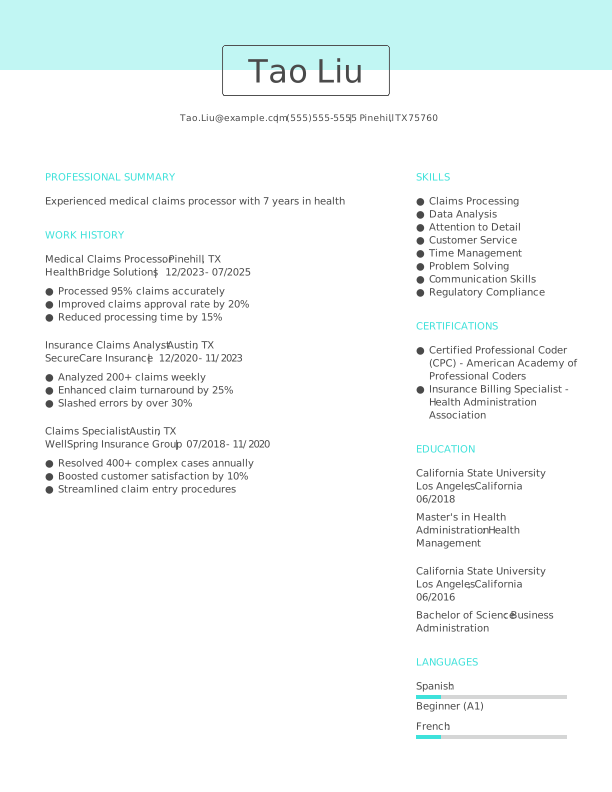
Why this resume works
- Quantifies accomplishments: By citing measurable accomplishments like a 20% improvement in claims approval rates, the applicant showcases tangible success and impactful contributions.
- Showcases career progression: The progression from resolving complex cases to analyzing and processing claims highlights increasing expertise and responsibilities, reflecting steady career growth in insurance and health management roles.
- Uses action-oriented language: Action verbs like processed, improved, and resolved emphasize initiative and problem-solving abilities.
More Medical Claims Processor Resume Examples
Our medical claims processor resume examples demonstrate how to highlight your attention to detail, analytical skills, and experience with insurance claims. Use these insurance resume samples to craft a resume that showcases your expertise in claims processing.
Entry-Level Medical Claims Processor
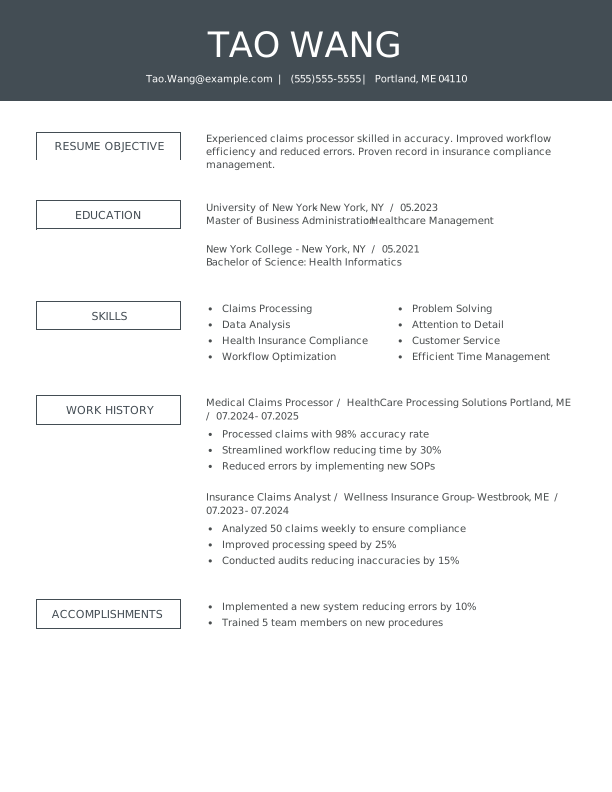
Why this resume works
- Effective use of keywords: Skillfully embedding industry-specific keywords like claims processing and compliance ensures the resume highlights focused expertise that aligns with employer expectations.
- Shows digital literacy: The applicant’s experience with workflow optimization and data analysis tools showcases computer skills and readiness for tech-driven workplaces.
- Centers on academic background: Degrees in health informatics and healthcare management show the applicant’s dedication to academic excellence early on, laying a strong foundation for career growth.
Mid-Level Medical Claims Processor

Why this resume works
- Points to measurable outcomes: Accomplishments like processing over 200 claims monthly and reducing errors by 40% vividly illustrate the applicant’s commitment to efficiency and accuracy in their role.
- Includes a mix of soft and hard skills: Combining interpersonal skills with technical expertise, the applicant excels in both leading teams and handling complex data analysis tasks.
- Demonstrates language abilities: The applicant’s language skills in Spanish, French, and German improve cross-cultural communication, supporting diverse client interactions and broadening their professional reach.
Experienced Medical Claims Processor
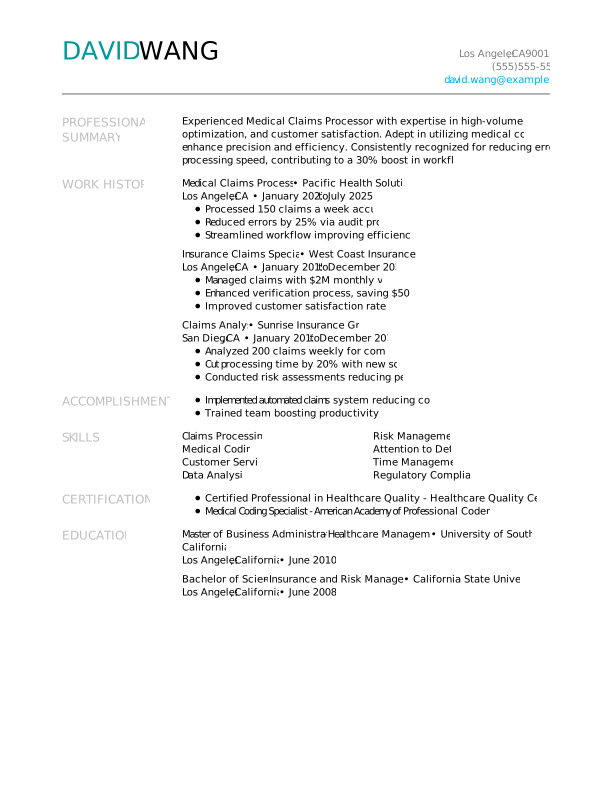
Why this resume works
- Lists relevant certifications: Earning certifications like Certified Professional in Healthcare Quality and Medical Coding Specialist suggests a proactive approach.
- Showcases impressive accomplishments: The applicant’s ability to manage $2M in monthly claims and save $500K annually showcases impactful accomplishments that reflect senior-level performance.
- Emphasizes leadership skills: Through leading initiatives like training a team to boost productivity by 15%, the applicant effectively demonstrates strong leadership skills.
Medical Claims Processor Resume Template (Text Version)
Take the easy route with this text template. For designs you can download, browse our resume templates.
Tao Liu
Pinehill, TX 75760
(555)555-5555
Tao.Liu@example.com
Professional Summary
Experienced medical claims processor with 7 years in health
Work History
Medical Claims Processor
HealthBridge Solutions – Pinehill, TX
December 2023 – July 2025
- Processed 95% claims accurately
- Improved claims approval rate by 20%
- Reduced processing time by 15%
Insurance Claims Analyst
SecureCare Insurance – Austin, TX
December 2020 – November 2023
- Analyzed 200+ claims weekly
- Enhanced claim turnaround by 25%
- Slashed errors by over 30%
Claims Specialist
WellSpring Insurance Group – Austin, TX
July 2018 – November 2020
- Resolved 400+ complex cases annually
- Boosted customer satisfaction by 10%
- Streamlined claim entry procedures
Skills
- Claims Processing
- Data Analysis
- Attention to Detail
- Customer Service
- Time Management
- Problem Solving
- Communication Skills
- Regulatory Compliance
Certifications
- Certified Professional Coder (CPC) – American Academy of Professional Coders
- Insurance Billing Specialist – Health Administration Association
Education
Master’s in Health Administration Health Management
California State University Los Angeles, California
June 2018
Bachelor of Science Business Administration
California State University Los Angeles, California
June 2016
Languages
- Spanish – Beginner (A1)
- French – Beginner (A1)
- Mandarin – Intermediate (B1)
Related Resume Guides
Advice for Writing Your Medical Claims Processor Resume
Explore our advice on how to write a resume tailored for a medical claims processor role, where you’ll discover how to highlight your knack for detail and expertise in navigating the complex world of healthcare claims. Whether you’re seasoned or just starting, these tips will help you stand out in the crowd and get noticed by potential employers.
Highlight your most relevant skills
Listing relevant skills when applying for the job of a medical claims processor is important because it shows that you have the right abilities to do the work well.
A dedicated skills section on your resume allows hiring managers to quickly see what you can do. It’s good to include a mix of technical skills, like using billing software and understanding medical codes, and soft skills, like communication and attention to detail. This balance helps show that you’re not only capable of handling the technical aspects but also able to work well with others.
Integrating key skills into your work experience section can make an even stronger impact. For example, if you mention in your work history that you’ve used specific billing software or managed large volumes of claims accurately, it highlights those skills in a real-world context.
Showing how you’ve used soft skills like problem-solving or teamwork in past jobs makes your resume more compelling. This approach paints a fuller picture of your capabilities as a medical claims processor and helps potential employers see how you could fit into their team.
A resume format that highlights attention to detail, accuracy in data entry, and familiarity with insurance processes can set medical claims processors apart.
Showcase your accomplishments
Organize your work experience in reverse chronological order, starting with your most recent position. Each job entry should include the job title, employer name, location, and employment dates. This helps hiring managers quickly see your career progression and current skills.
Quantifying accomplishments makes your resume more compelling than simply listing job responsibilities. Turn duties into achievements by incorporating measurable results such as percentages, time savings, cost reductions, or efficiency improvements.
For instance, instead of saying you “processed medical claims,” say you “processed over 1,000 medical claims per month with a 98% accuracy rate.” This shows not only what you did but also how well you did it. Use action-oriented words focused on core duties and measurable achievements to highlight your impact. Words like “improved,” “reduced,” or “increased” can demonstrate your effectiveness.
Quantified accomplishments help hiring managers quickly assess your impact and skills as a medical claims processor. They paint a clearer picture of your abilities and show that you have made meaningful contributions in previous roles.
5 medical claims processor work history bullet points
- Processed an average of 150 claims daily, achieving a 98% accuracy rate and reducing processing time by 20%.
- Collaborated with healthcare providers to resolve discrepancies in claims, improving resolution speed by 30%.
- Used new software tools to automate claim verification processes, increasing efficiency by 25%.
- Conducted training sessions for junior staff on best practices in medical claim processing, improving team productivity.
- Streamlined billing procedures, reducing manual errors and cutting rework costs by 15%.
Choose a resume template that has straightforward sections and readable fonts. Avoid flashy designs; clean layouts help employers concentrate on your skills and work experience.
Write a strong professional summary
A professional summary on a resume serves as an introduction to hiring managers. It sets the tone for your application, letting employers quickly see your qualifications and decide if they want to learn more about you. When writing a resume, choose between a professional summary and a resume objective based on your experience level and career goals.
A professional summary is typically three to four sentences long, highlighting your experience, skills, and achievements. It’s best for experienced applicants with a solid work history, and aims to showcase your professional identity while demonstrating the value you can bring to potential employers.
In contrast, a resume objective focuses on your career goals. This is ideal for entry-level job seekers, career changers, or those with employment gaps. Think of it as “what I’ve accomplished” (summary) versus “what I aim to contribute” (objective).
Next, we will provide examples of both summaries and objectives tailored for different industries and experience levels. See our library of resume examples for additional inspiration.
Medical claims processor resume summary examples
Entry-level
Recent health administration graduate with a focus on medical billing and coding. Completed internship in claims processing, gaining familiarity with insurance guidelines and the claims adjudication process. Certified in medical billing and coding (CPC) and eager to contribute to efficient claim resolutions while ensuring compliance with healthcare regulations.
Mid-career
Experienced medical claims processor with over five years in the healthcare industry, specializing in reviewing and adjusting claims for accuracy. Proficient in using claims management software and known for reducing processing time through effective problem-solving skills. Demonstrates strong knowledge of insurance policies, regulatory requirements, and adept at managing high-volume workloads.
Experienced
Seasoned medical claims processor with a decade of experience leading teams in complex claim evaluations. Expert in resolving discrepancies, negotiating settlements, and driving improvements in workflow efficiency. Holds advanced certification in health information management (CHDA), recognized for implementing cost-saving measures that improve operational productivity while ensuring excellent service delivery.
Medical claims processor resume objective examples
Recent graduate
Detail-oriented recent health administration graduate eager to start a career in medical claims processing. Aiming to use analytical skills and understanding of insurance protocols to efficiently manage claims and support the administrative functions of a healthcare organization.
Career changer
Dedicated customer service professional transitioning into medical claims processing, bringing strong communication abilities and problem-solving skills from previous roles. Looking forward to applying attention to detail and an empathetic approach in resolving claim discrepancies for patients and providers.
Entry-level applicant
Aspiring medical claims processor with coursework in healthcare management and experience in data entry seeking an opportunity to contribute effectively in a healthcare setting. Eager to learn industry practices while ensuring accuracy and timeliness in claim evaluations.
Showcase your skills as a medical claims processor quickly with our Resume Builder. Just choose a template, add your details, and make a professional resume fast!
Match your resume to the job description
Tailoring your resume to match job descriptions is essential because it helps you stand out and pass through an applicant tracking system (ATS). Employers use ATS to scan resumes for specific keywords and phrases found in their job postings. By including these terms, you increase your chances of getting noticed by hiring managers.
An ATS-friendly resume includes keywords and phrases from the job description that align with your skills and experiences. This approach helps your resume get past the initial screening process, allowing a real person to review it.
To find the right keywords, carefully read the job posting. Look for skills, qualifications, and duties mentioned multiple times. For example, if you’re applying for a medical claims processor position, focus on terms like “claims processing,” “insurance verification,” or “patient billing.”
Once you’ve identified key terms, weave them naturally into your resume content. Instead of simply listing them, rewrite your job experience descriptions to include these words. For instance, change “Handled insurance claims” to “Managed insurance claims processing efficiently.”
Targeted resumes not only help with ATS compatibility but also show employers that you’ve taken the time to customize your resume for their specific needs. This effort increases your chances of landing an interview and ultimately securing the job.
Boost your chances of getting noticed by using our ATS Score Checker to find and fix formatting problems, missing words, or layout issues before hitting send on your job application.
FAQ
Do I need to include a cover letter with my medical claims processor resume?
Including a cover letter with your medical claims processor resume can make you stand out to employers.
A cover letter lets you highlight why you’re interested in the role and how your skills align with the job requirements, like your attention to detail and knowledge of insurance policies.
If the company uses specific software or processes that you’re familiar with, mention this in your cover letter to show you’re ready to hit the ground running.
Consider using tools or templates like our Cover Letter Generator to help structure your cover letter effectively, ensuring it complements your resume without repeating information.
Reviewing cover letter examples for similar roles can provide insight into what employers are looking for and help you tailor yours more effectively.
How long should a medical claims processor’s resume be?
For a medical claims processor, aim for a concise one-page resume to effectively highlight your essential skills and experience. This length is typically sufficient to showcase your skill in handling medical claims, understanding healthcare regulations, and attention to detail.
If you have extensive experience or specialized certifications that are highly relevant, a two-page resume can be appropriate. Just make sure every detail included is relevant and demonstrates your capabilities in processing claims efficiently and accurately.
Explore our guide on how long a resume should be for more examples and tips on determining the ideal length for your career stage.
How do you write a medical claims processor resume with no experience?
If you’re creating a medical claims processor resume with no experience, highlight transferable skills, education, and any related training that fit the job. These elements can help your resume get noticed by employers. Here are a few tips to help you get started:
- Highlight education or coursework: If you’ve studied healthcare administration, insurance processes, or similar topics, list them prominently. Include degrees, certifications (like HIPAA compliance training), and any relevant classes.
- Showcase transferable skills: Skills like attention to detail, data entry skills, customer service experience, or familiarity with spreadsheets and databases are highly valuable in this role. Link these skills to tasks a medical claims processor might handle.
- Include volunteer work or internships: If you’ve volunteered at a hospital or clinic or done internships where administrative work was involved, describe those experiences as they relate to billing and claims processing responsibilities.
- Focus on achievements: Even if unrelated to healthcare, show accomplishments that demonstrate reliability—such as meeting deadlines or excelling in accuracy-heavy roles.
Tailor your resume by using keywords from the job description and formatting it clearly for recruiters scanning for potential in entry-level candidates.
Rate this article
Medical Claims Processor


Jasmine is a certified career coach and recognized expert in job search strategy. She is committed to helping job seekers navigate the job market and succeed in their careers.
More Articles by Jasmine EscaleraShare this page
 Add MyPerfectResume as a preferred source on Google
Add