Table of Contents
Get started with MyPerfectResume today!
- Build a resume on any device
- Pick an ATS-friendly template
- Tailor with AI copy suggestions
Why this resume works
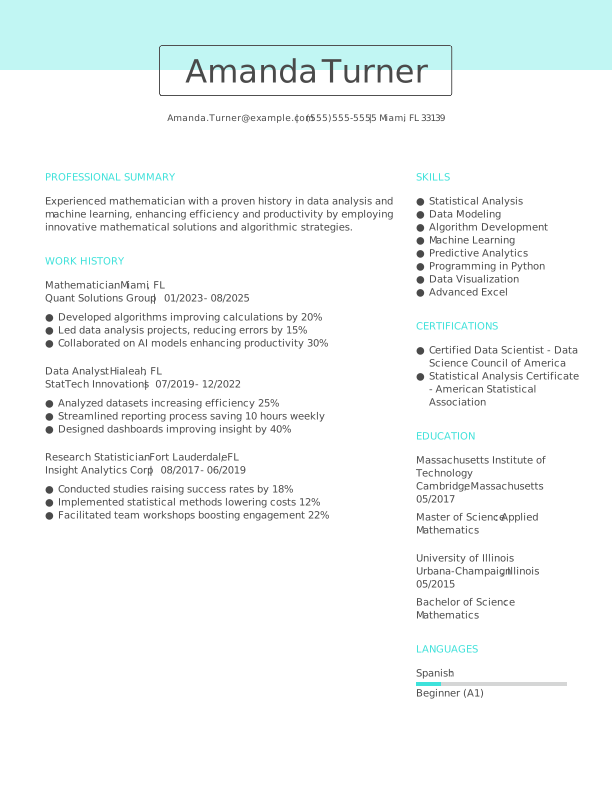
- Quantifies accomplishments: By showcasing metrics like a 30% productivity increase, the applicant illustrates compelling contributions, making quantifiable accomplishments shine.
- Highlights industry-specific skills: The applicant’s expertise in algorithm development and data modeling expertly aligns with the demands of mathematical roles, emphasizing industry-specific skills important for success.
- Showcases career progression: Progressing from research statistician to mathematician highlights the applicant’s career advancement, marked by increasing responsibilities and significant achievements in algorithm development.
More Mathematician Resume Examples
Our mathematician resume examples offer great insights into highlighting your analytical skills, problem-solving abilities, and research experience. Use these education resume samples to craft a compelling resume that demonstrates your expertise in mathematics.
Entry-Level Mathematician
Why this resume works
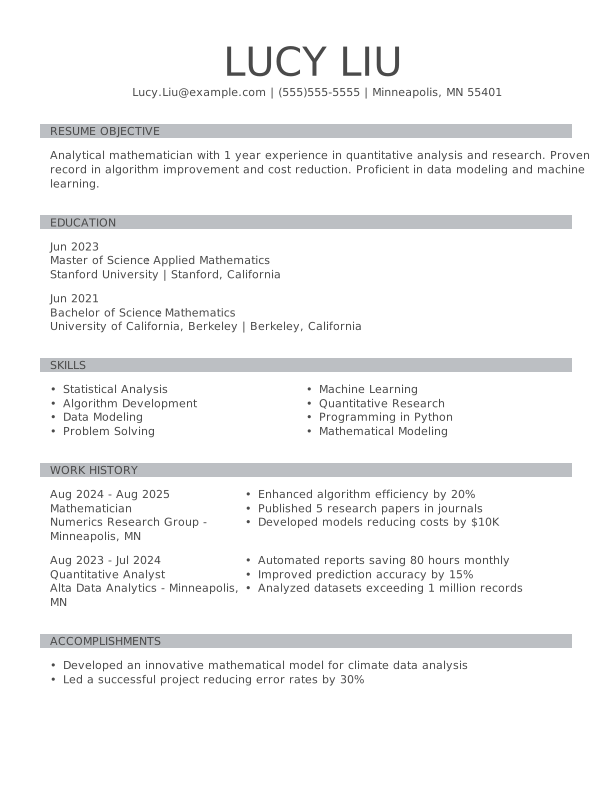
- Effective use of keywords: Using role-specific keywords like “algorithm development” and “quantitative research” improves the applicant’s resume for keywords optimization, aiding applicant tracking systems (ATS) navigation.
- Shows digital literacy: The applicant’s computer skills shine through in Python programming, showcasing readiness for tech-driven environments.
- Centers on academic background: Highlighting degrees from Stanford and Berkeley in the education section emphasizes strong academic foundations pivotal for establishing credibility in mathematical fields.
Mid-Level Mathematician
Why this resume works
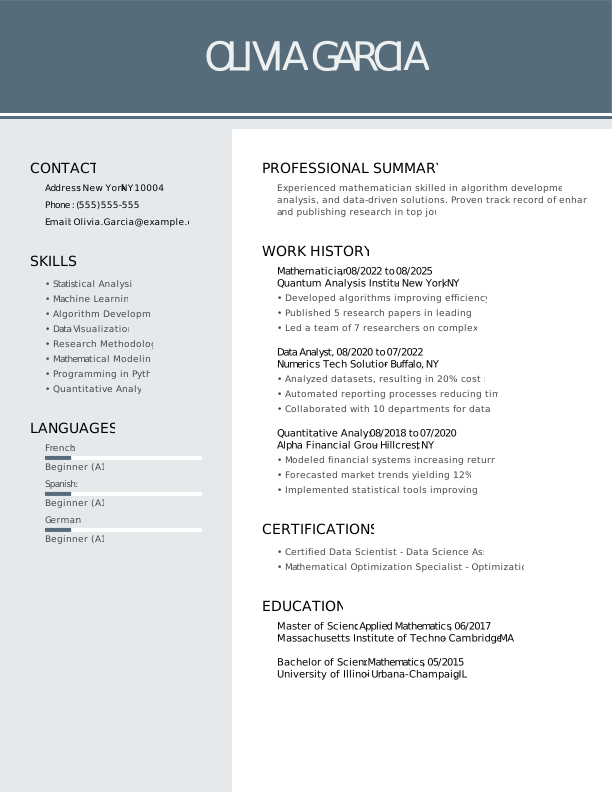
- Points to measurable outcomes: Listing achievements like a 30% efficiency improvement and a 20% cost reduction emphasizes the applicant’s impact through measurable outcomes.
- Demonstrates language abilities: The applicant’s language skills in Spanish, German, and French support cross-cultural collaborations and broadening international project opportunities.
- Clear contact information: An organized resume header with clear contact details ensures employers can easily reach out for interviews, boosting callback chances.
Experienced Mathematician
Why this resume works
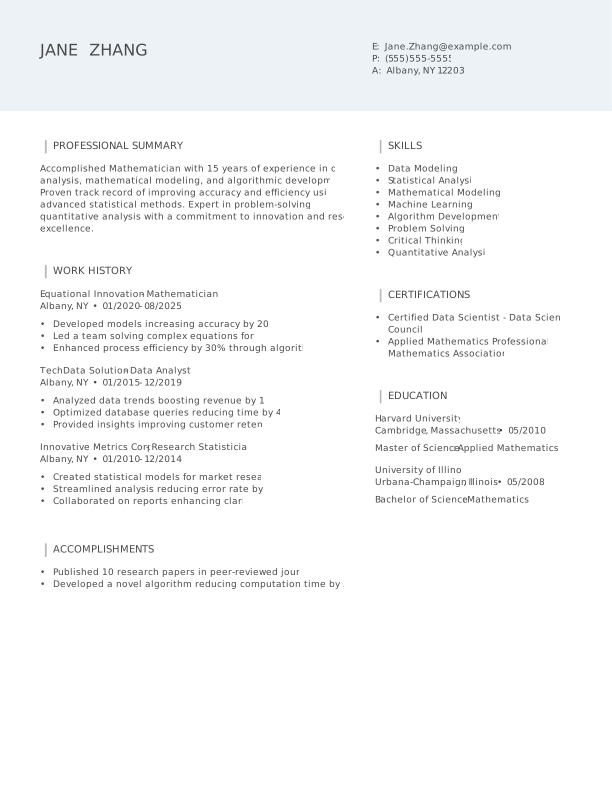
- Showcases impressive accomplishments: By showcasing achievements like a novel algorithm reducing computation time by 35%, the applicant highlights their significant business impact and senior-level performance.
- Focuses on work history: Using a chronological resume, the applicant effectively highlights an extensive work history, tracing a career path through three major data-focused roles.
- Emphasizes leadership skills: Leading teams to solve complex AI equations, the applicant’s leadership skills shine through in managing intricate projects and driving innovation.
Mathematician Resume Template (Text Version)
Need a fast solution? The format below is ready to edit right now. For more designs, explore our resume templates.
Amanda Turner
Miami, FL 33139
(555)555-5555
Amanda.Turner@example.com
Professional Summary
Experienced mathematician with a proven history in data analysis and machine learning, enhancing efficiency and productivity by employing innovative mathematical solutions and algorithmic strategies.
Work History
Mathematician
Quant Solutions Group – Miami, FL
January 2023 – August 2025
- Developed algorithms improving calculations by 20%
- Led data analysis projects, reducing errors by 15%
- Collaborated on AI models enhancing productivity 30%
Data Analyst
StatTech Innovations – Hialeah, FL
July 2019 – December 2022
- Analyzed datasets increasing efficiency 25%
- Streamlined reporting process saving 10 hours weekly
- Designed dashboards improving insight by 40%
Research Statistician
Insight Analytics Corp – Fort Lauderdale, FL
August 2017 – June 2019
- Conducted studies raising success rates by 18%
- Implemented statistical methods lowering costs 12%
- Facilitated team workshops boosting engagement 22%
Skills
- Statistical Analysis
- Data Modeling
- Algorithm Development
- Machine Learning
- Predictive Analytics
- Programming in Python
- Data Visualization
- Advanced Excel
Certifications
- Certified Data Scientist – Data Science Council of America
- Statistical Analysis Certificate – American Statistical Association
Education
Master of Science Applied Mathematics
Massachusetts Institute of Technology Cambridge, Massachusetts
May 2017
Bachelor of Science Mathematics
University of Illinois Urbana-Champaign, Illinois
May 2015
Languages
- Spanish – Beginner (A1)
- French – Intermediate (B1)
- German – Beginner (A1)
Related Resume Guides
Advice for Writing Your Mathematician Resume
Discover essential tips on how to write a resume tailored for mathematicians, and learn how to highlight your analytical skills and problem-solving expertise.
Highlight relevant technical skills
Technical skills are essential for a mathematician’s success, as they enable tackling complex problems and developing new theories. Creating a dedicated technical skills section can highlight these abilities on a resume. This section should list specific software, programming languages, and tools used in mathematical modeling or data analysis.
For a mathematician role, typical technical skills might include skill in software such as MATLAB or R for statistical computing. Familiarity with programming languages like Python or Java is beneficial for mathematical simulations or algorithms. Additionally, expertise in data visualization tools like Tableau proves useful when presenting findings clearly. Including these skills allows employers to see how you solve problems using modern technology.
When listing technical skills, use bullet points for clarity and focus on those most relevant to the mathematician job you’re targeting. Tailor your resume by emphasizing how you’ve applied these skills in past projects or research to address issues or create solutions. Whether through dedicated sections or integrated descriptions within work experiences, ensure your technical prowess shines through clearly and effectively.
Example of a technical skills section
- Mathematical modeling and simulation (MATLAB, Mathematica, Python)
- Data analysis and visualization (R, Tableau, Excel)
- Statistical methods and probability theory
- Numerical optimization techniques
- Machine learning algorithms for predictive analysis
- Algebraic and geometric computation tools
- Quantitative research methodology
- Cryptography and number theory applications
- Partial differential equations and dynamic systems
- Big data analytics with Hadoop and Spark
Employers look for soft skills like communication, teamwork, and adaptability because they show you can solve problems and work well with others. Use our Resume Builder to highlight these to make your resume stand out.
Quantify your accomplishments
Quantifying your accomplishments as a mathematician makes your resume stand out by clearly showing what you’ve achieved. Instead of just listing what you did, turn duties into achievements by including measurable results like percentages, time savings, cost reductions, or efficiency improvements.
For example, if you improved a calculation process that saved 20% of the time compared to the old method, make sure to highlight that. This approach allows hiring managers to quickly see your impact and skills. In the work experience section, each entry should include your job title, employer name, location, and employment dates.
Use action verbs and metrics to describe your accomplishments. For instance, saying “developed a model that reduced costs by 15%” is more powerful than simply stating “worked on cost models.” This results-driven approach shows potential employers how you can contribute to their team based on past successes.
By quantifying your achievements, you help hiring managers assess your contributions at a glance. It’s not just about what you did but how well you did it and the difference it made. Tailoring this for a mathematician’s role can effectively showcase analytical abilities and problem-solving skills in real-world scenarios.
5 mathematician work history bullet points
- Developed complex mathematical models to optimize supply chain logistics, resulting in a 20% cost reduction and improved delivery efficiency.
- Collaborated with cross-functional teams to analyze large datasets using statistical techniques, improving decision-making processes that led to a 15% increase in operational effectiveness.
- Implemented advanced algorithms for data analysis, providing insights that increased forecasting accuracy by 25%, aiding strategic planning.
- Conducted quantitative research on market trends and consumer behavior, contributing to a successful launch strategy with a projected revenue growth of 30%.
- Led the redesign of financial risk assessment models, improving accuracy by 40% and reducing potential loss exposure.
Looking at professional resume examples can give you cool ideas on how to make your own resume stand out and show off your skills.
Write a powerful professional summary
A professional summary is like an introduction on a resume, giving hiring managers a snapshot of who you are. It’s the first thing they read and can make a strong impression.
A professional summary is usually three to four sentences long and highlights your experience, skills, and achievements. It’s great for experienced applicants because it shows your professional identity and the value you bring to a role. As a mathematician, this is where you’d talk about how you solve complex problems or develop models that improve processes.
On the other hand, a resume objective states your career goals. It’s ideal for entry-level applicants, those changing careers, or anyone with gaps in their work history. While summaries focus on past accomplishments (“what I’ve done”), objectives emphasize future contributions (“what I aim to contribute”).
Next, let’s look at examples of both summaries and objectives tailored for different industries and levels of experience.
Mathematician resume summary examples
Entry-level
Recent graduate with a Bachelor of Science in mathematics from a top-tier university. Strong foundation in calculus, linear algebra, and statistical analysis. Completed coursework in mathematical modeling and discrete mathematics. Proficient in using MATLAB and Python for complex problem-solving. Eager to apply theoretical knowledge to real-world applications and contribute to team-based projects.
Mid-career
Mathematician with over five years of experience in data analytics and applied mathematics within the finance industry. Proven track record in developing predictive models and conducting quantitative analysis to inform decision-making processes. Experienced with SQL, R, and machine learning algorithms. Known for delivering precise insights that drive business growth and operational efficiency.
Experienced
Senior mathematician specializing in cryptography and algorithm development with over 15 years of experience. Advanced expertise in number theory, combinatorics, and computational complexity. Led teams on high-impact research projects resulting in significant advancements in data security protocols. Published author in numerous peer-reviewed journals, dedicated to mentoring junior mathematicians and fostering innovation.
Mathematician resume objective examples
Entry-level
Aspiring mathematician with a Bachelor of Science in mathematics eager to apply strong analytical and problem-solving skills in a collaborative research environment. Passionate about contributing to projects that advance knowledge in applied mathematics and computational methods.
Career changer
Detail-oriented professional transitioning into a career as a mathematician, bringing extensive experience in data analysis and statistical modeling from the finance industry. Eager to leverage transferable skills and mathematical knowledge to drive innovative solutions within a research team.
Recent graduate
Recent graduate with a degree in mathematics seeking an entry-level position where foundational knowledge of mathematical theories and quantitative analysis can be used. Committed to supporting innovative projects that solve real-world problems through precise mathematical applications.
Select a resume template that features clear sections and simple fonts, avoiding excessive colors or graphics to help employers focus on your skills and job experience without distraction.
Showcase your credentials
Listing certifications, licenses, and specialized training is very important for a mathematician. These credentials show your skills and knowledge in the field. They can set you apart from others when applying for jobs by showing that you have the expertise needed for technical work.
Creating a dedicated certifications section on your resume helps employers quickly see your qualifications. It’s a good addition to your education section, making sure all your learning achievements are easy to find.
- Chartered Mathematician (CMath)
- Fellow of the Institute of Mathematics and its Applications (FIMA)
- Society for Industrial and Applied Mathematics (SIAM) Certification
- Certified Actuarial Analyst (CAA)
- Data Science Council of America (DASCA) Senior Data Scientist
Having these certifications can really help you succeed as a mathematician. They demonstrate that you have the right skills for complex mathematical tasks. Including them on your resume makes it easier for employers to see how qualified you are.
Example of a certifications section
Certified Mathematical Modeling Analyst
Issued by: International Association of Mathematics
Issued 2022
Statistical Analysis Software Certification
Issued by: Institute for Operations Research and the Management Sciences (INFORMS)
Expires 2025
Advanced Data Science Certificate
Issued by: Coursera – Johns Hopkins University
Issued 2023
Mathematics Teaching Credential
Issued by: National Council of Teachers of Mathematics (NCTM)
Expires 2026
Quantitative Finance Certificate
Issued by: Global Association of Risk Professionals (GARP)
Issued 2021
Our ATS Resume Checker quickly scans your resume for 30 common formatting and content errors and suggest improvements to ensure your resume gets to hiring managers.
Salary Insights for Mathematicians
Knowing salary data can help you make good choices about your career path or moving to a new place.
Top 10 highest-paying states for mathematicians
Mathematicians earn varying salaries across the United States, with a national average of $123,128. The table below highlights the states where mathematicians command the highest compensation.
Our salary information comes from the U.S. Bureau of Labor Statistics’ Occupational Employment and Wage Statistics survey. This official government data provides the most comprehensive and reliable salary information for mathematicians across all 50 states and the District of Columbia. The figures presented here reflect the May 2025 dataset, which is the most recent available as of this publication.
| State | Average Salary |
|---|---|
| District of Columbia | $168,390 |
| Washington | $156,610 |
| Virginia | $141,720 |
| California | $135,410 |
| Maryland | $131,090 |
| Illinois | $123,220 |
| New York | $123,190 |
| New Jersey | $116,290 |
| Nevada | $105,350 |
| Florida | $104,610 |
FAQ
Do I need to include a cover letter with my mathematician resume?
Including a well-written cover letter with your mathematician resume can significantly improve your application and boost your chances of securing interviews.
A cover letter offers you the chance to express enthusiasm for the specific role and institution, elaborate on relevant mathematical research or projects, and highlight unique skills like problem-solving or data analysis.
If the organization is known for particular mathematical applications or theories, detail your experience or interest in those areas within the letter.
Using a Cover Letter Generator can help you craft a personalized cover letter that aligns seamlessly with your resume, offering tailored content suggestions to improve your application.
Also, exploring various cover letter examples can provide insights into effectively showcasing your qualifications and career motivations in mathematics.
How long should a mathematician’s resume be?
As a mathematician, determining how long a resume should be depends on your experience and achievements.
Typically, a one-page resume is ideal for recent graduates or those with limited experience, allowing you to concisely display your analytical skills, research projects, and relevant coursework.
For seasoned professionals or those with extensive publications and presentations, a two-page resume might be more appropriate. This format lets you dive deeper into your contributions to the field, advanced mathematical techniques you’ve mastered, and any teaching or mentoring roles.
How do you write a mathematician resume with no experience?
Building a resume with no experience as a mathematician includes emphasizing your education, showcasing skills, and detailing relevant projects that illustrate your abilities. Follow these tips:
- Emphasize education: Begin by listing your degree in mathematics or related fields prominently. Include the institution name, graduation date, and any academic honors or relevant coursework.
- Showcase projects and research: If you’ve completed any math-related projects or research during your studies, include these as examples of applied knowledge. Describe what you did and the outcomes achieved.
- Highlight skills: Focus on analytical skills, problem-solving abilities, programming languages (like Python or MATLAB), and statistical tools that are applicable to mathematics. These are important for a mathematician’s role.
Rate this article
Mathematician


Elizabeth is a Certified Professional Resume Writer (CPRW) and a member of the Professional Association of Resume Writers & Career Coaches. She is committed to helping job seekers navigate the job market and succeed in their careers.
More Articles by Elizabeth Muenzen, CPRWShare this page
 Add MyPerfectResume as a preferred source on Google
Add