Table of Contents
Get started with MyPerfectResume today!
- Build a resume on any device
- Pick an ATS-friendly template
- Tailor with AI copy suggestions
Why this resume works
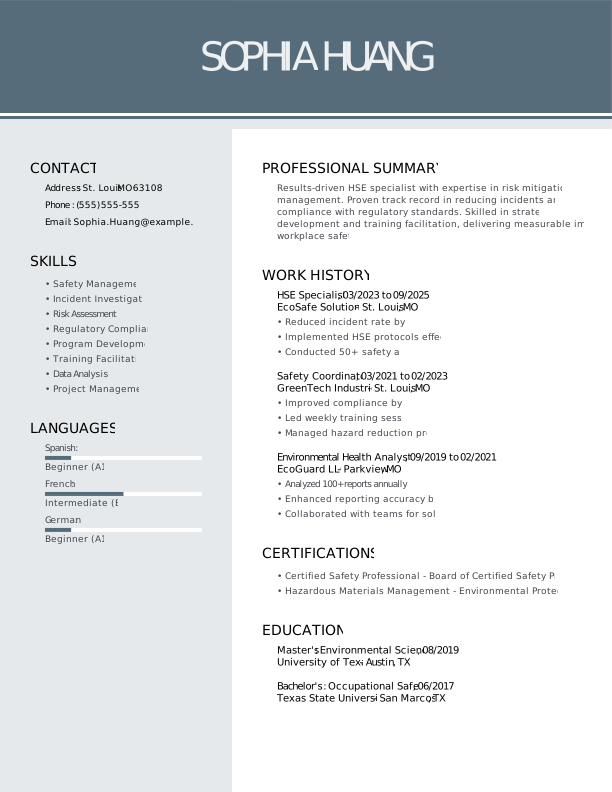
- Quantifies accomplishments: By reducing incident rates by 20% and conducting over 50 audits, the applicant’s measurable accomplishments effectively showcase their tangible impact on workplace safety.
- Highlights industry-specific skills: The applicant demonstrates a strong fit for HSE roles through industry-specific skills like regulatory compliance and risk assessment, reflecting their targeted expertise in environmental health.
- Showcases career progression: Progressing from an analyst to an HSE specialist role, the applicant illustrates career growth and expanded responsibilities in safety management and compliance enhancement.
More HSE Resume Examples
Certifications, incident rates, and safety responsibilities can provide useful context for workplace safety experience. Compare how the examples below use those details, then browse our safety and security resumes library.
HSE Officer
Why this resume works
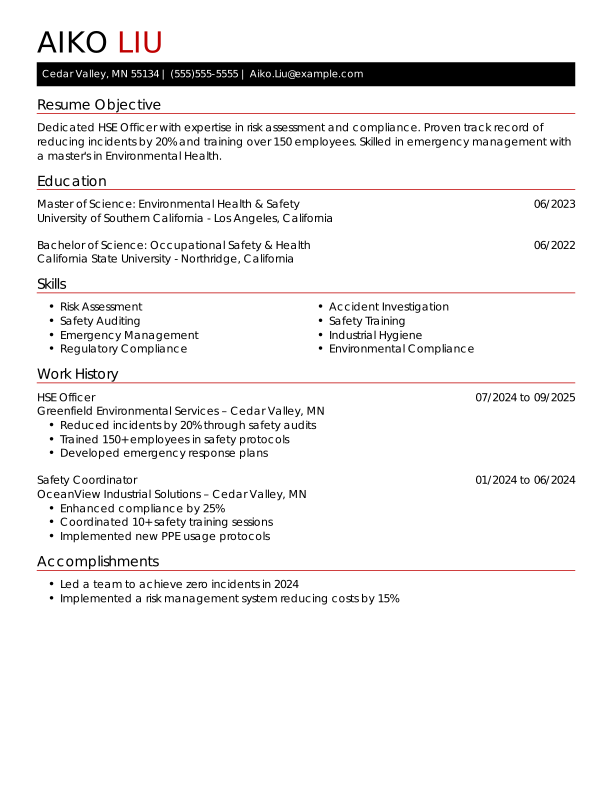
- Centers on academic background: The applicant’s academic foundation is emphasized through advanced degrees in environmental health and occupational safety, showcasing a strong commitment to specialized knowledge early in their career.
- Shows digital literacy: Fluency in tools like ISO 45001 auditing highlights digital literacy, aligning with computer skills essential for modern workplace safety management practices.
- Effective use of keywords: Strategic placement of terms like risk assessment and regulatory compliance ensures alignment with ATS-friendly keywords, optimizing visibility for relevant safety roles.
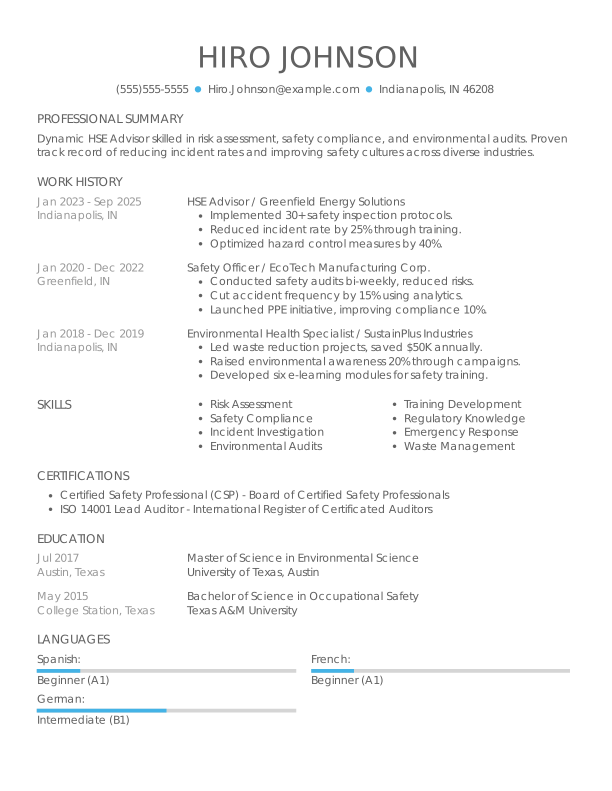
HSE Advisor
Why this resume works
- Points to measurable outcomes: Focusing on measurable outcomes like cutting incident rates by 25% and saving $50K annually emphasizes an ability to drive effective safety and environmental improvements.
- Demonstrates language abilities: Language skills in Spanish, French, and German support effective communication across diverse teams and improve collaboration in global environments.
- Includes a mix of soft and hard skills: Mixing technical expertise in risk assessment with interpersonal skills like training development highlights a well-rounded approach to fostering safer workplaces.
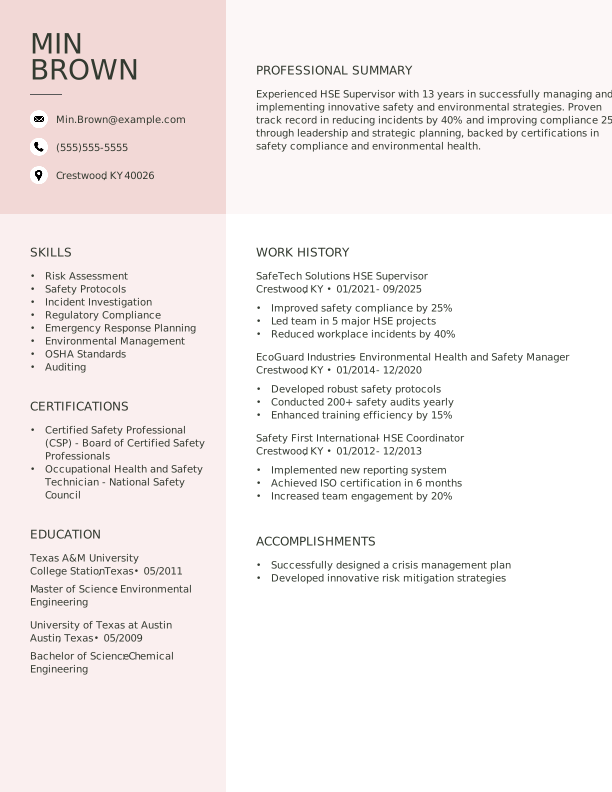
HSE Supervisor
Why this resume works
- Focuses on work history: Using a chronological resume format showcases career progression with detailed roles and achievements in safety management.
- Showcases impressive accomplishments: The applicant’s standout achievements, like reducing incidents by 40%, naturally illustrate senior-level performance.
- Sections are well-organized: Bullet points and headers neatly organize sections, making each accomplishment easy to spot and improving the resume’s reader-friendly flow.
HSE Resume Template (Text Version)
First impressions count. Copy the text below for content, then explore our free resume templates for a polished style.
Sophia Huang
St. Louis, MO 63108
(555)555-5555
Sophia.Huang@example.com
Skills
- Safety Management
- Incident Investigation
- Risk Assessment
- Regulatory Compliance
- Program Development
- Training Facilitation
- Data Analysis
- Project Management
Languages
- Spanish – Beginner (A1)
- French – Intermediate (B1)
- German – Beginner (A1)
Professional Summary
Results-driven HSE specialist with expertise in risk mitigation and safety management. Proven track record in reducing incidents and enhancing compliance with regulatory standards. Skilled in strategic program development and training facilitation, delivering measurable improvements in workplace safety.
Work History
HSE Specialist
EcoSafe Solutions – St. Louis, MO
March 2023 – September 2025
- Reduced incident rate by 20%
- Implemented HSE protocols effectively
- Conducted 50+ safety audits
Safety Coordinator
GreenTech Industries – St. Louis, MO
March 2021 – February 2023
- Improved compliance by 15%
- Led weekly training sessions
- Managed hazard reduction projects
Environmental Health Analyst
EcoGuard LLC – Parkview, MO
September 2019 – February 2021
- Analyzed 100+ reports annually
- Enhanced reporting accuracy by 10%
- Collaborated with teams for solutions
Certifications
- Certified Safety Professional – Board of Certified Safety Professionals
- Hazardous Materials Management – Environmental Protection Agency
Education
Master’s Environmental Science
University of Texas Austin, TX
August 2019
Bachelor’s Occupational Safety
Texas State University San Marcos, TX
June 2017
Related Resume Guides
Advice for Writing Your HSE Resume
HSE officers support safer workplaces by monitoring health, safety, and environmental practices across operations or worksites. See how to make a resume that presents your compliance knowledge and safety experience clearly.
Write a Strong Professional Summary
A professional summary on a resume serves as an introduction for hiring managers, providing a snapshot of your skills and accomplishments. You can decide whether to use a summary or a resume objective based on your experience level and career goals.
Typically three to four sentences long, the professional summary highlights your experience, skills, and achievements. It suits experienced applicants wanting to showcase their professional identity and the value they can bring. In an HSE role, this might include experience in risk assessment or improving workplace safety standards.
On the other hand, resume objectives are statements about career goals, ideal for entry-level applicants, those changing careers, or individuals with employment gaps. Unlike summaries that focus on accomplishments, objectives emphasize future contributions.
Next, we will provide examples of both summaries and objectives tailored for various industries and experience levels to assist you in crafting the perfect introduction for your resume. Explore our professional resume examples for additional inspiration.
HSE Resume Summary Examples
Entry-level
Recent graduate with a Bachelor of Science in environmental health and safety, eager to apply foundational knowledge in workplace safety protocols and hazard prevention. Holds OSHA 30-hour certification and is familiar with conducting risk assessments and supporting compliance with safety standards. Enthusiastic about contributing to team efforts in promoting safe work environments.
Mid-career
HSE professional with over five years of experience in the manufacturing industry, adept at implementing health and safety policies and conducting regular audits. Proven track record of reducing workplace incidents through training programs and proactive hazard identification. Possesses NEBOSH certification and is skilled in fostering a culture of safety across all levels of the organization.
Experienced
Senior HSE manager specializing in strategic planning and execution of comprehensive safety programs within multinational corporations. Expertise in regulatory compliance, incident investigation, and crisis management. Certified Safety Professional (CSP) known for leading cross-functional teams to drive continuous improvement initiatives that significantly reduce accident rates. Committed to building resilient systems that support long-term organizational health.
HSE Resume Objective Examples
Entry-level
Aspiring HSE professional with a background in environmental science eager to start a career in health, safety, and environmental management. Looking to contribute analytical skills and a keen attention to detail to support workplace safety initiatives and promote sustainable practices.
Career changer
Dedicated educator transitioning into the HSE field, bringing strong communication skills and experience in policy implementation. Excited to apply these abilities in fostering safe work environments and engaging employees in proactive safety measures.
Recent graduate
Recent occupational health and safety degree holder seeking an entry-level position as an HSE officer. Committed to applying academic knowledge of risk assessment and hazard control to improve workplace safety standards while continuously learning from experienced professionals.
Want a great-looking resume without the hassle? Try our Resume Builder to easily create a professional resume that stands out.
Include Relevant Certifications and Training
Listing certifications and training is important for HSE roles because it shows you have the skills to keep people and environments safe. These credentials prove that you know the latest safety standards and practices.
Including a dedicated certifications section on your resume makes it easy for employers to see what special skills you bring to the job. It’s especially useful in technical fields like HSE, where having specific knowledge can set you apart. Here are a few examples:
- Certified Safety Professional (CSP)
- Occupational Health and Safety Technician (OHST)
- Hazardous Waste Operations and Emergency Response (HAZWOPER)
- NEBOSH International General Certificate
- ISO 45001 Lead Auditor
These certifications show that you’re ready to handle health, safety, and environmental challenges efficiently. They help your resume stand out by highlighting your expertise in keeping workplaces safe. Employers will appreciate seeing these qualifications as they look for skilled HSE professionals.
Example of a Certifications Section
Certified Safety Professional (CSP)
Issued by: Board of Certified Safety Professionals (BCSP)
Expires 2025
Occupational Health and Safety Technologist (OHST)
Issued by: Board of Certified Safety Professionals (BCSP)
Issued 2022
ISO 45001:2018 Lead Auditor
Issued by: International Register of Certificated Auditors (IRCA)
Expires 2024
HAZWOPER Certification
Issued by: Occupational Safety and Health Administration (OSHA)
Issued 2023
First Aid/CPR/AED Instructor Certification
Issued by: American Red Cross
Expires 2026
Choose a polished and well-organized resume template that effectively showcases your skills and qualifications to stand out to hiring managers in your field.
Showcase Your Work Experience
The work experience section is the best place to demonstrate how you’ve applied your HSE expertise in real-world situations. Rather than simply listing responsibilities, highlight the measurable impact of your work—such as reducing incidents, improving compliance, or strengthening emergency preparedness.
Employers value candidates who can show they don’t just maintain safety programs but actively improve them. When writing this section, start each statement with a strong action verb and follow with a clear outcome. Wherever possible, use numbers or percentages to prove the effectiveness of your contributions.
Align your examples with the job posting by weaving in keywords like OSHA compliance, training, audits, or risk reduction. See sample work history bullet points below to get started.
5 Hse Work History Bullet Points
- Implemented a comprehensive safety training program, resulting in a 25% decrease in workplace incidents.
- Conducted regular safety audits across the company’s facilities, leading to a 40% improvement in compliance with OSHA standards.
- Developed and enforced new health protocols during the pandemic, maintaining zero transmission cases within the office.
- Led emergency response drills biannually, improving evacuation times by 15%.
- Collaborated with department heads to revise safety policies, achieving ISO 45001 certification within three months.
For HSE roles, a resume format that highlights safety certifications, compliance achievements, and risk management expertise can improve your application.
Match Your Resume With the Job Description
Tailoring resumes to specific job descriptions is essential because it helps job seekers stand out to employers and pass through applicant tracking systems (ATS). These systems scan resumes for keywords and phrases from job postings to match job seekers with the right skills and qualifications.
An ATS-friendly resume includes relevant keywords and phrases that align with the job seeker’s skills. By incorporating these terms, applicants increase their chances of getting noticed by hiring managers who rely on ATS to filter applicants.
To identify keywords from HSE job postings, look for skills, qualifications, and responsibilities that appear repeatedly. Examples might include safety audits, OSHA compliance, risk assessments, incident investigations, or emergency preparedness.
Incorporate these terms naturally into your resume content. For example, you can customize your resume by rewriting a duty such as “Responsible for safety inspections” as “Conducted regular safety inspections to ensure OSHA compliance and reduce workplace hazards.”
This approach mirrors the language of the posting while showing the measurable impact of your work. Targeted resumes not only improve ATS compatibility but also increase the likelihood of catching a hiring manager’s attention.
Get better results fast! Our resume scanner reviews your resume and gives quick tips to help you stand out to hiring managers.
FAQ
Do I need to include a cover letter with my HSE resume?
Including a cover letter with your HSE resume can improve your application and boost your chances of landing interviews.
A cover letter lets you highlight your passion for health, safety, and environmental roles while detailing specific experiences or projects that make you a strong job seeker for the job.
If a company is known for its sustainability initiatives or unique safety programs, be sure to mention any relevant experience you have in those areas.
Consider using our Cover Letter Generator to craft a tailored cover letter that aligns with industry expectations and highlights your strengths effectively.
Browsing through our collection of cover letter examples can also offer inspiration and guidance on structuring and wording your own compelling cover letter.
How long should an HSE’s resume be?
For a Health, Safety, and Environment (HSE) professional, a one-page resume efficiently captures core competencies like risk management, safety protocols, and compliance expertise. This format works well for professionals early in their careers or those with focused experience.
On the other hand, if you have extensive experience or advanced certifications that demonstrate leadership in large-scale HSE projects or initiatives, a two-page resume could be better suited. Ensure every detail included is relevant to your contributions.
Review our guide on how long a resume should be to determine the ideal length based on your career stage.
How do you write an HSE resume with no experience?
Crafting a resume with no experience can be challenging, especially in the HSE field. Focus on highlighting your education, skills, and any relevant certifications to create an effective entry-level resume. Here are some tips to get you started:
- Highlight your education: Start with your degree in safety engineering or a related field. Include the institution, graduation date, and any honors or relevant coursework.
- Include certifications: If you have obtained certifications like OSHA training or NEBOSH qualifications, list them prominently to show your commitment to health and safety standards.
- Emphasize transferable skills: Skills such as risk assessment, knowledge of regulations, and communication are important in HSE roles. Highlight these skills if developed through internships, volunteer work, or academic projects.
- Showcase your passion for safety: Mention any involvement in safety workshops or seminars. Participation in student organizations focused on safety issues can demonstrate your dedication.
For more insights on crafting a resume with no experience tailored to HSE positions, explore our comprehensive guide filled with examples and tips from industry professionals.
Rate this article
HSE


Elizabeth is a Certified Professional Resume Writer (CPRW) and a member of the Professional Association of Resume Writers & Career Coaches. She is committed to helping job seekers navigate the job market and succeed in their careers.
More Articles by Elizabeth Muenzen, CPRWShare this page
 Add MyPerfectResume as a preferred source on Google
Add