160+ Skills for a Resume: Examples for Any Job


Our customers have been hired at: *Foot Note


Table of Contents
Get started with MyPerfectResume today!
- Build a resume on any device
- Pick an ATS-friendly template
- Tailor with AI copy suggestions
What to Expect
- Hard skills are technical abilities, while soft skills are transferable, people-focused strengths. Both show employers you have the competencies needed to do the job and work effectively with others.
- Some of the most valuable resume skills include communication, adaptability, digital literacy, attention to detail, time management, and collaboration.
- The best resume skills vary by industry, with different fields requiring different technical and soft skills.
- The job description shows which skills matter most for the role and provides keywords to tailor your resume.
- Skills should appear throughout your resume, not only in the skills section. Your summary and work history can show how you’ve applied your most relevant skills.
Crafting a strong resume starts with choosing skills that accurately represent what you can bring to a role. The strongest skills sections balance technical abilities with transferable strengths and connect those skills to your actual experience. This guide covers skills for a resume across industries, with examples to help you build a relevant, well-rounded skills section.
What Is a Resume Skills Section?
A resume skills section is a dedicated area on your resume that lists your relevant abilities and competencies. Because recruiters and hiring managers often spend only a few seconds scanning each resume, a clear, well-organized skills section makes it easy for them to quickly see whether you have the qualifications needed to succeed in the role.
Typically placed after your professional summary or work history, this section also helps optimize your resume for applicant tracking systems (ATS). By reflecting the skills and keywords used in the job description, you improve your chances of passing automated screenings and getting a human to review your resume.
Tailor your resume skills section for each application by focusing on the specific skills mentioned in the job posting and prioritizing those that align most closely with the role and your industry.
Hard Skills vs Soft Skills
Hard skills are technical abilities, while soft skills are personal and interpersonal strengths that shape how you work with others. A strong resume should include both to show the technical qualifications and workplace abilities needed for the role.

Hard Skills
Hard skills are the technical abilities you’ve gained through training, education, or hands-on experience. They’re specific to your role or industry and show employers you have what it takes to do the job, such as software, tools, or specialized methods.
Here are some examples of hard skills:
- Data analysis
- Programming language (e.g., Python or Java)
- Graphic design software (e.g., Adobe Photoshop or Illustrator)
- Project management tools (e.g., Asana or Trello)
- Foreign language proficiency (e.g., Spanish or Mandarin)

Soft Skills
Soft skills are the personal qualities and interpersonal abilities that shape how you approach work and interact with others. They can be natural traits or skills you develop over time, and they play a key role in a positive, functional company culture.
Here are some examples of soft skills:
- Time management
- Critical thinking
- Conflict resolution
- Self-motivation
- Emotional intelligence
When writing your resume, list around five to 15 key skills, including a mix of hard and soft skills. This highlights a well-rounded skill set that shows you can perform the role and work effectively.
Top 10 Skills to Put on a Resume
The best skills to put on a resume demonstrate how you work, solve problems, and contribute to an organization. Employers value a mix of interpersonal, technical, and workplace skills, but the most relevant choices depend on the role, industry, and employer’s needs.
1. Interpersonal Skills
Interpersonal skills help you build strong working relationships, communicate effectively, and collaborate with others. They’re valuable across industries because most roles require employees to interact with coworkers, customers, clients, or other stakeholders.
2. Adaptability
Adaptability shows that you can respond effectively to changing priorities, responsibilities, and workplace demands. It’s especially valuable in roles and industries where technology, processes, or business needs can change quickly.
3. Digital Literacy & AI Proficiency
Digital literacy and AI proficiency show that you can use technology effectively to complete tasks, solve problems, and improve workflows. These skills are increasingly relevant across industries as employers adopt new digital tools and AI technologies.
4. Attention to Detail
Attention to detail helps you produce accurate, consistent, and high-quality work. It’s especially valuable in roles where mistakes can affect customers, finances, records, compliance, or day-to-day operations.
5. Time & Workflow Management
Time and workflow management skills show that you can organize priorities, meet deadlines, and manage multiple responsibilities effectively. These skills show you can work efficiently while maintaining quality.
6. Strong Work Ethic
A strong work ethic reflects your reliability, dedication, and commitment to doing your job well. Employers value this skill because dependable employees can be trusted to follow through on responsibilities and contribute consistently to team goals.
7. Customer-Centric Thinking
Customer-centric thinking shows that you understand and respond to customers’ or clients’ needs. This skill is valuable in roles that involve solving problems, building relationships, gathering feedback, or improving the customer experience.
8. Innovation & Creativity
Innovation and creativity help you develop new ideas, improve processes, and find effective solutions to challenges. These skills show you can contribute beyond routine responsibilities and spot opportunities for improvement.
9. Project & Operations Management
Project and operations management skills show that you can organize work, coordinate resources, manage priorities, and move projects toward completion. They’re valuable for roles responsible for processes, projects, teams, or day-to-day operations.
10. Cross-Functional Collaboration
Cross-functional collaboration shows that you can work effectively with people across different teams, departments, and areas of expertise. This skill is valuable in workplaces where achieving shared goals depends on coordinating work across functions.
10 Best Hard Skills for a Resume
Including the right hard skills on your resume can help you stand out and show employers you’re qualified for the role. Below are some of the most valuable hard skills to feature on your resume.
1. Data Analysis
Data analysis skills show that you can work with information, identify patterns, and use data to support business decisions. These skills are valuable in roles that rely on accurate analysis, reporting, forecasting, or performance measurement.

2. Cybersecurity
Cybersecurity skills demonstrate your ability to protect systems, networks, and data from security threats. They’re particularly valuable in technology and information security roles where protecting sensitive information is a core responsibility.

3. Programming
Programming skills demonstrate your ability to create, maintain, and troubleshoot software, websites, applications, and other digital systems. Relevant programming languages vary by role and the employer’s technology stack.

4. Marketing
Marketing hard skills show your ability to reach audiences, promote products or services, and support business growth. They can include campaign management, market research, content creation, and digital marketing.

5. Accounting
Accounting skills demonstrate your ability to manage financial information accurately and support financial decision-making. Relevant abilities can include budgeting, financial reporting, account management, and knowledge of accounting software.

Related Jobs
6. Design
Design skills show your ability to create visual content and experiences for print, digital, or multimedia applications. They’re especially relevant to roles involving graphic design, web design, branding, or other visual communication.

Related Jobs
7. Writing
Writing skills demonstrate your ability to communicate information clearly and effectively. They’re valuable across industries for documentation, marketing, presentations, technical communication, and content creation.

Related Jobs
8. Cloud Computing
Cloud computing skills demonstrate your ability to work with cloud-based technologies, systems, and services. They’re increasingly relevant to technology roles involving cloud infrastructure, applications, data storage, and digital operations.

Related Jobs
9. Specialized Machinery
Specialized machinery skills demonstrate your training or ability to safely operate specific equipment. These skills can be valuable in industries such as construction, transportation, manufacturing, and inventory management, where equipment operation is part of the job.

Related Jobs
10. Foreign Languages
Language skills demonstrate your ability to communicate with people who speak another language. They can be especially valuable in roles involving international customers, multilingual communities, travel, education, translation, or global business.

Related Jobs
See how other job seekers highlight their skills in context by browsing our full library of professional resume examples. Reviewing examples for different roles and industries can help you identify which skills to feature and how to connect them to your experience.
10 Best Soft Skills for a Resume
Soft skills are highly valuable to employers and can improve job performance while increasing your career advancement opportunities. Explore the top soft skills for resumes below.

1. Communication
Employers expect strong communication skills for most jobs. In your resume, include achievements that show you interact well with others, and list “verbal and written communication” in your skills section.

2. Teamwork
Even if you’re working remotely, collaborating with and supporting other team members remains an essential soft skill to highlight on your resume. Provide examples of how you’ve successfully worked alongside others and contributed to the successful operations of your team.

3. Problem-Solving
Using creative thinking, experience, and resourcefulness to overcome obstacles is an essential workplace skill. Showcase problem-solving skills in your resume’s work history section by highlighting accomplishments where you worked through a challenge.

4. Empathy
Understanding others’ feelings helps build strong workplace relationships. Empathy improves communication, teamwork, and customer service by fostering respect and collaboration.

5. Leadership
Demonstrating leadership skills—whether by leading a project, mentoring junior employees, or providing clear direction for a team or company—is highly valuable across industries.

6. Dependability
Employers need team members they can count on to consistently deliver quality work and meet deadlines. Demonstrating dependability shows you’re responsible and trustworthy—qualities that make you a valuable asset to any team.

7. Active Listening
Active listening helps you communicate more effectively, build stronger relationships with colleagues and clients, and identify problems and solutions more efficiently. Highlighting this skill on your resume shows that you’re attentive and dependable.

8. Critical Thinking
Employers value employees with critical thinking skills who can think independently and adapt to changing situations. Demonstrate this skill by sharing examples of times you used good judgment to complete a project, improve a process, or achieve a successful outcome.

9. Conflict Management
When conflict arises with coworkers, managers, other departments, or clients, staying calm, objective, and focused on solutions is a valuable asset. Conflict management skills to highlight on your resume include facilitation, mediation, and active listening, all of which demonstrate your ability to navigate difficult situations.

10. Organization
Highlight organizational skills on your resume by showcasing experiences where your planning and coordination made a measurable difference. Keeping tasks on track is essential, especially for roles that involve managing large amounts of data, paperwork, events, or teams.
160 Essential Resume Skills by Industry
The best resume skills vary by industry, so focus on abilities that directly match the role and job description. Below are examples of skills commonly relevant to different industries.
Top Accounting Skills
- Attention to detail
- Organization
- Time management skills
- Critical thinking
- Customer relationship management (CRM) systems
- Knowledge of tax regulations
- Proficiency with specific software (e.g., Intuit QuickBooks Online, FreshBooks)
- Financial reporting and budgeting
Top Business Operations Skills
- Communication
- Motivational skills
- Organizational abilities
- Problem-solving
- Project management
- Negotiation skills
- Compliance and oversight
- Financial analysis and reporting
Top Computer Software Skills
- Amazon Web Services (AWS)
- Project management
- Knowledge of programming languages (e.g., Java, Python)
- Software testing and debugging
- Problem-solving
- Written and verbal communication
- Attention to detail
- Adaptability
Top Customer Service Skills
- Communication
- Flexibility
- Positivity
- Active listening skills
- Product/service knowledge
- Point-of-sale (POS) systems
- Customer management
- Digital awareness
Top Data Administration Skills
- Attention to detail
- Problem-solving
- Communication
- Collaboration
- Data collection and management
- Knowledge of database applications (e.g., DB2)
- Troubleshooting
- Database administration certification (e.g., Oracle MySQL)
Top Finance Skills
- Analytical ability
- Communication
- Attention to detail
- Problem-solving
- Financial reporting
- Data collection and management
- Proficiency in accounting software (e.g., QuickBooks)
- Project management
Top Fitness & Nutrition Skills
- Motivation
- Patience
- Communication skills
- Empathy
- Personal training techniques
- Knowledge of physiology
- Knowledge/certification in dietetics
- Assessing nutritional needs
Top Food Service Skills
- Multitasking
- Teamwork
- Communication
- Flexibility
- Customer service
- Menu memorization
- Knowledge of food safety standards/procedures
- Inventory management
Top Healthcare Support Skills
- Excellent communication
- Attention to detail
- Empathy
- Adaptability
- Analyzing medical information and data
- CPR/First Aid certification
- Specialized medical knowledge (e.g., occupational therapy)
- Knowledge of regulatory practices
Top Hospitality Skills
- Communication
- Multitasking
- Conflict resolution
- Teamwork
- Customer service
- Human resource management
- Maintenance and cleaning
- Marketing skills
Top Human Resources Skills
- Teamwork
- Communication
- Multitasking
- Time management
- Performance management
- Legal knowledge
- Project management
- Knowledge of HR-related software (e.g., BambooHR, OpenHR)
Top Information Technology Skills
- Organizational skills
- Problem-solving
- Attention to detail
- Critical thinking
- Coding skills
- Computer networking
- Project management
- Troubleshooting
Top Inventory Management Skills
- Verbal and written communication
- Organizational skills
- Problem-solving
- Teamwork
- Inventory control
- Warehouse operations
- Supply chain management
- Knowledge of inventory software (e.g., NetSuite)
Top Marketing Skills
- Organizational skills
- Excellent time management
- Verbal and written communication
- Collaboration
- Copywriting
- Social media
- Project and campaign management
- Data analysis
Top Medical Skills
- Problem-solving
- Empathy
- Flexibility
- Interpersonal skills
- Patient preparation
- Taking vital signs
- Administration
- Expertise in specific medical fields (e.g., phlebotomy)
Top Nursing Skills
- Empathy
- Time management
- Communication
- Strong work ethic
- Basic life support
- Patient records maintenance
- Critical care nursing
- Electronic health records (EHR)
Top Production Skills
- Dependability
- Strong work ethic
- Teamwork
- Attention to detail
- Quality management
- Computer-automated technologies
- Knowledge of continuous improvement processes
- Internal purchasing
Top Sales Skills
- Communication
- Active listening
- Problem-solving
- Time management
- Product knowledge
- Negotiation
- Prospecting
- Buyer research
Top Teaching Skills
- Patience
- Communication skills
- Conflict resolution
- Enthusiasm
- Subject matter expertise (e.g., social studies, science)
- Mentorship
- Creativity
- Lesson planning
Top Web Development Skills
- Verbal and written communication
- Analytical abilities
- Problem-solving
- Detail-oriented
- Coding and programming skills (e.g., HTML/CSS, Java, Python)
- Knowledge of web platforms and browsers
- Testing and debugging
- Back-end or front-end knowledge
How to List Skills on a Resume
List skills on your resume by identifying key skills from the job description that match your abilities, then incorporating them throughout your resume summary, work experience section, and dedicated skills section. This approach shows employers what you can do and how you’ve applied those skills in your work.
Review the Job Posting to Identify Key Skills
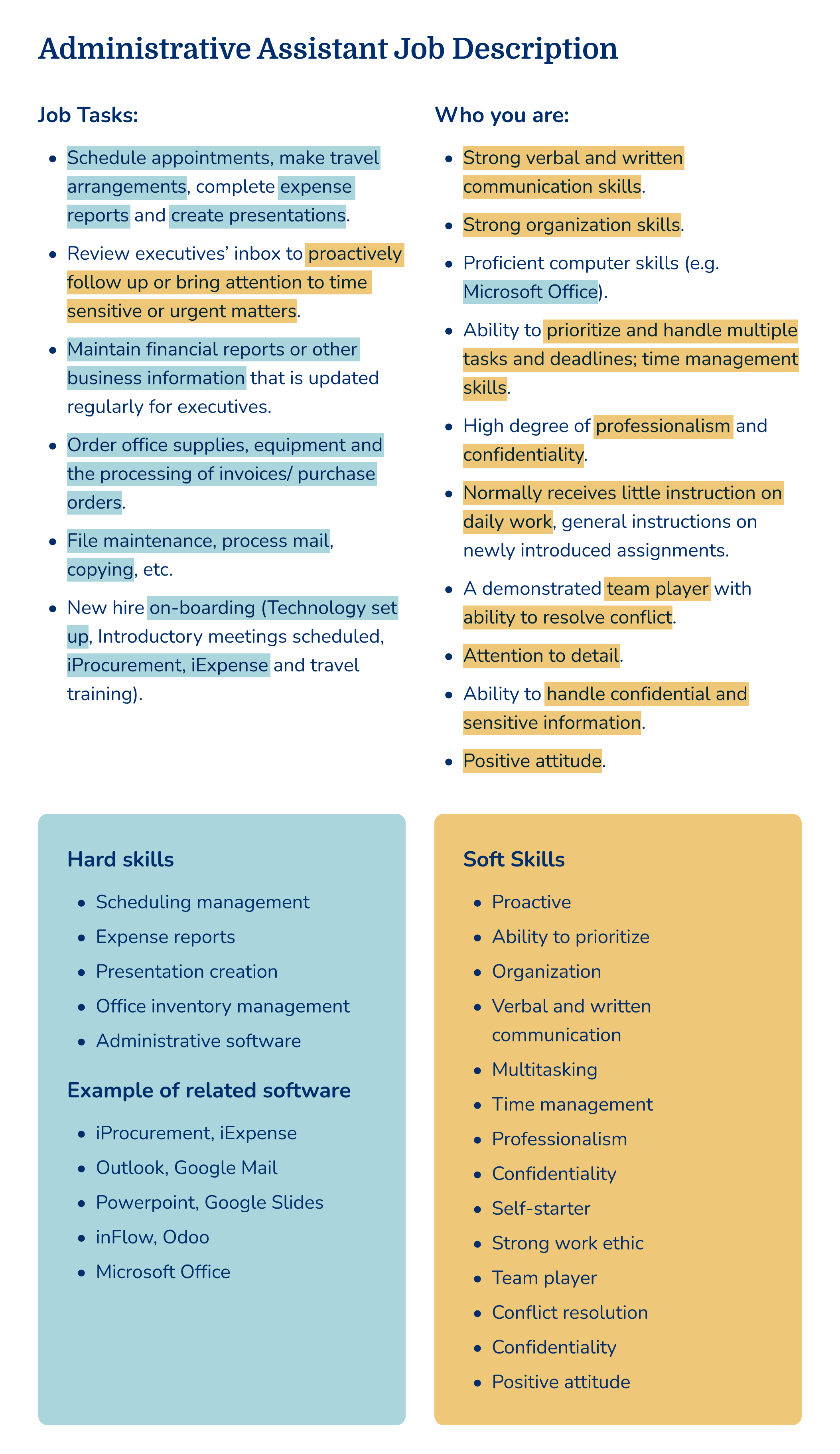
Review the job description carefully to identify the abilities the employer wants, and note which key skills to add to your resume.
Depending on the job and industry, required skills may include personal qualities such as teamwork, problem-solving, and communication, or hard skills like Photoshop or AutoCAD.
You can also visit the company’s website to learn more about its mission and goals, which can highlight the qualities its culture embodies and the goals it’s working toward.
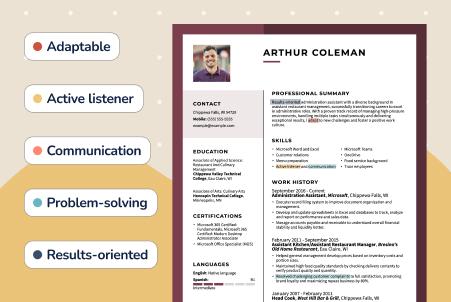
Here’s an example of how to analyze the job description to identify key skills:
Match Your Skill Set to the Job Requirements
Once you’ve pinpointed your skills that match the company’s needs, create a master list of the most critical hard and soft skills for your resume.
Not every skill you possess needs to or should be listed in your resume skills section. Instead, create a targeted resume by including only the skills that directly impact the job you’re applying for and will help you prove you’re the best candidate for the role.
If you’re making a career change, focus on transferable skills, which are qualities and abilities that can be transferred from one job to another, even in different industries.
Need help creating your skills section? Our AI Resume Skills Generator instantly builds a skills list tailored to your job title:
AI Resume Skills Generator

Create a Dedicated Skills Section
A dedicated skills section gives recruiters a scannable snapshot of your most relevant abilities. The position and layout of your skills section will depend on the resume format you use.
You can choose from three main resume formats—chronological, functional, and combination— depending on your experience level and career goals, and we’ll cover how to structure the skills section for each below.
Chronological Resume Skills Section
If you have extensive experience in the career or field you’re interested in, use a chronological resume format. In this format, your work history is followed by a list of six to eight key skills.
Focus on your top soft and hard skills, and provide examples of how you’ve applied your skills in past jobs under your work history entries.
Here’s an example of a skills section on a chronological resume:
SKILLS
- Team leadership
- Project management
- Data analysis
- Communication
- Problem-solving
- Microsoft Excel
And here’s an example of how these skills can be demonstrated in the work history section:
WORK EXPERIENCE
Project Manager
Target | Minneapolis, MN | Dec 2024–Present
- Lead 12 cross-functional projects from planning through completion, coordinating timelines, resources, and deliverables across multiple departments.
- Analyze project data in Microsoft Excel to identify recurring delays and helped reduce average project turnaround time by 18%.
- Present weekly project updates to department leaders, communicating risks, progress, and recommendations to keep projects on track.
Functional Resume Skills Section
If you have limited work experience but have developed relevant skills through training, education, volunteer work, or other experiences, a functional resume format can help you emphasize your qualifications.
This example shows how grouping skills into categories makes it easier for employers to see your strengths and understand how they relate to the job:
PROFESSIONAL SKILLS
Administration Skills
- Scheduled 10+ visitors daily and greeted them upon arrival at the reception.
- Verified insurance credentials and ensured claims complied with office policies.
- Reordered stock in short supply with enough lead time to restock before it ran out.
Interpersonal Skills
- Interacted with 10+ vendors, professional services personnel, and contractors to receive orders and communicate instructions.
- Collaborated and organized weekly staff meetings with teams of 20+ personnel.
- Organized conference rooms with appropriate materials and distributed notes for personnel.
Technical Skills
- Composed internal memos and external correspondence for four senior executives using MS Office.
- Coordinated bookkeeping activities in QuickBooks and AdvancedMD medical billing software.
- Managed a multiline telephone system and directed internal and external calls to senior executives.
Combination Resume Skills Section
Use a combination resume format if you have a few years of experience in your field or are switching careers and want to display your most relevant skills alongside your experience. This format balances skills and work experience, allowing you to present your qualifications in detail.
Here’s an example of how to feature skills on a combination resume:
SUMMARY OF SKILLS
- Project management: Coordinate projects from planning through completion, managing timelines, priorities, and deliverables while keeping cross-functional teams aligned and projects on schedule.
- Data analysis: Analyze sales and operational data using Microsoft Excel to identify trends, measure performance, and develop reports that support business decisions.
- Client communication: Build strong client relationships by providing clear project updates, addressing concerns, and working with internal teams to resolve issues efficiently.
KEY SKILLS
- Client relations
- Cross-functional collaboration
- Microsoft Excel
- Process improvement
- Problem-solving
- Time management
- Presentation skills
- Reporting
Feature Job-Relevant Skills in Your Resume Summary
Your resume summary is the first thing recruiters read, so start strong by highlighting your top qualifications and skills. What’s the one trait or area of expertise you want employers to know most about? Mention it right off the bat in your summary.
For example:
Organized, compassionate patient service representative with 10+ years of experience in fast-paced healthcare environments. Skilled in patient advocacy, education, and front office coordination, with a proven ability to manage high patient volumes while maintaining accuracy, empathy, and professionalism. Adept at streamlining administrative workflows, supporting cross-functional medical teams, and ensuring a positive patient experience from check-in to discharge.
Show How You’ve Applied Your Skills in Your Work History Section
Incorporate examples of how you’ve applied your skills in your work experience section to show real-world impact. Highlight achievements, projects, or results that reflect your expertise and give recruiters concrete evidence of what you can do.
For example:
WORK EXPERIENCE
Project Manager
BrightTech Solutions, New York, NY
January 2025–Present
- Lead a team of 12 to successfully deliver 10+ software development projects on time and under budget, improving client satisfaction by 20%.
- Develop and implement project plans, timelines, and budgets, demonstrating strong organizational and planning skills.
- Streamline reporting processes using project management software (Asana, Jira), enhancing team productivity and efficiency by 15%.
This work history entry is effective because it includes measurable accomplishments that highlight key skills like project management, leadership, communication, problem-solving, and software proficiency, giving employers concrete evidence of the candidate’s impact.
Bring Your Resume Skills to Life In Your Cover Letter
Use your cover letter to expand on the skills you feature on your resume by showing how you’ve applied them in real situations. Choose two or three skills most relevant to the job, and briefly explain how you’ve used them to solve problems, support a team, or achieve results.
Here are a few strategies for highlighting skills when you write your cover letter:
Include Your Most Relevant Skills in the Introduction
Mention one or two of your most relevant skills in your cover letter introduction to immediately show employers why you’re a strong match for the role. Choose skills that appear in the job description and connect them to your experience, accomplishments, or interest in the position rather than simply repeating your resume’s skills list.
For example:
With over a decade of experience in fast-paced healthcare settings, my strongest asset is my ability to provide organized, compassionate, and efficient patient service. I pride myself on creating a seamless front-office experience while ensuring patients feel heard, respected, and well-informed throughout their care journey.
Provide Specific Examples in the Body Paragraphs
Use the body paragraphs of your cover letter to show your most relevant skills in action. Choose one or two skills and describe a specific situation where you used them, explaining what you did and what you accomplished. Concrete examples give employers a clearer picture of your abilities than a list of skills alone.
For example:
In my previous role as a patient service representative, I coordinated a high-volume front desk, managing up to 100 daily patient interactions while maintaining accuracy in scheduling, insurance verification, and medical record handling. I also collaborated closely with clinical teams to resolve urgent patient concerns, improving patient satisfaction scores by 20% over 12 months. My attention to detail and calm presence under pressure earned recognition from both supervisors and patients alike.
Beyond administrative coordination, I’ve championed patient advocacy and education efforts, creating patient-friendly intake forms and FAQs that reduced check-in times and clarified treatment plans. Whether helping a nervous patient navigate a new diagnosis or streamlining workflows behind the scenes, I bring a service mindset and a deep commitment to healthcare excellence.
Reiterate Skills in the Closing Paragraph
Reinforce your most relevant skills in the closing paragraph by briefly connecting them to the value you could bring to the role. Rather than introducing new qualifications, remind the employer of the strengths you highlighted in your letter and express your interest in discussing how your experience aligns with the position.
For example:
I’m confident that my organizational skills and patient-first approach would make me a valuable addition to your team. I welcome the opportunity to support your mission of delivering empathetic care and would be honored to contribute to your continued success.
Key Takeaways
- Prioritize skills that show you fit the role. The most effective skills are relevant to the position and supported by your experience.
- Tailor your skills to each application. A personalized skills list can better reflect the employer’s requirements and the qualifications most important to the position.
- Show your skills in action. Use accomplishments, projects, and results in your work history to give employers evidence of how you’ve applied your abilities.
- Reinforce important skills throughout your resume. Your skills section provides a quick overview, while your summary and work history add context and evidence.
- Choose a resume format that supports your experience and goals. Chronological, functional, and combination formats emphasize different aspects of your qualifications.
- Keep your skills section concise and relevant. A focused mix of hard and soft skills makes your qualifications easier for recruiters to identify quickly.
Frequently Asked Questions
What skills should I put in my resume?
On your resume, focus on abilities that are relevant to the job you want and that you can demonstrate through your experience. Include a mix of interpersonal and technical skills, prioritizing those mentioned in the job description. Support important skills with specific examples or accomplishments in your work history to show how you’ve applied them.
How many skills should I list on my resume?
You can list anywhere from five to 15 skills on your resume, depending on your experience and the job requirements. For most job seekers, eight to 10 well-chosen skills is a useful target because it gives you enough room to highlight relevant qualifications without making your skills section feel crowded. Prioritize skills that match the job description and that you can demonstrate through your experience.
Should I customize my resume skills for each job?
Yes, you should customize your resume skills for each job by prioritizing the qualifications that are most relevant to the position. Review the job description for specific skills, tools, and abilities the employer mentions, then include the ones you genuinely possess in your skills section and work experience. This helps your resume match each position’s requirements without overstating your qualifications.
Are resume skills important for ATS?
Yes, resume skills are important for ATS because applicant tracking systems may scan your resume for keywords that match the job description. Include relevant hard and soft skills using the terminology from the posting when it accurately describes your abilities. Place important skills in your skills section and reinforce them naturally in your work experience to give both ATS and employers clear context.
Should I list skills I don’t have if they’re in the job description?
No, you shouldn’t list skills you don’t have just because they appear in the job description. Instead, highlight the qualifications you genuinely possess and use specific examples to demonstrate them. If a required skill is one you’re currently learning, you can mention relevant training or coursework, but avoid claiming proficiency you cannot demonstrate. Accurate skills help keep your resume credible and aligned with the role.
How We Reviewed This Article
Since 2012, we have helped more than 11 million job seekers. We want to make your career journey accessible and manageable through our services and Career Center’s how-to guides and tips. In our commitment to bring you a transparent process, we present our Editorial Process.
Rate this article
Resume Skills


Elizabeth is a Certified Professional Resume Writer (CPRW) and a member of the Professional Association of Resume Writers & Career Coaches. She is committed to helping job seekers navigate the job market and succeed in their careers.
More Articles by Elizabeth Muenzen, CPRWShare this page
 Add MyPerfectResume as a preferred source on Google
Add
Our customers have been hired at:*Foot Note