Table of Contents
Get started with MyPerfectResume today!
- Build a resume on any device
- Pick an ATS-friendly template
- Tailor with AI copy suggestions
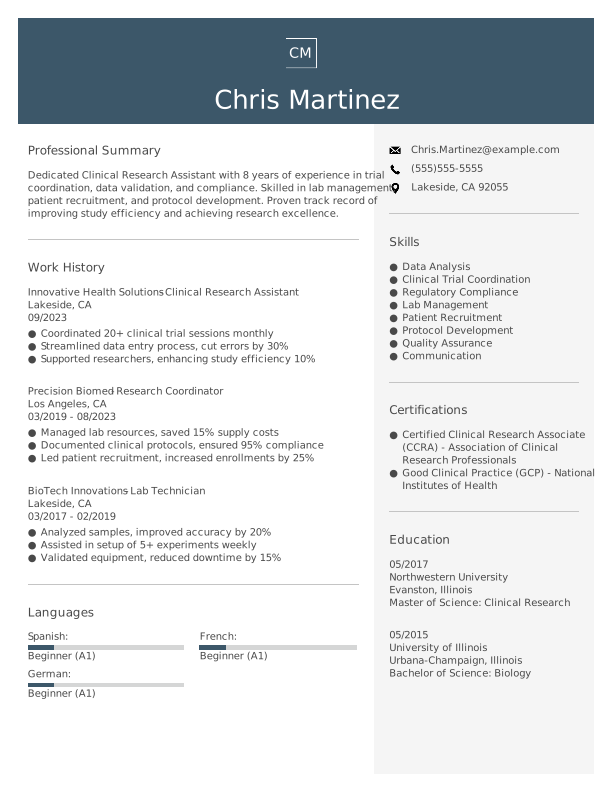
Why this resume works
- Quantifies accomplishments: By detailing measurable accomplishments like cutting data entry errors by 30%, the applicant showcases their tangible impact on operations.
- Highlights industry-specific skills: The inclusion of healthcare skills such as clinical trial coordination and regulatory compliance showcases the applicant’s fit for the research sector.
- Illustrates problem-solving ability: Reducing equipment downtime by 15% reflects the applicant’s problem-solving skills, demonstrating initiative in improving lab productivity through innovative solutions.
More Clinical Research Assistant Resume Examples
Explore our clinical research assistant resume examples to learn how to highlight your skills, experience, and accomplishments. These medical resume samples will help you create a resume that effectively showcases your expertise to potential employers.
Research Coordinator
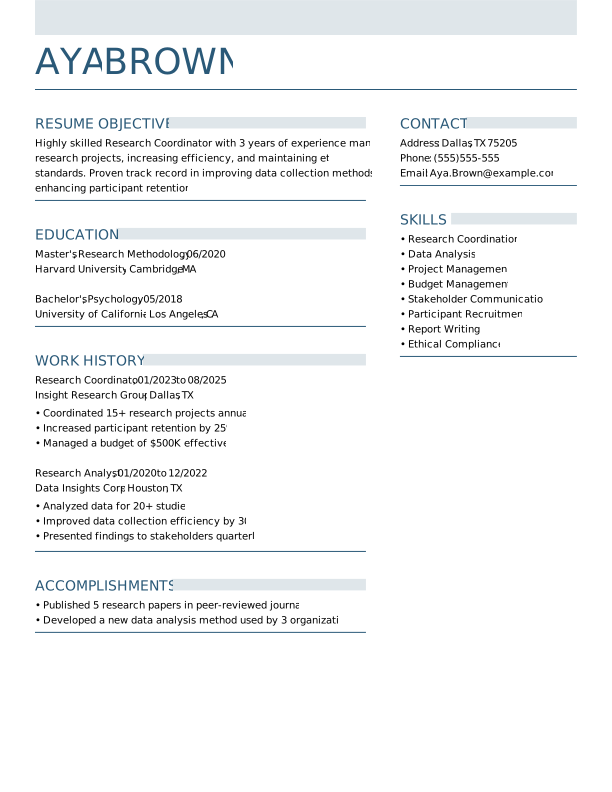
Why this resume works
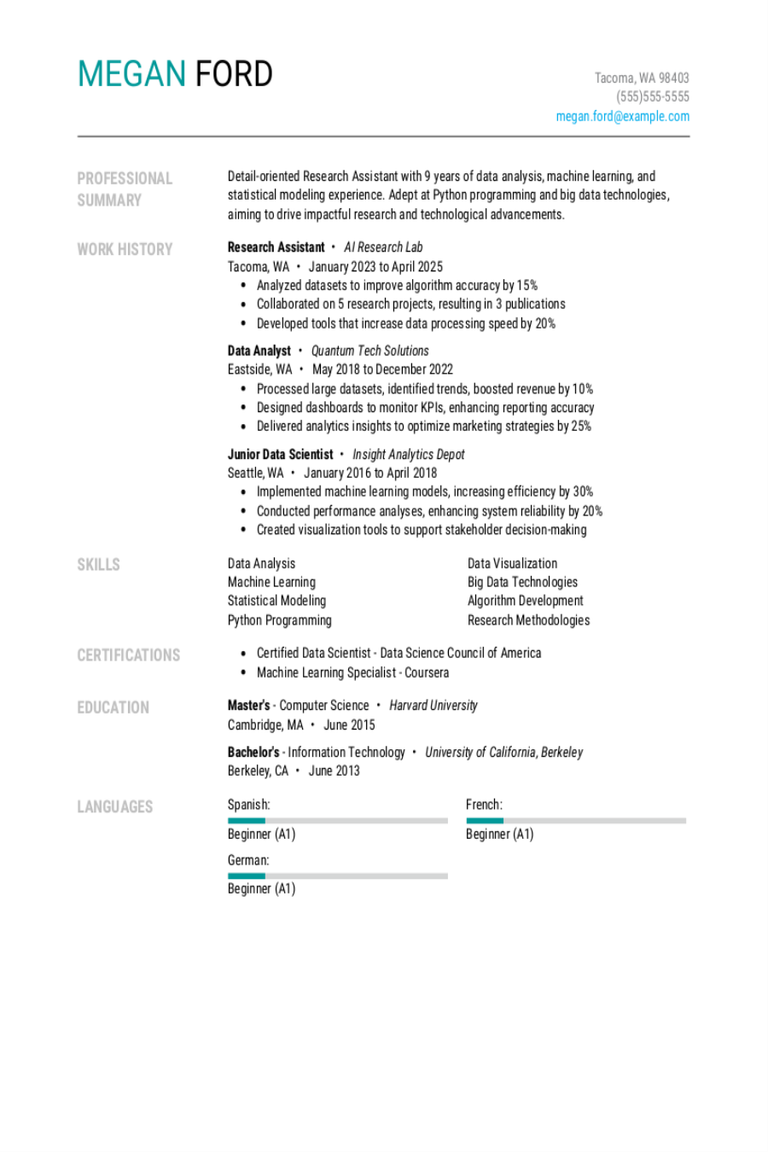
- Centers on academic background: By showcasing a master’s degree in research methodology, the applicant’s education section reflects deep academic roots essential for early career stages.
- Puts skills at the forefront: The skills-based resume format positions research project management and data analysis skills front and center, ideal for recent graduates.
- Shows digital literacy: Emphasizing data trend analysis and report development signals digital fluency, aligning with computer skills needed in today’s tech-driven roles.
Laboratory Technician
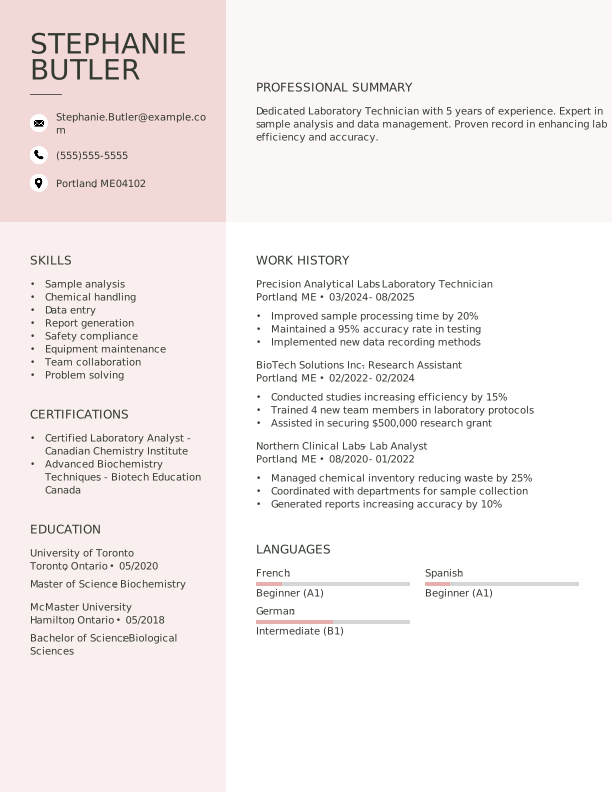
Why this resume works
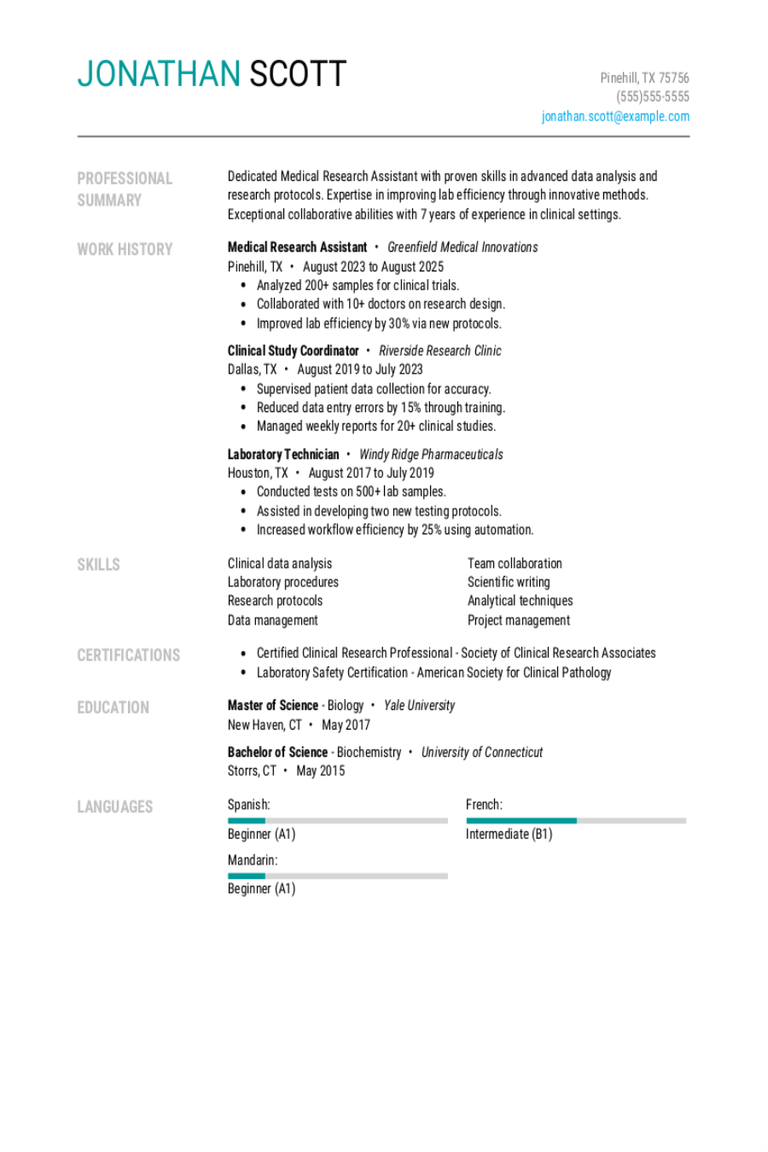
- Points to measurable outcomes: By cutting sample processing time by 20% and maintaining high accuracy, the applicant showcases an ability to achieve measurable outcomes in lab work.
- Displays technical expertise: Through certifications in advanced biochemistry techniques and handling lab automation, the applicant clearly displays technical expertise important for laboratory roles.
- Demonstrates language abilities: Language skills in French, Spanish, and German facilitate effective cross-cultural communication in diverse team settings.
Clinical Data Coordinator
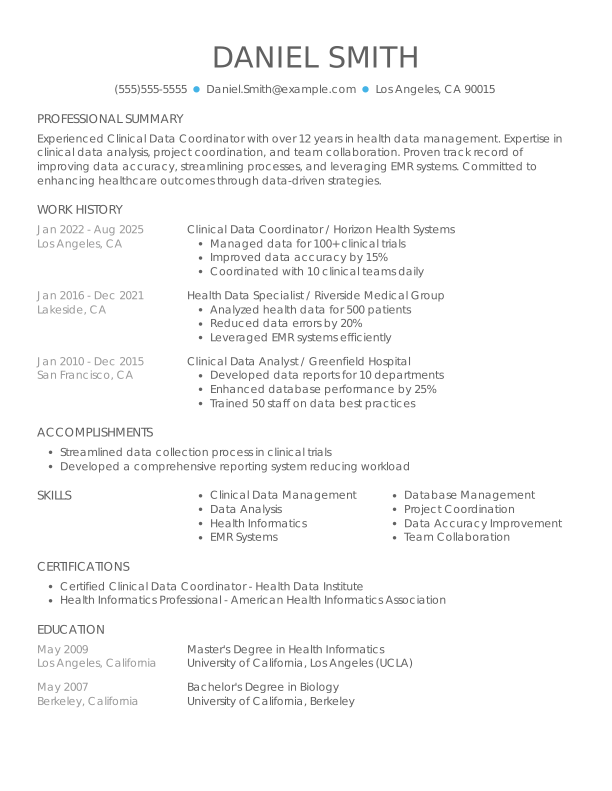
Why this resume works
- Lists relevant certifications: By listing certifications like Certified Clinical Data Coordinator and Health Informatics Professional, the applicant showcases a commitment to expertise and continuous learning in health data management.
- Focuses on work history: The chronological resume format details roles from clinical data analyst to coordinator, showing extensive career growth.
- Emphasizes leadership skills: Managing multiple clinical teams daily highlights the applicant’s leadership skills, emphasizing their ability to coordinate complex projects effectively.
Clinical Research Assistant Resume Template (Text Version)
Start with this format, or check out our resume templates for more options to consider.
Chris Martinez
Lakeside, CA 92055
(555)555-5555
Chris.Martinez@example.com
Professional Summary
Dedicated Clinical Research Assistant with 8 years of experience in trial coordination, data validation, and compliance. Skilled in lab management, patient recruitment, and protocol development. Proven track record of improving study efficiency and achieving research excellence.
Work History
Clinical Research Assistant
Innovative Health Solutions – Lakeside, CA
September 2023
- Coordinated 20+ clinical trial sessions monthly
- Streamlined data entry process, cut errors by 30%
- Supported researchers, enhancing study efficiency 10%
Research Coordinator
Precision Biomed – Los Angeles, CA
March 2019 – August 2023
- Managed lab resources, saved 15% supply costs
- Documented clinical protocols, ensured 95% compliance
- Led patient recruitment, increased enrollments by 25%
Lab Technician
BioTech Innovations – Lakeside, CA
March 2017 – February 2019
- Analyzed samples, improved accuracy by 20%
- Assisted in setup of 5+ experiments weekly
- Validated equipment, reduced downtime by 15%
Languages
- Spanish – Beginner (A1)
- French – Beginner (A1)
- German – Beginner (A1)
Skills
- Data Analysis
- Clinical Trial Coordination
- Regulatory Compliance
- Lab Management
- Patient Recruitment
- Protocol Development
- Quality Assurance
- Communication
Certifications
- Certified Clinical Research Associate (CCRA) – Association of Clinical Research Professionals
- Good Clinical Practice (GCP) – National Institutes of Health
Education
Master of Science Clinical Research
Northwestern University Evanston, Illinois
May 2017
Bachelor of Science Biology
University of Illinois Urbana-Champaign, Illinois
May 2015
Related Resume Guides
- Clinical Documentation Improvement Specialist
- Clinical Project Manager
- Clinical Trial Associate
- Coding Specialist
- Dermatologist
- Dialysis Technician
- Doctor
- Electrocardiograph Technician
- Emergency Department Technician
- Emergency Room Registration Clerk
- Equipment Technician
- Health Information Technician
- Hospital Administrator
- Hospital Volunteer
- Intake Coordinator
- Intensive Care Physician
- Medical Laboratory Technologist
- Medical Records Specialist
- Medical Representative
- Medical Research Assistant
- Midwife
- MRI Technologist
- Neurosurgeon
- Nuclear Medicine Technologist
- OB-GYN Medical Assistant
- Ophthalmologist
- Ophthalmology Assistant
- Optometrist
- Orthopedic Surgeon
- Pediatric Assistant
- Pediatrician
- Physician
- Physician Assistant
- Podiatrist
- Psychiatrist
- Radiologist
- Radiology Technician
- Resident Medical Officer
- Respiratory Therapist
- Speech Language Pathologist
- Surgeon
- Surgery Scheduler
- Ultrasound Technician
Advice for Writing Your Clinical Research Assistant Resume
Explore our advice on how to write a resume that highlights your skills in data collection, patient interaction, and collaboration with healthcare teams. Whether you’re just starting or looking to update your existing resume, our tips will help you stand out in the competitive field of clinical research.

Highlight relevant certifications and training
Certifications and specialized training are essential for a clinical research assistant. They demonstrate your knowledge and skills in academic and research settings, highlighting expertise in areas like research methods, data analysis, or specific software tools used in clinical studies.
These credentials prove you have up-to-date skills that match the demands of the role. Here are a few examples of certifications for your resume:
- Good Clinical Practice (GCP) certification
- Clinical Research Coordinator (CRC) certification
- Certified Clinical Research Professional (CCRP)
- Research Methodology training
- Data Analysis using SPSS
Listing certifications after education or skills ensures they’re easy to find and highlights your readiness for the position. These qualifications not only improve your resume but also increase your chances of succeeding as a clinical research assistant by showing commitment to ongoing learning.
Example of a certifications & training section
Good Clinical Practice (GCP) Certification
Issued by: National Institutes of Health (NIH)
Expires 2024
Clinical Research Coordinator (CRC) Certification
Issued by: Association of Clinical Research Professionals (ACRP)
Issued 2021
Human Subjects Protection Training
Issued by: CITI Program
Completed 2023
Advanced Cardiovascular Life Support (ACLS)
Issued by: American Heart Association
Expires 2025
Biomedical Research Investigators and Key Personnel Course
Issued by: Collaborative Institutional Training Initiative (CITI)
Completed 2022
Looking to make your resume stand out? Our professional resume examples offer great ideas and layouts to help you start strong.
List your most relevant skills
For a clinical research assistant role, it’s important to balance technical and soft skills. On the technical side, being familiar with software used in clinical trials can set you apart. This might include data management programs or statistical analysis tools.
Having artistic abilities, like creating clear and engaging presentations, can also help communicate findings effectively. A dedicated skills section on your resume is a great way to showcase these abilities clearly.
Soft skills are just as important for a clinical research assistant. Communication skills help you work well with others and share results. Being organized and detail-oriented ensures that studies run smoothly and data is accurate. Teamwork is key when collaborating with researchers and participants, while problem-solving helps tackle any challenges that arise during trials.
To make these skills stand out even more, weave them into your work experience bullet points. Instead of simply listing tasks you did, describe how you used specific skills to achieve goals or solve problems in past roles.
For example, mention how your organizational skills led to successful project completion or how your communication abilities helped facilitate team collaboration. This approach makes your resume more effective by showing how you’ve applied your skills in real-world situations.
Selecting a resume format that highlights your experience in data collection, protocol adherence, and teamwork can make clinical research assistants stand out.
Write a strong professional summary
A professional summary is a brief introduction at the top of your resume that informs hiring managers about your key qualifications and what you offer. When creating your resume, you can decide between including a summary or an objective based on where you are in your career and what goals you have.
Typically, a professional summary consists of three to four sentences that highlight your experience, skills, and accomplishments. This format works well for experienced professionals who want to convey their expertise and value immediately.
In contrast, a resume objective emphasizes career aspirations and suits entry-level job seekers, career changers, or those with gaps in employment. It shifts the focus to “what I aim to contribute” rather than “what I’ve achieved so far.”
Next, we’ll explore examples of both summaries and objectives tailored for various industries and experience levels. Reviewing these examples will help determine whether a resume objective or summary better aligns with your goals as a clinical research assistant.
Clinical research assistant resume summary examples
Entry-level
Recent graduate with a Bachelor of Science in Biology and a strong foundation in clinical research methodologies. Completed internships at leading healthcare institutions, gaining exposure to patient data collection and regulatory compliance. Certified in Good Clinical Practice (GCP) and passionate about contributing to strong research projects.
Mid-career
Clinical research assistant with over four years of experience in managing clinical trial documentation and coordinating participant recruitment for phase II trials. Skilled in using electronic data capture systems and ensuring adherence to study protocols. Recognized for streamlining processes that improved data accuracy by 15%.
Experienced
Seasoned clinical research assistant with 10+ years of expertise in oncology trials and pharmacovigilance activities. Proven leader in mentoring junior staff and optimizing study workflows, resulting in a 20% reduction in trial timelines. Expert at liaising with cross-functional teams to facilitate successful project outcomes.
Clinical research assistant resume objective examples
Recent graduate
Detail-oriented and enthusiastic recent Bachelor of Science in Biology graduate seeking a clinical research assistant position to use academic knowledge and laboratory skills in advancing medical research. Committed to supporting research teams in conducting studies that contribute to healthcare improvements.
Career changer
Dedicated professional transitioning from administrative healthcare roles into clinical research, equipped with strong organizational skills and a passion for scientific inquiry. Eager to leverage experience coordinating patient care and managing data to support innovative research projects.
Entry-level applicant
Motivated individual with a background in health sciences looking for an entry-level clinical research assistant role. Eager to apply knowledge of data collection, analysis, and ethical practices while contributing to compelling medical studies within a collaborative team environment.
Easily create a standout resume using our AI Resume Builder. It offers templates that can highlight your skills as a clinical research assistant.
Showcase your accomplishments and publications
Highlighting your accomplishments and publications as a clinical research assistant can make your resume stand out. Including peer-reviewed articles, book chapters, and conference papers shows active engagement in the scientific community. It highlights your commitment to research and helps employers see you as a knowledgeable job seeker.
Ensure these items are listed in a structured format with citation details like journal name, volume, issue, and year. Using a professional style guide, such as APA or MLA, ensures that this section is organized and easily understood. Beyond publications, showcasing major awards, grants, or fellowships can further support your credibility in research.
These accomplishments demonstrate recognition from peers and institutions for the quality and impact of your work. Including links to online research profiles like Google Scholar or ResearchGate can also improve this section by giving easy access to your complete body of work.
This approach allows potential employers to explore more about your experience and contributions in the field of clinical research. By carefully structuring this section on your resume, you present yourself not only as someone with experience but also as a contributor to advancements in clinical research.
Example of publications section
Publications
- Smith J, Johnson A, Doe L. “Efficacy of New Anticoagulant Therapies in Stroke Prevention.” Journal of Clinical Medicine, 2023.
- Doe L, Patel R. “Improving Patient Adherence in Diabetes Clinical Trials: A Data-Driven Approach.” Clinical Trials Journal, 2022.
- Brown T, Doe L. “Safety Monitoring Strategies in Oncology Research.” International Journal of Clinical Research, 2021.
Choose a resume template that features clear sections and simple fonts. Stick to minimal colors and graphics to ensure your skills and experiences are easy to read.
FAQ
Do I need to include a cover letter with my clinical research assistant resume?
Including a well-crafted cover letter with your clinical research assistant resume can improve your application and make you more memorable to hiring managers.
A cover letter provides an opportunity to highlight your passion for clinical research, detail relevant skills like data analysis or patient interaction, and express enthusiasm for specific research projects at the facility.
If the organization is known for particular studies or methodologies, you can discuss your experience or interest in those areas to align yourself with their mission.
Consider using our Cover Letter Generator to efficiently create a personalized cover letter that complements your resume, capturing all necessary details professionally.
Additionally, reviewing cover letter examples can offer valuable insights into effective formats and language specific to clinical roles, giving you confidence in crafting your unique narrative.
How long should a clinical research assistant’s resume be?
For a clinical research assistant, a one-page resume is often sufficient to emphasize key skills like data analysis, familiarity with clinical trials, and collaboration with cross-functional teams.
If you have extensive experience or specific certifications in clinical research methodologies, opting for a two-page resume can be appropriate. Make sure each section adds value by detailing relevant projects and outcomes.
Consider exploring resources on how long a resume should be to tailor your resume length according to your career stage and ensure it effectively captures your qualifications and achievements.
How do you write a clinical research assistant resume with no experience?
When creating a resume with no experience for a clinical research assistant position, emphasize your education, relevant skills, and any related coursework or volunteer work.
- Emphasize your education: Start by listing your degree in a relevant field like biology, chemistry, or health sciences. Include the name of the institution, graduation date, and any honors or relevant coursework.
- Include relevant coursework and projects: Detail specific classes or academic projects that are relevant to clinical research. Highlight any lab work, data analysis, or research methods you learned.
- Showcase transferable skills: List skills such as attention to detail, statistical analysis, skill in software like MS Excel or SPSS, and strong communication abilities.
- Highlight volunteer work or internships: If you’ve volunteered in healthcare settings or had internships related to research or medical fields, make sure to include these experiences. Describe your responsibilities and what you accomplished.
Check out additional resources on crafting a resume with no experience for more examples and tips from industry experts.
Rate this article
Clinical Research Assistant
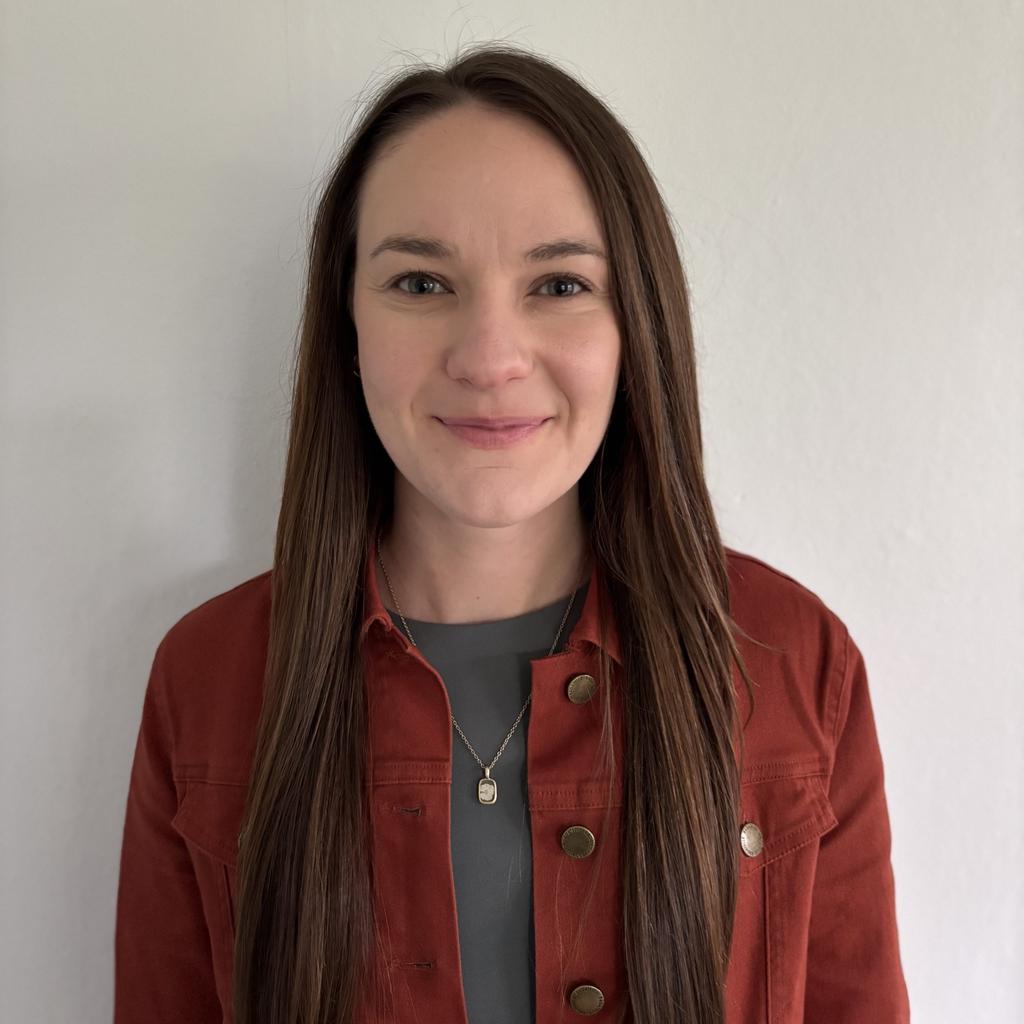

Elizabeth is a Certified Professional Resume Writer (CPRW) and a member of the Professional Association of Resume Writers & Career Coaches. She is committed to helping job seekers navigate the job market and succeed in their careers.
More Articles by Elizabeth Muenzen, CPRWShare this page
 Add MyPerfectResume as a preferred source on Google
Add