Table of Contents
Get started with MyPerfectResume today!
- Build a resume on any device
- Pick an ATS-friendly template
- Tailor with AI copy suggestions
Why this resume works
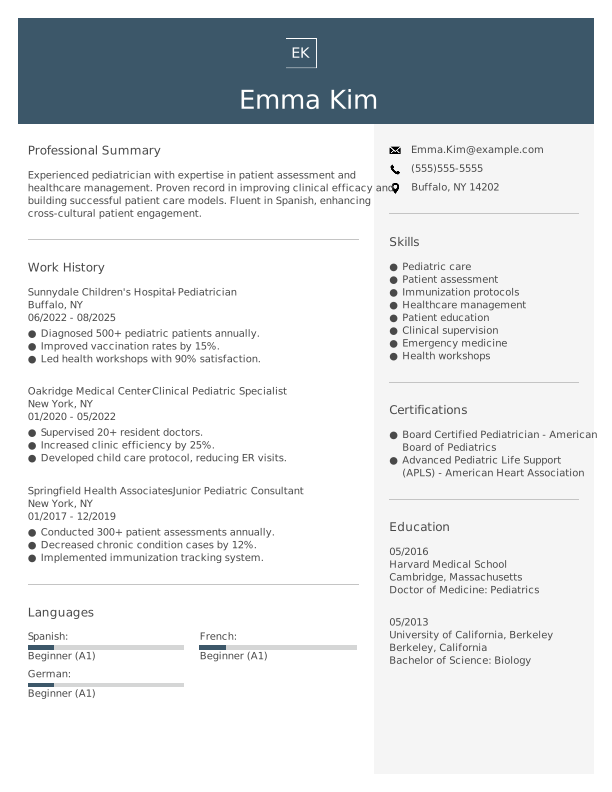
- Quantifies accomplishments: Measurable accomplishments, such as diagnosing over 500 pediatric patients annually and improving vaccination rates by 15%, highlight the applicant’s tangible impact on community health.
- Uses action-oriented language: Using powerful action verbs like “led” and “implemented,” the applicant’s resume conveys initiative and effectiveness.
- Showcases career progression: Progressing from junior consultant to pediatrician at reputable institutions demonstrates the applicant’s career growth and increased responsibility in healthcare management.
More Pediatrician Resume Examples
Board certification, licensure, specialty, hospital privileges, and practice setting can help present a complete physician profile. Compare how the examples below organize those credentials, then browse our medical resumes library.
Entry-Level Pediatrician
Why this resume works
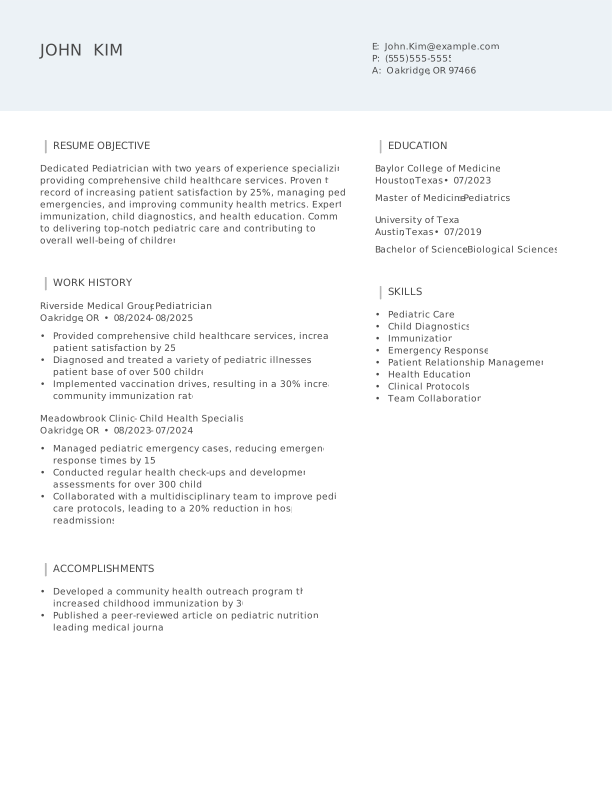
- Effective use of keywords: By weaving in role-relevant keywords like “pediatric care” and “immunization,” the applicant shows strategic thinking to navigate applicant tracking systems (ATS) effectively.
- Shows key accomplishments: The applicant showcases relevant accomplishments, such as developing a community health outreach program that increased childhood immunizations by 30%.
- Puts skills at the forefront: The skills-based resume format places key skills prominently, highlighting expertise in child diagnostics and emergency response.
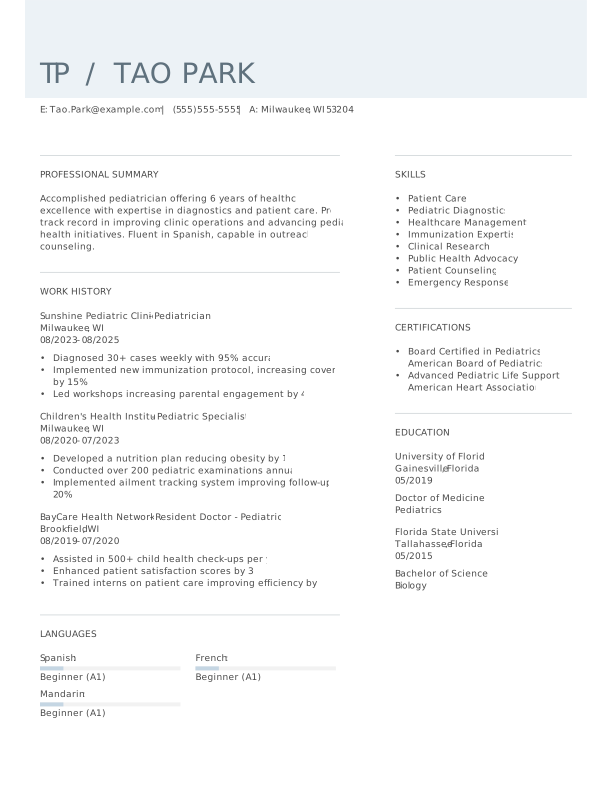
Mid-Level Pediatrician
Why this resume works
- Points to measurable outcomes: By showcasing achievements like increasing immunization coverage by 15% and reducing obesity by 10%, the applicant clearly demonstrates their effectiveness in driving measurable health improvements.
- Clear contact information: An accessible resume header with clear contact information ensures potential employers can easily reach out, facilitating timely communication for job opportunities.
- Includes a mix of soft and hard skills: Highlighting both technical skills like pediatric diagnostics and interpersonal skills such as patient counseling, the applicant presents a well-rounded skill set essential for healthcare success.
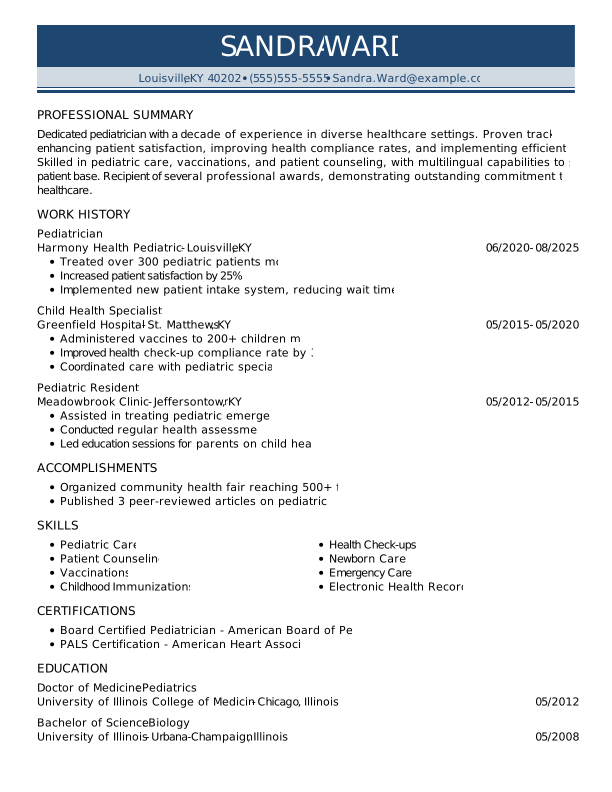
Experienced Pediatrician
Why this resume works
- Lists relevant certifications: Listing certifications from prestigious boards shows a strong foundation in pediatrics, reinforcing the applicant’s dedication to maintaining high professional standards and ongoing education.
- Showcases impressive accomplishments: Showcasing impressive accomplishments, like boosting patient satisfaction by 25%, reflects the applicant’s ability to drive meaningful improvements in healthcare environments.
- Emphasizes leadership skills: Implementing an intake system that reduced wait times by 20% reveals leadership skills and initiative in optimizing clinical operations for better patient experiences.
Pediatrician Resume Template (Text Version)
Copy and paste the text below to begin. For a wider selection, visit our free resume template downloads.
Emma Kim
Buffalo, NY 14202
(555)555-5555
Emma.Kim@example.com
Professional Summary
Experienced pediatrician with expertise in patient assessment and healthcare management. Proven record in improving clinical efficacy and building successful patient care models. Fluent in Spanish, enhancing cross-cultural patient engagement.
Work History
Pediatrician
Sunnydale Children’s Hospital – Buffalo, NY
June 2022 – August 2025
- Diagnosed 500+ pediatric patients annually.
- Improved vaccination rates by 15%.
- Led health workshops with 90% satisfaction.
Clinical Pediatric Specialist
Oakridge Medical Center – New York, NY
January 2020 – May 2022
- Supervised 20+ resident doctors.
- Increased clinic efficiency by 25%.
- Developed child care protocol, reducing ER visits.
Junior Pediatric Consultant
Springfield Health Associates – New York, NY
January 2017 – December 2019
- Conducted 300+ patient assessments annually.
- Decreased chronic condition cases by 12%.
- Implemented immunization tracking system.
Languages
- Spanish – Beginner (A1)
- French – Beginner (A1)
- German – Beginner (A1)
Skills
- Pediatric care
- Patient assessment
- Immunization protocols
- Healthcare management
- Patient education
- Clinical supervision
- Emergency medicine
- Health workshops
Certifications
- Board Certified Pediatrician – American Board of Pediatrics
- Advanced Pediatric Life Support (APLS) – American Heart Association
Education
Doctor of Medicine Pediatrics
Harvard Medical School Cambridge, Massachusetts
May 2016
Bachelor of Science Biology
University of California, Berkeley Berkeley, California
May 2013
Related Resume Guides
- Clinical Documentation Improvement Specialist
- Clinical Project Manager
- Clinical Research Assistant
- Clinical Trial Associate
- Coding Specialist
- Dermatologist
- Dialysis Technician
- Doctor
- Electrocardiograph Technician
- Emergency Department Technician
- Emergency Room Registration Clerk
- Equipment Technician
- Health Information Technician
- Hospital Administrator
- Hospital Volunteer
- Intake Coordinator
- Intensive Care Physician
- Medical Laboratory Technologist
- Medical Records Specialist
- Medical Representative
- Medical Research Assistant
- Midwife
- MRI Technologist
- Neurosurgeon
- Nuclear Medicine Technologist
- OB-GYN Medical Assistant
- Ophthalmologist
- Ophthalmology Assistant
- Optometrist
- Orthopedic Surgeon
- Pediatric Assistant
- Physician
- Physician Assistant
- Podiatrist
- Psychiatrist
- Radiologist
- Radiology Technician
- Resident Medical Officer
- Respiratory Therapist
- Speech Language Pathologist
- Surgeon
- Surgery Scheduler
- Ultrasound Technician
Advice for Writing Your Pediatrician Resume
Pediatricians provide preventive and medical care while supporting children’s health through different stages of development. Learn how to write a resume that highlights your clinical expertise and pediatric experience.
Write a Strong Professional Summary
A professional summary on a resume serves as an introduction to hiring managers, helping you make a strong first impression. Depending on your experience, you can choose between a professional summary or a resume objective at the top of your resume.
Typically, a professional summary is three to four sentences that showcase your experience, skills, and achievements. It’s ideal for experienced applicants who have much to offer in terms of their professional identity and value. This section conveys what you’ve accomplished in your career so far.
In contrast, a resume objective focuses on your career goals and is perfect for entry-level applicants, career changers, or those with employment gaps. Unlike summaries that emphasize past achievements, objectives highlight what you aim to contribute in the future.
Next, we’ll provide examples of both summaries and objectives tailored to different industries and experience levels. Explore our library of professional resume examples for additional inspiration.
Pediatrician Resume Summary Examples
Entry-level
Recent medical school graduate with a Doctor of Medicine (MD) degree and completion of pediatric residency. Skilled in performing routine exams, diagnosing common childhood illnesses, and providing preventive care guidance. Certified in Pediatric Advanced Life Support (PALS) and Basic Life Support (BLS). Enthusiastic about building strong relationships with patients and their families to promote healthy development.
Mid-career
Board-certified pediatrician with 7+ years of experience in private practice and hospital settings. Proficient in managing acute and chronic conditions, coordinating immunization schedules, and implementing developmental screenings. Experienced in mentoring medical students and collaborating with healthcare teams to provide comprehensive care. Recognized for excellent communication skills and a family-centered approach to treatment.
Experienced
Seasoned pediatrician with over 15 years of experience specializing in neonatal care, adolescent medicine, and complex chronic conditions. Board-certified MD with additional certifications in child nutrition counseling and behavioral health management. Proven track record of leading multidisciplinary teams, streamlining clinic operations, and improving patient outcomes through evidence-based practices. Dedicated to advancing pediatric healthcare initiatives at the community level.
Pediatrician Resume Objective Examples
Entry-level
Compassionate and dedicated recent medical school graduate with a focus on pediatrics, eager to start a career as a pediatrician. Seeking to apply foundational knowledge and skills gained during clinical rotations to provide high-quality care and support children’s health and development in a collaborative healthcare environment.
Career changer
Passionate healthcare professional transitioning into pediatrics, bringing experience in patient care and community health education. Looking to join a pediatric clinic where skills can be used to promote wellness and address the unique needs of children through empathetic care and interactive engagement.
Entry-level with specialized training
Recent medical graduate with specialized training in pediatric emergency medicine, aiming to begin a career as a pediatrician. Committed to leveraging training to manage acute conditions effectively while fostering a nurturing atmosphere for young patients in fast-paced clinical settings.
Use our Resume Builder to craft your pediatrician resume. It lets you highlight your medical experience and organize key details easily, so you stand out to hiring managers.
Include Relevant Certifications and Training
For a pediatrician, having certifications and specialized training is very important. These credentials show that you have the skills and knowledge to care for children’s health needs. Listing these qualifications prominently can help you stand out in this technical field.
A dedicated certifications section in your resume will make it easy for employers to see that you meet the required standards. Here are a few examples of relevant certifications for your resume:
- Board certification in pediatrics
- Pediatric advanced life support (PALS)
- Neonatal resuscitation program (NRP)
- Advanced trauma life support (ATLS)
- Certificate of added qualification in pediatric emergency medicine
Including certifications not only boosts your resume but also shows your commitment to providing quality care. They reassure employers that you’re prepared to handle complex medical situations with children. Highlighting these credentials can make a big difference in your success as a pediatrician.
Example of a Certifications Section
Board Certified Pediatrician
Issued by: American Board of Pediatrics (ABP)
Expires 2025
Pediatric Advanced Life Support (PALS)
Issued by: American Heart Association
Expires 2026
Neonatal Resuscitation Program (NRP) Certification
Issued by: American Academy of Pediatrics
Issued 2023
Advanced Trauma Life Support (ATLS)
Issued by: American College of Surgeons
Expires 2024
Fellow of the American Academy of Pediatrics (FAAP)
Issued by: American Academy of Pediatrics
Choose a polished and well-organized resume template that effectively showcases your skills and qualifications to stand out to hiring managers in the medical field.
Showcase Your Work Experience
Showcasing relevant work experience on a resume is key to landing a job as a pediatrician. It helps employers see the depth of your experience and how you can contribute to their team effectively.
List your work history in reverse chronological order, starting with your most recent job. Include important details like your job title, the name of the employer, the location, and the dates you worked there. Use clear, action-oriented language that highlights what you did and achieved in each role.
When describing your past jobs, focus on measurable results to show the impact you’ve made. For example, mention how many patients you saw daily or any programs developed that improved patient care significantly. Include core responsibilities such as diagnosing illnesses, prescribing treatments, conducting routine exams, and providing vaccinations.
Using this approach makes it easier for potential employers to understand your qualifications quickly by viewing where you’ve worked and what you’ve accomplished in previous roles at a glance. This structured format not only showcases your abilities but also demonstrates your commitment to delivering high-quality pediatric care throughout your career journey.
5 Pediatrician Work History Bullet Points
- Provided care to over 500 pediatric patients annually, ensuring accurate diagnosis and treatment plans for diverse medical conditions.
- Administered vaccinations to more than 1,000 children yearly, contributing to a 95% immunization compliance rate within the community.
- Collaborated with a multidisciplinary team to reduce hospital readmission rates by 20% among pediatric patients with chronic illnesses.
- Educated parents and guardians on child health topics, achieving a 30% increase in patient satisfaction scores through effective communication strategies.
- Developed and implemented wellness programs that improved early detection of developmental delays by 25%, enabling timely interventions.
To make a strong impression, pediatricians should select a resume format that highlights their experience with patient care, successful treatments, and relevant skills.
Match Your Resume With the Job Description
Tailoring resumes to job descriptions is important because it helps job seekers stand out to employers and pass through applicant tracking systems (ATS). These systems scan resumes for specific keywords and phrases from job postings, ensuring that only the most relevant applications reach hiring managers.
An ATS-friendly resume uses these keywords and phrases effectively. By aligning the language in your resume with the skills required for a pediatrician role, you increase your chances of catching a hiring manager’s attention.
To find the right keywords, carefully read job postings for repeated skills, qualifications, and duties. Look for terms like “pediatric care,” “clinical assessments,” or “healthcare team collaboration.” You can customize your resume by incorporating these terms naturally into your experiences.
For example, instead of saying “Provide high-quality patient care,” you might write “Delivered high-quality patient care to improve overall health outcomes.”
Targeted resumes not only help with ATS compatibility but also demonstrate to employers that you’ve taken the time to match their specific needs, increasing your chances of getting an interview.
Ensure your resume passes through applicant tracking systems. Our ATS Score Checker finds common problems and provides actionable tips to strengthen your resume.
Salary Insights for Pediatricians
Pediatrician salaries vary widely across the United States, with a national average of $217,335. The table below highlights the top-paying states.
These figures come from the U.S. Bureau of Labor Statistics’ Occupational Employment and Wage Statistics survey, which covers all 50 states and the District of Columbia. These are the most recent numbers available, drawn from the dataset released in 2026.
| State | Average Salary |
|---|---|
| Louisiana | $378,020 |
| South Dakota | $288,400 |
| Montana | $284,770 |
| Alaska | $282,020 |
| Idaho | $273,550 |
| Oklahoma | $257,980 |
| New Hampshire | $255,760 |
| Wisconsin | $245,400 |
| Maine | $243,380 |
| North Dakota | $242,000 |
FAQ
Do I need to include a cover letter with my pediatrician resume?
Including a cover letter with your pediatrician resume can improve your application by outlining your passion for child healthcare and highlighting your unique skills.
A cover letter allows you to express why you’re interested in the practice or hospital and how your background aligns with their needs.
For example, discussing experience in areas like cardiology or neurology can be helpful if the facility emphasizes community outreach or pediatric specialties.
To streamline the process, consider using our Cover Letter Generator, which helps tailor content that complements your resume seamlessly.
You might also benefit from reviewing cover letter examples related to pediatrics, as they can provide insights into structuring and articulating your experiences effectively.
How long should a pediatrician’s resume be?
For a pediatrician, the length of your resume often depends on your experience and accomplishments.
Generally, if you’re early in your career or just finishing residency, a concise one-page resume is optimal. It allows you to highlight core competencies such as patient care, medical training, and relevant certifications efficiently.
However, for seasoned pediatricians with extensive clinical experience, publications, or leadership roles, a two-page resume can be more appropriate. It provides space to detail significant achievements without compromising clarity.
Explore our guide on how long a resume should be for insights on tailoring the length to your professional journey.
How do you write a pediatrician resume with no experience?
When creating a resume with no experience, especially for a pediatrician role, emphasize your education and relevant skills. This approach can help leave a strong impression despite the lack of direct experience. Here are a few tips to help you get started:
- Highlight your medical education: Begin with your medical degree, specifying the institution, graduation date, and any honors or awards received. Include relevant coursework or projects that specifically pertain to pediatrics.
- Use clinical rotations effectively: Even if you haven’t worked as a pediatrician yet, clinical rotations in pediatrics during medical school count as valuable experience. Detail specific responsibilities like patient exams, diagnostic procedures, and collaboration with pediatric specialists.
- Emphasize transferable skills: Skills such as communication, empathy, and teamwork are important in pediatrics. If you have volunteered or worked in roles involving children or healthcare settings, illustrate how these experiences helped hone such skills.
See our guide on writing a resume with no experience for more detailed advice on crafting a resume specifically tailored to entry-level pediatrician positions.
Rate this article
Pediatrician


Elizabeth is a Certified Professional Resume Writer (CPRW) and a member of the Professional Association of Resume Writers & Career Coaches. She is committed to helping job seekers navigate the job market and succeed in their careers.
More Articles by Elizabeth Muenzen, CPRWShare this page
 Add MyPerfectResume as a preferred source on Google
Add