Table of Contents
Get started with MyPerfectResume today!
- Build a resume on any device
- Pick an ATS-friendly template
- Tailor with AI copy suggestions
Why this resume works
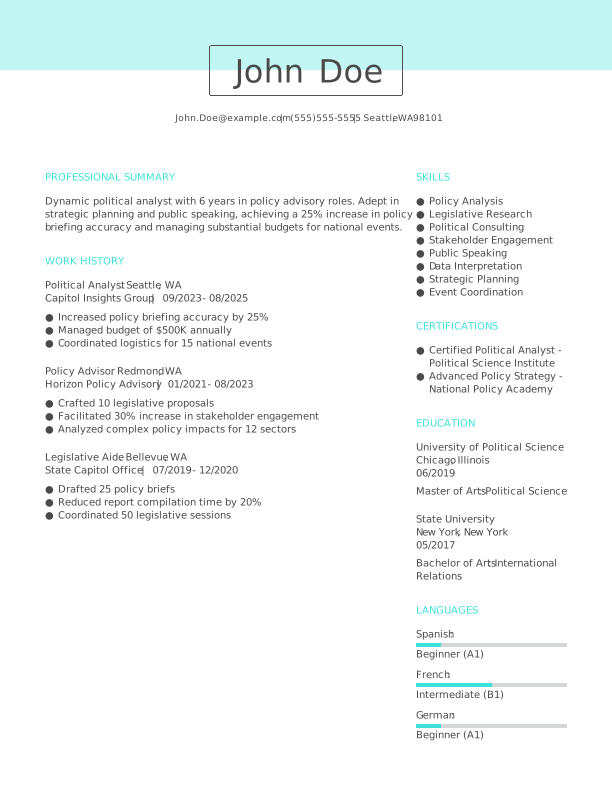
- Quantifies accomplishments: By managing a $500K budget and increasing policy briefing accuracy by 25%, the applicant’s measurable achievements showcase their impact and value.
- Showcases career progression: Transitioning from legislative aide to political analyst, the applicant’s career progression highlights a growth in responsibilities, including managing national event logistics and crafting legislative proposals.
- Uses action-oriented language: Action verbs like “crafted,” “facilitated,” and “coordinated” conveys initiative and effectiveness in the applicant’s roles.
More Politics Resume Examples
See our politics resume examples to learn how to highlight your policy knowledge, leadership abilities, and public speaking skills. These samples will help you craft a resume that effectively showcases your political expertise.
Legislative Assistant
Why this resume works
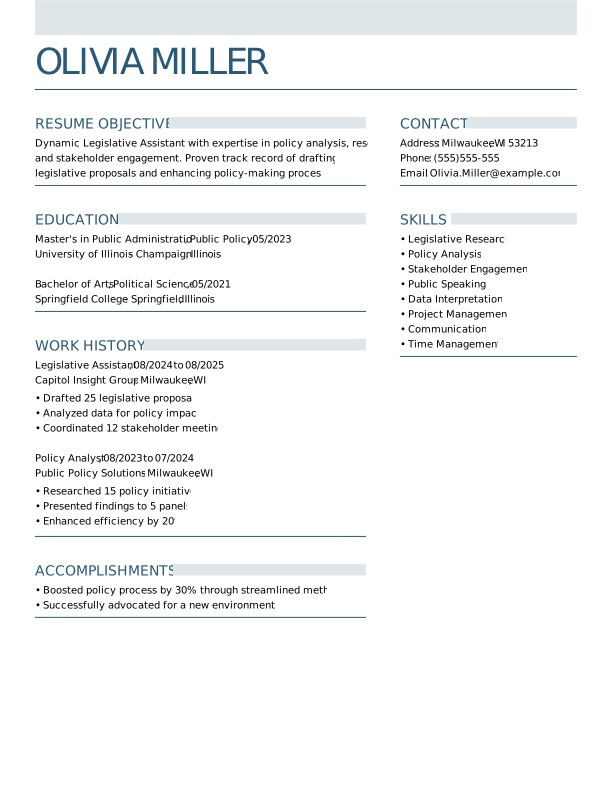
- Centers on academic background: The applicant’s educational section includes a master’s in public administration and a bachelor’s in political science, forming a solid academic base early in their career.
- Effective use of keywords: Strategically weaving in role-specific keywords like “policy analysis” and “stakeholder engagement'” helps the resume pass through applicant tracking systems (ATS) filters efficiently.
- Shows digital literacy: Skills like data interpretation and project management reflect the applicant’s computer skills, showcasing readiness for digital tasks in modern workplaces.
Campaign Manager
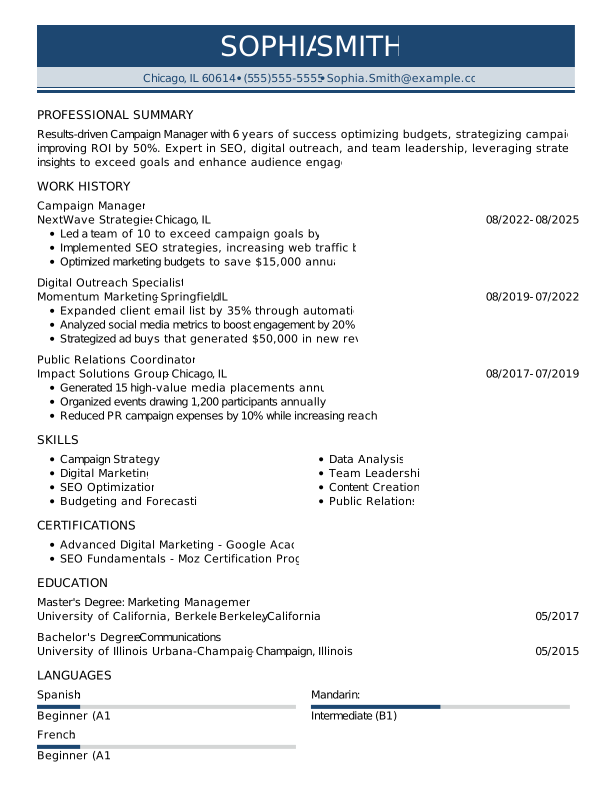
Why this resume works
- Points to measurable outcomes: By showcasing achievements like exceeding campaign goals by 25% and saving $15,000 annually, the applicant clearly embraces measurable outcomes to illustrate their impact in marketing roles.
- Includes a mix of soft and hard skills: Mixing technical skills like SEO with interpersonal skills such as team leadership, the applicant effectively presents a balanced skill set important for modern marketing.
- Demonstrates language abilities: Possessing language skills in Spanish, Mandarin, and French suggests a strong capability for cross-cultural communication and potential international collaboration.
Policy Analyst
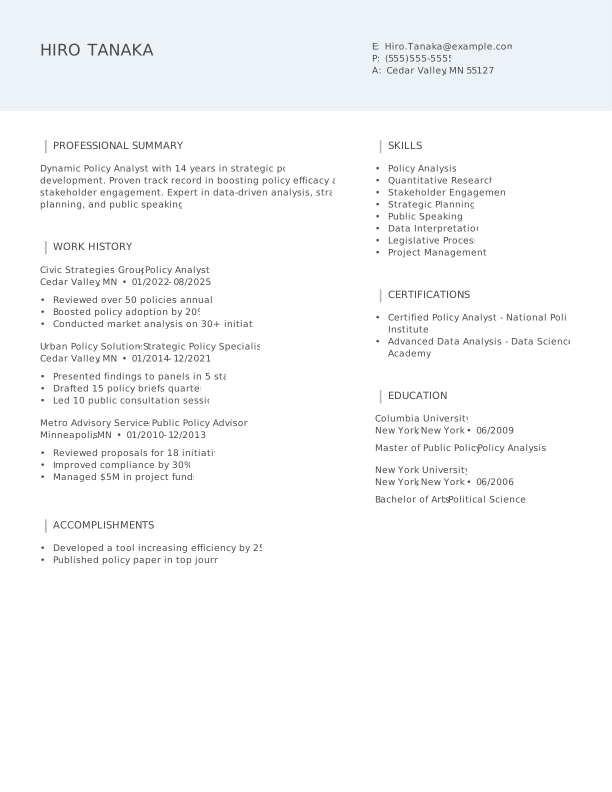
Why this resume works
- Showcases impressive accomplishments: By boosting policy adoption by 20% and conducting market analysis on over 30 initiatives, the applicant showcases impressive accomplishments reflecting senior-level performance.
- Focuses on work history: Using a chronological resume format effectively presents an extensive work history, emphasizing consistent growth across roles from public policy advisor to policy analyst.
- Emphasizes leadership skills: Leading 10 public consultation sessions and managing $5M in project funds highlights the applicant’s strong leadership skills in steering significant projects and initiatives.
Politics Resume Template (Text Version)
Use this text template for content, then visit our resume templates for polished, professional options.
John Doe
Seattle, WA 98101
(555)555-5555
John.Doe@example.com
Professional Summary
Dynamic political analyst with 6 years in policy advisory roles. Adept in strategic planning and public speaking, achieving a 25% increase in policy briefing accuracy and managing substantial budgets for national events.
Work History
Political Analyst
Capitol Insights Group – Seattle, WA
September 2023 – August 2025
- Increased policy briefing accuracy by 25%
- Managed budget of $500K annually
- Coordinated logistics for 15 national events
Policy Advisor
Horizon Policy Advisory – Redmond, WA
January 2021 – August 2023
- Crafted 10 legislative proposals
- Facilitated 30% increase in stakeholder engagement
- Analyzed complex policy impacts for 12 sectors
Legislative Aide
State Capitol Office – Bellevue, WA
July 2019 – December 2020
- Drafted 25 policy briefs
- Reduced report compilation time by 20%
- Coordinated 50 legislative sessions
Skills
- Policy Analysis
- Legislative Research
- Political Consulting
- Stakeholder Engagement
- Public Speaking
- Data Interpretation
- Strategic Planning
- Event Coordination
Certifications
- Certified Political Analyst – Political Science Institute
- Advanced Policy Strategy – National Policy Academy
Education
Master of Arts Political Science
University of Political Science Chicago, Illinois
June 2019
Bachelor of Arts International Relations
State University New York, New York
May 2017
Languages
- Spanish – Beginner (A1)
- French – Intermediate (B1)
- German – Beginner (A1)
Related Resume Guides
- Aviation
- Banking
- Billing And Collections
- Biology
- Boating
- Business Operations
- Casino
- Chemistry
- Child Care
- Civil Engineering
- Compliance
- Computer Hardware
- Computer Software
- Construction
- Copywriting
- Cosmetology
- Costco
- Culinary
- Customer Service
- Dance
- Data Systems Administration
- Deloitte
- Dentistry
- Driving
- Education
- Electrical
- Electrical Engineering
- Energy
- Engineering
- Entertainment
- Entrepreneur
- Entry Level
- Environmental
- Environmental Science
- Event Planning
- Executive
- Fashion
- Film
- Finance
- Fitness & Nutrition
- Food Service
- Freelancing
- General Laborer
- Goldman Sachs
- Government
- Graphic Design
- Healthcare Support
- Hospitality
- Human Resources
- HVAC
- Industrial Engineering
- Information Technology
- Insurance
- Interior Design
- Inventory Management
- Janitorial
- Landscaping
- Language Services
- Law
- Law Enforcement
- Library
- Logistics
- Maintenance
- Marketing
- McKinsey
- Mechanical Engineering
- Mechanics
- Media And Communication
- Medical
- Mental Health
- Meta
- Metal Work
- Military
- Mining
- Museum
- Music
- Netflix
- Non Profit
- Nursing
- Pharmaceutical
- Photography
- Physical Therapy
- Plumbing
- Production
- Program Manager
- Project Manager
- Psychology
- Purchasing
- Quality Control
- Real Estate
- Religion
- Retail
- Safety And Security
- Sales
- Sciences
- Shipping
- Social Services
- Special Education
- Sports
- Statistics
- Student
- Teaching
- Team Lead
- Tesla
- Training And Development
- Transportation
- Travel
- Veterinary
- Walgreens
- Walmart
- Web Development
Advice for Writing Your Politics Resume
Discover our tailored advice on how to write a resume for politics positions and learn how to highlight your leadership skills, policy expertise, and passion for public service.
Highlight your most relevant skills
When applying for a job in politics, listing relevant skills is very important. It helps show employers that you have what it takes to succeed in the role. By highlighting both technical and interpersonal skills, you can present yourself as a well-rounded job seeker.
Technical skills might include data analysis or policy development, while soft skills like communication and teamwork are just as important. A dedicated skills section makes it easy for hiring managers to see your strengths at a glance.
To make your application even stronger, try weaving key skills into your work experience section. For example, if you’ve led successful campaigns, mention how your leadership and strategic planning made them possible.
This not only shows that you have the skills but also proves you’ve used them effectively in real situations. Balancing these elements ensures that your resume tells a compelling story about why you’re suited for a career in politics.
A resume format that highlights leadership qualities, public speaking skills, and community engagement can make job seekers stand out in politics.
Showcase your accomplishments
When showcasing your accomplishments in a politics-related resume, it’s important to list your work experience in reverse chronological order. This means you should start with your most recent job and go backwards.
Each job entry should clearly display your job title, the name of the employer, the location, and the dates you worked there. By arranging it this way, potential employers can easily follow your career path.
To make your resume stand out, focus on quantifying your achievements rather than just listing duties. For example, instead of saying “managed a team,” you could say “led a team of 10 to increase voter registration by 20%.”
Using numbers like percentages or time savings makes it easier for hiring managers to see what you’ve accomplished. Action words such as “developed,” “implemented,” or “increased” also help highlight your role and impact.
Quantified accomplishments are key because they show the real difference you’ve made in previous positions. They give hiring managers a quick sense of your skills and impact. By turning duties into measurable results, you provide clear evidence of how you contributed to past teams and projects in politics.
5 politics work history bullet points
- Drafted and advocated for policy proposals, resulting in the passage of 3 key legislative bills within a year.
- Coordinated political campaigns, achieving a 20% increase in voter turnout compared to previous elections.
- Managed constituent communications for a state senator, improving response time by 40% and increasing engagement.
- Organized community engagement events that attracted over 1,000 attendees, fostering stronger community relations.
- Conducted research and analysis on legislative issues, influencing decision-making processes with data-driven insights.
Choose a resume template with clear sections and simple fonts, ensuring hiring managers can easily find your skills and experience without being distracted by excessive colors or graphics.
Write a strong professional summary
A professional summary on a resume serves as an introduction to hiring managers, allowing them to quickly grasp your qualifications.
The professional summary provides a concise snapshot of your experience, skills, and achievements. It works best for applicants with significant experience because it highlights your professional identity and the value you bring to the role. This section essentially answers the question of “what I’ve accomplished” throughout your career.
In contrast, the resume objective emphasizes your aspirations and what you plan to contribute to the company. It’s particularly useful for entry-level job seekers, career changers, or individuals with gaps in their employment history. By focusing on “what I aim to contribute,” this section shifts attention from past accomplishments to future goals.
Next, we’ll share tailored examples of both summaries and objectives designed for various industries and levels of experience.
Politics resume summary examples
Entry-level
Recent political science graduate with a strong foundation in international relations and public policy analysis. Completed internships with local government offices, gaining experience in legislative research and community outreach initiatives. Skilled in data analysis and familiar with key political software platforms. Eager to contribute to policy development and advocacy efforts.
Mid-career
Political analyst with over five years of experience working within think tanks and non-profit organizations. Expertise in conducting comprehensive policy research, drafting reports, and providing strategic recommendations on domestic and foreign affairs. Proven track record of successful collaboration with stakeholders across various sectors to drive strong legislative changes.
Experienced
Seasoned political strategist specializing in campaign management and governmental relations. Over 15 years of experience leading high-profile political campaigns, leveraging advanced knowledge of electoral processes and voter engagement strategies. Accomplished in negotiating bipartisan support for critical legislation, resulting in significant improvements to community welfare programs.
Politics resume objective examples
Entry-level
Aspiring political analyst with a Bachelor of Arts in political science and strong research skills, eager to contribute insights into policy development and public affairs. Committed to applying analytical thinking and communication skills to support advocacy initiatives and legislative processes.
Career changer
Dedicated educator transitioning into a political career, bringing extensive experience in communication and community engagement. Passionate about leveraging educational background to foster civic awareness and influence positive change through grassroots campaigns and policy advocacy.
Recent graduate
Recent graduate with a degree in international relations seeking an entry-level position in political consultancy. Equipped with strong analytical abilities and a deep understanding of global politics, aiming to support strategic decision-making processes for clients navigating complex international issues.
Create a standout political resume quickly with our Resume Builder. Choose a template, add your experience, and impress potential employers in no time!
Match your resume to the job description
Tailoring resumes to job descriptions is key for standing out to employers and getting past ATS. Many companies use ATS to sort through resumes quickly, looking for specific keywords and phrases that match the job posting. If your resume includes these terms, it’s more likely to catch the eye of hiring managers.
An ATS-friendly resume includes words and phrases from the job description that align with your skills. This means using the same language that employers use in their job postings. When you do this, it increases the chance that both the ATS and hiring managers will notice your resume.
To find these important keywords, start by reading the job posting carefully. Look for skills, qualifications, and duties mentioned multiple times. For example, if a politics-related job mentions “policy development,” “public speaking,” or “research analysis” often, be sure to include those exact terms in your resume.
Customize your resume naturally by rephrasing your experiences. For instance, instead of saying “Worked on policy projects,” you could say “Led policy development projects to influence decision-making processes.” This makes sure you’re not just listing words but showing how you’ve used these skills.
Targeted resumes are more likely to pass ATS checks and impress employers. By focusing on matching keywords from job descriptions with your real experiences, you increase your chances of moving forward in the hiring process.
Boost your resume quickly! The ATS Score Checker reviews your resume and provides immediate tips to improve your chances with employers.
FAQ
Do I need to include a cover letter with my politics resume?
Yes, including a tailored cover letter with your politics resume can give you an edge in the application process.
A cover letter lets you explain why you’re passionate about the specific role and organization, while highlighting your skills in policy analysis, public speaking, or campaign strategy.
For instance, if the political office or organization focuses on issues like climate policy or healthcare reform, you can describe how your background aligns with their mission.
To make this easier, try using a Cover Letter Generator to craft a polished and professional letter that complements your resume seamlessly.
You can also explore our collection of cover letter examples for inspiration and insights into structuring yours effectively for roles in the political field.
How long should a politics’s resume be?
For a politics role, a two-page resume is typically the best choice. This format lets you detail your experience thoroughly, including campaign management, policy development, and public speaking engagements.
However, if you’re early in your career or have fewer experiences to highlight, a one-page resume could also be effective.
Make sure every detail you include is relevant and showcases your skills in political strategy, communication, and leadership. Tailor each section to show how your background aligns with potential job requirements.
To determine how long a resume should be for your specific situation, explore our guide. This will help you decide whether a one-page or two-page resume better suits your career stage and experience level.
How do you write a politics resume with no experience?
Writing a politics resume with no experience may feel challenging, but focusing on your relevant skills, education, and any activities that demonstrate your enthusiasm for the field can make a strong impression. Follow these tips:
- Emphasize your education: Start with your degree in political science or related fields. Include the name of your institution, graduation date, and any honors or relevant coursework that aligns with political roles.
- Showcase internships and volunteer work: If you’ve volunteered for campaigns or interned at political offices, include those experiences. Detail your responsibilities and achievements to show practical involvement.
- Highlight transferable skills: Skills such as communication, research, public speaking, and organization are important in politics. Mention how you’ve developed these through class projects, student government participation, or other extracurricular activities.
- Include relevant projects: If you’ve worked on political research papers or organized events related to politics during school, list these as they demonstrate your proactive interest and capabilities.
Rate this article
Politics


Elizabeth is a Certified Professional Resume Writer (CPRW) and a member of the Professional Association of Resume Writers & Career Coaches. She is committed to helping job seekers navigate the job market and succeed in their careers.
More Articles by Elizabeth Muenzen, CPRWShare this page
 Add MyPerfectResume as a preferred source on Google
Add